• Quick note - the problem with Youtube videos not embedding on the forum appears to have been fixed, thanks to ZiprHead. If you do still see problems let me know.

Molten Steel

Status
Not open for further replies.
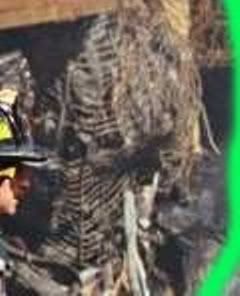
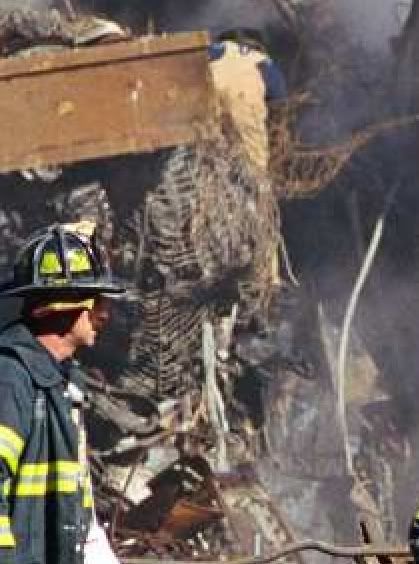
hey guys, i was wondering if you could take a look at this pic. everyone here has seen this before but i never noticed this stuff on the middle, left right above the firemans head. it looks as if it was once molten metal that has solidified. it resembles the stuff on the cut column too. there is alot of it there.

note ....look to the far left of the pic. not the middle. there is a fireman right behind the pile of (solidified metal?) also.
 
hey guys, i was wondering if you could take a look at this pic. everyone here has seen this before but i never noticed this stuff on the middle, left right above the firemans head. it looks as if it was once molten metal that has solidified. it resembles the stuff on the cut column too. there is alot of it there.

note ....look to the far left of the pic. not the middle. there is a fireman right behind the pile of (solidified metal?) also.[qimg]http://www.internationalskeptics.com/forums/imagehosting/thum_28544499e3e1945975.jpg[/qimg]
I also notice the firemen in the center appears to have no fingers on his right hand. (possible one forefinger) and, OMG, the other fireman has no hands at all.

Also, there is an object in the upper left that looks an awful lot like a bra. And what's with that spiderweb just to right of the face of the fireman on the left.

I betcha NIST never investigated any of those things.
 
I also notice the firemen in the center appears to have no fingers on his right hand. (possible one forefinger) and, OMG, the other fireman has no hands at all.

Also, there is an object in the upper left that looks an awful lot like a bra. And what's with that spiderweb just to right of the face of the fireman on the left.

I betcha NIST never investigated any of those things.

ill circle it for ya.
 
That was helpful. How about this? Contact the FDNY and see if they can track down the firefighters in the photo and ask them what was there. Then this truly profound mystery will finally be solved.

ETA: And while you've got them on the phone, ask them about that mysterious "engineer" whose presence and opinions you find so troubling. So many unanswered questions!
 
Last edited:
Wire mesh or some kind of rebar type stuff. It's too uniform to be slag. It does have a simliar color to slag though. But this minute examination of low-res images for suspicious things reminds me of loons on one forum looking at the images from the Mars Rovers and claiming there's animal bones and mini space ports, as well as the 'Face on Mars' from satellite pictures.

It's ludicrous
 
Last edited:
Wire mesh or some kind of rebar type stuff. It's too uniform to be slag. It does have a simliar color to slag though. But this minute examination of low-res images for suspicious things reminds me of loons on one forum looking at the images from the Mars Rovers and claiming there's animal bones and mini space ports, as well as the 'Face on Mars' from satellite pictures.

It's ludicrous

Reminds me of the plane impact videos where the video had been reduced in resolution, size and overcompressed before people used them to make the most ridiculous minute analysis and most the 'anomalies' were things like compression artifacts.
 
Is there a higher resolution available of the "meteorite" you were pointing out earlier? The video itself is nothing new to me, however I am not able to judge the contents of the material without something of sufficient quality. The low resolution video appears to be the only one I am able to locate. I'm more interested if there is a better quality video than anything else. As of this point I'm inclined to conclude it as being something very similar to the other artifact discussed previously which was the compressed concrete floor slabs which don't strike me as unusual.


there is no better quality video that i am aware of. would you support that the relic in question be analyzed so as to determine empirically whether the relic in question really is a fused element of steel and concrete as the expert suggests?

peace and good to hear from you again grizzly
 
Reminds me of the plane impact videos where the video had been reduced in resolution, size and overcompressed before people used them to make the most ridiculous minute analysis and most the 'anomalies' were things like compression artifacts.

click on the image i posted with the circle and it will blow up to the largest size i found on the net.
 
hey guys, i was wondering if you could take a look at this pic. everyone here has seen this before but i never noticed this stuff on the middle, left right above the firemans head. it looks as if it was once molten metal that has solidified. it resembles the stuff on the cut column too. there is alot of it there.

You mean this stuff that DavidJames rightly described as like "spider web" ?

anglecutmeshcropped.jpg
 
No. That is the exact opposite of what I intended. I noted that AVIRIS is only a fixed-wing platform to make clear that the DEA imagery is not from the AVIRIS instrument. This is critical.

ok, so we have DEA helicopters and NASA aircrafts both taking thermal images over ground zero on different dates.

No, it is not. You cannot achieve an accurate temperature measurement using a typical infrared camera. You need a spectrometer.

Looking 10 minutes on the web i found a portable thermal camera with the temperature range from 0 to 2800 F. Below is the insert: http://www.ir55.com/MikroScan.html
The THV 5XX package includes LCD screen & onboard color viewfinder, voice documentation microphone and headset for image notation, batteries, High resolution 0.1c thermal sensitivity, 0 f - 2800 f Temperature measurement range, image storage cards, digital live image ccd camera, software & all standard accessories

whether such technology existed in 2001, i dont know. I am not saying your wrong Mackey, but i think it is a little premature to discount the 2800 F reading stated in the Professional Safety Magazine until (a) the author is contacted (b) the raw data is obtained (c) the instrument used to take the thermal images is known. Until one or all of those has been satisfied even going on a well informed and possibly true hunch, is not enough.

There are no retrofittable spectrometers available now, and weren't then. If there were, and DEA had that capability, they wouldn't have bothered buying the AVIRIS flights in the first place.

What evidence do you have that they bought the AVIRIS flights? Why would they need to if they had helicopters? I thought we agreed that there were DEA helicopters and the NASA flights on separate missions?

No, this is where you come in. I know of absolutely nothing that would cause that effect. That's one of the many reasons I know it didn't happen. If you can think of one, go right ahead. Your claim, your explanation.

Would you support the analyze of the meteorite to establish empirically and to end all speculation that it is indeed – (as the expert suggests) – a fused element of steel and concrete through heat?

Now assuming it is determined to be a fused element by heat and we know that to melt steel takes 2800 F. We can conclude that absolutely ‘something’ must have generated this heat. Any ideas?

Given that the office fires would not be hot enough to cause such an effect, that the collapse itself would not generate the heat to cause this effect, then perhaps it was created in the rubble pile? If not then i would be more inclined to believe that it was caused from exotic accelerants.

You don't derail threads, I don't request thread splits. That's the deal.

Your thread was open to all ideas and questions (need i quote your exact words?), i had one that you failed to answer and so got me removed from the thread. but hey its water under the bridge for me now, so you have my forgiveness.

peace
 
Last edited:
there is no better quality video that i am aware of. would you support that the relic in question be analyzed so as to determine empirically whether the relic in question really is a fused element of steel and concrete as the expert suggests?

peace and good to hear from you again grizzly

I wouldn't mind having a look at it to satisfy some curiosity... However, if the mass is anything at all like the other artifact which has -- in the past & still is by some groups -- been claimed to be the proof of the same thing your contending this is of, then I'm largely in the view point that extreme cases requiring the claims of thermite and the like are not necessary to explain it.
 
Last edited:
The only thing that resembles anything that has solidified in that picture is the cut on the centre beam. Note how far the previously liquid metal has run down the beam. It didn't get very far before solidifying did it? If thermite had been used to produce identical cuts in order to bring the towers down then we would expect to see similar solidified "run off" on a number of beams. This also means that the liquid metal would in no way be able to form "molten pools" either in the towers or the rubble pile. The steel just solidifies too quickly.

Members of the truth movement always seem to be looking at photos and seeing something that isn't there. They cannot observe a photo independently without trying to make that photo confirm to their wacky theories. How does wire mesh = previously liquid metal. :eye-poppi
 
You mean this stuff that DavidJames rightly described as like "spider web" ?

anglecutmeshcropped.jpg
no.jpg

You beat me. I was looking for the hires version. Have not found it yet.

911Truth start with delusions and get worse. They accuse first and act like a lynch mob killing reality with hearsay, lies, and fantasy.
 
Last edited:
Looking 10 minutes on the web i found a portable thermal camera with the temperature range from 0 to 2800 F. Below is the insert: http://www.ir55.com/MikroScan.html

Ah, no you didn't.

I assume you're referring to the following specification:
Sierra Pacific Innovations (??) said:
Spectral Range: 8-12 microns for models 570 and up (LWIR)
Detector: 320 x 240 PtSi focal plane array (550 model) / 320x240 MicroBolometer for models 570 and greater.

Standard Field of View (FOV): 24° x 18°
Instantaneous FOV: 1.1 mrad
Multiple colour palattes
Swedish, French, Spanish and english user selectable menus
Accuracy: +/- 2% or 2°C
Thermal measurement Range: 1500c (*570 E cameras) email rk@x20.org for additional info

Now, what this marketeering site doesn't tell you is that in order to get measurements in the 1500oC range, you need to set up the camera very, very carefully, and even then the accuracy will be abysmal. You can't just pull it out of the case, turn a dial, and get that result. You need to know precisely what the material is made of. You need to set up proper filters for a particular temperature range. And you need to control the geometry of the problem. You would need to place a calibrated target basically right next to the object you wanted to measure, and shoot from only that location. Changes in angle, smoke, and sunlight will require a recalibration.

None of this is possible from a helicopter, period.

The reason for this is in the detector. Note this is an LWIR device, with peak sensitivity between 8 and 12 microns. This is a great range for measuring the temperature of something where the peak emission wavelength is between 8 and 12 microns, or, in other words, 241 K to 362 K, or about -30oC to 90oC, according to Wien's Law. This covers the range of most daily temperatures and most living things, and this is the range nearly all LWIR cameras operate in. This includes the FLIR mounted on DEA helicopters, which I imagine is what the images referred to actually came from.

The way the camera measures temperature is one of two ways, either measuring photons (focal-plane array) or measuring the total amount of energy deposited in a given pixel (bolometer). The effect is pretty much the same, though the physics is different. The FPA approach is electrical in nature, sort of like a CCD, whereas the bolometer measures tiny increases in temperature caused by absorption.

Both approaches have their strengths and weaknesses. The FPA is preferred in nearly all portable applications, because it allows a lighter device. Bolometers need active cooling and large heat sinks, often using liquid nitrogen, and are expensive and messy particularly in an aviation context. On the other hand, the FPA is much harder to calibrate, and every single pixel requires its own calibration because tiny variations in the array change its characteristics; most FPAs have a built-in sequence to do this but accuracy is limited. A good bolometer can be made with great precision, and as a result can be pushed further outside its normal envelope by a clever researcher.

Whichever device is used, it measures temperature by measuing how much energy arrives at a pixel in some given length of time. When the sensitivity window is comparable to the peak wavelength of the emitted spectrum, the detector captures a large fraction of the total energy. This energy varies with the fourth power of temperature. In our typical example above, going from the low end to the high end -- 241 to 362 K -- means a five-fold increase in energy. So our detector needs to respond to a maximum gain of five. If you want to resolve temperature differences of 1 K, you need about eight bits of resolution, because the difference from 241 to 242 K is about 1/245th of the difference from 241 to 362 K. No problem.

Aha, but now you want to point that detector at a hot fire, up to 1500oC, or 1773 K. Big, big difference.

First of all, the peak frequency is now well outside the sensor's range -- it's at 1.6 microns.

Second of all, the total power output has raised by a factor of nearly three thousand.

Both cause you problems. Obviously, the energy output is so much higher that you need some way to either block it (like putting on sunglasses) or else you need a whole lot more than eight bits of range. But you also need a totally new analysis approach. Before, you could assume that your detector captured a good fraction, say 25% or more, of the total energy. Now, that is no longer true. Your window of 8-12 microns is now not even a few percent. So your original assumption -- and the equation your camera uses to estimate temperature -- goes out the window.

The other problem is that your detector is not only sensitive to the 8-12 micron band. It is most sensitive there, and there is some rudimentary filtering applied (filtering that is as lightweight as possible, since it too emits thermal energy and will confuse your readings), but it will be partially sensitive to radiation well outside this range. The actual response curve will be a spiky, jaggy thing over the entire continuum. So, suppose your detector is 100% efficient on photons in the 8-12 micron range, and a mere 5% efficient in the 1-2 micron range. Well, with a temperature this high, the contribution from 1-2 microns may actually swamp that of the intended range. Unless you've tested this, you cannot predict how it will behave. And as the temperature goes up, more and more of the shorter wavelengths come into play.

So the smart thing to do, obviously, is pick a different detector that is most sensitive around the new peak wavelength. Why don't we do that? Well, we do, in fact, with a device called an optical pyrometer. What this does is to either intercept all of the incoming radiation, across all bands, or it seeks the peak wavelength, and from either measurement extrapolates temperature. These are pretty common.

Unfortunately, they don't work in this case. A lot of the energy is in the visible or near-IR spectra. That's bad because now there are lots of new sources of interference. Smoke will block it, sunshine will add to it, and now the emissivity of the material becomes of crucial importance. An optical pyrometer only works well if you can test it in the shade, and if you can get pretty close to the object you're studying. Neither of these work well in this case.

The reason the DEA FLIR is still somewhat relevant is the 8-12 micron range is pretty good at cutting through smoke, and is not greatly affected by daylight. So it's a good one to use from a helicopter. But, because you're operating in the entirely wrong part of the spectrum, it gives you terrible performance in temperature estimation. I even believe the FLIR may have given them a 2800oF estimate, but that number can't be trusted -- it would be +/- 1000oF or more. I've actually observed this effect with LWIR cameras. The ones with better software throw you an "UNCAL" flag to warn you that the number is totally bogus.

Now, back to the specification. You can, if you're careful, set up a good LWIR camera just like an optical pyrometer. But to do this requires repeatability. Nobody knows what the camera will do if you point it at a 2800oF object under certain conditions of lighting, distance, surface condition, and so on, so what you do is set up a test where the temperature is known. Then you add filters and adjust the gain and fiddle with the camera until that known object shows up in the middle of the camera's operating range. Then, so long as everything stays the same, you can use it to estimate temperature of a similar, unknown object. It's doable in the laboratory, and absolutely ridiculous on the Pile from a helicopter.


But there is one other way to do it, one that doesn't require all the babysitting described above. The other way is, rather than estimate temperature from the total energy received by the detector, is to look at the shape of the blackbody curve. Even if you're restricted to a suboptimal frequency band like the 8-12 micron range, you can still make a pretty good guess about the temperature from how steep the blackbody curve is in that region.

To do this, you need a detector with many different, narrow bands of sensitivity, or one that measures not just the total number of photons, but the actual energy (the "color," if you will) of each one. Such a device is known as a spectrometer. This is what AVIRIS does, and that's why it produces reliable temperature estimates, though the processing is complicated. See the papers I already linked you to, where they describe the shape-fitting process to work out the actual temperature.

But this can't be done with a thermal imager, period. Those have no capacity for spectroscopy.


In summary, there is no IR camera that will work in this case. Can't be done. You would either need (a) a near-IR camera, in which case smoke and daylight and materials will interfere so much that it's not worth doing; (b) some way to brute-force calibrate a LWIR camera that accurately describes the conditions of the Pile, which is not possible period; or (c) give up and hire a spectrometer.

The officials in charge chose option (c), and the instrument determined the temperatures were nowhere near 2800oF. Maximum observed was under 1400oF. That's all there is to it.

What evidence do you have that they bought the AVIRIS flights? Why would they need to if they had helicopters? I thought we agreed that there were DEA helicopters and the NASA flights on separate missions?

The evidence I have is that there are several papers presenting the AVIRIS data. Obviously that instrument was there, is capable of measuring the temperature, and proved it was much lower than the other article (with no support and no credible way of getting its measurement) claimed.

Would you support the analyze of the meteorite to establish empirically and to end all speculation that it is indeed – (as the expert suggests) – a fused element of steel and concrete through heat?

Now assuming it is determined to be a fused element by heat and we know that to melt steel takes 2800 F. We can conclude that absolutely ‘something’ must have generated this heat. Any ideas?

No. There is no reason to assume it was fused by heat. During the collapses, it would have experience pressures in excess of 100,000 PSI. That's more than enough to fuse steel and concrete. Even at room temperature, if you hit steel hard enough, it will weld.

Anyway, regarding the camera specification, it's an honest mistake you made and I hope my explanation helps to clarify. Unfortunately, there is a huge difference between finding something that sounds like it could be right, and actually being right. This is why merely Googling around is no substitute for actual training and expertise, and this is why the Truth Movement ever existed to begin with.

 
Last edited:
Ah, no you didn't.
..

Anyway, regarding the camera specification, it's an honest mistake you made and I hope my explanation helps to clarify. Unfortunately, there is a huge difference between finding something that sounds like it could be right, and actually being right. This is why merely Googling around is no substitute for actual training and expertise, and this is why the Truth Movement ever existed to begin with.


Your answer is lame. Try again.tm
 
to give an example, the meteorite i posted a video link to in my initial post, to determine whether or not its composition does contain molten steel would you agree to it being analysed for confirmation?

A very fine difference but yes. However would you be for or against the analyze of the meteorite said to be an element of fused steel and concrete to empirically settle this issue?
Why your obsession with this? It isn't a meteorite. It's a section of building contents sandwiched between corrugated floor plates. The floor plates run completely through it. There is no evident molten metal in it. There are lots of rust stains. Perhaps thousands of people, including me, have seen this piece in person. There is absolutely nothing suspicious about it.

thewholesoul said:
there is no better quality video that i am aware of.
Then again, you're not even trying.

WTCConc8Hangar17-full.jpg


WTCConc9Hangar17-full.jpg
 
Last edited:
Status
Not open for further replies.

Back
Top Bottom