Merged Molten metal observations

A mission patch was recovered from the wreckage of the Columbia Shuttle. How did that survive the heat?

Not only the mission patch, but earthworms in an experiment, and IIRC there was several hard drives which had data on them...

Oh man, that NWO destruction team didnt' do it right... they should have learned from the wtc7 crew.
 
You cannot determine what a metal is by the colour of the molten material unless you KNOW the temperature. Then with the temperature and colour you can determine what the metal most likely is. Without a specific knowledge of the temperature you cannot make the claim that the molten material is anything besides a "molten material."

This merits emphasis. We've discussed years ago why trying to get anything above rough estimates of temperatures from images and video is rocky. Back in 2008, I posted about this myself:
Recognition of the limits of human perception is a necessary component of analysis. That is something you dismiss at your peril when you cling to your conclusions of the temperature of the falling components in the video. You haven't accounted for the inaccuracies in question, again not the least of which was, as mentioned above, the color calibration of the monitor the image is viewed on, as well as the accuracy of the camera in question. And this is all before the human inaccuracies that is the point of this response. Note the information at the link you yourself provided earlier.
Tables comparing temperature and color appeared at least as early as 1836 (Pouillet). The one below shows three attempts at correlating temperature and color. The verbal descriptions given by Howe2 and White and Taylor3 have been omitted and their temperatures placed with the verbal description in the Holcomb Steel data that was closest to theirs. The variation demonstrates how unreliable this method is even in the hands of careful observers.


http://www.sizes.com/materls/colors_of_heated_metals.htm

As an example of the table at that site, note the temperature differences between the Halcomb Steel descriptions and the White & Taylor ones: Orange-yellow is 1300 degrees C in one as opposed to 941 in another. And that's with careful observation of material in person, not 3rd party observation of a recording, with all the additional error that is added by the recording device.

Keep in mind that when you discuss quantitative conclusions - such as the temperature of phenomena observed at the twin towers - qualitative assessments lack the precision necessary to draw such conclusions. The charts at the link above demonstrate this. Proper application of empiricism understands the difference between qualitative and quantitative assessments, and proper analysis of phenomena understand the errors that can occur in both equipment used and human observation. And you'd hope that the error in the equipment is measured or at least accounted for, not dismissed by increasing the numerical range of the conclusion drawn. You are not keeping any of this in mind, not when you defend your conclusions as being as based in perception as anyone elses. Yes, your assessments are based in perception, but your failure to take properly into account the sources of error and limits of such perceptions are what render your conclusions suspect.

That still holds true today, including the part about some not taking into account sources of error, such as a camera's dynamic range, as well as its white balance, the gamma of the monitor a person is viewing it on, and so on. Gumboot's also spoken towards this well before I did, and with professional authority too (he's in the film industry). The point is that the caveats regarding a person judging molten material's temperature from a video need to be heeded. Especially since there were a plethora of materials that can be mixed into the falling flow we saw, which means there's a chance it was not a single material but rather a mix of things. None of this is being taken into account when the proposal that it's molten steel is forwarded, and that's a big mistake.
 
When I was 16 and working at a gas station they were outting in a new underground tank. To do so they had to blast some hard granite bedrock. After the mats were lifted I walked over and looked in the hole. As I did so an old glass bottle slid out from under the existing asphalt into the hole. It was old enough to have several bubbles in it, not a mass produced bottle its most likely from around 1920 or earlier. This bottle had gotten there many decades earlier when some sand was used to level the area, it survived all that time, it survived 3 sticks of dynamite going off within 8 feet of its location. That bottle is still in my collection. I will be 55 this year.
 
A mission patch was recovered from the wreckage of the Columbia Shuttle. How did that survive the heat?

Exactly my point. Thanks for posting another example on how he's wrong in believing the fireball is a destroy all event. Much appreciated.
 
Exactly my point. Thanks for posting another example on how he's wrong in believing the fireball is a destroy all event. Much appreciated.

No it's not a destroy all event, incredible things happen during the most unlikely times. Indeed. Your biggest problem isn't proving the ability to survive the crash, nor should it be anyone else's concern. It's actually proving that the thermite is there to begin with. A good way to start is to show evidence of the chemical signatures in the debris pile, signatures that cannot under any circumstance be associated with something else if you're so afraid that people will be able to come with an alternative cause. For example chemicals exclusive only to therm*te or remnant slag elsewhere that can only be attributed to melting from such a mixture. So far the amount you have is none.

You were asked about this before; speaking of which let me remind you that unlike your sun analogy access to the debris was well within our capabilities, and not a single person has come forward who has examined the pile supporting the thermite pseudo-science.
 
Last edited:
Exactly my point. Thanks for posting another example on how he's wrong in believing the fireball is a destroy all event. Much appreciated.
Meaning you debunk some major points of 911 truth, from the WTC, Flight 93, and Flight 77. C-4 planted subjected to fire would cook off, burn up, not explode. Are you switching sides to fail to support your point, and end up debunking 911 truth? The C-4 not ejected would burn up in fire. What was your claim? You claim there was melted steel, but you have no evidence. Where is your melted steel? Got some evidence? Is your claim worthy of a Pulitzer?
 
No it's not a destroy all event, incredible things happen during the most unlikely times. Indeed. Your biggest problem isn't proving the ability to survive the crash, nor should it be anyone else's concern. It's actually proving that the thermite is there to begin with. A good way to start is to show evidence of the chemical signatures in the debris pile, signatures that cannot under any circumstance be associated with something else if you're so afraid that people will be able to come with an alternative cause. For example chemicals exclusive only to therm*te or remnant slag elsewhere that can only be attributed to melting from such a mixture. So far the amount you have is none.

You were asked about this before; speaking of which let me remind you that unlike your sun analogy access to the debris was well within our capabilities, and not a single person has come forward who has examined the pile supporting the thermite pseudo-science.

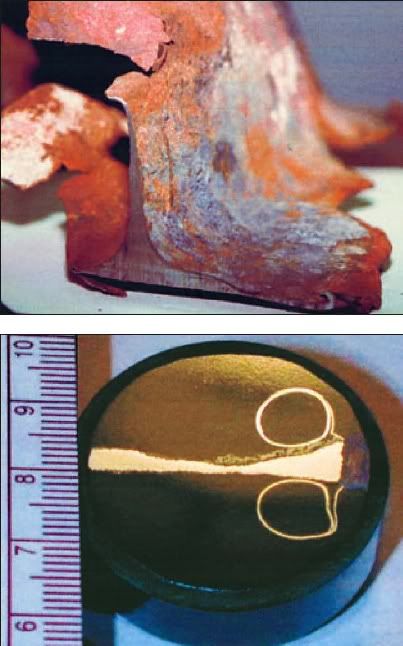
Yea well I guess there's the issue of this little piece that you still have to overcome.

http://911research.wtc7.net/wtc/evidence/metallurgy/images/WTC_apndxC_img_2.jpg
 
Yea well I guess there's the issue of this little piece that you still have to overcome.

http://911research.wtc7.net/wtc/evidence/metallurgy/images/WTC_apndxC_img_2.jpg
Where is the melted steel? You showed corrosion, the paper said corrosion, you messed up and thought the paper said melted steel, because you failed to read the paper about the piece of steel you posted now, and believed some liars who spread false information.

Why did you fall for the melted steel delusion?

You posted a photo of corroded steel, not melted steel. Try reading one of the many reality based studies on 911.
111corosion.jpg
Where is your melted steel. Next time read the study before falling for the lies.
 
Last edited:
Where is the melted steel? You showed corrosion, the paper said corrosion, you messed up and thought the paper said melted steel, because you failed to read the paper about the piece of steel you posted now, and believed some liars who spread false information.

Why did you fall for the melted steel delusion?

You posted a photo of corroded steel, not melted steel. Try reading one of the many reality based studies on 911.
111corosion.jpg
Where is your melted steel. Next time read the study before falling for the lies.

The industrial batteries I work on look like this pic after they have been overfilled/boiled over and the sulfuric acid attacks the metal case (takes a while to get that bad). They appear flaky and brittle. Start off with a white "salt" all over them. Same idea (result) but different method?
 
Last edited:
Yea well I guess there's the issue of this little piece that you still have to overcome.

http://911research.wtc7.net/wtc/evidence/metallurgy/images/WTC_apndxC_img_2.jpg

I agree with Beachnut, I do not see any evidence that this piece of steel (from WTC 7) 'melted'. Certainly nothing at all that looks anything at all like a thermite burn caused this thinning.

Getting back to WTC 2; I still see no reason to dismiss the idea that fires proximate to the area from which this molten material is seen exiting the building did not cause the material become molten.

We could be looking at a crack in the floor from above, through which molten material is flowing, or a broken piece of concrete along which it is flowing towards the side of the building. If its quite viscous it would spread accross a slab and drip off the low end in blobs, especially if its coming onto the slab from more than one point.

Colour means little as well since as soon as it starts falling, for all we know the added windstream is causing it to burn, releasing more heat and keeping the reaction going until the mass of the 'blob' is too small to retain enough heat. (that is to say that the surface area to volume ratio gets larger) In the few instances when a 'blob' gets blown back and hits the building it shatters (wow I hesitated to say 'explode' for some odd reason:D) into a shower of white hot material.

The most basic fact is that we cannot tell what the larger hot item is nor can we tell what the molten material is. Java man is using this to , in essence say, that since we cannot know for sure these very basic facts that his conjecture is as good or better than any other. Not so of course for the simple reason that we know for a fact that the building was on fire and that a particularily intense area of fire was proximate to the place where the molten material flows from the building. Office fires routinely get above the melting point of several candidate materials, decades of fire engineering research backs this up.

OTOH for Java man's conjecture one must assume yet another unknown, the existance of thermite at this location. Furthermore having thermite at this one specific location would make little sense in a giant conspiracy to bring down the towers and therefore IF the conjecture is true then there must have been a great deal more thermite in various locations in the building yet there is no evidence whatsoever of any thermitic material anywhere, nor any other location from which molten material flowed from the structure.
 
Last edited:
Certainly nothing at all that looks anything at all like a thermite burn caused this thinning.

Well beachnut is on my banned list. So so much for his comment. In regards to what you say. Yes it is hard for thermite to do that thinning.

If its quite viscous it would spread accross a slab and drip off the low end in blobs, especially if its coming onto the slab from more than one point.

I'm hard pressed to believe aluminium or led would be "viscous" and "red hot" at the same time. Given they both melt way before they are even incandescent.
 
Well beachnut is on my banned list. So so much for his comment. In regards to what you say. Yes it is hard for thermite to do that thinning.

You mean you 'ignore' list perhaps? Unless by some miracle you have become a moderator of the forum.


I'm hard pressed to believe aluminium or led would be "viscous" and "red hot" at the same time. Given they both melt way before they are even incandescent.

OK, not so viscous. You realize that both aluminum and lead would be incadescent if hot enough while molten, right?
 

Back
Top Bottom