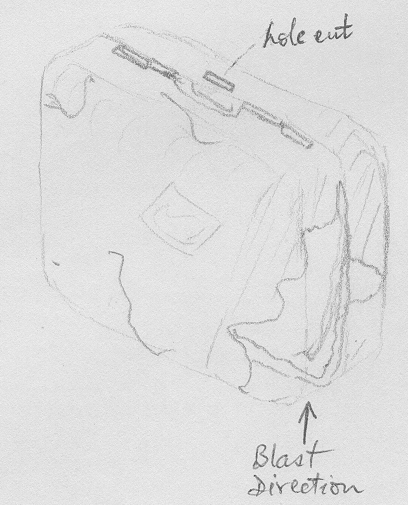
Lockerbie: London Origin Theory

Where do you think these photos came from.....? However, another source promised me the whole report, we just haven't quite got organised about it.

John's pretty tied up at the moment, although he got excited enough about the implications of PD/899 to email me on Friday night. I intend to ask him specifically about that lock, because it's now bugging me. Don't know when I'll get an answer though.

Rolfe.
 
Last edited:
There seemed to be two strands to it. One was this height business, claiming that it was 10 inches, or you seemed to think 13.5 inches, when the bomb suitcase was only 9 inches deep. The other was a claim, I think by that guy Cullis, that there had been something underneath the bomb suitcase, shielding the base of the container. Caustic Logic was quite taken by that but I couldn't really see it. The container base is so beat up it's like Mystic Meg reading a palm.

We've talked about the Claiden spot earlier. Claidens estimate was based on damage (a hole) to the adjacent container AVN7511. It 's guesswork.

Cullis claimed that there had been something underneath the bomb suitcase because he didn't see any pitting on the floor and because the floor was dished.

It is very well possible that the dishing was the result of a process called "explosive shaping". When the floor panel was subjected to an explosion above it, it probably adapted the shape of the 747 cargo floor beneath it.

Pitting is a combination of three effects: 1) the munroe-effect, 2)gas-wash and 3) microcratering.

The first two are very close range (0-20 cms for a 450 gram charge) "high temperature" effects. Microcraters are formed upon impact of high velocity particles. Microcraters can be found meters away from the IED, but a few cms of clothing and a few mm of hardshell plastic are very good arresters for high velocity particles.

The Germans were right: the evidence is flimsy
 
Last edited:
We've talked about the Claiden spot earlier. Claidens estimate was based on damage (a hole) to the adjacent container AVN7511. It 's guesswork.

Cullis claimed that there had been something underneath the bomb suitcase because he didn't see any pitting on the floor and because the floor was dished.

It is very well possible that the dishing was the result of a process called "explosive shaping". When the floor panel was subjected to an explosion above it, it probably adapted the shape of the 747 cargo floor beneath it.

Pitting is a combination of three effects: 1) the munroe-effect, 2)gas-wash and 3) microcratering.

The first two are very close range (0-20 cms for a 450 gram charge) "high temperature" effects. Microcraters are formed upon impact of high velocity particles. Microcraters can be found meters away from the IED, but a few cms of clothing and a few mm of hardshell plastic are very good arresters for high velocity particles.

The Germans were right: the evidence is flimsy


I didn't understand most of that, but it seems to add up to that one word, guesswork. Which is how it appeared to me.

I think we can all agree that the aggregation of the evidence places the bomb in either the bottom case of the left-hand front stack, or the one above it. I simply cannot understand how anyone can imagine it's possible to say for sure which case it was purely by staring at the bits of the container and associated structures. It may be that the consensus prefers the second layer, but as to ruling out the bottom layer to 100% certainty - it's preposterous. And yet that is what they strove to do, and convinced themselves they had done.

Reading the accounts of the early weeks and months of the inquiry, the blinkered determination to place the explosion on the second layer (or among the Frankfurt luggage somehow, anyway) is truly remarkable. And yet they had Bedford's statements showing that there was a Heathrow suitcase on the bottom layer "in the frame" for the position of the bomb suitcase, and that it had appeared mysteriously while he was on his break. By February they also knew that Bedford's description of the mysterious suitcase matched the bomb suitcase.

But rather than take a look at that suitcase, even try to figure out which of the legitimate Heathrow items it had been, the entire boiling of them are running around trying to find ways to decide the bang was too high for it to be worth a second glance.

Why?

And they're all at it. The Scottish cops, and the RARDE team (including Feraday and Cullis and probably Hayes too), and the AAIB inspectors too by the look of it.

Why?

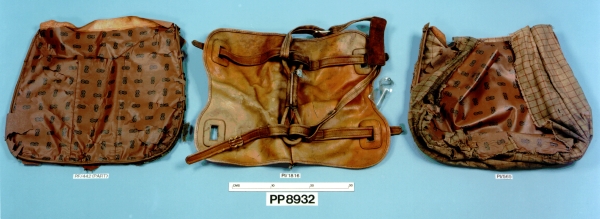
Now look. They're all obsessing about the bumps on the container. But what about the suitcases on the back row, considering that Bedford's evidence lets us figure out pretty well which one was where? And on 20th January Hayes draws this, in relation to one of the suitcases known to have been sitting upright on the floor of the container behind the bomb suitcase.

PP8932sketch.jpg


Am I wrong about this? Why would anyone draw that, or look at that drawing, and not realise the bomb suitcase was on the bottom layer?

Rolfe.
 
The problem with the suit carrier is it doesn't fit well with Bedford's description of two hard-shell suitcases:

"I went to see Peter Walker in baggage build-up leaving Camjob in interline. I returned about 4.40 p.m., Camjob [sic] told me two further suitcases had arrived for PA 103 which he had put in the tin. I looked inside the tin and saw the suitcases that I had put in the tin still in the same position. Lying on their sides in front of the other suitcases, handles pointing towards the back of the tin, were two suitcases. They were hard suitcases, the type Samsonite make. One was brown in colour, and the other one, if it wasn't the same colour, it was similar. In size, they took up the remaining base area of the tin. [day 44, p 6463-65]

A suit carrier is made of fabric, and it's much flatter than a suitcase.

If Bedford was somehow mistaken, and the suit carrier was the right-hand item, then a bag from Frankfurt must have been loaded on top of it. The lower half, or more, of this item must have been level with the bottom left-hand case.
 
The problem with the suit carrier is it doesn't fit well with Bedford's description of two hard-shell suitcases:

A suit carrier is made of fabric, and it's much flatter than a suitcase.

If Bedford was somehow mistaken, and the suit carrier was the right-hand item, then a bag from Frankfurt must have been loaded on top of it. The lower half, or more, of this item must have been level with the bottom left-hand case.


I think he must have been mistaken, possibly seeing the two similar-coloured items and assuming they were the same in other ways - having looked mostly at the left-hand one. Sidhu, in contrast, thought the cases were soft-sided, though he wasn't adamant about it.

We don't know how much was in the suit carrier - the photo shows it empty. Kamboj said it was a large case. If there was quite a lot in it, it could have been nine inches thick. There are likely to be plenty candidates among the Frankfurt items to have been on top of it - there were 20 Frankfurt-origin cases recoded as blast-damaged to a greater or lesser extent.

I realise the Bernstein case doesn't fit Bedford's description all that well. But look at it. Where else could it have been?

Rolfe.
 
If Bedford was somehow mistaken, and the suit carrier was the right-hand item, then a bag from Frankfurt must have been loaded on top of it. The lower half, or more, of this item must have been level with the bottom left-hand case.

Yes, and that's why I'm also interested in some of the Frankfurt suitcases, for example the one of Johannes Schauble.
 
Human factors? Nobody with the guts to stand up against the prevailing opinion. It's a well known problem in police investigations.


Oh sure. But where did that opinion come from in the first place? When Bedford hands them what looks like the clue of the century on day 13? The groupthink ignoring that suitcase is absolutely extraordinary.

Rolfe.
 
Which were done in April. They were hell-bent on the second layer from January.

Indian Head was carried out in order to provide support for a line of thinking they'd been committed to for over three months.

Rolfe.
 
I have two semi-plausible thoughts about this. One is that when they found out that the container involved was the one with the Frankfurt luggage (last week of December) they immediately rejoiced that it was all going to turn out to be Germany's fault. Then when Bedford told them about the Heathrow-origin cases, in the first week of January, they refused to reconsider.

The other is that after seeing off the Met (who tried to muscle in right at the start) the senior police (who were looking at the highest profile operation any of them was likely to see in several lifetimes) didn't want to countenance a modus operandi that would inevitably have seen the Met involved all over again and probably taking over.

It still doesn't make a lot of sense though. If you look at the information that flooded in to the SIO in the first six to eight weeks of the investigation, the Heathrow evidence is absolutely overwhelming and the Frankfurt evidence is non-existent. He actively buried some important aspects of the Heathrow evidence and bent over backwards to find spurious reasons to declare the bomb had been on the feeder flight.

More than anything, this is what I want to see investigated. Yes, PT/35b stinks to high heaven and certain people ought to be taken out and shot for the way they groomed and pressurised Tony Gauci to accede to the suggestion that Megrahi might have been the man who bought the clothes. But that's all later. I want to know whether the misdirection in the first few months of 1989 was cock-up or conspiracy. Cos it looks a lot like conspiracy to me (as this is an even-numbered day).

Rolfe.
 
Here is a time-line of the period before Indian Head.

21st December 1988, 7.03 pm
Thirty-eight minutes after taking off from Heathrow airport, Maid of the Seas falls out of the sky on to the town of Lockerbie, killing 270 people

24th December

First piece of blast-damaged baggage container recovered from the wreckage on the ground, confirming suspicious that the crash was a terrorist attack, and that the explosive device was located among the passenger baggage

c. 28th December
Container identified as AVE4041, which was in turn identified as the one which had contained the transfer luggage from the feeder flight from Frankfurt

30th December
The Senior Investigating Officer issues a press release stating that the bomb almost certainly came from Frankfurt, and Heathrow is in the clear (this received blanket coverage in all UK broadsheets and also appeared in the foreign press)

3rd January 1989
Witness statement from John Bedford reveals not only that there were suitcases in AVE4041 before it was used for the Frankfurt baggage, but that two items at the front of the container appeared in somewhat mysterious circumstances while it was unattended in the Heathrow terminal building between 4.15 and 4.45 pm

7th January
BKA memo shows the position where the explosion was at that time believed to have happened, based on the pattern of damage to the container. This puts the explosion in exactly the place Bedford's left-hand suitcase was located

sketchpos.jpg


9th January
Further statement from Bedford in which he describes at least one of the mystery suitcases as "a brown hardshell, the type Samsonite make"

10th January

Witness statement from Amarjit Sidhu, who loaded the Frankfurt luggage, stating that he simply placed the Frankfurt items on top of the ones that were already there

20th January
Examination of one of the suitcases which was placed upright in the row behind the position of the explosion reveals damage consistent with the bomb suitcase having been on the floor of the container

PP8932sketch.jpg


24th January
Reconstructions carried out by John Bedford, Tarlochan Sahota and Amarjit Sidhu (the three baggage handlers who saw the container as it was just before it was taken out on to the tarmac) indicate there were seven or eight suitcases in it at that time

31st January
Witness statement from Raymond Manly reveals that there had been a break-in into the airside area of Terminal 3, the area where AVE4041 was subsequently loaded, about 16 hours before the mysterious suitcases appeared in the container

15th February
Memo from Dr. Thomas Hayes notes that the "primary suitcase" appears to have been a brown plastic hardshell (later identified as a Samsonite Silhouette 4000 hardshell in a colour variously described as brown, bronze and maroon)

16th February

Transport minister Paul Channon issues a press statement identifying the Frankfurt flight as the probable route of the IED, leading to a clash with his West German counterpart Jürgen Warnke

28th March
The Senior Investigating Officer informs the Lockerbie inquiry that "on the balance of probabilities" the IED was among the luggage transferred from the feeder flight

This "balance of probabilities" argument appears to have been based on the fact that almost all the blast-damaged luggage recovered at that stage was of Frankfurt origin, therefore the IED was deduced to have been among an enclave of luggage from the feeder flight. A moment's thought reveals the illogic of this. The explosion was known to have occurred at about the level where the single layer of Heathrow items ended and the many-layered heap of Frankfurt items began. The layout was well established from the evidence of the three baggage handlers, with Frankfurt-origin items easily outnumbering Heathrow-origin items in that corner of the container. Given the estimated height of the explosion, it was clear that the bomb suitcase was either the left-hand one of the two Bedford described as having appeared while he was on his break, or the one Sidhu had loaded on top of it from the Frankfurt flight, or (just possibly) one placed in the overhang section of the container immediately to the left (later forensic evidence was able to rule out this last possibility).

In this context, the relative prevalence of Frankfurt versus Heathrow items among the recovered blast-damaged fragments is not helpful in establishing which of these three positions was occupied by the primary suitcase. Indeed, if any inference can be made, it is surely the converse. Given the geometry of the loading in that corner of the container, if the bomb suitcase was the one loaded at Heathrow, then that actually explains a relative dearth of legitimate Heathrow items among the recovered blast-damaged luggage - exactly as was observed.

However, that suitcase was not followed up. Inquiries in relation to Heathrow were confined to following up the legitimate passenger baggage which had passed through the interline shed and may have been loaded into AVE4041. Considerable information was amassed on the 17 passengers who had flown in to Heathrow on other airlines earlier in the day, and their luggage. In due course it was clear that none of these passengers’ suitcases had contained the bomb, and as the investigation was by then entirely focussed on Malta, Heathrow was forgotten.

Nevertheless, as more and more detail emerged regarding these 17 passengers, their luggage and its condition on recovery, additional evidence appeared which further strengthened the case for Bedford’s brown Samsonite being the bomb suitcase.

  • While the baggage handlers’ evidence from 24th January indicated there were at least seven suitcases in the container, the final luggage reconciliation could identify only six legitimate passenger items as having been placed there
  • None of the suitcases belonging to the passengers in question was a brown Samsonite, or indeed a brown hardshell of any description
  • All six legitimate passenger items were recovered, and none was damaged in a way consistent with its having been placed underneath the bomb suitcase
  • The mix of recovered fragments of blast-damaged luggage contained only confirmed legitimate passenger items and the bomb suitcase itself, with no sign of another stray innocent suitcase which might somehow have ended up on the floor of the container under the bomb suitcase
The suitcase Bedford had described in early January as being placed in the exact corner of the container determined to have held the bomb was never matched to any legitimate item of passenger baggage, or to any innocent piece of luggage recovered on the ground.

OK, a cut-and-paste, but all my own work.

How does any police inquiry ignore that lot?

Rolfe.

 
Last edited:
To be fair, on the other side of the scales, they were convinced the bombers were a Palestinian gang based in Frankfurt. Why they might have imagined it was impossible for a Frankfurt-based gang to have travelled to Heathrow to plant a bomb, I have no idea.

It got even more surreal when they discovered (at least by May 1989) that the type of bomb they were assuming had been used, the trademark modus operandi of the Frankfurt gang, would have had to have been loaded at Heathrow if the transatlantic flight was the intended target. Such a bomb loaded at Frankfurt would have gone off over Belgium. Instead of going back and reconsidering the Heathrow evidence in the light of that information, they dreamed up a few rather bizarre scenarios wherein it might have been possible for such a bomb loaded at Frankfurt not to have gone off until after the second take-off. On that basis they felt comfortable carrying right on ignoring Heathrow and Bedford's mystery suitcase.

Rolfe.
 
LittleSwan, just a couple of quick questions.

Assuming for the sake of argument that the damage to PD/889 was indeed caused by the explosion, as Hayes said, is it indeed pointing to the floor-level case in front rather than the case on the second layer? (Looks like a no-brainer to me, but my speciality is flesh and blood, not PVC.)

What do you think about the possibility of Bernstein's holdall being on the extreme right of the row on the back, beyond PD/120, even though the holdall was noted to have some explosive damage and PD/120 wasn't?

holdall.jpg


Rolfe.
 
Assuming for the sake of argument that the damage to PD/889 was indeed caused by the explosion, as Hayes said, is it indeed pointing to the floor-level case in front rather than the case on the second layer? (Looks like a no-brainer to me, but my speciality is flesh and blood, not PVC.)

The damage to PD/889 is asymetrical, thus floor-level is more likely than second layer. However, bear in mind that if the IED suitcase was in the "third position" (Ashtons book) the bomb suitcase wasn't laying completely flat on the floor.

What do you think about the possibility of Bernstein's holdall being on the extreme right of the row on the back, beyond PD/120, even though the holdall was noted to have some explosive damage and PD/120 wasn't?

Why not. Again, I don't see damage on the pictures (maybe I need a pair of glasses). If there was some free space between the back row and the cases that were lying at the front there will always be some sooting or puncturing.
 
Dont wish to disturb the flow here but isnt a lot riding on these baggage handlers remembering where each and every case was?
Baggage handlers are usually baggage handlers because its the only job they can get, and TBH I would wager that most arent too concerned about remembering the order bags go in and also I pressume they loaded more than one plane that day with possibly hundreds of suitcases.

Why is their testimony relevant at all, they would likely agree with anything put to them regards the order of cases.
 
Dont wish to disturb the flow here but isnt a lot riding on these baggage handlers remembering where each and every case was?
Baggage handlers are usually baggage handlers because its the only job they can get, and TBH I would wager that most arent too concerned about remembering the order bags go in and also I pressume they loaded more than one plane that day with possibly hundreds of suitcases.

Why is their testimony relevant at all, they would likely agree with anything put to them regards the order of cases.


Nobody is expecting or relying on these people remembering where they put each and every case. However, they did remember sufficient detail about what they did that afternoon for it to be possible to work out where the important cases probably were.

As I explained to you before, PA103 was the last flight of the day, and the only one departing after mid-day. After a busy morning, there were only three people left dealing with that flight, and that flight only. That happened, for those within the shed, between 2 pm and about 4.50 pm. News broke about the crash at 9 pm for most people (BBC News). So these men knew that flight was something to be remembered before they dealt with anything else.

Bedford said he placed "one or two" suitcases upright at the back of the container, just after 2 pm. This was luggage that had arrived during the morning, screened, and then left aside to be dealt with after the other flights had gone. Passenger records reveal this was only one suitcase, and it belonged to Bernt Carlsson who flew in from Brussels in the morning. So we know exactly where Mr. Carlsson's case was.

He then said that he placed "four or five" more cases in the back row, working left to right, as they arrived, again upright with the handles up. We know that three cases (two McKee one Gannon) arrived from Larnaca in the early afternoon, and then two more from Vienna (Bernstein) a bit later. The aggregate of the evidence indicates that the Vienna luggage arrived before 4.15 when Bedford went on his break, so that is the five cases he handled. We don't know the exact order, but we know the three Larnaca cases were to the right of the Carlsson case and to the left of the Bernstein cases.

He then said that when he returned from his break at 4.45 pm there were two more cases lying flat at the front of the container. He did not put them there. He thought that Kamboj had put them there, but Kamboj denied all knowledge of this. It wasn't his job to put cases into the container. The front left-hand case seems to have caught Bedford's eye, because he volunteered that it was a brown hardshell, apparently a Samsonite. He was less certain about the right-hand case but described it as "similar".

The next person to see the container was Tarlochan Sahota, who simply looked into it to see how much space there was for the Frankfurt transfer luggage. He confirmed the general arrangement of the cases as Bedford had described, but was unable to describe any of them. He didn't move any of the cases.

The next person to see the container was Amarjit Sidhu, who again confirmed the arrangement as Bedford described and again said he didn't move the cases. Thus we can be pretty sure that nobody moved the cases after Bedford last saw the container, as the arrangement of the cases did not change. Sidhu described the front two items as "large dark" cases but said he didn't pay any particular attention to them. He just loaded the Frankfurt luggage, using these cases as a base.

These people were asked to describe everything they remembered about that luggage container. They weren't asked a load of leading questions. When they were asked whether or not they remembered a specific thing, they didn't always say yes. Several people were asked about Nicola Hall's case (sent on PA101 in error), and said they didn't remember seeing it. Sidhu was asked about the carton of bottles Maier described at Frankfurt, and about the metal case Sandhu described, and didn't remember either. Sidhu was asked, at the FAI, did you say these cases at the front were light-coloured? He replied, no, they were dark-coloured.

I'm actually quite surprised how accurate some of the accounts are. Both Kamboj and Parmar described cases they remembered taking off the carousel for x-ray. They were pretty close to the money as regards which airlines the items had flown in on, and Kamboj even described a case which fits the description of Bernstein's suit carrier. Bear in mind that the passenger records detail exactly what luggage they handled, so their memories can be checked against this.

I was and remain surprised that Bedford got that front left case so right. Brown - no wait maroon - Samsonite hardshell, with the light reflecting off it. It was a lucky break the investigators simply threw away. That he wasn't so right about the left-hand one is not perhaps entirely surprising.

So really, that is a remarkably good basis for being able to look at these six suitcases as they were recovered, and figure out where each one was.

Rolfe.
 
The damage to PD/889 is asymetrical, thus floor-level is more likely than second layer. However, bear in mind that if the IED suitcase was in the "third position" (Ashtons book) the bomb suitcase wasn't laying completely flat on the floor.


Good point. I was thinking particularly about the bottom of the case, which we can't see properly in any of the pictures, but which seems to be very badly damaged compared to the top (handle side).

Although the case probably wasn't lying completely flat, the right-hand side would have been in contact with the floor. But indeed, with the left-hand side elevated, the height of the explosion would be closer to mid-point of the height of the cases in the row behind, even though it was the case on the bottom layer.

Why not. Again, I don't see damage on the pictures (maybe I need a pair of glasses). If there was some free space between the back row and the cases that were lying at the front there will always be some sooting or puncturing.


I don't see it either, but then we don't have a picture of the other side of these pieces. I don't even know how they fit together to make a piece of luggage. I only know that item was recorded as exhibiting some explosion damage.

Logically, it must have been on the extreme end of the back row with PD/120 next to it, I wanted to know if that was possible in view of the damage sustained. I thought that what you suggested was possible, thanks for confirming it.

Bear in mind PD/120 was a hardshell and perhaps less subject to obvious damage when not absolutely right up close and personal to the explosion. It was recorded as showing explosives "contamination".

Rolfe.
 
Some more about the Bernstein suit carrier

The report tells us that the two recovered pieces of this suit carrier are shown in the [2438] photograph. The first of these is PI/991. What does the report say about PI/991?
A “PI/991. This is part of a severely disrupted suitcase. It has a reinforcing strip of semi-rigid maroon plastics measuring 740 millimetres by 55 millimetres, with an attached large fragment of maroon cloth canvas, a black cloth canvas and maroon soft plastics handle, and a bright metal D-shackle. The item showed evidence of explosion damage with blackening and penetration of the soft plastics handle by fragments of sheet plastics. These
fragments were removed and collectively identified as PT/54 and consist of the following:
“A, a fragment of plastics from the primary suitcase.
“B, some fibres and plastics fragments from the American Tourister suitcase.”
Q And the next item is PK/1795. Do we see that as the larger item in the photograph?
A Yes, sir.
Q What does the report say about that?
A “PK/1795. This consists of the major part of a maroon-coloured fabric suit carrier possessing maroon plastics trimmings and a matching zip fastener. There is severe blackening and many [2439] penetration holes present along the bottom ends of the suit carrier consistent with its close proximity to a violent explosion. The materials and construction of this item match closely those of item PI/991.”
 

Back
Top Bottom