Here is a time-line of the period before Indian Head.
21st December 1988, 7.03 pm
Thirty-eight minutes after taking off from Heathrow airport, Maid of the Seas falls out of the sky on to the town of Lockerbie, killing 270 people
24th December
First piece of blast-damaged baggage container recovered from the wreckage on the ground, confirming suspicious that the crash was a terrorist attack, and that the explosive device was located among the passenger baggage
c. 28th December
Container identified as AVE4041, which was in turn identified as the one which had contained the transfer luggage from the feeder flight from Frankfurt
30th December
The Senior Investigating Officer issues a press release stating that the bomb almost certainly came from Frankfurt, and Heathrow is in the clear (this received blanket coverage in all UK broadsheets and also appeared in the foreign press)
3rd January 1989
Witness statement from John Bedford reveals not only that there were suitcases in AVE4041 before it was used for the Frankfurt baggage, but that two items at the front of the container appeared in somewhat mysterious circumstances while it was unattended in the Heathrow terminal building between 4.15 and 4.45 pm
7th January
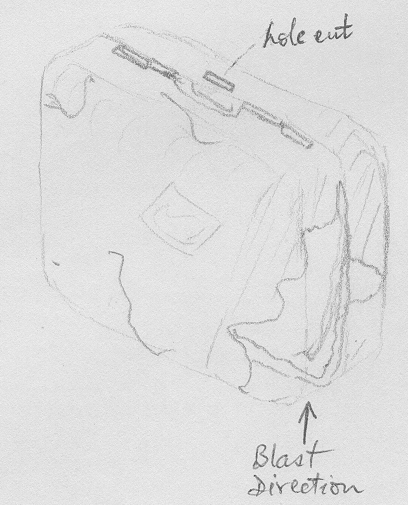
BKA memo shows the position where the explosion was at that time believed to have happened, based on the pattern of damage to the container. This puts the explosion in
exactly the place Bedford's left-hand suitcase was located
9th January
Further statement from Bedford in which he describes at least one of the mystery suitcases as "a brown hardshell, the type Samsonite make"
10th January
Witness statement from Amarjit Sidhu, who loaded the Frankfurt luggage, stating that he simply placed the Frankfurt items on top of the ones that were already there
20th January
Examination of one of the suitcases which was placed upright in the row behind the position of the explosion reveals damage consistent with the bomb suitcase having been on the floor of the container
24th January
Reconstructions carried out by John Bedford, Tarlochan Sahota and Amarjit Sidhu (the three baggage handlers who saw the container as it was just before it was taken out on to the tarmac) indicate there were seven or eight suitcases in it at that time
31st January
Witness statement from Raymond Manly reveals that there had been a break-in into the airside area of Terminal 3, the area where AVE4041 was subsequently loaded, about 16 hours before the mysterious suitcases appeared in the container
15th February
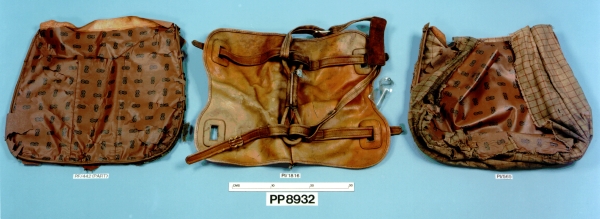
Memo from Dr. Thomas Hayes notes that the "primary suitcase" appears to have been a brown plastic hardshell (later identified as a Samsonite Silhouette 4000 hardshell in a colour variously described as brown, bronze and maroon)
16th February
Transport minister Paul Channon issues a press statement identifying the Frankfurt flight as the probable route of the IED, leading to a clash with his West German counterpart Jürgen Warnke
28th March
The Senior Investigating Officer informs the Lockerbie inquiry that "on the balance of probabilities" the IED was among the luggage transferred from the feeder flight
This "balance of probabilities" argument appears to have been based on the fact that almost all the blast-damaged luggage recovered at that stage was of Frankfurt origin, therefore the IED was deduced to have been among an enclave of luggage from the feeder flight. A moment's thought reveals the illogic of this. The explosion was known to have occurred at about the level where the single layer of Heathrow items ended and the many-layered heap of Frankfurt items began. The layout was well established from the evidence of the three baggage handlers, with Frankfurt-origin items easily outnumbering Heathrow-origin items in that corner of the container. Given the estimated height of the explosion, it was clear that the bomb suitcase was either the left-hand one of the two Bedford described as having appeared while he was on his break, or the one Sidhu had loaded on top of it from the Frankfurt flight, or (just possibly) one placed in the overhang section of the container immediately to the left (later forensic evidence was able to rule out this last possibility).
In this context, the relative prevalence of Frankfurt versus Heathrow items among the recovered blast-damaged fragments is not helpful in establishing which of these three positions was occupied by the primary suitcase. Indeed, if any inference can be made, it is surely the converse. Given the geometry of the loading in that corner of the container, if the bomb suitcase was the one loaded at Heathrow, then that actually explains a relative dearth of legitimate Heathrow items among the recovered blast-damaged luggage - exactly as was observed.
However, that suitcase was not followed up. Inquiries in relation to Heathrow were confined to following up the legitimate passenger baggage which had passed through the interline shed and may have been loaded into AVE4041. Considerable information was amassed on the 17 passengers who had flown in to Heathrow on other airlines earlier in the day, and their luggage. In due course it was clear that none of these passengers’ suitcases had contained the bomb, and as the investigation was by then entirely focussed on Malta, Heathrow was forgotten.
Nevertheless, as more and more detail emerged regarding these 17 passengers, their luggage and its condition on recovery, additional evidence appeared which further strengthened the case for Bedford’s brown Samsonite being the bomb suitcase.
- While the baggage handlers’ evidence from 24th January indicated there were at least seven suitcases in the container, the final luggage reconciliation could identify only six legitimate passenger items as having been placed there
- None of the suitcases belonging to the passengers in question was a brown Samsonite, or indeed a brown hardshell of any description
- All six legitimate passenger items were recovered, and none was damaged in a way consistent with its having been placed underneath the bomb suitcase
- The mix of recovered fragments of blast-damaged luggage contained only confirmed legitimate passenger items and the bomb suitcase itself, with no sign of another stray innocent suitcase which might somehow have ended up on the floor of the container under the bomb suitcase
The suitcase Bedford had described in early January as being placed in the exact corner of the container determined to have held the bomb was never matched to any legitimate item of passenger baggage, or to any innocent piece of luggage recovered on the ground.
OK, a cut-and-paste, but all my own work.
How does any police inquiry ignore that lot?
Rolfe.