Lockerbie: London Origin Theory

Well, I'll bow to your apparently superior knowledge. But I have a hard time believing that Sidhu would have lifted the Bedford bag out of the container to replace it with another, given the time and manpower constraints he was working with. And especially I don't really believe he put Patricia's suitcase in its place, for a lot of reasons but right now can we go with the fact that her big case would probably have pushed the explosion higher than ten inches. If he did take it out and put another bag in its place, it must have been a relatively slim item. Why do that?

Logically, my first guess would be as per the FAI, that Bedford's bags weren't moved. But we know that can't be true. Shoving them apart to stick something small in between seems a lot more likely than lifting them out. These guys are loading suitcases, not building drystone walls. (And the drystone wallers say the main trick with that is once you've picked a stone up, put it in the wall, once a stone is in the wall, don't move it.)

Rolfe.
 
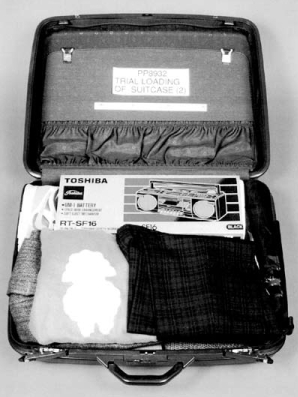
Something else struck me here, about the packing of the suitcase. Here's the "trial loading" the forensics guys produced, packing the case with the stuff Tony sold.

suitcase.jpg


They've put the radio across the back. That would be the intuitive place to put it if you were packing a normal suitcase I think. However, I don't think if could have been packed like that.

Not to diss your pics, CL, but my overwhelming impression here is that only the extreme left-hand side of the bomb suitcase protruded into the sloping section of the container. Either it was on the second layer and horizontal, and just pushed along until it made contact with the side of the container, or on the bottom and pushed about four or five inches into the sloping section.

I think the radio must have been packed on the extreme left of the case, as it was oriented in the container.

If it was packed as shown, the spine of the case must have been the side pushed into the sloping section. But we know that probably wouldn't have been how it happened, because Bedford was quite clear he would put the cases either handle in or handle out - not handle to the side.

I think the radio was packed at right angles to the position shown, along the left-hand side of the case.

This is not an intuitive way to pack such an item. Nobody packing a case that would eventually be randomly placed would pack it like that. However, if you were intending to place the case precisely, with the bomb as close to the skin of the aircraft as possible. that's exactly how you'd pack it.

Discuss.

Rolfe.
 
Something else struck me here, about the packing of the suitcase. Here's the "trial loading" the forensics guys produced, packing the case with the stuff Tony sold.

[qimg]http://www.vetpath.co.uk/jref/suitcase.jpg[/qimg]

Not to diss your pics, CL, but my overwhelming impression here is that only the extreme left-hand side of the bomb suitcase protruded into the sloping section of the container. Either it was on the second layer and horizontal, and just pushed along until it made contact with the side of the container, or on the bottom and pushed about four or five inches into the sloping section.

I don't disagree, except where and if it conflicts with the physical evidence. The container damage suggests second layer most clearly, and rules out flat on the (main) floor, but there are other possibilities in between, as we've considered. The constraints are these:
1) No visible chemical pitting of the (main, flat) container floor, aside from maybe a thin strip at the outboard edge. This suggests something substantial between the IED and (nearly all of) the floor. (AAIB finding, I concur by looking at the photo)
2) No visible pitting to the inboard face of the vertical member nearest the blast. (AAIB finding, photo evidence supports it, but isn't clear on the other faces - was the outboard face blasted either, or only the inner face?) So it could be just in-line with that beam, or somewhat outboard of it, perhaps, but not inboard. The AAIB decided 2" outboard, but I don't think that's really so certain.

But not only the case, but the blast center within it, have to be outboard of that beam, in the overhang. With average radio casings, the suitcase should have to stick at least 4 or 5 inches into the overhang, I think.

But considering the case was 22 by 26 inches, bomb placement well-off center is evident.

If it was packed as shown, the spine of the case must have been the side pushed into the sloping section. But we know that probably wouldn't have been how it happened, because Bedford was quite clear he would put the cases either handle in or handle out - not handle to the side.

What's more, he explained that even though he didn't place the two mystery cases, they were aslo laid in handles-in, spines out.

I think the radio was packed at right angles to the position shown, along the left-hand side of the case.

Actually, right-hand as shown here. Bedford said they were placed handles in, so backwards from this. And some forensic evidence (piece of the lock in a neighboring case within the container, a bit of the spine frame blasted into the next container over) suggests the same (for the exploding brown Samsonite, whoever's it was).

This is not an intuitive way to pack such an item. Nobody packing a case that would eventually be randomly placed would pack it like that. However, if you were intending to place the case precisely, with the bomb as close to the skin of the aircraft as possible. that's exactly how you'd pack it.

I might, if it fit and seemed a different way to do things. Depending on what else I had and whether I was feeling rushed or whimsical, etc ... But whoever packed it, the bomb was clearly, as you say, along one side, and that side wound up nearest the hull, a 1-in-4 or so shot within its location. And the general location being best is more like one-in-20 or something.

London intro, as we're visualizing it, has a roughly one-in-one chance of initial optimal placement and orientation, with only possible external interference to worry about. If there was any, it was apparently nothing more than a slight move, and wound up hurting nothing much.
 
Last edited:
I don't disagree, except where and if it conflicts with the physical evidence. The container damage suggests second layer most clearly, and rules out flat on the (main) floor, but there are other possibilities in between, as we've considered. The constraints are these:
1) No visible chemical pitting of the (main, flat) container floor, aside from maybe a thin strip at the outboard edge. This suggests something substantial between the IED and (nearly all of) the floor. (AAIB finding, I concur by looking at the photo)
2) No visible pitting to the inboard face of the vertical member nearest the blast. (AAIB finding, photo evidence supports it, but isn't clear on the other faces - was the outboard face blasted either, or only the inner face?) So it could be just in-line with that beam, or somewhat outboard of it, perhaps, but not inboard. The AAIB decided 2" outboard, but I don't think that's really so certain.


I suppose I really ought to take on board more seriously your conviction that the case couldn't possibly have been on the bottom layer. I've just never really bought it on the basis of the height of the explosion, and the general uncertainty over a lot of these deductions.

But not only the case, but the blast center within it, have to be outboard of that beam, in the overhang. With average radio casings, the suitcase should have to stick at least 4 or 5 inches into the overhang, I think.

But considering the case was 22 by 26 inches, bomb placement well-off center is evident.


Yes. Easy enough to ensure the case isn't just in the right position but the right way round, if you're the one putting it in the container.

What's more, he explained that even though he didn't place the two mystery cases, they were aslo laid in handles-in, spines out.

Actually, right-hand as shown here. Bedford said they were placed handles in, so backwards from this.


I also take your point about the handles being towards the back of the container, I'd forgotten that Bedford had specified that. (He also suggested he might put the handles of hardshell suitcases to the front, the handles-to-the-back thing was mainly for soft cases that might cause the pile to tilt, so that the tilt would be in the right direction not to bring the whole lot down.)

But yes, along the right-hand-side as we're looking at it. Unless the case was placed upside-down, which is always possible, in which case it would have been the left.

There are far too many variables involved for anyone simply trusting to luck to be able to influence placement at all, in the way the case was packed. I'd imagine a more central position might be favoured to guard against the thing ending up in the most unfavourable position possible - if the terrorists even thought about it.

Only someone anticipating being able to place the suitcase himself would worry about where in the case the radio should be placed.

And some forensic evidence (piece of the lock in a neighboring case within the container, a bit of the spine frame blasted into the next container over) suggests the same (for the exploding brown Samsonite, whoever's it was).


Ah, that's helpful. So not only do we know the Bedford case was placed handle-back spine-forward, we know the bomb bag was similarly placed. I had wondered if it was possible to argue Sidhu might have placed the bomb bag coming off the conveyor from the 727 with the spine to his left, and so achieved the same effect (the case was more nearly square than the average suitcase), but it seems not.

This confirms that the radio can't have been packed along the back as shown, but must have been packed along one side of the other, and then placed so that that side was outboard.

It also heightens the apparent "coincidence" the Official Version is proposing. Not only did Sidhu move the Bedford bag and replace it with a virtually identical one, he put the identical one in the same orientation (although for a hardshell there was no especial preference for which side the handle should go, and indeed baggage handlers don't usually care whether a case is upside-down or not). Yeah right.

I might, if it fit and seemed a different way to do things. Depending on what else I had and whether I was feeling rushed or whimsical, etc ...


Well, anything's possible I suppose. But I do feel that the normal way to pack that box would be as shown in the photo, and that putting it along one side, as seems to have actually been done, is far more likely to be the act of someone thinking carefully about where he was going to place the suitcase in the container, than a passing whim.

But whoever packed it, the bomb was clearly, as you say, along one side, and that side wound up nearest the hull, a 1-in-4 or so shot within its location. And the general location being best is more like one-in-20 or something.

London intro, as we're visualizing it, has a roughly one-in-one chance of initial optimal placement and orientation, with only possible external interference to worry about. If there was any, it was apparently nothing more than a slight move, and wound up hurting nothing much.


Indeed. What we don't know of course is how far off that optimum placement would still have been "good enough" to bring down the plane. We'd need to know that in prder to make a real assessment of the probability that a case packed like that, placed randomly, would still have done the job. Nevertheless, the chance of the case being placed outboard in a position like that was less than 50%, and then the chance of an asymmetrically-paced bomb being on the outside of the case was again only 50%.

My main point, however, was that it looked as if the radio was asymmetrically packed, and that this is far more likely to be the act of someone who knew he himself had control over how the case was placed in the container. The extra information you have provided seems to confirm this reading.

Rolfe.
 
Last edited:
Some time ago, I said I was about 90% sure the bomb was introduced at Heathrow (leaving maybe 10% for the Frankfurt bag-switch theory to make some running). Given the additional points we've uncovered, in particular the fact that the case Bedford saw was not legitimate passenger luggage and the point about the asymmetric packing suggesting that whoever packed it expected to have control over the eventual placing and orientation of the case, I'm upping that to at least 99%.

The only way that wasn't the bomb suitcase, as far as I can see, is if John Bedford hallucinated the entire thing. And the concept that he hallucinated a suitcase exactly matching the description of the bomb suitcase in almost exactly the position of the bomb suitcase, and told the cops all about it in considerable detail within days of the crash, is honestly a bit much to swallow.

Rolfe.
 
I wonder if the investigators ever followed up the possibility of the Heathrow introduction? I mean, what suspicious characters were passing through Heathrow that day (as if that would be relevant....)? It beggars belief that any investigator could be aware of Bedford's evidence and how it related to the description of the bomb suitcase, and not think it worth following up. But we don't hear anything about it.

Who else was working in the interline shed? Did they see anyone out of place? Is it possible Heathrow security was so lax they couldn't get any sensible answers to any of this? Was it a desperately embarrassing dead end?

I wish I could figure out about the exact placing of that case. Just pushing it about six inches to the side seems to produce perfect positioning. And that's something I could easily see Sidhu doing as he was loading the container, depending on what was coming off the conveyor. I have serious doubts that he would have lifted any case right out of the container given the time constraints.

I don't believe Patricia's case was under the bomb bag, because I think it was too deep to permit the ten-inch explosion, and because I think it was on top, and because I think if it really had been under it we'd have been told that at the FAI and fed the whole "oh the luggage was all moved" riff at that point. And because being underneath would definitely have meant the Bedford case was lifted out - which I don't think Sidhu would do. If Patricia's case was in flat-side contact with the bomb bag and nothing else was, what was on the other side? Carlsson's allegedly wrecked case? Unless there was only one such contact and the bomb bag was on the bottom?

So if it wasn't Patricia's case, what else and how did it get there? The "push the right-hand one under the left-hand one" idea sounds unlikely to me - it's not a natural action. How would Carlsson's or another of the Heathrow cases have got there? Bedford would have noticed so there was nothing there at that stage. The idea of the terrorist coming back while the container was outside the build-up shed grabs me less and less the more I think about it.

I'm a serious fan of the "pushed it six inches to the left" hypothesis but I don't understand how big a no-no the state of the floor plate really is.

Rolfe.
 
The questioning at Zeist of Bedford, and most notably Kamboj, leaves the absolutely critical introduction of the two bags placed at the front on the floor in AVE4041, without clarity or certainty. Which, given the clear implication and testimony provided that at least one of these suitcases exactly matched the latterly identified bomb-bag, is utterly frustrating.

Because, if either Kamboj (as seems most likely) or even Bedford (if he subsequently lied) were the ones who put the case(s) into 4041, then whoever introduced them, either onto the outer conveyor belt taking suitcases into the interline shed or taken by hand into the shed, then they were placing an awful lot to chance and luck that either of them would load the suitcase in a preferable position: on the floor, and most importantly, close to the outer edge of the baggage container.

So, in order to have control on the positioning of the primary case, whoever it was who introduced this bag, they surely would have had to reveal themselves to either Kamboj or Bedford if neither really placed that bag where Bedford saw it.

If the bomb-bag was introduced outside the Interline shed, tagged for PA103, it then goes into the shed, removed from the belt by a PanAm worker, and passed to Alert employee, Kamboj, to x-ray and subsequently passed to Parmar (Kamboj's Alert Security assistant) to wrap a security band around screened luggage. The bag is then left to the side for a PanAm worker to place inside the appropriate baggage container.

Thus, in any event, if Bedford or Kamboj are lying and one of them did place the bag into 4041, then the would be bomber was, after an exhaustive and highly dangerous mission to get the bag this far passed security, would send it on its merry way relying on the hope that one of these baggage workers would place the bag fortuitously in the position that was apparently required for this device to be successful.

And if neither of those two did actually load the suitcase into 4041, then whoever did must have been witnessed by Bedford or Kamboj. Neither are really pressed on determining once and for all, how did those bags come to be not just inside container 4041, but indeed who brought them to interline shed itself.
 
And if neither of those two did actually load the suitcase into 4041, then whoever did must have been witnessed by Bedford or Kamboj. Neither are really pressed on determining once and for all, how did those bags come to be not just inside container 4041, but indeed who brought them to interline shed itself.

Just as a side-note, the Walker version, where they were placed at baggage build-up, doesn't have that problem. There was a span of about 45 minutes where the intruder could place the bags unseen by the person in charge of the container. Of course this version I've abandoned, as it implies Bedford lying for admittedly less than clear reasons, and so on. But just as an ember, I'll keep it

This unsupervised stay at build-up could also offer a chance to re-arrange cases he had placed earlier, and the option is then open that he just sent them in unseen on the conveyor ... and just let Kamboj X-ray it/them. Hmm...

Anyway, I think those possibilities show how it's possible none of the three ever saw the intruder. But it's still a good point that they might have. Heathrow was absolved from minute one, officially, but in the first days, the cops should be open-minded and ask about any unusual events, persons, or anything. None was apparently recorded or it might have surfaced at trial, so either it was exclude or else, quite possibly, neither of them saw him.

But we do have such good reason to suspect him being there. Someone broke the airside lock that morning of all morning, for some reason. Somehow a brown hard-shell Samsonite style suitcase, that was not the luggage of any passenger, wound up in the rough spot that was soon blown up by that exact kind of non-passenger luggage containing the bomb. The spot in question was the very best one, and it was placed bomb-end out.

And on the 38-minute time "coincidence" between Khreesat's bombs and the explosion on PA 103, a great article from late '89, that gets everything but the numbers right. How that happened, I don't know.

WEST German forensic experts have discovered evidence which suggests that the bomb which brought down Pan Am flight 103 over Lockerbie last December could have been loaded at Heathrow.
The evidence comes from an examination of three other bombs made by the Palestinian group believed to be responsible for the attack. It casts serious doubt on the theory that the bomb was placed on an earlier connecting flight.

All three devices were identically constructed, with electronic timers set to detonate the Semtex explosive within 43 to 46 minutes of being activated by a barometric pressure trigger at about 3,000 feet. The West German police believe they were destined for El Al planes or flights to Tel Aviv.

If the Lockerbie bomb was the same, it would have had to have been placed on board the jumbo at Heathrow, rather than at Frankfurt, Malta or Cyprus - the three possibilities so far publicly canvassed.

For the rest, with links to corrections, and Dr. Swire, click this link. Thanks for the traffic.
 
And if neither of those two did actually load the suitcase into 4041, then whoever did must have been witnessed by Bedford or Kamboj. Neither are really pressed on determining once and for all, how did those bags come to be not just inside container 4041, but indeed who brought them to interline shed itself.


I don't quite know how this follows. Bedford left the container for at least half an hour to go and have that cup of tea with Walker. Kamboj wasn't watching it like a hawk during that time, and I don't suppose Parmar was either - nobody ever seems to ask him.

Bedford is perfectly clear that anyone in the interline shed wearing a plausible uniform could have put a suitcase on that container. He says that in so many words. I think it's perfectly clear that a terrorist with some knopwledge of normal practice in that shed (which is what we're assuming) could not only have got that suitcase on the container himself, but could have anticipated that the opportunity would arise.

I think this is one of the good reasons for waiting until PA103 and not going for PA101 at lunch time. The shed was a lot quieter in the late afternoon. It's always possible that did try for PA101, but there wasn't an opportunity to get at the container. Which would make all the Larnaca passengers, and Jafaar, and the Frankfurt connection, pure coincidence of course.

Rolfe.
 
Caustic Logic said:
Just as a side-note, the Walker version, where they were placed at baggage build-up, doesn't have that problem. There was a span of about 45 minutes where the intruder could place the bags unseen by the person in charge of the container. Of course this version I've abandoned, as it implies Bedford lying for admittedly less than clear reasons, and so on. But just as an ember, I'll keep it

This unsupervised stay at build-up could also offer a chance to re-arrange cases he had placed earlier, and the option is then open that he just sent them in unseen on the conveyor ... and just let Kamboj X-ray it/them. Hmm...


Oh, I absolutely appreciate that this unsecured period when the whole container was sitting outside Walkers build-up shed is when it would have presented the would-be bomber with the best opportunity for introducing the bomb bag. With no witnesses or risk as to were the bag might be put in the tin. This 45min window does allow unrestricted access to 4041 for the bomb bag to be placed precisely.

Of course, it does still leaves the chance (although significantly reduced) of bomb bag being disturbed and relocated when the tin was taken out to meet the luggage arriving on 103A. But really, short of accompanying the bomb-bag out onto the tarmac when loading 103A was happening, Walkers build-up shed is the final point of possible introduction.

And, in light of all the evidence, it is the most favourable for two, perhaps three, critical reasons: positioning in 4041, no x-ray to go through and the lack of any witness however remote the chance was of someone remembering you if you'd taken it to the interline shed yourself.


Still, if we accept that Bedford is telling the truth, it seems to me that to simply place the bag on the outer belt of the Interline shed, send it on its merry way and simply cross fingers hoping it would end up, not just in the desired but critical position to succeed, in AVE4041.

Moreover, if the bag wasn't placed in the desired place by Kamboj or Bedford, I doubt the would-be bomber would have anticipated that the container would then be left outside Walkers shed for this to be done.

Remember, Bedford was supposed to take this tin from the Interline shed to meet 103A, the standard procedure, but with the Frankfurt flight running late, it was now arriving after Bedford's shift had finished, and this was the only reason the tin was taken over to Walker. This couldn't have been known in advance, just as it couldn't have been known in advance that the tin would be left unattended outside Walkers shed. I don't think that this was normal procedure, so it wouldn't have been factored in by the bomber as an ideal opportunity to place the bomb as required.

Thus, if Bedford is being truthful, then the bomber was still taking a significant risk that the whole shebang would flop. For two reasons: either it would be placed in an inopportune position by Bedford/Kamboj, or placed in some far corner by those loading 103A's baggage. But amazingly, this is what we should believe, because if the bomb bag was already in 4041 after Bedford had returned from his break, as he claimed, then that leaves only two possibilities: the bomber loaded it onto the outer belt and hoped it would be loaded by Bedford or Kamboj were it was required to be, or the bomber went into the interline shed themselves, revealing their identity, and once x-rayed by Kamboj, placed the bag into 4041 as desired.

The risk of sending the bag with the bomb all the way from Malta via Frankfurt, hoping it would end up where required at Heathrow inside the baggage container, is clearly stretching incredulity into fantasy, but nevertheless, given the planning, effort not to mention the financial rewards at stake to the perpetrator, to be that close to completing the mission, you just send the bag into the interline shed and hope it'll be placed exactly where you need it to be, appears not quite as preposterous as the Malta introduction, but very uncertain nevertheless and still a good chance the whole mission would fail all the same.


Rolfe said:
I don't quite know how this follows. Bedford left the container for at least half an hour to go and have that cup of tea with Walker. Kamboj wasn't watching it like a hawk during that time, and I don't suppose Parmar was either - nobody ever seems to ask him.

Bedford is perfectly clear that anyone in the interline shed wearing a plausible uniform could have put a suitcase on that container. He says that in so many words. I think it's perfectly clear that a terrorist with some knopwledge of normal practice in that shed (which is what we're assuming) could not only have got that suitcase on the container himself, but could have anticipated that the opportunity would arise.

I think this is one of the good reasons for waiting until PA103 and not going for PA101 at lunch time. The shed was a lot quieter in the late afternoon. It's always possible that did try for PA101, but there wasn't an opportunity to get at the container. Which would make all the Larnaca passengers, and Jafaar, and the Frankfurt connection, pure coincidence of course.

Rolfe.


I not so sure that a quieter period is the most opportune? Is there not the risk of being far more conspicuous during a downtime and baggage workers are all sitting about relatively attentive and with time on their hands, as oppose to a busier period when your much less likely to be noted?

Instinct suggests that a hectic period, with workers of all airlines and bags coming in and out, leaves the best opportunity to introduce the bag not just to the interline shed, but as a favour to another worker, 'here I'll just put this in the tin while your busy doing..xyz'

By contrast during the quiet period , you could walk in, revealing yourself very openly, and find two or three guys standing about doing nothing, ready to x-ray the bag and with all the time to put the bag into the container at their leisure.

Unless of course, if as you say, it is someone with some knowledge of the practices, perhaps even some of the (unconscientious or lazy) workers in the interline shed, and the bag being introduced while Bedford was away from the shed, and more importantly was not supervising the loading of 4041, then that is deliberate as it would present the ideal opportunity to not only introduce the bag into the interline shed, but most importantly, if persuaded or simply through inattention of the interline worker there (in this case Kamboj), the bag could be positioned in the container exactly where required.

Still, the bomber would be revealing themselves to Kamboj, and despite any opinions anyone may have about his attentiveness or professional capacity, he could perhaps subsequent to the event, remember who you were, what you looked like or what airline you appeared to represent. Is that the risk worth taking?...yes, perhaps, but there is an argument there to suggest that would be very risky too.

 
I think the question here is how the bomber got past Kamboj. (I did wonder at one point if Kamboj might have been involved, but since we find him in 2000 still living apparently blamelessly in Middlesex and still working in security at Heathrow, I think he's clean!) You're thinking he put the case on the conveyor, from outside the shed, and then let it be handled from there.

I don't think he did, first, because Kamboj really doesn't seem to remember putting the case into the container, and Bedford certainly says he didn't. I think the terrorist got into the shed with the suitcase, and put it straight on the container himself. Nobody ever seems to have asked Kamboj if he always had his eye on that container while Bedford was away on his break, or if he saw anyone else putting anything in it. On the other hand he himself agrees he went for a break some time in the afternoon.

Bedford is certainly pretty clear that anyone in the right sort of uniform could have come and put a case directly into the container, and I think that's exactly what happened. I wonder if the midnight break-in was to get the case into the shed without using the conveyor, so that there was no chance of a legitimate employee taking charge of it? Walking into the shed carrying a case might have looked odd, if they were all sent in on the conveyor, and if it was put on the conveyor it would risk someone else lifting it off.

We're not told whether there was anywhere in that shed where the case might have been concealed. Easy to think there might have been though. This is the sort of enquiry the police ought to have been making, not just shrugging it off with "not introduced at Heathrow".

I don't believe anyone would have planned to wait until the container had left the interline shed, for the very reason you state. Normal practice was for containers to go straight out on the tarmac, and there would usually be no opportunity to get anything else into them without being seen. That period outside Walker's office might have been a great opportunity, but it's one nobody could have known would arise, and it's too late for it to have been grabbed fortuitously. Also, Bedford saw the suitcase before then, so that really rules it out.

I'm still curious about the security bands (or sometimes stickers). Nobody seems to have asked Bedford if the cases he saw had the security bands. One would presume so. On the other hand the things were apparently kept in an unlocked drawer.... Midnight break-ins can achieve a lot of things I would have thought.

Rolfe.
 
it seems to me that to simply place the bag on the outer belt of the Interline shed, send it on its merry way and simply cross fingers hoping it would end up, not just in the desired but critical position to succeed, in AVE4041.

I have a hard time believeing the 'critical bomb placement'. These are IED homemade bombs we are talking about, where the bombmaker has taken a radio casette player apart, squished some semtex and a detonator inside it, carefully wired it all up, and put the case back together so that the radio looks like a normal model from the outside, perhaps it even still worked as a radio.

We are told from the AAIB report that the bomb was in the area of 450g. They work this out from the pattern of damage observed in the cargo container and fuselage of the aircraft. I'm guessing once they know the basic model of radio used they can also work out how much it's possible to get into one of them without it oozing out.

So essentially there ia bunch of margin of error for the size of the bomb.

Assuming it was Jibril. He has prior form in bombing airplanes, not always successfully. He attacked an Austrian flight in 1970 with a cargo hold barometrically triggered bomb, blew a hole in the plane and it landed safely.

I think the bomb makers knew the best place to put the bomb if they could get it there to make sure the plane was destroyed. I doubt that the bomb was placed precisely onto the flight, and think the bombmakers expected that if they got it into the right baggage holder that was going to be close enough.

It might well be that the scientific evidence shows us that had the bomb not been *exactly* where it was it wouldn't have caused the total loss of the aircraft. I really find it hard to believe that the bombers knew their bombs that well, and used a precision placement.

I do think that for sure it was placed more carefully than sticking it in some luggage 3 flights away and hoping to luck that it got put in the right place at the right time, which is one of the central planks of the prosecutions Megrahi case.

I think the actual bomber walked into the shed where an accomplice had stashed the bombcase after breaking into Heathrow the previous night. Waited till the right baggage container was being loaded for the flight, the one that would be in the back left corner. Put the bomb case in the container in more or less the 'best spot' for it. Hoped like hell it wouldn't get moved much, expecting it not to matter too much if it did, just as long as it was in that container. Then legged it and managed to not be spotted by Bedford or Kamboj in the process.
 
The defence obviously tried to imply that the bomb could have been loaded on the conveyor from outside, but that doesn't make logical sense. OK, it's a Heathrow loading so the 38-minute detonation is explained, and it avoids all the uncertainties and security screenings of the Malta route, but it's no better than Malta as regards positioning. Frankly, I think even if one believes the positioning might have been good luck, the orientation is stretching that a lot. The case was packed asymmetrically, which to me suggests someone who expected to be able to put that case down how he wanted it.

And then again, if the tagged suitcase had come into the shed off the conveyor, there should have been no reason for Bedford to remember it. The probability was that it would be snagged by Bedford, x-rayed by Kamboj, security-marked by Parmar, and put randomly in the container by Bedford. For precisely the case that contained the bomb to have been the one (or one of two) to be handled so peculiarly inside the shed, so that Bedford remembered it particularly and was able to tell the police all about it nearly two weeks later, is pushing coincidence to its limits yet again.

I think it's fairly compelling that the terrorist was inside the shed with the bag, managed to find a moment when that container was unattended by anyone, and simply put the bag where he wanted it and moved a second bag to minimise the possibility of it sliding to the right. He may have been waiting for some time for that opportunity, he may even have hoped to get the thing on PA101 and failed to find an opening.

What we don't know is whether there were hiding places in that shed, whether anyone remembered seeing a worker he didn't recognise hanging around - even whether the container really was deserted by Kamboj and Parmar as well as Bedford at any point. All we have to go on is Bedford's admission that anyone at all could have come up and put an item of luggage on the container. He didn't say, oh but Kamboj would have had to have x-rayed it first, he just said "anyone who worked at the airport" could have put cases into the container.

What baffles me is, where is the police team who were tasked in early 1989 with investigating Heathrow and establishing whether Bedford's suitcase was or could have been the bomb bag? It seems inconceivable that nobody was given this job. Who? Where is their report? What were their conclusions? Who else did they interview?

If that had been done, and reasonable circumstantial evidence obtained making it unlikely that the case was in fact the bomb bag, why isn't the leader of that team in the witness box explaining his reasoning? Why are we left with, well nobody followed it up, but the case must have been moved and got lost, duh.

Rolfe.
 
Sorry, cross-posting.

I think the actual bomber walked into the shed where an accomplice had stashed the bombcase after breaking into Heathrow the previous night. Waited till the right baggage container was being loaded for the flight, the one that would be in the back left corner. Put the bomb case in the container in more or less the 'best spot' for it. Hoped like hell it wouldn't get moved much, expecting it not to matter too much if it did, just as long as it was in that container. Then legged it and managed to not be spotted by Bedford or Kamboj in the process.


That is close to exactly what I think.

I do think they were trying to get the bomb as close to the skin of the aircraft as possible. I think they realised that the further into the hold, the dodgier the whole thing was likely to be. I think the case was packed so that it could be placed with the bomb as close to the outside as possible, and that was in the end achieved.

I agree, though, that we can get too hung up on the "critical" part. I suspect they were trying for that positioning because they realised it improved their chances, while at the same time not necessarily seeing it as "critical".

Rolfe.
 
Two points. Ambrosia mentioned the Caravelle, in 1970, where the same plan didn't work. Ahmed Jibril is an evil murdering bastard, but he isn't stupid. Is he going to say, well, if I keep doing this, the case must end up in the right position some time? I don't think so. I think he was going to try to get the positioning better.

Then again, we have to remember that all these containers are much the same. They all fitted into the curve of the hull that way. There wasn't anything special about AVE4041. So if you're happy to get the bag randomly into the container, you're happy to get it randomly in any container, really.

Oh, and thirdly. Why the radio, if the case was never going through x-ray? Why not just double or triple the amount of Semtex, and the hell with where the bag is placed? I don't think they could be sure of it not being x-rayed. There had to be a chance there would be no opportunity to place it directly, and in that case it would have had to be presented to Kamboj. Even then, with luck, he'd still let the "baggage handler" place the suitcase.

Speculation, of course, but everything about this part of the story can only be speculation because the freaking investigation was never done. Or if it was, it was smothered.

Rolfe.
 
Oh, and thirdly. Why the radio, if the case was never going through x-ray?

Because if your operative gets pulled over for a broken brake light, stopped by a bored plod, or some other thing happens and the contents of the case get exposed, then a packed suitcase is a lot easier to explain than a case full of plastic explosive?

Made transporting easier, and allowed the bombers to switch the bomb from bag to bag if needed?


As far as loading it precisely. I'd have thought that baggage handlers load heavy flatish objects at the bottom of cargo containers. Then put odd shaped holdalls, ruck sacks and the like on top of those. I get the impression that the bombs ideal place was as far left as possible and that the height wasn't so important.

because the freaking investigation was never done. Or if it was, it was smothered.

I still find it staggering that it either wasn't investigated, or was sat on.
 
Because if your operative gets pulled over for a broken brake light, stopped by a bored plod, or some other thing happens and the contents of the case get exposed, then a packed suitcase is a lot easier to explain than a case full of plastic explosive?

Made transporting easier, and allowed the bombers to switch the bomb from bag to bag if needed?


Oh, totally. It's just that the limitations of the size of the radio are what made the bomb small enough to make positioning important. But that does seem to be how they worked, witness the other three or four devices that were recovered. They always went for the "disguised as innocent electrical goods" method.

And as I say, I suspect they were prepared to let Kamboj x-ray it if there was no opportunity to get it on while his back was turned. But he went off for a snack at one point, and anyway, that wasn't the only container they were dealing with - it was unattended while they were processing items for other flights.

As far as loading it precisely. I'd have thought that baggage handlers load heavy flatish objects at the bottom of cargo containers. Then put odd shaped holdalls, ruck sacks and the like on top of those. I get the impression that the bombs ideal place was as far left as possible and that the height wasn't so important.


I've watched these things being loaded with some interest, since I started looking into this. Almost invariably, they position items as they come. They don't select particular items to go on first, but they do select the position according to the nature of the item to some extent.

Anything from the interline shed was going to be near the bottom of that container, and it was very unlikely in my opinion that Sidhu would lift a hardshell case out when he was loading the Frankfurt stuff - why would he? It's not as if it was something soft that was going to be squashed on the bottom. Pushing it aside to get something else in, if there was still room on the bottom of the container, is a lot more likely.

I'm also certain that Sidhu would have placed the items coming off the 727 as they came. It may be that the crew on the plane who were placing the items on the conveyor would choose the bigger items to send first. Or not, I don't know.

I still find it staggering that it either wasn't investigated, or was sat on.


There are a number of features of this case which are completely inexplicable. I was always sure the cops must have tabulated and reconciled all the luggage, and know who had what, and what belonged to the Heathrow interline passengers. I had a pretty strong suspicion that the prosecution knew there was no legitimate brown Samsonite that the Bedford bag could have been - because if there had been, we would have been told about it. But at Zeist none of that was presented, leading to everyone playing guessing games about what that case could have been and where it vanished to. It was only when I found the FAI report (thanks Buncrana) that I discovered I was right.

This is kind of in the same category. It seems unbelievable that the investigators knew Bedford had seen that brown Samsonite in almost the position of the bomb bag, and simply never inquired further about it. Did they really ignore it completely, or is there an investigation we haven't seen any details of? Neither possibility is good.

Rolfe.
 
Last edited:
I accept that 'critical' is incorrect in describing the positioning of the bag in that it perhaps implies that there was only one (or perhaps two) exact locations that the bomber was looking to place the suitcase in 4041. I wasn't meaning to suggest that.

I was referring to the issues and failures previously experienced by Jibril's group and I feel they had most likely determined that, given the relatively small amount of explosive that could be hidden in a radio player, positioning of the device was highly significant to raising the chances of achieving its aims. Therefore it was seen as important that the suitcase containing the bomb be placed as near to the outer edge of the container thus nearest the fuselage of the aircraft would be desirable.

Had the suitcase and device been located elsewhere in the container, higher up or towards the inner hull of the plane, and surrounded by other luggage, we will never know the consequences to 103 although we do have evidence Jibril's group had failed on other occasions for perhaps these reasons.
 
As I said, I'm also struck by the asymmetric packing. The radio must have been along the right-hand side of the case (as seen in the "trial loading" photo) to explain the apparent location of the centre of the blast (assuming the case was positioned right-side-up).

I don't think you pack the case like that unless you anticipate being able to position it deliberately, with that side outboard.

Rolfe.
 
I still find it staggering that it either wasn't investigated, or was sat on.


It's baffling. Bedford gave his statements in early January 1989, at a point when minds should still have been extremely open to all possibilities regarding what had happened two weeks earlier. (Except, a few days before Bedford was interviewed, a press release had been issued saying that the bomb had almost certainly not originated at Heathrow.)

The two bags lying flat clearly required further investigation, as Bedford said he didn't put them there, and a few days later Kamboj said he didn't put them there either. Not only that, the rough position of the bomb had already been more or less figured out by about then, and it should have been clear that the left-hand case, the one Bedford described as "a maroony-brown hardshell, the type Samsonite make" was extremely close to the location of the explosion.

Did they do anything about that, at that stage? Not that I ever heard of.

I'm not entirely clear when it was realised that the bits of sort-of-bronze hardshell suitcase, which turned out to be a Samsonite, stacking up in the property store, were actually the bomb bag. Not immediately, but it didn't take that long either. February, possibly.

Surely to God that set off every alarm bell there was! This was way before there was any reason to believe that Malta was in the frame. Sure, the "Made in Malta" label on the Babygro had been spotted, but so what? It wasn't until the German cops handed over the Erac printout in August that Malta was latched onto as the origin of the bomb suitcase.

From February to August the investigation had no evidence from Frankfurt at all to show whether or not the suitcase might have been among the luggage coming in on the 727. They did know from February/March at the latest that the bomb had been in a bronze/brown/maroon Samsonite, and that a "maroony-brown Samsonite-type" case had been seen in approximately the position of the bomb bag, before the 727 landed. They also knew that the case had appeared in mysterious circumstances, and by February/March they also knew that none of the Heathrow interline passengers was carrying such a suitcase (Crawford's recollections). And it was an open secret that Heathrow security was as leaky as a sieve. (And they should have known about the break-in the night before, though it's unclear just at what level this information was suppressed.)

WHAT THE HELL WERE THESE GUYS DOING????

Did they investigate, but get nowhere because of the wide-open security and all the random people wandering around? Surely they didn't just ignore it?

Or did they?

Rolfe.
 

Back
Top Bottom