• Quick note - the problem with Youtube videos not embedding on the forum appears to have been fixed, thanks to ZiprHead. If you do still see problems let me know.

Loch Ness Monster real?

My basic contention is that anything can be evidence, but you can't ignore the question of exactly what it is evidence of..

Exactly. This is the respective weight of evidence; if it can only account for one single phenomena, it is strong evidence. If not, it is weak.

That's why we evaluate evidence, to see just how many different phenomena could account for the observation. Unfortunately, it's also where the most bias comes up as well.

Athon
 
Oh, I disagree. And here's why;


The elephant theory is supported by evidence that a) elephants are known to exist, b) a circus was on the shore of the Loch at the approxiamate time of the photographs c) elephants are known to go into the water with their trunks raised and d) the photographs could be of elephant trunks. The 'unknown animal' theory is supported by the photographs, and that on occasion new animal species are discovered (both incredibly weak forms of evidence) and that's all.

Ok, now let's exmine this elephant theory a little more closely shall we?

1. The visiting circus was apparantely at Inverness. Loch Ness is ten miles plus from Inverness.

2. There are no actual examples by way of photographs of this circus actually at Loch Ness, nevermind of elephants in the water there. Indeed, there are not even any written accounts of this circus visiting the shores of Loch Ness, nor of the circus elephant swiming in Loch Ness.

3. The idea was 'suggested' by Dr Neil Clarke of the University of Glasgow. It is merely a theory. No more. This is a part of his theory.

http://www.washingtonpost.com/wp-dyn/content/article/2006/03/07/AR2006030701434.html

Mills's traveling circus was visiting nearby Inverness and ""would have stopped on the banks of Loch Ness to allow their animals to rest.""

Why "would have"? Why not "did stop on the banks of Loch Ness". You see, it is all conjecture. In fact, there is no reason why the circus "would have stopped by" the Loch at all. It didn't bypass the Loch from what I can find out. It visited Inverness. The circus would not have bypassed the Loch to go to Inverness. I haven't heard that it visited Fort William or Kyle Of Lochalsh etc which probably would have entailed by passing Loch Ness from Inverness.

4. Are elephant owners in the habit of letting their precious elephants loose and swimming off on their own in some new body of water? I don't know, I'm asking. Plus, as discussions elsewhere have enquired, wouldn't the activity on the shore have been noticed as well or did everyone on shore go and hide when this elephant was going for a swim? Was nobody shouting "here boy" in an attempt to get the elephant back or not stray too far?

5. The water temp. Do elephants like to swim in very very cold water?? Loch Ness is very very cold year round. The temp doesn't appear to rise above 5 degrees centigrade. An Indian elephant completely submerging itself and swimming far off shore in cold water?? Is that likely?? Native species like deer etc, which are adapted to survive the Scottish winter are known to swim in the loch but an exotic animal like an Indian elephant? I suspect an Indian elephant would have to be forced at gunpoint to swim in the cold waters of Loch Ness. It's hard to believe an Indian elephant would willingly go for a swim in the loch.

Many people, including those skeptical about the Loch Ness monster such as Adrian Shine, dismiss Clarke's theory.

the photographs could be of elephant trunks.
I'm trying to establish what exact photographs are suggested to be of an elephant's trunk. The only photograph I know of from that era that could be misinterpreted as an elephant's trunk would be the famous Surgeon's photo, but that has already been established as a hoax which was made by using a toy, as far as I know. What other photos are there showing what looks like an elephant's trunk from the 1930s?? Do you have a link so I can look for myself?

Care to quantify that 'could be'?
The opening post in this thread. I'm not saying that this is the answer. I'm not even saying there is something mysterious in Loch Ness, just that there could be something to all this. I don't see what is so unreasonable or why scoftics get upset about when people say "hmmmmmm, maybe!".

And here's my point. At what point is it safe to say it is non-existent?
Quite simple. When there are no eye witness reports and no claims. Then it is quite safe to say it is non existant. There are no eye witnesses to a one eyed, bald, three legged pink baboon stalking the Norfolk Broads. It is safe to say that doesn't exist.

There's no middle ground here - either it is real or it isn't. And in order for it to be considered real, I require the same amount of evidence that I would for anything else I believe in. Until that happens, it does not exist.
That is no more quantifiable than somebody saying "I saw it, it does exist!"

I can keep my mind open to the possibility of new evidence, but that's not the equivalent of having a present stance that something is possibly real.
Do you think it is possible Nessie is some giant freak eel? Eels live a hell of a long time.

That's not how science works.
Ah but that is not the point. Not everyone is a scientist and science isn't always correct. Science is often wrong. Scientists are prone to make some bold pronouncements, only to be proven wrong at a later date. I am not talking about scientific acceptance. Anyways, even scientists disagree.

Acknowledgement of a phenomena relies on accumulation of evidence. Until a claim has that evidence, it cannot be supported.
But the Loch Ness Monster, like bigfoot type creatures, does have evidence to support it. How little or how much importance certain scientists and scofics place in that evidence is the bone of contention. Some dismiss it totally. Some don't. In a court of law, multi eyewitness accounts are not dismissed. They are considered as evidence.


The notion that uncatalogued organisms have been discovered in modern times is indeed evidence in support of the likes of the Loch Ness Monster and Bigfoot. But again, in the absence of any other material, it does little to increase the likelihood of these things being real.
Who said there is abscence of any other material? Some (yes even scientists) suggest there is. Others do not. There is not agreement here. I say there is other material.

Dinosaurs once existed, and organisms which have remained unchanged for millions of years have been discovered, which lends evidence to the fact that dinosaurs could to. Yet this does not advance into demonstrating that dinosaurs continue to live today. For that claim to be made, further evidence would be required.
...but how many people are claiming dinosaurs do still exist today? Are there consistent reports that are suggesting dinosaurs are being spotted?

You're kidding? Well, you must be kidding yourself, at least. Hell, I have a desire for it to exist. How cool would that be?!!
Ok, I'll back down here a bit. Yes I would like bigfoot to exist. I'm sure there is such an animal. My opinion that they do exist is not based of my desire for it to exist though but rather the evidence that persuades me they do exist. I would like King Kong to exist on Skull Island. However, there is no evidence that persuades me King Kong does exist, therefore I do not have the opinion that King Kong does exist, however much I would like him to. I would love Spider-Man to exist and to see him swinging around New York. I don't believe he does exist though. It would be cool if vampires and werewolves existed in Transylvania. I would like them to. I don't believe they do. The Loch Ness Monster and alien big cats in Britain are another matter. It matters not to me if they exist or not. This thread is the first time I have broached these subjects in a long time. I don't lie awake at night thinking about them and wishing and hoping they exist. Well, I know that alien cats in Britain exist so for me there is no wonder to it but Loch Ness? Well, yeah I'm a bit blase.

The fact you act blase about their existence seems incomprehensible. You obviously take the possibility seriously enough to defend it...
See above. While I have consistently defended the idea of bigfoot for many years, this is not the same with the Loch Ness Monster. As I said I am not even certain there is something there. It could well even be a giant catfish for all I know.

Anyway, it's that last sentence I find odd. 'If they are proven to not exist...' is a safe out; you know full well that this statement is impossible. Nothing can be proven to not exist, and this comment of yours hints again at the fact that you don't understand how science works.
No, it was more of an attempt at sarcasm than anything else.

The reality of something is demonstrated by accumulation of evidence. I can't repeat that enough. I cannot prove that purple unicorns don't exist, but in order for them to achieve 'exist' status, I simply need to produce sufficient evidence.
Where did unicorns come from? Are there scientists seriously looking into the question of unicorns? How about fairies?
 
Last edited:
Carch, I wouldn't say that you are arguing this because you want big cats to be living in UK. But it does appear as if you do want eyewitnesses to be believed, and ultimately for them to be correct.

No no no. I just don't think they should be dismissed out of hand, because we know for a fact that alien cats have been proven to be roaming around parts of Britain. That is the point. There are many people who are not even aware that alien cats have indeed been shot and caught roaming the British countryside. The super scoftics poo poo the idea even though they are not even aware of the real facts.

The problem is with witnesses ability to accurately tell us what they saw. The photos I posted show that witnesses can be spectacularly wrong.
Not really because most are inconclusive. Some do not look like moggies. The inconclusive pictures do not mean they are wrong...becuase they are inconclusive. Inconclusive means not proven either way.

We can't make the best evaluation of the Fen Tiger, because we are deprived of the video.
The stills are enough. That clearly is no moggy. Anybody who thinks that is a moggy clearly is being stubborn and or Deveils Advocate.

We do have the statement of one zoologist, but he suggests it may be a black puma which puts his credibility in question.
But he also suggests that no pumans are black and he also suggests it could be a leopard or a jaguar. Looking at the stills it looks more like a leopard or a jaguar than a moggy.

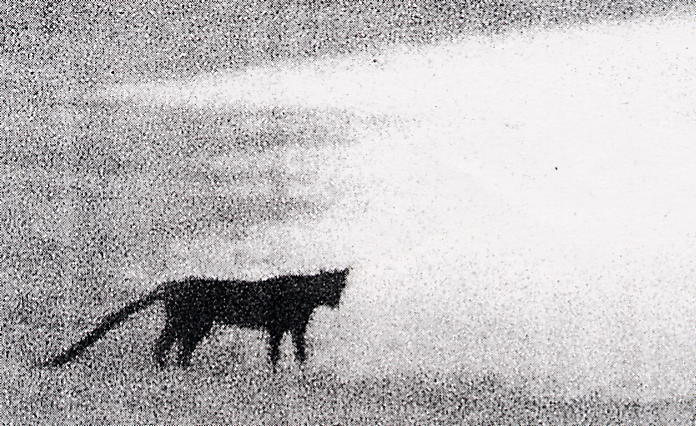
Since we know that many people see (and photograph) black moggies and then tell others that they saw a panther or puma(!) - what are we supposed to think of the Beast of Bodmin?
What are we supposed to think about the Beast Of Bodmin? Well, that it isn't out of the realms of possibilty, even probability, that there was an alien cat or cats responsible for the witness sightings, seeing as alien cats have been known to be roaming around the British countryside. Many eye witnesses, plenty of dead farm animals killed, video footage and pictures, some of the best terrain in the country for such an animal or animals to live. It all adds up to a likely scenario in my opinion.

You say an ex-Royal Marine Commando saw it. Did he receive training on distinguishing moggies from panthers by the military?
You mean you need training to be able to distinguish a moggy from a panther? I think I am quite able to distingish a moggie from a panther thank you LOL. When I visit my local big cat sanctuary, as I often do, and go to the leopard enclosure I don't have to ask the staff if the black leopard (panther) they have there isn't a moggy. I can clearly see that it isn't, even when it is at the back of the enclosure some distance away.

Let me give you another analogy. Do you think all these people would also not be able to tell the difference between a Shetland pony and a racehorse?

Hoaxers are another wildcard. We know they exist because they have been caught. Hoaxers don't need to be released from a cage before roaming the UK countryside.
What do you mean by hoaxers? People dressing up in big cat suits and scaring the local populace? Hey, you know I'm not adverse to the idea of people deliberately releasing their exotic pets into an area already previously known for a legend. Maybe this has happened? Maybe somewhere like Bodmin has been a 'draw' for the odd idiot to release an exotic pet??? If that is what you mean then I am with you.
 
Last edited:
Ok, now let's exmine this elephant theory a little more closely shall we? *snip*

Debating back and forth the merits of the elephant theory is irrelevant in the light of my reasons for mentioning it. You're using semantics to debate the possibilities of inconsistencies, and honestly I have so little invested in the concept, I couldn't care less.

The point is that this theory -- even if you are totally correct in your arguments for why it is a weak one -- is still stronger than any other. If that is still something you cannot comprehend, in spite of what I wrote on the nature of the concept of evidence, then I'm not sure how else I can point out where you're wrong.

The opening post in this thread. I'm not saying that this is the answer. I'm not even saying there is something mysterious in Loch Ness, just that there could be something to all this. I don't see what is so unreasonable or why scoftics get upset about when people say "hmmmmmm, maybe!".

For the same reason as claiming that fairies 'could be' stealing my socks is unproductive. I went through this; making decisions based on inflated confidence in evidence for a claim is wasteful and unproductive in the least, not to say damaging to science.

Quite simple. When there are no eye witness reports and no claims. Then it is quite safe to say it is non existant. There are no eye witnesses to a one eyed, bald, three legged pink baboon stalking the Norfolk Broads. It is safe to say that doesn't exist.

Therefore, a single claim for something is enough to ponder its existence? I seriously don't think you'd believe that.

Again, this evidence (anecdotal observation) is weak, as there are various phenomena that could explain it. I never said there was zero evidence; just that the threshold for determining when something is likely enough to argue in favour of it should be higher than a string of apparent observations and some fuzzy photographs.

That is no more quantifiable than somebody saying "I saw it, it does exist!"

No, it doesn't. Read the follow up post -- I expected that this would be a point of contention.

Do you think it is possible Nessie is some giant freak eel? Eels live a hell of a long time.

I would if it was demonstrated that such giant eels live in the Loch. See how this works? Speculation is nothing until it is supported by evidence.

Ah but that is not the point. Not everyone is a scientist and science isn't always correct. Science is often wrong. Scientists are prone to make some bold pronouncements, only to be proven wrong at a later date. I am not talking about scientific acceptance. Anyways, even scientists disagree.

I'm not even sure where to begin with this. To torture a famous quote, 'You're not even wrong'. Let me just say for the moment that science is a process and not an end result. It cannot be wrong, in that the process itself is self-correcting and ongoing. To go beyond this I would need to take you through the scientific method, and how knowledge accumulates...something that I'm beginning to wonder if it would be worth going through in this instance.

But the Loch Ness Monster, like bigfoot type creatures, does have evidence to support it. How little or how much importance certain scientists and scofics place in that evidence is the bone of contention. Some dismiss it totally. Some don't. In a court of law, multi eyewitness accounts are not dismissed. They are considered as evidence.

Well, there's a can of worms! If you think you've won my favour by suggesting it works in a court of law... man! One reason why out justice system needs an overhaul. Eyewitness accounts are known to be untrustworthy in the least. Open another thread on that if you want me to extrapolate why (just so we don't derail this one).

I've already agreed that evidence does exist -- however, the evidence is so thin, and can be accounted for by other phemonena, that it cannot be used to create confidence in the claim. Have you actually read anything I've written? I'm beginning to think not.

Who said there is abscence of any other material? Some (yes even scientists) suggest there is. Others do not. There is not agreement here. I say there is other material.

Great. Care to point this out?

...but how many people are claiming dinosaurs do still exist today? Are there consistent reports that are suggesting dinosaurs are being spotted?

Define 'consistent reports'. There have been. Do a quick Google for 'dinosaur sightings'. Most are creationist sites, sure, and I'm sure your next argument would be on reliability of eyewitnesses...and we'd end up in a discussion on whose witnesses were more reliable...and you'd miss the irony in it all. So I'll leave it at that -- yes, there are those who claim to have seen dinosaurs in this century.

More reliably (and more likely to be true...although again, only if stronger evidence is provided) are the thylacine sightings in Tasmania. Previously extinct animals are often being sighted; when do you think authorities should declare an apparently extinct species as non-extinct? That's a serious question.

Ok, I'll back down here a bit. Yes I would like bigfoot to exist. I'm sure there is such an animal. My opinion that they do exist is not based of my desire for it to exist though but rather the evidence that persuades me they do exist. I would like King Kong to exist on Skull Island. However, there is no evidence that persuades me King Kong does exist, therefore I do not have the opinion that King Kong does exist, however much I would like him to. I would love Spider-Man to exist and to see him swinging around New York. I don't believe he does exist though. It would be cool if vampires and werewolves existed in Transylvania. I would like them to. I don't believe they do. The Loch Ness Monster and alien big cats in Britain are another matter. It matters not to me if they exist or not. This thread is the first time I have broached these subjects in a long time. I don't lie awake at night thinking about them and wishing and hoping they exist. Well, I know that alien cats in Britain exist so for me there is no wonder to it but Loch Ness? Well, yeah I'm a bit blase.

Cool; no harm in admitting it. And I can't say whether this desire impacts on your belief -- it's not my place to speculate. Yet I do question your ability to scrutinise the validity of evidence, hence why I raised this in the first place.

No, it was more of an attempt at sarcasm than anything else.

It was? I must have missed that.

Where did unicorns come from? Are there scientists seriously looking into the question of unicorns? How about fairies?

If a scientist was seriously looking, would that make a difference to you?

Athon
 
For the same reason as claiming that fairies 'could be' stealing my socks is unproductive. I went through this; making decisions based on inflated confidence in evidence for a claim is wasteful and unproductive in the least, not to say damaging to science.

Now, I'll admit I haven't read this entire thread, but what decisions are you talking about here? Where to go on holiday? Why would it be wasteful and unproductive to go to Loch Ness and look for the monster? And how is it damaging to science?

I realize you're probabably talking in more general terms here, but an example appropropriate to this context would be appreciated. The question raised
I don't see what is so unreasonable or why scoftics get upset about when people say "hmmmmmm, maybe!".
is one that puzzles me as well. Your response doesn't really make much sense to me: wasteful, unproductive and damaging to science? It seems a rather thin excuse for the strong emotions that these discussions seem to generate regularly.
 
Debating back and forth the merits of the elephant theory is irrelevant in the light of my reasons for mentioning it.

So why debate it in the first place? Are you now saying it is 'irrelevant' because you have realised it isn't really going to go the way you'd like it to?

You're using semantics to debate the possibilities of inconsistencies, and honestly I have so little invested in the concept, I couldn't care less.
But you cared enough to bring it up though.:D

The point is that this theory -- even if you are totally correct in your arguments for why it is a weak one -- is still stronger than any other.
Than ANY other? I'm shocked. Is it stronger than the theory that people are simply mistaken or lying? Is the theory of an Indian elephant swimming around in the almost freezing waters of Loch Ness the strongest theory?

For the same reason as claiming that fairies 'could be' stealing my socks is unproductive.
But is it the same reason though? Do fairies exist? Is it likely or even possible they exist? Do eels exist? Yes. Do freak giant eels exist? Possibly. Certain species of fish can grow to freakish lengths. We know that for a fact. Apart from a freak eel, could it be a giant fish? I do not see what is so 'unproductive' about speculating. Speculating can lead to ideas and ideas can lead further. Get my drift?

I went through this; making decisions based on inflated confidence in evidence for a claim is wasteful and unproductive in the least, not to say damaging to science.
Huh? It's 'damaging to science' to speculate if reports of Nessie are influenced by a freak giant eel or giant fish? Man, you are a real party pooper aren't you?:p:D

And who is making 'decisions'? I haven't 'decided' Nessie is a giant freak eel. Im just saying 'maybe'. I find it somewhat of an interesting concept.

Therefore, a single claim for something is enough to ponder its existence? I seriously don't think you'd believe that.
Talk about twist it around. No, I didn't say that at all and you know I didn't.

I would if it was demonstrated that such giant eels live in the Loch. See how this works?
Yes I do see. You have it bass ackwards (as Sweaty Yeti in the Bigfoot threads would put it). You want proof of something before you deem fit to consider the evidence or possibility for that something. Don't worry, now that I have spent a month or so on these boards I am beginning to see a pattern here. Its proof first, possibility/evidence later.:eek:. Well if we have the proof then it is pointless to have the evidence isn't it, becuase we already have the proof!??

Speculation is nothing until it is supported by evidence.
No it is not 'nothing'. It is speculation. Speculation is not 'nothing'. Speculation is 'something', as I have already pointed out.

I'm not even sure where to begin with this. To torture a famous quote, 'You're not even wrong'. Let me just say for the moment that science is a process and not an end result. It cannot be wrong,in that the process itself is self-correcting and ongoing
That's a get out clause if ever there was one. Scientists can be wrong. Scientists are part of science. If you are theorising that science cannot be wrong then it follows that science cannot be right. Both statements would be complete hogwash. Science thought the coelacanth was extinct. Science was wrong.

To go beyond this I would need to take you through the scientific method, and how knowledge accumulates...something that I'm beginning to wonder if it would be worth going through in this instance.
Don't worry, I'm not really all that interested. I can see how you shift the goalposts to support your arguments accordingly.;)

Well, there's a can of worms! If you think you've won my favour by suggesting it works in a court of law... man! One reason why out justice system needs an overhaul.
And that means what exactly???? Because you think your justice system needs an overhaul then it follows that eye witness accounts are not deemed as 'evidence'???

They are.

Eyewitness accounts are known to be untrustworthy in the least.
How about multi eyewitness accounts of the same event? How about when multi eyewitness accounts are consistent and sober? Eyewitness accounts are enough to lock people up.

I've already agreed that evidence does exist -- however, the evidence is so thin, and can be accounted for by other phemonena,
Not all of it can be. See the bigfoot threads.

that it cannot be used to create confidence in the claim.
Says you? But you are using YOUR standards. Plenty of people (yes including scientists and biologists) have enough confidence in the evidence. Others have enough open mindedness to the situation based on the evidence. Do the names Schaller and Goodall ring any bells?

Have you actually read anything I've written? I'm beginning to think not.
Sure I have, but who are you? Who decides that you make the boundaries?

Great. Care to point this out?
Take a look at some of the bigfoot threads.

Define 'consistent reports'.
Ohhhhh let's see. If I take the PNW of the U.S and British Columbia of Canada, for example, there is a high level of consistency in the appearance and behaviour of what people are claiming they have seen, going back a considerable time. These reports are also remarkable in the fact that apart from the appearances of the sasquatches they claim to have sighted, the creatures themselves have behaved most unremarkably, almost mundane with very few dramatic accounts. The witnesses decribe a remarkable looking animal doing unremarkable things. In the main. Though of course, there are exceptions. I would therefore deem most of these reports very consistent.

There have been. Do a quick Google for 'dinosaur sightings'. Most are creationist sites, sure, and I'm sure your next argument would be on reliability of eyewitnesses...and we'd end up in a discussion on whose witnesses were more reliable...and you'd miss the irony in it all. So I'll leave it at that -- yes, there are those who claim to have seen dinosaurs in this century.
Well I know that. My question was are these reports consistent, and are there sufficiently enough good reports to seriously look into it? Do these reports make sense? Do similar reports keep cropping up again and again in the same persuasively consistent manner? Are the dinosaurs similar in appearence? Do they consistenty behave in the same manner? Is there back up 'evidence' (whether you choose to accept that evidence or not) such as tracks that have been cast and examined and suggested by some bona fide scientists as possibly/probably real?

More reliably (and more likely to be true...although again, only if stronger evidence is provided) are the thylacine sightings in Tasmania.
The Thylacine question isn't too much of a quandary in my view since it has only been 70 years since the last one 'supposedly' died. If anybody would seriously argue until they are blue in the face that there are catagorically no more Thylacines left and that everybody who claims to have seen one is a fool, a liar or mistaken (and I am sure there are some people like this) then I would shake my head at them.

Previously extinct animals are often being sighted; when do you think authorities should declare an apparently extinct species as non-extinct? That's a serious question.
I don't know. I'm not a local wildlife authoritarian. I have never pondered the question since in my country most species went extinct a long time ago.LOL.

Cool; no harm in admitting it. And I can't say whether this desire impacts on your belief -- it's not my place to speculate.
All the same, I fail to see how 'desire' makes me believe. Like I said, that being the case I would believe in vampires and werewolves.

Yet I do question your ability to scrutinise the validity of evidence, hence why I raised this in the first place.
But I do scrutinize the validity of evidence. I don't accept all of it. I disregard a lot of it.


It was? I must have missed that.
Obviously.:)

If a scientist was seriously looking, would that make a difference to you?
A scientist? Probably not a scientist. However if a number of scientists, biologists and professionals in other areas were taking a serious look at the subject then yes it would probably make a difference to me. However, on top of this I would also have to study the subject and then see if what they have looked at is also persuasive to me.
 
Last edited:
Now, I'll admit I haven't read this entire thread, but what decisions are you talking about here? Where to go on holiday? Why would it be wasteful and unproductive to go to Loch Ness and look for the monster? And how is it damaging to science?

Yes, that got me too. I couldn't quite fathom why he reacted in that manner. Damaging to science? I can't see it. In actual fact, some of these expeditions to Loch Ness have been very productive for science. Ask Adrian Shine. They have found out a lot more about Loch Ness via these expeditions like Deepscan etc than they ever would have had they not been carried out.
 
making decisions based on inflated confidence in evidence for a claim is wasteful and unproductive in the least, not to say damaging to science.

Why would it be wasteful and unproductive to go to Loch Ness and look for the monster? And how is it damaging to science?

I realize you're probabably talking in more general terms here, but an example appropropriate to this context would be appreciated. The question raised

Hell, I'd go look for monsters in Loch Ness (I kept my eyes peeled at Okanogan in B.C.), but in more general terms, how about the slaughter of people believed to be witches? That's not just a thing of the past. It's going on right now in certain African nations. Extreme, sure, but it demonstrates what belief in faulty "evidence" can lead to. To a lesser degree, people kill snakes, spiders, wolves, bears, big cats, and a whole host of other animals simply because they believe them to be dangerous. Wasteful and unproductive. Witness the hostility of some believers even here on the forum, when challenged to support their claims or demonstrate what they believe to be true.

The damage to science comes when enough of the population is convinced that scientists don't know much about anything (there's always been a sizeable portion of them anyway, but what can you do?). So money for grants or technologies get subverted to faith-based organizations that will teach us to pray to statues or send money to televangelists rather than seek medical treatments. And so on and so on...but that's bleak.
Back to Nessie!
Here she is!!!
 
Hell, I'd go look for monsters in Loch Ness (I kept my eyes peeled at Okanogan in B.C.), but in more general terms, how about the slaughter of people believed to be witches? That's not just a thing of the past. It's going on right now in certain African nations. Extreme, sure, but it demonstrates what belief in faulty "evidence" can lead to.
Not just extreme, but also unrelated to either the context or the question posed. I'm not asking what so bad about believing in such things without sufficient evidence to justify the belief, but what's so bad about going "hmmmmmm, maybe!" in regards to the available evidence for bigfoot or nessie?

The damage to science comes when enough of the population is convinced that scientists don't know much about anything (there's always been a sizeable portion of them anyway, but what can you do?). So money for grants or technologies get subverted to faith-based organizations that will teach us to pray to statues or send money to televangelists rather than seek medical treatments. And so on and so on...but that's bleak.

Not just bleak, but again unrelated to the question at hand unless you seriously expect me to believe that people going "Hmmm...maybe!" about nessie and other such things leads to medical research grants going to Oral Roberts University rather than Johns Hopkins.

In fact, your post pretty much illustrates the point - why do you get upset at the idea that people don't immediately assess the evidence as you do and totally reject the idea of such creatures and instead go "hmmm, maybe"?

Back to Nessie!
Here she is!!!

Cut picture. Any trouble finding an elephant named Nessie? :D
 
I don't get upset if people go "Hmmmm...maybe." I do that too. That's why I've looked at a whole lot of information that's been put forth as evidence, as have many many other researchers. It's just that after I've looked at it, sniffed it, scratched it, weighed it, and measured it, I've gone from "Hmmmmmm maybe." to "Hmmmmmm...probably not."

The only thing I do get upset about is when people ignore or refuse to acknowledge basic facts about purported evidence and continue to put forth unsubstantiated ideas. For example Creationists. They are having an impact on science today. Witness the difficulty of teaching basic evolutionary facts in the classroom. Also the current political stranglehold on medical research, owing largely to strongly belief-driven right-wing officials. http://www.cnn.com/2007/POLITICS/01/11/stem.cell.ap/index.html

Now, backing up a bit and looking at fairies, the Loch Ness Monster and Bigfoot. If people want to believe in them, it's absolutely fine by me. My mother-in-law is quite positive about the fairies that live in her back yard. Hey, to each his/her own. But if they present a footprint, a dung-heap, or a movie of one and try to explain why it's real, that's something else. If it can be determined through careful analysis of the material that it is in all probability not real, then it is to me at least, silly to have it continuously heralded as being authentic proof of said being's existence. Because then, the very solid (or not so solid) evidence itself is open to direct analysis and it's now a scientific rather than belief system.

Monster-fans love to claim that scientists are outraged at the possibility that these things exist and that they'd do their best to hide the facts for fear of embarassment. Nothing could be further fromthe truth. All the researchers I know (as well as me, myself) would LOVE to find really good evidence of a Bigfoot or lake monster or even a good, old-fashioned Thunderbird. Problem is, the closer you look at the evidence, the more it seems to evaporate, like trying to read in a dream.
And finding elephants named Nessie is still easier than finding a good photo of a lake monster;)
 
Last edited:
The trouble is that footprints and movies can both be faked. What's really needed is some fairy scat. :D
 
I'm sorry to interrupt like this, barge in on your conversation here but I must know; and I hope you'll excuse me, I'm just a city boy, a bit of a rube if you will... really, what is this evidence supporting this Loch Ness Monster?

ETA: I just like the way rube sounds.
 
Last edited:
Lots and lots of really great stories and some really questionable photos, movies, and video. Oh, and a sonar blip or two.
 
Now, I'll admit I haven't read this entire thread, but what decisions are you talking about here? Where to go on holiday? Why would it be wasteful and unproductive to go to Loch Ness and look for the monster? And how is it damaging to science?

Excellent question, and one that's come up often. Often, it's asked in a manner of 'is it damaging to believe in nonsense'. I prefer to word it as 'is it damaging to make decisions on beliefs in which you have misinformed confidence in'.

And yes, any decision. But there is a relationship between your level of confidence and the decision you're making.

Say, for instance, the decision is which can of spaghetti you want for dinner. Your confidence in which is the best has been inflated inaccurately by the colourful advertising, hence you believe brand 'A' is best. You choose brand 'A', and have a rather unpleasant meal.

The decision was damaged by confidence that was increased by misleading advertising. Now...should you have researched your decision, looking up surveys on the internet, gaining confidence in your belief in a more productive manner? Hell no -- it's bloody spaghetti! You've changed your belief after one meal and the damage is insignificant.

The more important your decision, and the more wasteful or damaging a bad decision would be, the more rightly confident you should be in your beliefs. How damaging is it that your make a bad decision about holidays? How damaging is it to make a bad decision about something that could save or prolong your life? How damaging is it that you make a bad decision on whether to look for something that is not there?

The damage is indeed relative to the situation; I dare say, spending money on looking for the Loch Ness monster could be better spent on, perhaps, looking for species that could contribute better to our knowledge of biodiversity, or perhaps looking for new organisms that might contribute to medicine. It is damaging to science in that the very problem we have here -- a misunderstanding of how evidence works in conjunction with beliefs -- is further exasperated by people who feel that if people believe it to be true, scientific investigation must continue until that belief is substantiated.

I realize you're probabably talking in more general terms here, but an example appropropriate to this context would be appreciated. The question raised is one that puzzles me as well. Your response doesn't really make much sense to me: wasteful, unproductive and damaging to science? It seems a rather thin excuse for the strong emotions that these discussions seem to generate regularly.

I understand it sounds like that, and appreciate your concern for sounding 'too emotional'. If you've ever read any of my other posts on this forum, it's one thing I'm forever trying to limit on both sides of the argument. Emotions shouldn't drive a debate. I'm not trying to make it sound overdramatic, but there is an inherent danger in having misinformed confidence in a belief.

Athon
 
Last edited:
So why debate it in the first place? Are you now saying it is 'irrelevant' because you have realised it isn't really going to go the way you'd like it to?

No. I'm saying it's irrelevant to debate it, as the reason I brought it up was to demonstrate the difference in strengths of evidence. Even with your arguments of why it is weak, it still has more merit than anything else proposed. The fact you still don't see that is disturbing, although I'm not surprised you choose to ignore the main thrust of the argument.

Than ANY other? I'm shocked. Is it stronger than the theory that people are simply mistaken or lying? Is the theory of an Indian elephant swimming around in the almost freezing waters of Loch Ness the strongest theory?

I stand corrected. Poor choice of words on my behalf.

But is it the same reason though? Do fairies exist? Is it likely or even possible they exist? Do eels exist? Yes. Do freak giant eels exist? Possibly. Certain species of fish can grow to freakish lengths. We know that for a fact. Apart from a freak eel, could it be a giant fish? I do not see what is so 'unproductive' about speculating. Speculating can lead to ideas and ideas can lead further. Get my drift?

Speculation is free until decisions are made on the assumption that they carry more weight.

I've got no problem with people sitting around wondering whether the evidence for the Loch Ness monster is supported by alternative phenomena, including giant eels or friggin' Scotts in monster costumes or elephants or whatever. But to make decisions based on that requires reason to do so. There's little additional reason to assume that giant eels live in the Loch (have giant eels ever been caught in any loch before?). So far, Loch Ness monster can be accounted for by hoaxes, mistaken sightings and exaggerated eyewitness accounts. Until there is additional reason to believe it is caused by something else, all speculation is equal.

Indeed, it could be seals coming into the Loch. Or it could be a species of snake. Or it could be a type of thermocline that creates odd wave forms. Or it could be... Hell, I could keep going, each just as valid as the next without additional reason to support it. The point is, right now, mistakes and lies are the best theories, and without additional evidence, there's no reason to assume it's anything more.

Huh? It's 'damaging to science' to speculate if reports of Nessie are influenced by a freak giant eel or giant fish? Man, you are a real party pooper aren't you?:p:D

And who is making 'decisions'? I haven't 'decided' Nessie is a giant freak eel. Im just saying 'maybe'. I find it somewhat of an interesting concept.

I'm not insinuating that you did. I'm suggesting that making a decision on poor evidence and misinformed confidence is damaging. If you were to actively support an eel-finding mission in the Loch, I'd then say the same thing; until you have good reason to suspect that eels live in the Loch, why waste money going to look?

Talk about twist it around. No, I didn't say that at all and you know I didn't.

It was a question. If you don't believe that, then fine.

Yes I do see. You have it bass ackwards (as Sweaty Yeti in the Bigfoot threads would put it). You want proof of something before you deem fit to consider the evidence or possibility for that something. Don't worry, now that I have spent a month or so on these boards I am beginning to see a pattern here. Its proof first, possibility/evidence later.:eek:. Well if we have the proof then it is pointless to have the evidence isn't it, becuase we already have the proof!??

Who said anything about proof? Proof is a mathematical thing...don't get it confused with science. They are separate entities.

As Soapy said before, the Loch is hardly in an isolated place. I've been there - it's about as populated as it gets in non-urban Scotland. In all that time, nobody has caught, witnessed, seen the impact of or seen a dead giant eel in the Loch. So why are you inspired to continue speculating that it's a giant eel; purely because the possibility of it is enticing? There are better theories.

No it is not 'nothing'. It is speculation. Speculation is not 'nothing'. Speculation is 'something', as I have already pointed out.

Speculation is inspired day dreaming. Necessary in science, indeed, but worthless without an accumulation of evidence. Speculation is free, but starts to cost you when you advance without something more solid.

That's a get out clause if ever there was one. Scientists can be wrong. Scientists are part of science. If you are theorising that science cannot be wrong then it follows that science cannot be right. Both statements would be complete hogwash. Science thought the coelacanth was extinct. Science was wrong.

Nicely ignored. I'll say it again; science is a process. You're right -- it is neither right nor wrong. The knowledge resulting from science is incorporated into models that can be useful. You might think that a useful model is 'right', however that's not technically correct. It's just useful.

Let's say that giant eels are found in the Loch, and your eel model gains credibility. Does that mean that it was these eels the claimants observed? No. It's just that your model is a little more useful in predicting that somebody who sees an eel might mistaken it for something else.

Based on evidence, the coelacanth was extinct. As I said earlier, for all intents and purposes, this model was accurate, if in the long run incorrect. New evidence forced people to change their minds on that. That's how science works.

Don't worry, I'm not really all that interested. I can see how you shift the goalposts to support your arguments accordingly.;)

Really? Well, I'm hardly surprised that any description of how science works wouldn't interest you. It might disrupt your fantasy view of the universe.

And that means what exactly???? Because you think your justice system needs an overhaul then it follows that eye witness accounts are not deemed as 'evidence'???

They are.

How about multi eyewitness accounts of the same event? How about when multi eyewitness accounts are consistent and sober? Eyewitness accounts are enough to lock people up.

I already told you; if you want to seriously discuss the flaws in such a concept, start a new thread. Don't derail this one.

Says you? But you are using YOUR standards. Plenty of people (yes including scientists and biologists) have enough confidence in the evidence. Others have enough open mindedness to the situation based on the evidence. Do the names Schaller and Goodall ring any bells?

'Scientist' is not a card carrying organisation. Any individual with a text book and a pen could call themselves a scientist. It means nothing to appeal to the fact that a scientist might take interest. Does Targ and Puthoff ring any bells?

Sure I have, but who are you? Who decides that you make the boundaries?

Boundaries? What boundaries? I'm explaining the nature of how science works in terms of defining what constitutes evidence. If you don't agree, demonstrate where. If it doesn't suit your theorising, then I can't change that, but don't pretend that you're approaching this scientifically then.

Take a look at some of the bigfoot threads.

You make the claim. You support it. Bad form telling me to look it up for you.

Ohhhhh let's see. If I take the PNW of the U.S and British Columbia of Canada, for example, there is a high level of consistency in the appearance and behaviour of what people are claiming they have seen, going back a considerable time. These reports are also remarkable in the fact that apart from the appearances of the sasquatches they claim to have sighted, the creatures themselves have behaved most unremarkably, almost mundane with very few dramatic accounts. The witnesses decribe a remarkable looking animal doing unremarkable things. In the main. Though of course, there are exceptions. I would therefore deem most of these reports very consistent.

Reports of alien abductions are consistent. Sightings of the Flying Dutchman were consistent. The descriptions of various fairies were consistent. It could mean two things; one, that they were all seeing something that was real and consistent, or two, the phenomena causing them to describe such a thing (including expectation as described in the culture of the community they belonged to) was consistent. The latter is more likely.

Consistency is not strong evidence in absence of anything else.

The Thylacine question isn't too much of a quandary in my view since it has only been 70 years since the last one 'supposedly' died. If anybody would seriously argue until they are blue in the face that there are catagorically no more Thylacines left and that everybody who claims to have seen one is a fool, a liar or mistaken (and I am sure there are some people like this) then I would shake my head at them.

I wouldn't. But then, I remain open to the possibility, just as I remain open to any possibility -- should evidence be presented. Until then, I declare the thylacine extinct. It's really not difficult.

I don't know. I'm not a local wildlife authoritarian. I have never pondered the question since in my country most species went extinct a long time ago.LOL.

Evasion noted. It was a serious question; you're not an authority on wildlife, yet you happily (and rightfully) have an opinion on giant eels existing in the Loch. Surely you have an opinion on when an an organism can be declared extinct.

But I do scrutinize the validity of evidence. I don't accept all of it. I disregard a lot of it.

This is why I think you've intentionally ignored (or, perhaps not understood) what I wrote. I agree that you scrutinize evidence. But your analytical skills and your readiness to overinflate the weight of evidence to gain confidence in a speculation is what is at fault here.

A scientist? Probably not a scientist. However if a number of scientists, biologists and professionals in other areas were taking a serious look at the subject then yes it would probably make a difference to me. However, on top of this I would also have to study the subject and then see if what they have looked at is also persuasive to me.

Very well. Thank you for answering that. The fact that this again is considered strong evidence by your further supports my belief that you have poor evidence analysis skills. Many 'scientists' (and again, being called a scientist grants you no special powers) have supported all manner of odd and wacky things. Their interest only means they also find the notion interesting -- it does not automatically mean the notion is valid nor has merit.

Athon

 
Not just extreme, but also unrelated to either the context or the question posed. I'm not asking what so bad about believing in such things without sufficient evidence to justify the belief, but what's so bad about going "hmmmmmm, maybe!" in regards to the available evidence for bigfoot or nessie?

Like I said earlier, speculation is free. To sit and mull in your own mind -- without doing anything about it -- costs nothing and is fine. But, who really does this?

People talk about it. Your small contribution gives others confidence to add their own speculation. Still, harmless, until that speculation gains confidence through poor thinking skills. Speculation starts to gain ground as more than just a musing, and people confuse it with concepts such as 'theories'.

I'm not suggesting it's quite a slippery slope, but people routinely defer to mass appeal in supporting a belief. Sure, your moment of speculation is fine. And the impact of conversations musing 'what if' is so insignificant, it's laughable to think of it as 'damaging' in any way. Yet en masse, when the population at large find it difficult to know where speculation stops and science begins, it takes its toll on the scientific process.

I'm hardly predicting famine and plague as a result, but ideally people should have a better grasp of how to evaluate evidence.

Athon
 
What do you mean by hoaxers?

Hoaxers are people who create false evidence that they claim was created by the presence of a big cat (usually attributed to "panther" or "puma" in UK). The hoax can take various forms.

People dressing up in big cat suits and scaring the local populace?

That is a really stupid suggestion, but it might actually work.

Hey, you know I'm not adverse to the idea of people deliberately releasing their exotic pets into an area already previously known for a legend. Maybe this has happened? Maybe somewhere like Bodmin has been a 'draw' for the odd idiot to release an exotic pet??? If that is what you mean then I am with you.

We already know that a moggie in the bushes is a panther to some Brits. Releasing your unwanted pet monster feline in Bodmin is a fun scenario to think about. All of the eyewitnesses were completely wrong about there being a beast at Bodmin.... until you released your black jaguar.

Sure, a moggie on a stroll is often photographed and then becomes your inconclusive evidence when featured on a big cat reasearch website. I see a moggie at large. Some of those photos might be of the claimants' own cat. We can't know. They're just moggies on the internet.

Hoax 1: This is a photo of the Beast of Bodmin. It has been declared to be a cardboard cutout.
bodmin%20card%20board%20cut%20out.jpg


Hoax 2: This is a photo of a black panther in a UK forest clearing. It has been declared to be a plush stuffed toy replica of a panther.
Cwmbran%20Big%20Cat%20Photo%20low.jpg


Skeptics are only asking for good functional evidence of existing UK big cats that isn't wrong or hoaxed.
 
Last edited:
Now, I'll admit I haven't read this entire thread, but what decisions are you talking about here? Where to go on holiday? Why would it be wasteful and unproductive to go to Loch Ness and look for the monster? And how is it damaging to science?

I realize you're probabably talking in more general terms here, but an example appropropriate to this context would be appreciated. The question raised is one that puzzles me as well. Your response doesn't really make much sense to me: wasteful, unproductive and damaging to science? It seems a rather thin excuse for the strong emotions that these discussions seem to generate regularly.

Excellent question, and one that's come up often. Often, it's asked in a manner of 'is it damaging to believe in nonsense'. I prefer to word it as 'is it damaging to make decisions on beliefs in which you have misinformed confidence in'.

A lucid and logical response, but I notice you have to reword my question substantially in order to give that logical and rational response. I was not asking about believing in unproven things or about making decisions based on those beliefs. The only part that relates to my original question is below:

The damage is indeed relative to the situation; I dare say, spending money on looking for the Loch Ness monster could be better spent on, perhaps, looking for species that could contribute better to our knowledge of biodiversity, or perhaps looking for new organisms that might contribute to medicine. It is damaging to science in that the very problem we have here -- a misunderstanding of how evidence works in conjunction with beliefs -- is further exasperated by people who feel that if people believe it to be true, scientific investigation must continue until that belief is substantiated.

While I can understand your feeling that way, I hope you can understand that given the small amount of public funds allocated for such endeavors and the fact that you and I would no doubt differ in many particulars regarding the priority of various research projects, I don't consider that much support for your statement of "wasteful, unproductive and damaging to science".

I understand it sounds like that, and appreciate your concern for sounding 'too emotional'. If you've ever read any of my other posts on this forum, it's one thing I'm forever trying to limit on both sides of the argument. Emotions shouldn't drive a debate. I'm not trying to make it sound overdramatic, but there is an inherent danger in having misinformed confidence in a belief.

Actually you do quite well. I've been meaning to compliment you on your posts in the skeptics need to grow up thread. You brought up some good points I hadn't considered before and stayed calm despite the emotionally charged content of many of the posts. I've given up on that thread, but read it for several pages just to see what you had to say. I ended up putting slimething on ignore as a result of that thread. It was too tedious just to scroll though his rants.

Like I said earlier, speculation is free. To sit and mull in your own mind -- without doing anything about it -- costs nothing and is fine. But, who really does this?

People talk about it. Your small contribution gives others confidence to add their own speculation. Still, harmless, until that speculation gains confidence through poor thinking skills. Speculation starts to gain ground as more than just a musing, and people confuse it with concepts such as 'theories'.

I'm not suggesting it's quite a slippery slope, but people routinely defer to mass appeal in supporting a belief. Sure, your moment of speculation is fine. And the impact of conversations musing 'what if' is so insignificant, it's laughable to think of it as 'damaging' in any way. Yet en masse, when the population at large find it difficult to know where speculation stops and science begins, it takes its toll on the scientific process.

I'm hardly predicting famine and plague as a result, but ideally people should have a better grasp of how to evaluate evidence.

Athon

I can agree with your last paragraph, but not much else. The "damage" you are discussing is pure speculation. I could just as easily speculate that investigating such things is beneficial to science and well worth it's cost just for the public relations aspect of it.

You worry about the population doesn't know when speculation stops and science begins. Areas that are of great interest, such as nessie, are also a wonderful opportunity to draw people into discussion about it and illustrate such concepts.
 

Back
Top Bottom