LIGO gravitational wave announcement

The wavelength is much larger than the detector size, but this doesn't mean that orientation is irrelevant. Think about an incident (polarized) long wavelength electromagnetic wave (instead of a gravitational wave), and assume your linear antenna is perpendicular to the electric field of this e-m wave, you get no signal. Now assume the antenna is parallel to the E-field: you can get a signal, even if your antenna is small compared to the wavelenth (think e.g. of a portable radio receiver receiving in the medium wave band at 360 m https://en.wikipedia.org/wiki/Medium_wave).

I take your word for it. My mental analogy was a pressure change under a long wave tsunami, where a pressure detector that was insignificant in size to the wave would register the same change regardless of orientation. I assume that is too simplistic.

ETA: Is it really right to equate electromagnetic energy with space distortion. The former is something that can be captured in various ways. Is the latter?
 
Last edited:
I take your word for it. My mental analogy was a pressure change under a long wave tsunami, where a pressure detector that was insignificant in size to the wave would register the same change regardless of orientation. I assume that is too simplistic.

ETA: Is it really right to equate electromagnetic energy with space distortion. The former is something that can be captured in various ways. Is the latter?

My logic went along the lines of "If we (they) can measure displacements of fractional-proton diameters, then we (they) are not going to consider something hundreds or thousands of meters long as a point"

Even though, in terms of the vastness of the Universe, even a frigging galaxy is pretty much a point...
 
"ripples in the fabric of space and time." Nice words, but no human being can really grasp what it means. No scientist can grasp: a big bang, spacetime, quantumphysics, singularities etc. You think you understand these things because you gave it a fancy name. It is beyond our human capacity to actually understand what's going on in this world on these levels. ;)
Your personal incredulity does not negate any of these that others can comprehend.

I cannot visualise 4D objects and therefore cannot quite grasp the concept.
This does not negate 4D Euclidian space.
 
Fermi detected a Gamma-Ray burst 0.4 seconds after the event from the same location.

With an instantaneous view of 70% of the sky, the Fermi Gamma-ray Burst Monitor (GBM) is an excellent partner in the search for electromagnetic counterparts to gravi- tational wave (GW) events. GBM observations at the time of the Laser Interferometer Gravitational-wave Observatory (LIGO) event GW150914 reveal the presence of a weak transient source above 50 keV, 0.4 s after the GW event was detected, with a false alarm probability of 0.0022. This weak transient lasting 1 s does not appear connected with other previously known astrophysical, solar, terrestrial, or magnetospheric activity. Its localization is ill-constrained but consistent with the direction of GW150914. The duration and spectrum of the transient event suggest it is a weak short Gamma-Ray Burst arriving at a large angle to the direction in which detector response is not optimal. If the GBM transient is associated with GW150914,this electromagnetic signal from a stellar mass black hole binary merger is unexpected.
http://gammaray.nsstc.nasa.gov/gbm/publications/preprints/gbm_ligo_preprint.pdf
 
...the answer I quoted does appear to address your question. Here it is again:
Now assume that we are 2 m (~6.5 ft) tall and floating outside the black holes at a distance equal to the Earth’s distance to the Sun. I estimate that you would feel alternately squished and stretched by about 165 nm (your height changes by more than this through the course of the day due to your vertebrae compressing while you are upright).


Did you have something else in mind when you said "relatively close"? Did you have something else in mind when you said "noticeable effects"?

Tidal affects are dependent upon the size of the region under consideration. A ~2m tall person occupies a considerably smaller region than a planet or star. Similarly you won't see much affects from the tides on earth on the body of a human, but they certainly do have an affect on the oceans.

So, the fact that at that distance the gravitational waves wouldn't have a noticeable affect on a human body doesn't say much about how they would affect an object the size of a planet or star.
 
Fermi detected a Gamma-Ray burst 0.4 seconds after the event from the same location.

Which is interesting not least because it tends to refute the claims of the deniers. According to their model, anything that goes against the preferred scientific orthodoxy is carefully suppressed; yet this gamma ray burst, which doesn't fit into what's expected, is being published because it's actually a very interesting result, and may well lead to some new understanding.

Dave
 
I take your word for it. My mental analogy was a pressure change under a long wave tsunami, where a pressure detector that was insignificant in size to the wave would register the same change regardless of orientation. I assume that is too simplistic.

ETA: Is it really right to equate electromagnetic energy with space distortion. The former is something that can be captured in various ways. Is the latter?
If you rotate the antenna of your radio or television receiver, you get variable levels of signal, and the same is qualitatively true for gravitational waves detectors (though perhaps not quite as pronounced), they are also directional: if you could rotate the two long arms of a gravitational waves detector while a remote astrophysical source is emitting, you would observe also the signal level varies.
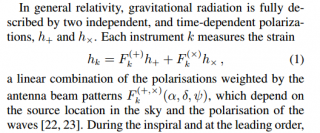
Now, if you want to see a reliable source, I can propose you this quote from the Ligo and Virgo collaborations:

(taken from: "Properties of the binary black hole merger GW150914",
The LIGO Scientific Collaboration and The Virgo Collaboration
(compiled 12 February 2016), http://arxiv.org/pdf/1602.03840v1.pdf ).
Assume for example that the remote astrophysical object emits gravitational waves with "+" polarization. Then, from equation (1), you get:
h(detector k) = F(detector k,+)h+
F(detector k,+), which expresses the directional nature of the detector, depends upon the position of the astrophysical object in the sky, so you can in principle try to use your knowledge of the signal amplitude physicists see h(detector k) to determine the source location. This is, however, difficult because the polarization of the celestial object is a priori unknown.
 
Last edited:
If you rotate the antenna of your radio or television receiver, you get variable levels of signal, and the same is qualitatively true for gravitational waves detectors (though perhaps not quite as pronounced), they are also directional: if you could rotate the two long arms of a gravitational waves detector while a remote astrophysical source is emitting, you would observe also the signal level varies.
Now, if you want to see a reliable source, I can propose you this quote from the Ligo and Virgo collaborations:

I take your word for it this time too. Thanks.
 
Fermi detected a Gamma-Ray burst 0.4 seconds after the event from the same location.
0.4 seconds seems quite a significant time gap between the two events if they are related- the actual event only lasted around 200ms and there wasn't expected to be much EM released. I don't think the distance between the detectors and Fermi can account for this delay.
 
0.4 seconds seems quite a significant time gap between the two events if they are related- the actual event only lasted around 200ms and there wasn't expected to be much EM released. I don't think the distance between the detectors and Fermi can account for this delay.

However gamma rays can take a non direct path over a billion light years distance which can account for a time delay.
 
0.4 seconds seems quite a significant time gap between the two events if they are related- the actual event only lasted around 200ms and there wasn't expected to be much EM released. I don't think the distance between the detectors and Fermi can account for this delay.

Keep in mind that over sufficiently long distances, electromagnetic radiation does not actually travel at c. c is the speed of light in vacuum -- in any other transparent medium light travels more slowly. Speed of light in air is about 299,700 km/s (90 km/s slower than c); in water it is about 2/3 c, and in glass 1/3 c. Interstellar space is the best vacuum in existence, but it is still not completely empty, so light travels through it a tiny, tiny bit slower than c -- and there are things which can overtake it. IIRC, neutrinos from supernova S1987A arrived on Earth 12 seconds before the light did.

Now, the above figures are for visible light. Gamma rays are far less affected by the medium through which they travel, but then, LIGO event is more than 7,000 times farther away than S1987A. If gravitational waves travel exactly at c, it is not inconceivable that associated gamma rays got delayed by 0.4 second in the course of 1.3 billion years.

I believe the primary reason for "delay" of electromagnetic radiation is because it can take the long way due to gravity wells along the way, not some medium it passes through.
 
I believe the primary reason for "delay" of electromagnetic radiation is because it can take the long way due to gravity wells along the way, not some medium it passes through.
Do gravitational waves get delayed by gravity wells?
 
Keep in mind that over sufficiently long distances, electromagnetic radiation does not actually travel at c. c is the speed of light in vacuum -- in any other transparent medium light travels more slowly. Speed of light in air is about 299,700 km/s (90 km/s slower than c); in water it is about 2/3 c, and in glass 1/3 c. Interstellar space is the best vacuum in existence, but it is still not completely empty, so light travels through it a tiny, tiny bit slower than c -- and there are things which can overtake it. IIRC, neutrinos from supernova S1987A arrived on Earth 12 seconds before the light did.

Now, the above figures are for visible light. Gamma rays are far less affected by the medium through which they travel, but then, LIGO event is more than 7,000 times farther away than S1987A. If gravitational waves travel exactly at c, it is not inconceivable that associated gamma rays got delayed by 0.4 second in the course of 1.3 billion years.

From Wiki it seems that in supernovae the neutrinos arrive earlier as they are not impeded by the material surrounding the collapsing star, whereas EM has to pass through this opaque material and is delayed through scattering. This is the case for visible light, I'm not sure if it applies to high-energy EM.

Perhaps the source of the gravitational waves is surrounded by material and the gamma rays are being generated by this material rather than the black holes themselves, and the delay is caused by the spacial distribution of the surrounding material.
 
Perhaps the source of the gravitational waves is surrounded by material and the gamma rays are being generated by this material rather than the black holes themselves, and the delay is caused by the spacial distribution of the surrounding material.

this makes all sorts of sense tho what "sense" can be made of forces at this scale remains to be discovered....we have a start tho.

If a gamma burst turns out to be associated with gravitational wave generation each time that adds an interesting twist plus additional information on the event.

Another one who knew it was real early on...

27
INTERVIEW 15 February 2016
I was one of the first to know gravitational waves are real
Matthew Evans is responsible for placing fake signals into LIGO data to test the system - so he knew right away that the gravitational wave signal wasn't a test

https://www.newscientist.com/articl...e-first-to-know-gravitational-waves-are-real/
 
Last edited:

ISF - Join now!

Every member here is approved by hand. No bots, no spam, just people who care about evidence and honest debate.

Membership is free!

Create your free account

Back
Top Bottom