
-
Security incident: ISF was recently accessed by intruders. Please change your password, and change it anywhere else you used it. Read more
You are using an out of date browser. It may not display this or other websites correctly.
You should upgrade or use an alternative browser.
You should upgrade or use an alternative browser.
LED lights and dimmer switches
- Thread starter Matty1973
- Start date
-
- Tags
- led lights
macdoc
Philosopher

. The only drawback is that they run on DC (they also get hot, but that's too be expected given they are essentially concentrated light)

I suggest your tinkering is not very "hands on"
We have been running LEDs in the office for several years now - we mix halogens and LEDs and you would not dare touch a halogen whereas you can put your fingers on an LED all day.
Heat is waste -
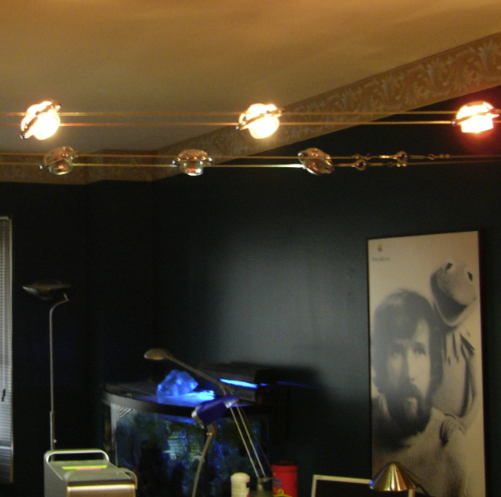
Front lights are halogen - lots of wasted light and heat - rear are LEDs - all light goes down to the work surface.
Lumens are similar but not as high yet on the LEDs and cost is 10x but they never burn out ( in practical terms )
We could light the entire office for 16 watts - and almost zero heat ( one of the goals )
We use 3 watt LED task lamps for all the work benches where we need intense light.
One pair of 3 watt LED will light a 120 gal fish tank easily. Even one is sufficient.
This field is changing very rapidly and a few of our clients are engaged on a Pro lighting basis for events so we tend to keep track and get deals on them.
We will replace the halogen overheads with LED when the next deal comes along.
But heat?? not a chance. :garfield"
Halogen 35W Bulb Replacement
Our 3W MR16 halogen replacement is as bright as 35W bulb. Cool to the touch, emits virtually no heat. Main benefit is low power consumption of 3W and average operating life of 50,000 hrs. Zero maintenance, no need to replace bulbs every 3 months as with regular halogen lights. Comes in a sleek silver chrome package, standard MR16 GU5.3 base. Operates from 8.5V-17V DC/AC, no transformer required.
I don't know if anyone has mentioned it here yet, but there are LED bulbs now that have a dimmer built into the base. You use a remote control to dim them. Some of these can also change color via the remote (I assume they have red, green, and blue diodes in them). I think the ones that change color and dim via remote can be had for as little as $30 to $35.
The other alternative for dimming LED's involve installing a different type of dimmer in your fixtures.
-Bri
The other alternative for dimming LED's involve installing a different type of dimmer in your fixtures.
-Bri
Last edited:
"Considering that they'll last 25 years instead of the half year or so that 50 cent incandescents last, ..."
Either you are exaggerating, or you are buying really bad incandescent bulbs. I have a number of incandescents that that have lasted over ten years at low duty (closet lights) and others that I have only replaced 2 to 3 times in 13 years at medium duty (so call it 4 to 6 years life).
It became environmentally friendly to misstate the length of life (relative) of Incandescent and fluorescent bulbs (as opposed to fluorescent tubes which actually do have long lives BUT are tubes) some years ago to justify their price. I have had NONE which lasted close to as long as most incandescents (and they cost, of course, much more). I realize this is anecdotal, but I would love for someone to note any electrical condition my house could have that would make that reasonable.
macdoc
Philosopher
I think the ones that change color and dim via remote can be had for as little as $30 to $35
These would be very low lumen output purely for accent lighting.
A decent output Halogen replacement goes as high as $110.
CaveDave
Semicentenarian Troglodyte

I'm not a nic nazi so feel free. If I had to write my username that's what I would use.

They are bright. Not laser bright, but bright enough to do damage. The warnings on the package are to be taken seriously. Trust me it hurts in a weird "Oh, that wasn't good" kinda way.
OK. I know what you mean. The newer ones CAN be brighter than is comfortable to look at.
If you google "LED IR remote RGB strip" you'll find it. I'd link it but I don't know about the new forum rules and what not. It's just a little PCB inside with a few chips on it. I've opened it up and there's not much to it.
Not sure which of the several results you are intending.
BTW, I cannot IMAGINE that that new rule precludes merely posting a link or making (positive or negative) comments about a particular commercial product. I might be mistaken, but I interpret it as a change designed to stop overt ABUSE of the forum, which I have seen on other fora, but not here (or, perhaps I just failed to see it, since I so seldom go anywhere other than SMM&T
 )
)Perhaps, any nearby moderator (hint, hint) could clarify?
Not me, I just modified it a bit to work with a different power supply. Nothing near as complex as you're thinking.
The flashlights. They use buck/boost drivers depending on the battery set-up. If you're running 3x18650 Li-po in series you need a buck driver for all the LED's on the market, I don't think anyone of them can handle the 16.6V from fully charged batteries.
Almost all of the drivers come with a microcontroller that handle the modes, low,medium,high, strobe, SOS or some combination therein. There are a few drivers that have 16 or 20 functions. As far as I know they vary in the percentage of the current to the LED. Basically on one mode low is 10%, medium is 20% and high is 100%, on another mode low is 5%, medium is 40% and high is 100%.
So dimming on the flashlights is handled by separate modes. There's only a few flashlights that have a built in resistor? that allows for typical resistance dimming (I think I have that right)
But, from what I gather you can use the same high power LED's for residential lighting as well. You can either go with a direct drive, or you can use a buck driver and an LED. I think however in residential lighting with multiple LED's you would have to go with a direct drive and use a variable power supply. Otherwise I don't think you can use the driver as a dimmer, there's no way to access the modes
Clear as mud?
You finally got it through my Adamantine skull,

Yes, buck is good for higher than needed input voltage, Boost for lower, Buck/boost for wider range.
Those multifunction products are very nice. They have the advantage of adding new functions simply by software (at the factory) w/o having to re-design the hardware. Versatile. Most of them vary the brightness using using PWM as opposed to current control - MUCH better efficiency.
While it is easy (as in: no-engineering-needed) to use a potentiometer to control brightness, it wastes a LOT of power (low efficiency) and requires hefty, expensive, "ugly" pots. same for "linear" regulators/transistors - MUCH more elegant and efficient to go switchmode (digital) - tiny microcontroller does all the clever things (like buck/boost, dimming, SOS, random flash, automatic shutoff, etc.), a relatively small transistor (MOSFET) handles the heavy lifting (power switching) with minimal losses since it in only ON or OFF, perhaps a handful of TINY discretes (capacitors, resistors, inductors, etc.), only a few (or even 1) interface devices (switch, pot, encoder, etc.) that are also TINY because they only control SIGNALS without significant current.
Home-brewing w/ analog for a one-off or a few might be justifiable, But I cannot imagine any sane engineer TODAY using that for any commercial product. There is just too much downside and and no benefit, IMHO. (This coming from the hard-headed designer who previously preferred analog, 7400 TTL, and wire-wrapping
 - but I FINALLY came (slowly and belatedly) to my senses.
(I wish I could show people the 12" X 16", 25 chip, mixed analog/digital SSI/MSI Abomination that I insisted on in the mid 1980s that could have even then been done on a 4" X 4" card with a microprocessor and a few support chips. BOY, was I an idiot back then.
 )
)l
ol, I admitted in another thread on CFL's that I refused to have one in the bathroom. Nothing like waking up to a green and purple monster every morning. When my last incandescent burned out I gave in a put a CFL in the bathroom. I'm getting used to it.
I honestly believe however that the new LED's are much better. I'm curious how they would compare but haven't seen anything yet.
Cheers,
Dave
These would be very low lumen output purely for accent lighting.
A decent output Halogen replacement goes as high as $110.
For $30 - $35, yes. There are brighter ones that cost more than that.
-Bri
Furcifer
Guest

- Joined
- Apr 30, 2007
- Messages
- 13,797
While it is easy (as in: no-engineering-needed) to use a potentiometer to control brightness, it wastes a LOT of power (low efficiency) and requires hefty, expensive, "ugly" pots. same for "linear" regulators/transistors - MUCH more elegant and efficient to go switchmode (digital) - tiny microcontroller does all the clever things (like buck/boost, dimming, SOS, random flash, automatic shutoff, etc.), a relatively small transistor (MOSFET) handles the heavy lifting (power switching) with minimal losses since it in only ON or OFF, perhaps a handful of TINY discretes (capacitors, resistors, inductors, etc.), only a few (or even 1) interface devices (switch, pot, encoder, etc.) that are also TINY because they only control SIGNALS without significant current.
Home-brewing w/ analog for a one-off or a few might be justifiable, But I cannot imagine any sane engineer TODAY using that for any commercial product. There is just too much downside and and no benefit, IMHO. (This coming from the hard-headed designer who previously preferred analog, 7400 TTL, and wire-wrapping
Interesting. I actually learned a bit today.
Not enough to fully understand how everything works, but closer realizing how an LED DC set-up might work and why there are so many options.
I think in a commercial application, say a floor of cubicle lighting, you could use one of these to drive about 10 high powered CREE XM-L emitters and use about 5 of these dimmers?
I'm not sure off hand how much area could be covered using this (assuming I've got it paired right) set-up, but it would run you about $150. (based on what I've seen of these emitters this would cover about 500 sqrft, just guessing)
Does this sound about right? At least as far as the electronics go. I haven't included the cost of the fixtures but they are minimal from what I've seen, perhaps as little as $5 each.
CaveDave
Semicentenarian Troglodyte
Looking into the more heavy duty style dimmers I see they use pulse width modulation. I'm assuming that's how it's accomplished on the smaller units as well.
The Old designs used phase-angle triggering (60 or 120 times / sec) that used a variable "delay" into each (half) cycle, but the waveform was using the sinusoid and chopping off some amount of the first part, limiting the energy throughput. This could be loosely referred to as a rudimentary form of pulse width modulation, but it would be a stretch.
I am not aware of what NEWER units use (I just never have had one in my hand to open and look.
), but I would not be surprised if they had gone to a more up-to-date design. True PWM (alternate, positive and negative variable width pulsesof 120 V each at 60Hz MIGH be usable, but there might be issues with harmonics or if anything other than resistive loads were connected (of course, phase angle dimmers would be nearly as bad  ) Induction motors might gag on that diet, but they aren't too happy with the old-type, either. I will have to think about or research further (in my abundant spare time).
That hypothetical design looks like it might be "friendlier" to LED type lamps (I guess they are built w/ a bridge rectifier at least, and might even have active devices to limit current - I don't know; never held one in my hand) and CFLs of my acquaintance use across-the-line rectifiers, so they could easily be designed to function happily on pulses and to "automagically" sense the pulse width and adjust the brightness to match. I bet they don't like phase angle feed all that much.
Educate me if you have better info...
Cheers,
Dave
CaveDave
Semicentenarian Troglodyte
I don't know if anyone has mentioned it here yet, but there are LED bulbs now that have a dimmer built into the base. You use a remote control to dim them. Some of these can also change color via the remote (I assume they have red, green, and blue diodes in them). I think the ones that change color and dim via remote can be had for as little as $30 to $35.
There are also "3-way" CFLs that fit table lamps and such made for 3-way bulbs; button, ring, and shell of standard Edison base. I, however class these as "exotics", in that are attempts to accommodate (read: shoehorn) new technology into existing, old style infrastructure that was designed 100+ Years ago. This must almost have to be done, because the upheaval and disruption could not be tolerated (imagine if vehicles were to suddenly {who knows why?}, because of some 'improvement", require 6' more road width, and anything narrower could no longer me produced; instant chaos). Observe the fact that (at least in the US), virtually every television signal is Digital and HD. Perhaps billions of "installed base" NTSC (which "standard" has it's own history of "kludges" to shoehorn color and stereo audio into a system that was never intended to allow those) so there are now NTSC adapter boxes to tide folks over until no more "old" sets are still used. Another example is the kludging in progress to migrate us from IPv4 (current, old-school internet) to IPv6 so that there wil be enough address space to last us a few more years.
The other alternative for dimming LED's involve installing a different type of dimmer in your fixtures.
-Bri
Yup, and therein lies my (intended) point!
Cheers,
Dave
Furcifer
Guest
- Joined
- Apr 30, 2007
- Messages
- 13,797
I suggest your tinkering is not very "hands on"
We have been running LEDs in the office for several years now - we mix halogens and LEDs and you would not dare touch a halogen whereas you can put your fingers on an LED all day.
lol, you obviously don't know anything about the new LED's. At 3A the XM-L get's hot enough to burn the paint off the emitter base in a few seconds. CREE recommends you don't run them without proper heat sinking for more than 5 seconds. The old style P60 drop-ins they were using a couple years ago don't have enough surface area to dissipate the heat the new emitters generate.
http://www.dhgate.com/trustfire-x6-sst-90-2300lm-5-mode-18650-led/p-ff8080812c3055c1012c399454c76f9e.html
Check out the heat fins on this sst-90 flashlight. They're there for a reason
mhaze
Banned

- Joined
- Jan 10, 2007
- Messages
- 15,718
So? You too are now joining the crowd of people aggraveated at those darn noodle bulbs. You know you want to shuck them, just do it.Well the flaw in my plan was waiting for my CFL's to 'burn out'. They haven't in almost five years now. The only ones that have are the ones directly above the bathroom sink......
CaveDave
Semicentenarian Troglodyte
Interesting. I actually learned a bit today.
I am HAPPY for you!
As a life-long LOVER of knowledge, gaining it for myself or sharing it with others, I am pleased for you and proud if I was able to help.
Seriously happy. (This makes an otherwise unbearably horrid month count for something!)Not enough to fully understand how everything works, but closer realizing how an LED DC set-up might work and why there are so many options.
If you EVER find someone who REALLY does (as opposed to thinking they do), you should take a photo. Many of them. Document your discovery, because you won't get many chances...
Those sure look like good choices (though I only looked briefly - didn't study the specs.
I'm not sure off hand how much area could be covered using this (assuming I've got it paired right) set-up, but it would run you about $150. (based on what I've seen of these emitters this would cover about 500 sqrft, just guessing)
Does this sound about right? At least as far as the electronics go. I haven't included the cost of the fixtures but they are minimal from what I've seen, perhaps as little as $5 each.
Perhaps that will work.
IIRC, Lighting Engineers want there to be certain light levels at different levels of the room, and that varies hugely depending on the intended use of the space. I recommend researching and get or make a usable lightmeter (even if not "standards compliant" it would be adequate for comparative purposes).
Cheers,
Dave
Last edited:
CaveDave
Semicentenarian Troglodyte
...
http://www.dhgate.com/trustfire-x6-sst-90-2300lm-5-mode-18650-led/p-ff8080812c3055c1012c399454c76f9e.html
Check out the heat fins on this sst-90 flashlight. They're there for a reason
Hoo-Eeeeee!
Man,... at that price someone would have to have a REALLY important use for a flashlight!

Dave
Furcifer
Guest
- Joined
- Apr 30, 2007
- Messages
- 13,797
IIRC, Lighting Engineers want there to be certain light levels at different levels of the room, and that varies hugely depending on the intended use of the space. I recommend researching and get or make a usable lightmeter (even if not "standards compliant" it would be adequate for comparative purposes).
Cheers,
Dave
Yes they do. I actually have a book around here somewhere that gives the specs (it's from the International Lighting Engineering Institute or something to that effect) It was part of an energy auditing course I took. I forget what unit it was given in, lumen or lux or watts. They have a pretty detailed breakdown for entry ways, work spaces, hallways etc.
In looking this up I see a 100W incandescent gives off about 1750 lumen. That's equivalent to about 2 of these XM-L emitters, which I've got for as little as $6 each. There are other multi-die emitters like CXA2011
that give off more light, around 2500 lumen and will run you about $16.
If the low voltage DC was there it would be a no brainer, LED's all the way. That's why I think this is where the industry is headed.
For home use, these $5 IR controllers are pretty handy. If you DIY it a bit you can do some pretty neat stuff IMO (you can run 3 lights off of 1 box, there's a Red channel a Green channel and Blue channel). Plus the remotes all work on the same frequency. Grab a remote, point it at the light and Bob's your uncle. I think you can do this with your normal AC as well but it's going to cost you.
Hoo-Eeeeee!
Man,... at that price someone would have to have a REALLY important use for a flashlight!
Dave
Yah eh? I just recently got interested in the LED flashlights (I call them torches now, something primitive about it
), but it's my understanding from what I've read over at the candle power forum that this is fairly reasonable for a torch. Some of the torches are upwards of $600! I've got a limit of $25. These days however $25 get you one heck of a torch. Not 2300 lumen mind you, but 1000 lumen is good enough for me.mhaze
Banned
- Joined
- Jan 10, 2007
- Messages
- 15,718
those are tactical ops lights, blind the bad guy and maybe there won't be shooting....Hoo-Eeeeee!
Man,... at that price someone would have to have a REALLY important use for a flashlight!
Dave
excaza
Illuminator

- Joined
- Nov 19, 2007
- Messages
- 3,593
But heat?? not a chance. :garfield"
Perhaps you should do some investigation before mocking the statements of others. The primary reason LEDs have taken so long to become viable for household use (costs aside) is because they generate too much heat, particularly when used in recessed fixtures. While not necessarily 'hot' to the touch like incandescents or halogens, this significantly impacts the useful lifespan of the bulbs. This is why all LED bulbs and other high-wattage LEDs come with heat sinks, and only recently reached a point where they could be effectively used in recessed fixtures.
Last edited:
macdoc
Philosopher
Let's see 35 watt halogen and 3 watt LED - care to compare heat signatures?
ALL high wattage devices will produce heat - LEDs produce far less for their lumen.....which is the reason they are efficient. Because they are small they still need to radiate waste heat and their circuits are subject to premature failure if they do not - hence the recessed issue.
They are pitched as comparatively no heat for good reason. Even a CFL base gets hot in an enclosed space.
As lumens and wattage climb on LEDs so will heat ....but no where close to halogens.
We have 4 years with LEDs in our office.....I am using one now and looking at a dozen others of various generations.
One reason we have them is to reduce heat in an office with a lot of computers.
Try actually using the technology you want to comment on and supporting your argument instead of misguided defense of someone who made a bald statement that was wrong
ALL high wattage devices will produce heat - LEDs produce far less for their lumen.....which is the reason they are efficient. Because they are small they still need to radiate waste heat and their circuits are subject to premature failure if they do not - hence the recessed issue.
http://blog.pegasuslighting.com/2011/02/3-myths-about-led-lighting/All light sources generate heat, so don’t let anyone tell you that LEDs are an exception to the rule.
It is true that LEDs do not emit as much heat as other sources of light: that’s because they are so energy efficient. However, LED fixtures still need to be designed to dissipate heat; otherwise, they will fail prematurely.
Where did this common misconception stem from? LED fixtures feel cool to the touch as long as they’re designed properly. As you can see in the photo, it’s even safe for a baby to hold a lit LED!
They are pitched as comparatively no heat for good reason. Even a CFL base gets hot in an enclosed space.
As lumens and wattage climb on LEDs so will heat ....but no where close to halogens.
We have 4 years with LEDs in our office.....I am using one now and looking at a dozen others of various generations.
One reason we have them is to reduce heat in an office with a lot of computers.
Try actually using the technology you want to comment on and supporting your argument instead of misguided defense of someone who made a bald statement that was wrong
excaza
Illuminator
- Joined
- Nov 19, 2007
- Messages
- 3,593
So, you said exactly the same thing I did, but I was wrong. Perhaps you should do some reading for comprehension instead of leaping at the opportunity to be a condescending prick.
I never said otherwise, but this was not your original argument.They are pitched as comparatively no heat for good reason. Even a CFL base gets hot in an enclosed space.
As lumens and wattage climb on LEDs so will heat ....but no where close to halogens.
Last edited:
CaveDave
Semicentenarian Troglodyte
Yes they do. I actually have a book around here somewhere that gives the specs (it's from the International Lighting Engineering Institute or something to that effect) It was part of an energy auditing course I took. I forget what unit it was given in, lumen or lux or watts. They have a pretty detailed breakdown for entry ways, work spaces, hallways etc.
Cool! I thought I remembered that right, but it has been [mumble-mumble] years since I flipped through one of those textbooks. Nice to know I got close.

In looking this up I see a 100W incandescent gives off about 1750 lumen. That's equivalent to about 2 of these XM-L emitters, which I've got for as little as $6 each. There are other multi-die emitters like CXA2011
that give off more light, around 2500 lumen and will run you about $16.
If the low voltage DC was there it would be a no brainer, LED's all the way. That's why I think this is where the industry is headed.
Pretty cool. I see there are PDF datasheets there, too, that I will download.
ISTR that Cree made something similar (earlier version) several years ago that had a copper-core circuit board for thermal coupling (to heat sink). Are they still doing that w/ these higher power modules?
For home use, these $5 IR controllers are pretty handy. If you DIY it a bit you can do some pretty neat stuff IMO (you can run 3 lights off of 1 box, there's a Red channel a Green channel and Blue channel). Plus the remotes all work on the same frequency. Grab a remote, point it at the light and Bob's your uncle. I think you can do this with your normal AC as well but it's going to cost you.
Now that the initial "fear, uncertainty, & doubt" since the Rule change has passed
, will you post a link for that, please?Yah eh? I just recently got interested in the LED flashlights (I call them torches now, something primitive about it
WOW! Stunning!
Yeah, for Tactical / First Responder / military, etc., I can see how they might be worth it. But, still, WOW!
I almost started using the (British) term "torch" myself on my last post, but decided it might not go over well.
Cheers,
Dave
Last edited: