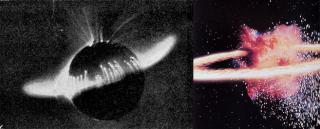
Iron Sun Surface Thermodynamically Impossible VIII
What's the difference between "Solid" and "Rigid" in this instance, specifically?
The term rigid implies something more dense, but not necessarily a solid. It could just be a more dense plasma. Technically Birkeland's cathode sun need not have a solid surface. I personally believe our sun does have a real crust, real volcanoes, and the whole nine yards.
What is the basis for this belief? If there were a solid iron surface, wouldn't spectographic absorption (spelling and/or term may be wrong there) lines indicate this, given a surface of this nature would block any light from underneath it? Is this seen? If not, why would it not, in accordance with this bizarre model?
At some point trying to understand how
Mozina comes up with such bizarre ideas becomes a hopeless task. One can only appeal to the word
stupid and all of its attendant conceptual basis and let it go at that. There is so much solid physical proof that the surface of the sun cannot be either solid or rigid that one can hardly accept blind thoughts to the contrary in any other light.
Two primary points come to mind. The first is simple
thermodynamics (a science which, I might add, is extensively supported by laboratory experiments, although Mozina seems quite happy to ignore the entire discipline). We know that
iron will melt at a temperature of 1811 Kelvins and boil at a temperature of 3134 Kelvins. But we also know that the sun presents us with an equivalent black body temperature of roughly 5800 Kelvins, give or take a few degrees. Since that is already well above the boiling point, one must ponder the rationality of truly expecting a "rigid" surface. Now, I say "equivalent" temperature because what is actually happening is that we see sunlight coming not from a surface, but from a layer about 400 km thick called the
photosphere. The photosphere is much hotter at its base, and much cooler at its top; we see progressively less light from the deeper photosphere because of the opacity of the overlying material, and progressively less light from the cooler upper layers because the photosphere thins out at higher altitudes so there is less stuff and it emits less light. But each level of the photosphere, each temperature layer as we progress from bottom to top, emits its own thermal (black body) radiation. All of those layers combined together show a spectral energy distribution (intensity as a function of wavelength or frequency called an
SED) that is very similar to, but not exactly the same as, a black body SED. For simplicity we can pretend that it is a true single temperature SED and find the best fit temperature to that shape SED, and that's where the 5800 Kelvins comes from. The highest temperature at the base of the photosphere is about 9400 Kelvins, and the very coldest temperature, above the top of the photosphere, is about 4400 Kelvins. There is a temperature inversion above that and, just as happens in Earth's atmosphere, the temperature goes up to about 6150 Kelvins at about 1200 km above the base of the photosphere. The coldest temperatures show up in the "dark" umbrae of sunspots, where it drops to about 3700 Kelvins on average. That's still significantly above the boiling temperature for iron, but one might reasonably be excused for thinking that somewhere in some odd sunspot, what with natural variability and all, a temperature might crop up that is actually similar to the boiling temperature. But nobody can be excused for thinking that, in light of this fair knowledge about the solar photosphere, derived from careful
observation I might add, there might be any kind of "solid" or "rigid" (or anything else that does not mean "vapor") surface to the sun. I have explained this repeatedly, but to no avail. There is simply no imaginable way to reconcile any surface made of anything with the observed properties of the solar photosphere, not the least of which is its temperature distribution.
The second point is the relatively recent (last few decades really) science of
helioseismology. Studying the acoustic vibrations of the sun allows the use of
tomography to diagnose the internal structure of the sun (tomography has been a well established technique both for reconstructing the internal details of Earth, and in medial technology for imaging internal organs). We now know that the internal structure of the sun differs only in minor ways from astrophysical models that existed before helioseismological tomography was available. That is a resounding success for the standard solar models and a dismal failure for the
Mozina solar models, which helioseismology solidly rules out (although he will tell you he thinks otherwise, it is because he not surprisingly does not understand helioseismology at any level).
It is important to realize hoe deep
Mozina's self-deception runs. He has set himself up as a maverick opposed to literally every branch of modern science. His ideas don't just fail the test of standard thermodynamics but also fail the test of plasma physics and electromagnetism, in which areas he falsely claims his ideas are superior to standard physics. The most efficient way to learn from discussions with
Mozina is to assume that literally
everything he says is not possible and have confidence that the opposite of what he says is the real truth. That might occasionally lead you astray, but not much.



 .
.