No, in physics the math is actually based on the observation, with the maths continually redefined to better fit the observation, not the other way around.
No, but as I said the physical models used for solar observation are used to make everything else to do with optics, many instruments of which are extremely sensitive and would pick up such errors. Yet they do not
I'm sure that your theory is compatible with electrical engineering, especially as opacity and absorbtion of of photons have absolutely nothing to do with how electrons move trough conductive material. I am equally certain that your theory is fully compatible with plate tectonics. However, having looked at your site, I have not seen a single mathematical model which validates your theory and yet also agrees with the known results of day to day optics and quantum physics. Bear in mind that the LHC so far is still giving results predicted by the standard model, even though hundreds of earger young PhD's and postdoc's working there would like nothing better than to prove their professors wrong and become the next einstein.
I have taken a look at Birkeland's work. Its a very nice and elegant way of simulating the earth's magnetosphere and is still considered highly in the research in that field. However, that sphere was merely made that way to create a magnetic field similar to the one of earth. And since the earth's magnetic field indeed originates from a metallic sphere in the center of the earth it is as accurate as could be done at the time. It does not presume that the earth IS a hollow sphere of iron and his work says nothing about the composition or inner working of the sun.
I'm sure it does, but what calculations prove the model and give predictive results that have the same margin of error as the current standard model?
Where does the original iron come from? What made it form a hollow sphere that still has hot plasma inside and does not explode? Why only the sun and not every other planet? Anyone can postulate a model, but if that model does not come with maths that predict nature as we can observe it, it is just an unproven theory.
I've seen you use the analogy of water bubbles in previous posts, but do you have anything that actually holds up in space? After all, water bubbles have a strict upper limit in size, they cannot be scaled up, as a thicker layer of water immediately collapses, they are not formed by ice, nor are magma bubbles observed and the starting materials of the sun would not be in a molten form as there would be no initial heat to melt them.
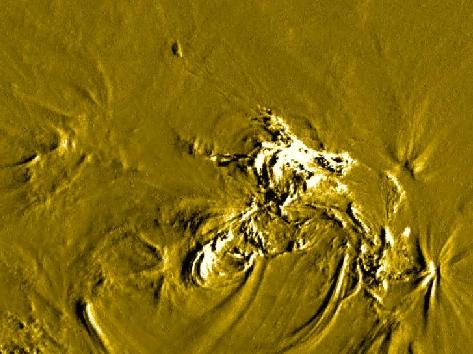
The other thing you keep going on about are 'persistant features' Now, I am in no way convinced that you actually see them, as the images show snapshots to look for something totally different, but GM and sol have explained that in detail.
However even IF there is a persistant feature, why assume it is solid? The Gulf stream is a persistant feature on earth, neither it, nor its 'banks' are solid. The movement of air is reasonably persistant, especially round the equator. The great red spot is a persistant feature on jupiter, yet not solid. The bands of color on jupiter and saturn are persistant, yet not solid. Why assume solitidy in the sun?


 !
! !
!


