Moderated Iron sun with Aether batteries...

Status
Not open for further replies.
I realize now that you are totally ignorant of what the SDO images are. They are:

....They are the end of your opaque math bunny claims and the end of your solar theory.

[*]Public relations images created by an artist from
[*]First light data, i.e. before the instrument was tested and calibrated .

Like they didn't think to calibrate it on the ground? I counted the whole limb RC. Even if it wasn't centered exactly, my methods would have compensated for that issue anyway. It's a smoke screen too. Nothing is going to make that green go away along the limb.
 
....They are the end of your opaque math bunny claims and the end of your solar theory.


Like they didn't think to calibrate it on the ground? I counted the whole limb RC. Even if it wasn't centered exactly, my methods would have compensated for that issue anyway. It's a smoke screen too. Nothing is going to make that green go away along the limb.

Moss killer?
 
Unlike you (see Micheal Mozina's iron crust has been debunked!), I will try to answer the questions:
Ok RC, time for your list. Let's start with:

  1. Why is it light green under the chomosphere all along the limb of SDO images?
  2. What are those persistent features we see in RD images?
  3. Where will find the edge of the disk in an SDO RD image, inside or outside the chromosphere? Pick a from the based of the chomosphere and state it in kilometers.
  4. Why is there interference only in 94A wavelength?

(numbers added for ease of reference)
  1. I do not know.
    It looks like the artist who created the public relations, first light, non-scientific image that you are obsessed with masked out some of one of the images that make up the PR image.
    This is supported by the missing green line in the other image that you are ignoring (Did you cherry pick the SDO image to support your fantasy? - the answer is yes. MM saw a "green line" in one PR image and ignored its absence in another.)
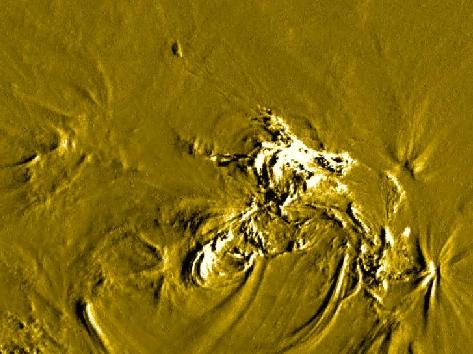
  2. There are no persistent features in RD images.
    There are records of persistent changes in the original images, e.g. heating plasma next to cooling plasma that an idiot could interpret as ridge lines making up mountain ranges.
  3. None of your options:
    Above the photosphere extending to the corona (depending on the changes in the Sun between the original images and the wavelength of light detected).
  4. What interference and how much?
    But my answer will be: I do not know.
Unlike you I am not afraid to admit my ignorance. I am not an astronomer.
 
Last edited:
There are no persistent features in RD images.

That is just pure denial.

171surfaceshotsmall.JPG
 
....They are the end of your opaque math bunny claims and the end of your solar theory.
The ignorance continues: limb darkening is the evidence of optical depth.
Please continue to display your ignorance of mathematics and the role it plays in science with your "math bunny" statements.

Like they didn't think to calibrate it on the ground?
They did.
They test and calibrate again in space because ... space is not the ground :jaw-dropp !
Your ignorance extends to not being able to read the SDO web site:
The SDO spacecraft is still in the commissioning and testing phase. In mid-May we start full-time science operations, and we'll be bringing you up-to-date movies of your Sun. Until then, we will update this page with movies and images regularly.

...
Nothing is going to make that green go away along the limb.
That is idiotic because there is another public relations, first light, non-scientific image n the same wavelength created by an artist and (sorry for yelling but you seem unable to underestand this):
  • It does not have a green line :jaw-dropp !
That "green go away along the limb" :eye-poppi !

In fact, in that another public relations, first light, non-scientific image that you are obssessed with:
  • "green go away along the limb" in places.
  • green not consistently bright along the limb.
  • green not consistently "deep" along the limb.
 
That is the image that MM is totally ignoring as in this question (number 60 of 64 :eye-poppi !)

Sorry, I was in the fog of overwhelmed at that point. I just got around to looking at the mission page at Nasa, it also seems to show the effects of the 'limb brightening' and lots of cool features. I have to reread the press release information about the darkening after the falre. The explanations seem scant at this point, in that they are there but not very technical. I wonder if they are going to be analyzing this data for months and years.
 
The above took some time and effort to put together, and is quite well done.
Thank you!
Without the advances in knowledge about the quantum world, nuclear physics, relativity, all the observational tools and technology for analysis, how plausible could it be that a 19th century person could fathom the workings of the sun? Bikleland could no more understand solar physics than Archimedes.

Ditto.
 
Galaxy Zoo, the Hunt for Supernova - you too can use running difference (RD) images to find supernovae!

One of the Galaxy Zoo developments is the hunt for supernovae. "Data for the site is provided by an automatic survey in California, at the world-famous Palomar Observatory, and astronomers are ready to follow up on your best candidates at telescopes around the world."
Your task is to hunt for new supernovae in images taken by the Palomar Transient Factory. They observe the same patch of sky roughly once every five days, and our task is to look for changes.

You'll always be given three images : a new image, a reference and a subtraction.

The new image is the most recent, usually taken just a few hours ago. The reference image is the result of several observations added together; this is what this bit of sky normally looks like.

The subtraction image is the new image minus the reference image. Any differences between the two - like a new supernova - will show up most clearly here.
Who'd've thunk it? Armchair amateur astronomers can do real science (astronomy), using SDO Palomar RD images.

Interested? Got some spare time? What are you waiting for! :D

(answers to the earlier questions - about the craters in the "exotic" hydrogen-helium "500K" "Bose-Einstein"-Alfven condensate that is the true sky - coming soon. In the meantime, how do you think a variable star would show up in a RD image?)
 
Every time that Michael uses the phrase "math bunnies",I just cringe and feel so embarassed for him.
 
No, in physics the math is actually based on the observation, with the maths continually redefined to better fit the observation, not the other way around.


No, but as I said the physical models used for solar observation are used to make everything else to do with optics, many instruments of which are extremely sensitive and would pick up such errors. Yet they do not


I'm sure that your theory is compatible with electrical engineering, especially as opacity and absorbtion of of photons have absolutely nothing to do with how electrons move trough conductive material. I am equally certain that your theory is fully compatible with plate tectonics. However, having looked at your site, I have not seen a single mathematical model which validates your theory and yet also agrees with the known results of day to day optics and quantum physics. Bear in mind that the LHC so far is still giving results predicted by the standard model, even though hundreds of earger young PhD's and postdoc's working there would like nothing better than to prove their professors wrong and become the next einstein.


I have taken a look at Birkeland's work. Its a very nice and elegant way of simulating the earth's magnetosphere and is still considered highly in the research in that field. However, that sphere was merely made that way to create a magnetic field similar to the one of earth. And since the earth's magnetic field indeed originates from a metallic sphere in the center of the earth it is as accurate as could be done at the time. It does not presume that the earth IS a hollow sphere of iron and his work says nothing about the composition or inner working of the sun.


I'm sure it does, but what calculations prove the model and give predictive results that have the same margin of error as the current standard model?
Where does the original iron come from? What made it form a hollow sphere that still has hot plasma inside and does not explode? Why only the sun and not every other planet? Anyone can postulate a model, but if that model does not come with maths that predict nature as we can observe it, it is just an unproven theory.

I've seen you use the analogy of water bubbles in previous posts, but do you have anything that actually holds up in space? After all, water bubbles have a strict upper limit in size, they cannot be scaled up, as a thicker layer of water immediately collapses, they are not formed by ice, nor are magma bubbles observed and the starting materials of the sun would not be in a molten form as there would be no initial heat to melt them.

The other thing you keep going on about are 'persistant features' Now, I am in no way convinced that you actually see them, as the images show snapshots to look for something totally different, but GM and sol have explained that in detail.
However even IF there is a persistant feature, why assume it is solid? The Gulf stream is a persistant feature on earth, neither it, nor its 'banks' are solid. The movement of air is reasonably persistant, especially round the equator. The great red spot is a persistant feature on jupiter, yet not solid. The bands of color on jupiter and saturn are persistant, yet not solid. Why assume solitidy in the sun?

Good luck, MM will engage in cogent discussion at times, but as you approach anything that looks like it threatens his model, he will change the subject.

He spoke with me reasonably on a number of posts, as I asked him why the solar wind has a mix of ions rather than the single polarity predicted by the electric sun model. It ended in peace but with no answer to the question.

This is also true of Ziggurat and the exploding sun.
Recently Sol I, Ben M and the opacity issue.
Ben M and many issues of the transit of light through the atmosphere on a sphere.
Gee Mack and the RD images.

Countless others.

And so on, the most strange has been the 'Casmir' effect and 'negative pressure' in the Dark Energy/Lambda Dark matter thread.
 
Galaxy Zoo, the Hunt for Supernova - you too can use running difference (RD) images to find supernovae!

One of the Galaxy Zoo developments is the hunt for supernovae. "Data for the site is provided by an automatic survey in California, at the world-famous Palomar Observatory, and astronomers are ready to follow up on your best candidates at telescopes around the world."

Who'd've thunk it? Armchair amateur astronomers can do real science (astronomy), using SDO Palomar RD images.

Interested? Got some spare time? What are you waiting for! :D

(answers to the earlier questions - about the craters in the "exotic" hydrogen-helium "500K" "Bose-Einstein"-Alfven condensate that is the true sky - coming soon. In the meantime, how do you think a variable star would show up in a RD image?)
So cool, thanks DRD.
 
I have the 2-volume polar expedition book, though I have not thoroughly explored all 900+ pages of it. As far as I can tell, Birkeland's terrella was intended only to model the earth and electric currents in earth's magnetic field. While Birkeland, like many other curious scientists of his times, was interested in the sun, he never produced anything that could be called a "model" of the sun, in any serious sense, so far as I know.

Just a little note that in post 682 I give a full description of what Birkeland was doing with his Terrella, with lots of quotes from his book, and how it (does not) relate to the Sun.
 
It's oh so easy to take cheap shots. It's so much harder to put up real numbers and make real testable predictions related to SDO images. Thus far standard theory has *FLUNKED* every SDO test on the books. What test does it pass in SDO?

(My bolding)
It appears to be so hard that you have given up on it and invented the term "math bunnies" instead.

I am not an astronomer and it is limited what I can contribute here.
Some of the things I do understand is that looking at the edges of the sun requires much deeper transparency than right at it. Also the scaling problems with a sun size iron shell, even if it were below melting point.

One of the characteristics of the crackpot is to keep weaving around instead of taking one point at the time with the nice and quite knowledgeable people here.
 
*sigh*

Michael:

I'm going to try this one more time. Please pay attention. And do try to keep up.

A Running Difference Image or video only records changes between frames.

Thus, anything that shows up as a "feature" in an RD image or video is, by definition, somethign that is changing.

Therefore, by definition and by what the process does, there CANNOT be rigid features in an RD image. It is not possible for RD to record rigid (i.e.-unchanging) features.

Those persistent areas you see in the RD image are not rigid features, they are AREAS THAT ARE UNDERGOING CHANGE BETWEEN EVERY SET OF FRAMES. THey are not rigid, they are CONSTANTLY CHANGING.

Until you can grasp this simple point, there's no sense in continueing conversation. You have a base failure of understanding at the initial premise of your conjectures. It's like looking at an infrared image of a person and claiming you can tell his color (he's red, see!). The image you are looking at DOES NOT RECORD THAT INFORMATION.
 
sol invictus said:
Michael, a big part of the problem here is that you ask questions like this. How can anyone state a prediction for how big the outline of a disk in an image will be in kilometers??

So what does the SSM "predict" in terms of the outline of the disk compared to the chromosphere? I "predicted" a number in terms of the disk size in relationship to the chromosphere. If we are to compare models, I need something to compare it to. Start with 171 spread 6 hours apart and we should come up with an image that looks a lot like that SOHO image. How big will the disk be compared to the chromosphere?

I'm sorry if that's a difficult sort of thing to "predict" in the SSM, because it's not a difficult calculation (no calculation at all in fact) in a Birkeland model. It must be 4800KM inside the chromosphere.

Remarkable.

Here's the deal sol. There is an easy way now with SDO to compare the outline of the chomosphere, to the outlines we see in the iron line image, and the RD iron line images. In a Birkeland models those "rigid features" on that RD disk must reside inside the outline of the chromosphere. I can "predict" at what point that will occur. If the SSM is just as useful, it too should be able to predict that number, shouldn't it?

Based on what you've said about your model, your "prediction" based on it is flat-out wrong.
 
*sigh*

Michael:

I'm going to try this one more time. Please pay attention. And do try to keep up.

A Running Difference Image or video only records changes between frames.

Thus, anything that shows up as a "feature" in an RD image or video is, by definition, somethign that is changing.

Therefore, by definition and by what the process does, there CANNOT be rigid features in an RD image. It is not possible for RD to record rigid (i.e.-unchanging) features.

Those persistent areas you see in the RD image are not rigid features, they are AREAS THAT ARE UNDERGOING CHANGE BETWEEN EVERY SET OF FRAMES. THey are not rigid, they are CONSTANTLY CHANGING.

Until you can grasp this simple point, there's no sense in continueing conversation. You have a base failure of understanding at the initial premise of your conjectures. It's like looking at an infrared image of a person and claiming you can tell his color (he's red, see!). The image you are looking at DOES NOT RECORD THAT INFORMATION.

I am not a scientist but I can understand that.Michael is not a scientist so he should be able to understand it too.
 
The photoionization issue that sol and I have been discussing is critical as it relates to the SDO images. In the standard solar model *NONE* of these iron ion wavelengths can come from under the chomosphere. They would photoionize something in the photosphere within a few feet

Right.

and would never show up in even a single pixel under that red chromosphere.

Wrong.
 
[qimg]http://www.thesurfaceofthesun.com/images/sdo/sd01.jpg[/qimg]

I know what an egregious failure of the SSM looks like.

Michael, I'd like to suggest an alternate interpretation of the SDO image that actually fits the image better and doesn't violate any laws of physics. Are there any obvious inconsistencies with my interpretation?
 

Attachments

  • limb alt explanation.jpg
    limb alt explanation.jpg
    45.1 KB · Views: 3
*sigh*

Michael:

I'm going to try this one more time. Please pay attention. And do try to keep up.

A Running Difference Image or video only records changes between frames.

Thus, anything that shows up as a "feature" in an RD image or video is, by definition, somethign that is changing.

Therefore, by definition and by what the process does, there CANNOT be rigid features in an RD image. It is not possible for RD to record rigid (i.e.-unchanging) features.

Those persistent areas you see in the RD image are not rigid features, they are AREAS THAT ARE UNDERGOING CHANGE BETWEEN EVERY SET OF FRAMES. THey are not rigid, they are CONSTANTLY CHANGING.

Until you can grasp this simple point, there's no sense in continueing conversation. You have a base failure of understanding at the initial premise of your conjectures. It's like looking at an infrared image of a person and claiming you can tell his color (he's red, see!). The image you are looking at DOES NOT RECORD THAT INFORMATION.

It is remarkable that this comment has been made so many times without MM addressing it. If he thinks RD images can show fixed features, he has not said why he thinks that. He just ignores the issue and raves on.
So I ask you again, Mr. Michael Mozina: if RD images are produced in accordance with the general understanding here, how can you see fixed features?
 
Last edited:
Status
Not open for further replies.

Back
Top Bottom