Moderated Iron sun with Aether batteries...

Status
Not open for further replies.
But that very same logic doesn't work for me and a Birkeland solar model because?


Kristian Birkeland never proposed a solid iron surface on the Sun. Still blaming the dead guy for your crackpot conjecture, I see. That's a pretty lousy argument to make to try to support your own failed notion.
 
Asking how "all this energy" suddenly "cools off" is very poor wording from a physical perspective. The better-phrased question would be "why is the matter in the umbra cooler than the matter in the surrounding, brighter areas."

Fair enough.

As previous posts have explained, the umbra is cut off from the convection cells that dominate the surrounding areas.

How exactly is it "cut off" from the convection below, and what about the momentum of that updrafting heat?

Thus, as the umbra radiates heat, it simply cools off because the matter in the umbra is not cycling back down to the deeper, hotter regions.

http://solar-b.nao.ac.jp/QLmovies/movie_sirius/2009/12/31/FG_CAM20091231000109_235508.mpg

http://solar-b.nao.ac.jp/news/070321Flare/SOT_ca_061213flare_cl_lg.mpg

Ooops, posted too soon. I'll get to the rest in a second, but I have a hard time jiving that concept with the visual data. That orange images shows a filament winding its way down the umbra and the B/W image shows the effect over a larger area. It certainly appears as though material is cycling back into the umbra, not simply coming up through it.
 
Last edited:
The density of the sun, computed from its gravity and diameter is about 1.4 g/cm**3.

The density of iron in the normal solid state is 7g/cm**3.

Simplifying greatly, an iron sun would weigh 5 times more than a gaseous one.

But really it would be much higher as the iron would be under such pressure at the center that in fact it would be a neutron star...


It gets worse.

density of iron = 7850 kg/m3mass of sun = 1.99x1030 kg
outer diameter of sun = 1.39x10⁹ meters

Using the outer diamter of the sun as an outer diamter for any iron shell, it is trivial to calculate that the thickness of this shell would have to be about 90 km in order to provide the gravity observed.

And that is assuming that the inside is hard vacuum. Add any mass in there (like, say, a heat soruce) and the thickness gets thinner.

Anybody want to calculate how much strength 90 km of iron has?
And how much stress and strain that shell would be under?
 
Of course there's still radiative and conductive heat transfer from below and from the surrounding areas.

Must be a lot of it too if all the materials are "opaque". :)

And, of course, the umbra itself is still radiating. But since the conductive and radiative coupling to the rest of the sun transfers quite a bit less energy than convection, the umbra's equilbrium temperature (where its radiation is equal to the energy it's receiving from the rest of the sun) is quite a bit lower than the equilbrium temperature of the non-sunspot areas.

Ok. It seems were back to explaining the cut off of the convection process again.

If you think that it's simply impossible for convection to be cut off like that, explain why.

Well, for starters, everything is plasma and highly mobile, and we're talking about a HUGE surface area and a process that lasts for days if not weeks. What process could operate like that over such a long period of time and over such a huge area?

If you think that cutting off convection couldn't cause the umbra's equilibrium temperature to be that much lower, I think you'll have to give us something quantitative rather than just asserting that this mechanism can't possibly give the observed result.

I guess I buy the basic concept if you can explain how you're cutting off convection for days over such a large area.

As for "it all suddenly cools off" - why do you think it's sudden?

Well, you have currents coming up for thousands of kilometers and within some (you name) the distance from the surface, the convection stops "cold". :)

Yes, it does. It just doesn't transfer heat as rapidly as convection does, so the sunspot's equilibrium temperature is lower.

The point here is that even without convection, the transfer of heat from an "opaque" area to another should be pretty efficient over any area of say 300KM. I hear your basic argument, and I can't say I object to it, I simply don't see how you intend to cut off that much convection over such a large area, for such a long time.

ETA - I'll openly admit this is not one of my areas of expertise. Tim, Zig, Sol, RC, etc - I'm confident that you'll let me know if I got any of it wrong.

IMO that's the single most "scientific" post I've seen today in this thread. Most of it has been pointless bickering over semantics. Thanks.
 
Fair enough.


How exactly is it "cut off" from the convection below, and what about the momentum of that updrafting heat?


http://solar-b.nao.ac.jp/QLmovies/movie_sirius/2009/12/31/FG_CAM20091231000109_235508.mpg

http://solar-b.nao.ac.jp/news/070321Flare/SOT_ca_061213flare_cl_lg.mpg

Ooops, posted too soon. I'll get to the rest in a second, but I have a hard time jiving that concept with the visual data. That orange images shows a filament winding its way down the umbra and the B/W image shows the effect over a larger area. It certainly appears as though material is cycling back into the umbra, not simply coming up through it.


Of course you know that your qualifications to understand solar imagery have been challenged and you have refused to demonstrate any such qualifications. Your unsupported opinion cannot be accepted as evidence.
 
But that very same logic doesn't work for me and a Birkeland solar model because?

Because in your model, the surface is completely surrounded by the photosphere, but in a sunspot, one side is exposed to (mostly) empty space.
 
It gets worse.

density of iron = 7850 kg/m3mass of sun = 1.99x1030 kg
outer diameter of sun = 1.39x10⁹ meters

Using the outer diamter of the sun as an outer diamter for any iron shell, it is trivial to calculate that the thickness of this shell would have to be about 90 km in order to provide the gravity observed.

And that is assuming that the inside is hard vacuum. Add any mass in there (like, say, a heat soruce) and the thickness gets thinner.

Anybody want to calculate how much strength 90 km of iron has?
And how much stress and strain that shell would be under?

FYI, the shell isn't solid iron IMO, it's a standard volcanic 'crust' like the Earth, or like Mercury in terms of overall composition. It's probably more metallic than either the Earth or Mercury, but it's not likely to be made of solid iron IMO and it has "plasma pressure" inside the shell. :) Just an FYI....
 
How exactly is it "cut off" from the convection below, and what about the momentum of that updrafting heat?

Others will have to go into the specifics. My understanding is that strong magnetic fields prevent the plasma from rising into the sunspot area (plasma and magnetic fields have a thing going on), and that creates a region that's cut off from the 'normal' convective flows.

And, I don't want to be too pedantic, but "the momentum of that updrafting heat" doesn't make any physical sense. Heat doesn't have momentum. I'll assume you mean the momentum of the upwelling hot plasma. Well, I believe it's being diverted by the magnetic fields, but I've never quite understood how magnetic fields manage momentum transfer. I can demonstrate it easily enough with a couple of kitchen magnets, but I can't claim that I really grok it.
 
FYI, the shell isn't solid iron IMO, it's a standard volcanic 'crust' like the Earth, or like Mercury in terms of overall composition. It's probably more metallic than either the Earth or Mercury, but it's not likely to be made of solid iron IMO and it has "plasma pressure" inside the shell. :) Just an FYI....

How much plasma pressure, Michael? Ballpark it for me, Michael, and I'll see how much difference it makes to the calculations. Then we can also talk about the temperature and density needed to create that pressure, and see if that's consistent with your model.
 
How did you measure the curvature of penumbral filaments in the Hinode images

Hi Tim Thompson, you may have been fooled by MM's ignorance of what the image contains.
Sunspots Revealed in Striking Detail by Supercomputers has the following caption for the image:

and from the animation page:

The image is of magnetic field strength, not convection.

It looks like MM has just looked at the image and said "looks like convection so must be convection" without bothering to even read the caption. What a surprise :jaw-dropp !
How can you be that close, and yet that far?
How could you not have read the image caption?
An image of simulated magnetic field strength is not an image of simulated convection.

The field and the strength at that field are directly related to the "mass flow" inside the discharge loops that we see in the Hinode overlay image which come up along side (inside) the penumbral filaments. I've shown you the mass flow image movies in 171A, the Hinode CA/X-ray overlay images, tons of Hinode images galore, and you still don't seem willing to put two and two together. Yes, you're right, those are "magnetic fields" and that "magnetic field" is directly related to the "mass flow/current flow" coming up/down inside the loops and through the penumbral filaments. How can you not see that or the curvature *DOWN* in the Gband images?
  • There are no discharge loops.
  • There is no "Hinode overlay image" in that computer simulation image.
  • There are mass flows in other computer simulation images - also without any "Hinode overlay".
  • There is no "curvature *DOWN* in the Gband images". There are features that you have chosen to interpret as curvature downwards.
    However you have a delusion that a TRACE 171A running difference movie of the corona shows "mountain ranges" under the photosphere. Given this example of you incompetence at evaluating solar images, there is great doubt about your evaluation of all solar images.
As I have stated before a couple of times:
It is possible that penumbral filaments do curve down into the depression at the center of sunspots. The better way to say this is that they become visible and then curve up and out of the depression. But
  1. You cannot tell this from looking at images that are looking down on the sunspot.
    There is no fixed lighting and you have no idea whether the filaments are curving up or down. This is a well known illusion in astronomy where you cannot tell if an image contains a hill or a crater until you establish where the light comes from.
  2. Sunspot depressions are at most 1000 kilometers deep.
    The penumbral filaments do not extend to the center of the depression and so originate at depths much less than 100 kilometers.
You go into claim that you can see 3000-3400 km deep. But you are unable to answer a simple question from Micheal Mozina's iron crust has been debunked!
Maybe you can answer this question:
First asked 22 April 2010
Michael Mozina,
How did you measure the curvature of penumbral filaments in the Hinode images?
 
Yes, you're right, those are "magnetic fields" and that "magnetic field" is directly related to the "mass flow/current flow" coming up/down inside the loops and through the penumbral filaments.

No, Michael. The magnetic field at the center of those sunspots is vertical. Any current flow responsible for creating a vertical magnetic field must be horizontal. Basic electrodynamics fail.
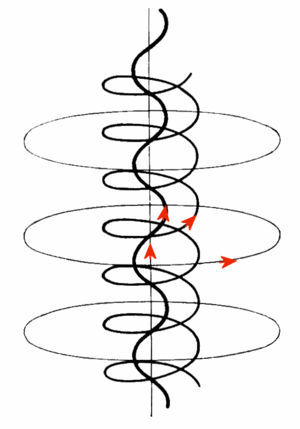
 
No, Michael. The magnetic field at the center of those sunspots is vertical. Any current flow responsible for creating a vertical magnetic field must be horizontal. Basic electrodynamics fail.
http://en.wikipedia.org/wiki/Birkeland_current
No, it's called a Birkeland current, otherwise known as an ordinary current carrying filament like the one we see winding it's way down the umbra in that orange Hinode image, only much faster, and at higher energy state.

300px-Magnetic_rope.png
 
Last edited:
Others will have to go into the specifics. My understanding is that strong magnetic fields prevent the plasma from rising into the sunspot area (plasma and magnetic fields have a thing going on), and that creates a region that's cut off from the 'normal' convective flows.

It seems to me that the devil is in the details and that's a little "handwavy" from my perspective. The strong magnetic lines in Hinode images are typically related to coronal loop configurations and those "magnetic lines" are "hot hot hot", as in million degree hot. You now want me to believe that something that tends to produce heat, somehow blocks the flow of plasma over a very wide area for a long time.

And, I don't want to be too pedantic, but "the momentum of that updrafting heat" doesn't make any physical sense.

That was very poor wording on my part. The opaque nature of the photosphere should allow heat to easily transfer from one area of plasma to another. Even if we stopped the mass flow entirely, the heat would still tend to transfer from one "opaque" region to another, especially if it's hotter underneath. Where else can it radiate heat other than "out"?

Heat doesn't have momentum.

No, but we would still have a considerably higher temperature plasma that will continue to radiate into lower temperature plasma, very efficiently too if all the plasma are "opaque".
 
Last edited:
http://en.wikipedia.org/wiki/Birkeland_current
No, it's called a Birkeland current, otherwise known as an ordinary current carrying filament like the one we see winding it's way down the umbra in that orange Hinode image, only much faster, and at higher energy state.

You really don't get it. The vertical field is not caused by vertical currents, even in cases where the two might coexist. And the vertical component caused by the spiraling (in the horizontal direction) opposes the field which causes the spiraling.
 
Status
Not open for further replies.

Back
Top Bottom