• Quick note - the problem with Youtube videos not embedding on the forum appears to have been fixed, thanks to ZiprHead. If you do still see problems let me know.

Moderated Iron sun with Aether batteries...

Status
Not open for further replies.
[qimg]http://www.thesurfaceofthesun.com/images/171surfaceshotsmall.JPG[/qimg]

http://trace.lmsal.com/POD/TRACEpodarchive4.html

When I squint and turn my head just right, I can see a Bunny in there.


Oops, GeeMack beat me to it.:(

ETA: Michael, if you "don't get the joke" yet, it has to do with you and your (few) "acolytes" being "Pixel Kiddies"; you stare for hours at legitimate images and tell yourselves stories about what you fancy is hidden inside, then congratulate yourselves on having made monumental discoveries that the scientific conspiracy clique missed or suppressed.

ANYONE can look long enough at clouds or wood grain and do much the same; the difference being MOST people have developed (as maturity progresses) the ability to distinguish between pareidolia and reality.
Just Sayin...

D.
 
Last edited:
After his ignorance is exposed, as on other threads, MM will simply withdraw, only to later reappear on another thread starting the same "9 year old kid version of looks-like-a-bunny science" all over again.

I love how you folks take million dollar satellite images and reduce the information to "looks like a bunny" nonsense.

It "looks like" a tsunami passes through the photosphere, yes, no?

What's that "rigid" (for lack of a better term) set of outlines in the image under the photosphere?
 
When I squint and turn my head just right, I can see a Bunny in there.

Same question to you as to PS. What causes those rigid outlines in the Doppler image by Kosovichev which the wave passes over in the image? What started the tsunami in the photosphere?

You know "observation" is in fact about "studying" an image, not simply reducing it to pixel intensities and ignoring the content altogether as GM is famous for at this point. "Flying stuff? What flying stuff?" When ignorant people like GM ignore the data altogether, all I can do is shake my head in absolute disgust. It's bad enough that you folks don't respect the "pixel Kiddies" doing what you're supposed to do as well. It's another thing entirely to ignore the physical evidence completely as you're evidently intent on doing.

That sure "looks like" that "discharge" passes through the photosphere too, but I'm sure you'll ignore that data as well.
15%20April%202001%20WL.gif
 
I love how you folks take million dollar satellite images and reduce the information to "looks like a bunny" nonsense.

It "looks like" a tsunami passes through the photosphere, yes, no?

What's that "rigid" (for lack of a better term) set of outlines in the image under the photosphere?


Only one of us in this conversation thinks running difference images show some kind of solid surface. That would be you. You are the one who buys into the little kid science of imagining things in pictures and believing without evidence that they somehow represent reality. (Well maybe there's two of you if brantc is willing to follow your crackpot claim about running difference images).

Michael, please explain every single pixel of that first image from your web site, as I and so many other people have done, or admit that you can't. Every single pixel. Pick a pixel or two or several hundred and describe exactly what has been done with the original images to make each of those pixels what it is. I bet you still can't do it. Not after a half a decade of claiming you can.

And wasn't it back in 2005 or '06 that you said you knew how a running difference image was constructed and said you were prepared to create some to show us we were wrong? What happened with that? Got some video you've made into a running difference video? A couple images perhaps? What's the matter, Michael? Can't you do it? You said you could.
 
So now your “solid surface” isn’t all that solid or just isn’t mostly iron?

It's mostly solid, not necessarily mostly iron. The overall content including the core is mostly iron and nickel but the crust is simply a crust just like the Earth's crust, and not homogeneous in content.

That you imagine it is kept “cool” by some “cool layer of plasma” that you imagine hardly constitutes an explanation, just your speculation and most of us would have already surmised that you think it is cooled somehow. Explaining where and how the heat is generated and how it is lost would be a start. The particular branch of physics in this case would be thermodynamics (as mentioned before).

Based on the article you cited are you claiming your ferrite “curst” is under some similar type of pressure? Are you aware of the relationships between pressure, volume, heat energy and temperature?

I'm simply suggesting the crust itself is cooled by it's plasma atmosphere, it's under greater pressure than on the surface of the Earth, and the constant flow of particles away from the sun move heat away from the surface. The outer layers of the sun are progressively hotter and thinner than the layer closest to the crust. Heat is carried away from the crust of sun by the constant flow of particles away from the sun.
 
Sure. I'm not a plasma Sun proponent, but I can easily explain the running difference graph. You take a series of images. You add 50% gray value to each pixel in the first image then subtract the value of each corresponding pixel in the second image. The result is a graph representing the change in the values of the pixels between the first and second image, or between successive images in the case of a running difference video.

There. Explained every single pixel.

Er, no. You "explained" the "running difference" imaging technique. Care to "explain" the CME event, or any relevant set of pixels in the image in terms of what they represent and how they exist like that during the CME event?

"Flying stuff? What flying stuff?" won't cut it. You'll need to explains something useful about the features in the image. How about Kosovichev's doppler image? What are those rigid features I outlined in the image?
 
It's mostly solid, not necessarily mostly iron. The overall content including the core is mostly iron and nickel but the crust is simply a crust just like the Earth's crust, and not homogeneous in content.


No, it's not solid. Helioseismology shows that there is nothing that can remotely be described as solid on, under, near, within, surrounding, or anywhere in the proximity of the surface of the Sun. None. It isn't solid. It all moves like plasma, somewhere in the neighborhood of 1200 meters per second. Solid stuff doesn't flow. That's part of the definition of solid.

Michael, you are wrong.

Now when can we expect that pixel by pixel analysis of that first image on your web site? You know, that one you keep dangling in everyone's face and lying about by saying nobody has explained it? That one that I've explained oh so many times in oh so many ways? (There is something humorously ironic about the fact that you cry and whine, and lie, about that image all the time, yet you can't explain it yourself.)

In 2006 you said you were prepared to explain that image, right down to the pixel, how it was created and why every pixel is the color that it is. If I recall you said you were going to "shine" because running difference images are your area of expertise. Well, you're on, Michael. Shine!
 
And as for seeing iron plasma, lots of it, in coronal loops, I think you've radically misunderstood what the 171Å and 195Å filters are doing for the satellite images. They are used for sorting out areas of varying thermal characteristics. They are not used to determine elemental composition of the plasmas.

I think we all understand that just fine GM. The problem is that you're "assuming" that the elements themselves stay "mixed", iron with hydrogen, nickel with helium, etc. That's the part of your model that lacks credibility, particularly in light of solar satellite imagery like Kosovichev's Doppler image and RD images.
 
Last edited:
Er, no. You "explained" the "running difference" imaging technique. Care to "explain" the CME event, or any relevant set of pixels in the image in terms of what they represent and how they exist like that during the CME event?


Yes. Sure. Each pixel is a graphical representation of the mathematical difference between the values of two coresponding pixels in a pair of sequential images of the Sun gathered through a 171Å filter. That filter is used to make a thermal analysis of a CME. But by the time you see a running difference image, it has become a simple graph showing a relative change in those thermal characteristics over a period of time.

"Flying stuff? What flying stuff?" won't cut it. You'll need to explains something useful about the features in the image. How about Kosovichev's doppler image? What are those rigid features I outlined in the image?


There are no rigid features. It only appears that way to the ignorant, the stupid, and the deluded. I repeat, they are not rigid features. See how easy this stuff can be when you actually understand? :D

And I take it from your continued ignorance of the question that you simply cannot explain that very first image on your web site. Dammit, I was so looking forward to you creating a running difference video so we could see that you actually understand them. You don't. (But I've known that for almost 5 years now. :))
 
I think we all understand that just fine GM. The problem is that you're "assuming" that the elements themselves stay "mixed", iron with hydrogen, nickel with helium, etc. That's the part of your model that lacks credibility, particularly in light of solar satellite imagery like Kosovichev's Doppler image and RD images.


You are apparently not qualified to discuss running difference images. You have never shown that you know anything about them. What you have said about them is in direct contradiction to the people who created them. You said you could make one. Do it. You said you could explain one. Do it. Pixel by pixel. I did. Are you going to admit after all these years that your butt has been kicked when it comes to that very first image on your web site? :p
 
Not in this universe. Physics is not so easily derailed as a thread on a discussion page :D

The melting point of iron is 1811 Kelvins, and its boiling point is 3134 Kelvins. The effective temperature of the photosphere of the sun is 5777 Kelvins, which significantly exceeds both of those temperatures.

In sunspots the lowest temp measured was 3180K Sunspots are holes in the photosphere.

Exposed to a temperature that high the iron will not "thermalize" anything, certainly not by any physics that works in this universe. It will melt & boil & vaporize, and it will do so fairly quickly.

From Scientific American.
When magnetic field lines reconnect, they release energy; some researchers suspect that fine-scale magnetic reconnections above the sun's surface provide the energy to heat the corona.

Whatever the cause, some heat does indeed leak back toward the solar surface, but the total amount of energy so transported is really quite small, and cannot raise the photospheric temperature very much. The reason for this is the extremely rapid fall-off of mass density with height above the solar surface. That is, although the material in the corona is very hot, it is also very tenuous. Thus, the energy transported back toward the surface is dissipated into an ever increasing mass of material as it works its way down, whereas the heat transported outward is readily dissipated into the vacuum of space."
http://www.scientificamerican.com/article.cfm?id=i-read-that-the-suns-surf&page=2

You could say the same thing about the photosphere vs the iron.
Only a small amount of energy(light) comes from the photosphere since its a thin plasma I would expect it to have lines.
However as you move up from the surface you would get varying levels of energies of ions. I.e. below the visible surface of the photosphere's .6 eV you would get .4eV etc as you go deeper. This is electric acceleration, the particles gain kinetic energy as they move away from the surface. The mass that intercepts the photons is moving away from the surface.

If the ion is trapped in a layer, all you are doing is measuring its radiation that tells you its at this temperature. So the actual heat motion of the photosphere is not transferred to the surface only the photons that are emitted by the photosphere that are in the visible to blue/H alpha range.

Here is the spectrum of an arc. This is what is being emitted from the surface. Look at the picture from TRACE.
http://ioannis.virtualcomposer2000.com/spectroscope/figs/Calibrated/gifs/CarbonArc.gif

So the emission from the photosphere may be only 2 or 300 nm wide with the rest of the light energy coming from the surface.

Solar wind origins ESA. Expansion at the loop footprint.
http://sci.esa.int/science-e/www/object/index.cfm?fobjectid=37003

Furthermore, one must remember that 5777 Kelvins is an effective temperature, a best fit blackbody to an actual thermal emission that is a superposition of blackbody emission curves that are generated at different depths in the photosphere.

Yeah, surface of last scattering, takes a million years for a photon to get to the surface, etc.

I'm saying that the temperature from 1000K to 5000K is the result of electric acceleration, the IR and light from molten to vaporized iron as well as full arc light from loop footprints..

The photosphere is effectively transparent to IR to visible, UV to EUV , hard x-rays, gammas..

Limb observations of the sun make it possible to retrieve the temperature structure of the photosphere as a function of depth, in much the same way as limb observations of Earth's atmosphere by satellites allows us to retrieve temperature profiles for the Earth's atmosphere (see, e.g., Solar Astrophysics by Peter Foukal, Wiley-VCh 2004, chapter 5: "The photosphere"; The Observation and Analysis of Stellar Photospheres by David Gray, Cambridge University Press 2005, 3rd edition). The temperature at the lowest level we can determine is 9400 Kelvins. We don't see much of that on Earth, because of the opacity of the overlying layers. But your iron surface is pretty much hugging the 9400 Kelvin base of the photosphere. To the best of my knowledge, the highest boiling point for any element is Rhenium, which boils at 5869 Kelvins, so no known element can survive as a solid or even as a liquid at the temperature found at the base of the photosphere.

Yes, I would expect a higher temperature because you are looking directly at the activity at the loop footprints on the surface. This reading is an average of the surface temperature(cold iron + spots of molten/ vaporized iron). Not a spot reading.
The full disk is a broader average leading to a lower temperature.

The iron surface of the sun is thermodynamic toast, and "thermalize" is a pleasant fiction that bears no resemblance to the physics of this universe.

See above. I will actually try to work out the spectrum bandwidths.

 
No, I do not. You and Michael Mozina may believe you see structures under the photosphere, but you don't either. Nobody does. Even with the IR filters that allow us the deepest view, we can only see about 500 km into the photosphere. It's all plasma, brantc, not a single solitary hunk of anything solid in there at all.

We are seeing the loop footprints.

And as for seeing iron plasma, lots of it, in coronal loops, I think you've radically misunderstood what the 171Å and 195Å filters are doing for the satellite images. They are used for sorting out areas of varying thermal characteristics. They are not used to determine elemental composition of the plasmas.

OK. We know that iron at this temperature emits light in this wavelength. By using a filter we can observe the activity of iron(loops, CME's, arcades) at this temperature. Its pretty much only iron at this temperature thats why they are using those wavelengths. And not only that we can see the surrounding area by this same EUV light.
So by default we know we are looking at ionized iron.

Abstract Recent atomic data have been used to analyze a solar flare spectrum obtained with the Goddard Space Flight Center's grating spectrometer on the OSO-5 satellite. There exist in the wavelength region 90–200 Å strong lines from each of the ions Fe xviii-Fe xxiv. The Fe xxi lines can be used as an electron density diagnostic for the 107 K plasma. From our analysis of a particular flare, we find a steep positive slope in the emission measure between 106.5 and 107.2 K and an electron density of sim4 × 1011 cm–3 at 107 K. We emphasise the need for high spectral and spatial resolution observations of solar flares in this wavelength region, which has to date been largely neglected.http://articles.adsabs.harvard.edu/...age=199&epage=199&send=Send+PDF&filetype=.pdf
 
Solar physics is already tough enough without the distraction of crackpots!

The state of "solar physics" today is absolutely pathetic. The mainstream can't even explain something like solar wind, something Birkeland "predicted" (real empirical predictions by the way) 100 years ago.
 
... What started the tsunami in the photosphere?
I know... I know... Is it turbulence due to heat flux?

... all I can do is shake my head in absolute disgust. ...
Much as we do...

That sure "looks like" that "discharge" passes through the photosphere too, but I'm sure you'll ignore that data as well.
[qimg]http://www.thesurfaceofthesun.com/images/15%20April%202001%20WL.gif[/qimg]
[/QUOTE]
Looks like a bunny?

It's mostly solid, not necessarily mostly iron. The overall content including the core is mostly iron and nickel but the crust is simply a crust just like the Earth's crust, and not homogeneous in content.
So it is solid throughout?
How do you justify that density-wise?

I'm simply suggesting the crust itself is cooled by it's plasma atmosphere, it's under greater pressure than on the surface of the Earth, and the constant flow of particles away from the sun move heat away from the surface. The outer layers of the sun are progressively hotter and thinner than the layer closest to the crust. Heat is carried away from the crust of sun by the constant flow of particles away from the sun.

Wave your hands, try to get the audience to look away, suggest all you want, you still cannot make it work thermodynamically.

Period.

Cheers,

Dave
 
The state of "solar physics" today is absolutely pathetic. The mainstream can't even explain something like solar wind, something Birkeland "predicted" (real empirical predictions by the way) 100 years ago.

So again we are back to 100 year old papers?

Alfven, Birkeland, real empirical predictions, laboratory experiments with REAL control mechanisms, ~RRRoock -- whee hoo~, Polly wants his cracker, ARRROCK.

[In case you missed that joke, too, that is the parrot you remind me of]

D.
 
Last edited:
So again we are back to 100 year old papers?

No, 100 year old experiments that show "electric universe" theories work in a lab, unlike 95+ percent of mainstream mumbo jumbo.

Alfven, Birkeland, real empirical predictions, laboratory experiments with REAL control mechanisms, ~RRRoock -- whee hoo~, Polly wants his cracker, ARRROCK.

[In case you missed that joke, too, that is the parrot you remind me of]

D.

I think you folks need someone harping on you about the value of real physics. You folks seem to have no clue how to tell the difference between a "real physical force" like an EM field and some crap you simulate on a computer related to invisible fairy energy.
 
We are seeing the loop footprints.

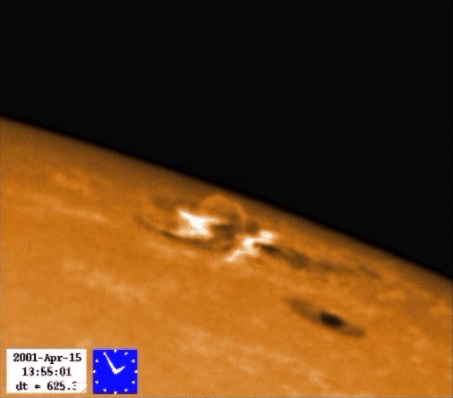
FYI, The footprints of the loops seen in 171A, 195A and 284A all originate *UNDER* the photosphere, not above it as LMSAL claims.

15%20April%202001%20WL.gif


LMSAL evidently doesn't bother to even look at their own videos or they'd notice the effect on the surface of the photosphere when the loops discharge through it.
 
I know... I know... Is it turbulence due to heat flux?

Well, if you mean a volcanic event, sure.

Much as we do...

I can just imagine Birkeland's reaction at seeing your confusion about the cause of solar wind.....

Looks like a bunny?

Do you folks do anything other than belittle the value of "observation"? Did it look like a tsunami, yes or no? Was it in fact a wave on the photosphere, yes or no? What are those rigid outlines under the wave?

So it is solid throughout?

No, I was talking about the crust itself, not the entire sun. Even parts of the surface are "volcanically active" and not necessarily solid per se. The sun itself isn't dense enough to be entirely solid.

How do you justify that density-wise?

I don't.
http://www.youtube.com/watch?v=zaHLwla2WiI

Wave your hands, try to get the audience to look away, suggest all you want, you still cannot make it work thermodynamically.

Even if that were completely true, so what? Mainstream theory can't make something as simple as solar wind work in a lab, and you aren't abandoning that theory. The mainstream has never demonstrated sustained fusion either. You still aren't abandoning fusion sun theory. What's the big deal with a few "unexplained" aspects of any theory?
 
Last edited:
You are apparently not qualified to discuss running difference images.

This from the guy who's best analysis of the images was "Flying stuff? What flying stuff?". Please. You haven't a lick of scientific credibility to your name after that ridiculous comment.

You have never shown that you know anything about them.

Except for the fact I've created them including those STEREO images on my website. Have you even bothered to make one yourself? Yes or no?

What you have said about them is in direct contradiction to the people who created them. You said you could make one. Do it.

http://www.thesurfaceofthesun.com/images/AM-A.JPG
http://www.thesurfaceofthesun.com/images/AM-B.JPG
http://www.thesurfaceofthesun.com/images/PM-A.gif
http://www.thesurfaceofthesun.com/images/PM-B.gif

Let's see you "do" one.
 
Status
Not open for further replies.

Back
Top Bottom