Not in this universe. Physics is not so easily derailed as a thread on a discussion page

The melting point of
iron is 1811 Kelvins, and its boiling point is 3134 Kelvins. The effective temperature of the photosphere of the sun is 5777 Kelvins, which significantly exceeds both of those temperatures.
In sunspots the lowest temp measured was 3180K Sunspots are holes in the photosphere.
Exposed to a temperature that high the iron will not "thermalize" anything, certainly not by any physics that works in this universe. It will melt & boil & vaporize, and it will do so fairly quickly.
From Scientific American.
When magnetic field lines reconnect, they release energy; some researchers suspect that fine-scale magnetic reconnections above the sun's surface provide the energy to heat the corona.
Whatever the cause, some heat does indeed leak back toward the solar surface,
but the total amount of energy so transported is really quite small, and cannot raise the photospheric temperature very much. The reason for this is the extremely rapid fall-off of mass density with height above the solar surface. That is, although the material in the corona is very hot, it is also very tenuous. Thus, the energy transported back toward the surface is dissipated into an ever increasing mass of material as it works its way down, whereas the heat transported outward is readily dissipated into the vacuum of space."
http://www.scientificamerican.com/article.cfm?id=i-read-that-the-suns-surf&page=2
You could say the same thing about the photosphere vs the iron.
Only a small amount of energy(light) comes from the photosphere since its a thin plasma I would expect it to have
lines.
However as you move up from the surface you would get varying levels of energies of ions. I.e. below the visible surface of the photosphere's .6 eV you would get .4eV etc as you go deeper. This is electric acceleration, the particles gain kinetic energy as they move away from the surface. The mass that intercepts the photons is moving away from the surface.
If the ion is trapped in a layer, all you are doing is measuring its radiation that tells you its at this temperature. So the actual heat motion of the photosphere is not transferred to the surface only the photons that are emitted by the photosphere that are in the visible to blue/H alpha range.
Here is the spectrum of an arc. This is what is being emitted from the surface. Look at the picture from TRACE.
http://ioannis.virtualcomposer2000.com/spectroscope/figs/Calibrated/gifs/CarbonArc.gif
So the emission from the photosphere may be only 2 or 300 nm wide with the rest of the light energy coming from the surface.
Solar wind origins ESA. Expansion at the loop footprint.
http://sci.esa.int/science-e/www/object/index.cfm?fobjectid=37003
Furthermore, one must remember that 5777 Kelvins is an effective temperature, a best fit blackbody to an actual thermal emission that is a superposition of blackbody emission curves that are generated at different depths in the photosphere.
Yeah, surface of last scattering, takes a million years for a photon to get to the surface, etc.
I'm saying that the temperature from 1000K to 5000K is the result of electric acceleration, the IR and light from molten to vaporized iron as well as full arc light from loop footprints..
The photosphere is effectively transparent to IR to visible, UV to EUV , hard x-rays, gammas..
Limb observations of the sun make it possible to retrieve the temperature structure of the photosphere as a function of depth, in much the same way as limb observations of Earth's atmosphere by satellites allows us to retrieve temperature profiles for the Earth's atmosphere (see, e.g.,
Solar Astrophysics by Peter Foukal, Wiley-VCh 2004, chapter 5: "The photosphere";
The Observation and Analysis of Stellar Photospheres by David Gray, Cambridge University Press 2005, 3rd edition). The temperature at the lowest level we can determine is 9400 Kelvins. We don't see much of that on Earth, because of the opacity of the overlying layers. But your iron surface is pretty much hugging the 9400 Kelvin base of the photosphere. To the best of my knowledge, the highest boiling point for any element is
Rhenium, which boils at 5869 Kelvins, so no known element can survive as a solid or even as a liquid at the temperature found at the base of the photosphere.
Yes, I would expect a higher temperature because you are looking directly at the activity at the loop footprints on the surface. This reading is an average of the surface temperature(cold iron + spots of molten/ vaporized iron). Not a spot reading.
The full disk is a broader average leading to a lower temperature.
The iron surface of the sun is thermodynamic toast, and "thermalize" is a pleasant fiction that bears no resemblance to the physics of this universe.
See above. I will actually try to work out the spectrum bandwidths.



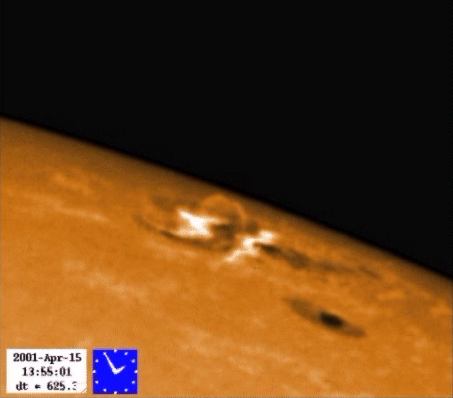

 )
)

