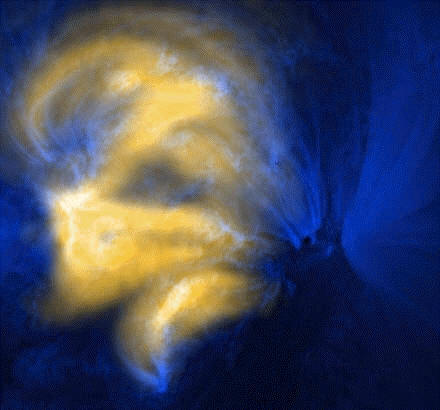
Coronal loops are the basic structures of the magnetic solar corona. These loops are the closed-magnetic flux cousins of the open-magnetic flux that can be found in coronal hole (polar) regions and the solar wind. Loops of magnetic flux well up from the solar body and fill with hot solar plasma. Due to the heightened magnetic activity in these coronal loop regions, coronal loops can often be the precursor to solar flares and coronal mass ejections (CMEs). Solar plasma feeding these structures is heated from under 6000 K to well over 1×10^6 K from the photosphere, through the transition region, and into the corona. Often, the solar plasma will fill these loops from one foot point and drain from the other (siphon flow due to a pressure difference, or asymmetric flow due to some other driver). This is known as chromospheric evaporation and chromospheric condensation respectively. There may also be symmetric flow from both loop foot points, causing a buildup of mass in the loop structure. The plasma may cool in this region creating dark filaments in the solar disk or prominences off the limb. Coronal loops may have lifetimes in the order of seconds (in the case of flare events), minutes, hours or days. Usually coronal loops lasting for long periods of time are known as steady state or quiescent coronal loops, where there is a balance in loop energy sources and sinks (example).