Jack by the hedge
Safely Ignored
Depends on the model of gravity you use.
I'm all ears.
You have a model of gravity in which an iron shell can exist which the conventional model says is 10,000 times too heavy to support itself?
Last edited:
Depends on the model of gravity you use.
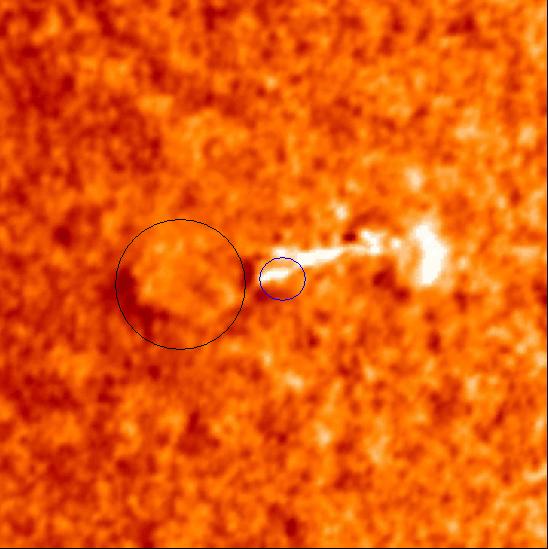
I have a question about that image. It appears to show a solid surface with ridges and other terrain elevation features.
These features can be seen in the image because they have distinct highlights and shadows that make them appear to be strongly and directionally illuminated, from a source located to the upper right of the area (since the highlights face that direction and the shadows are opposite) and from an elevation considerably above the plane of the surface (because the shadows are short).
My question for the iron sun proponents is, what's the source of that directional illumination?
If we're going to interpret the image based on what it looks like, it sure looks like there's a directionally localized light source brighter than the sun's surface shining on the sun's surface. What and where is that light source?
Respectfully,
Myriad
Iron's quite ductile, isn't it? I was just wondering how large a hollow iron sphere could be before it ceased to be rigid enough and collapsed under its own gravity. Don't really know where to begin, though.
Care to explain these images?
[qimg]http://www-istp.gsfc.nasa.gov/istp/events/2000apr4/SOHO/20000404_1632_c2rdif.gif[/qimg]
Apparently there are giant mountains extending out from the "surface" of the sun like spokes.
Either that, or interpreting light and dark parts of a running difference image as terrain features doesn't actually work.
Let's go through the calculation. I'll consider a small square patch of this surface, of sides LxL and depth z. The volume is L2z, and the mass is pL2z where p is the density. The weight of the shell is a bit tricker. At the outer surface, the gravity is g, but it's zero at the inner surface, and it varies linearly between the two. So the average gravity will be half the surface gravity, so the weight will be gpL2z/2.
OK, what keeps this patch of surface from falling inwards?
The term "resonant cavity" in this usage doesn't mean the sun *has* a cavity within it, just the modes of oscillation follow similar principles.
Yeah "in a lab", but last time I looked. labs could not duplicate Solar conditions.
And just WHERE do you come up with your fanciful percentages? I submit that you pull them from your rectum -- prove me wrong.
And there is the problem already mentioned that the temperture is observed to increase with depth.
Ok so now the surface is a bit mushy or "mostly solid" and made of 'unknownium' (since you apparently don't know what you want to claim it is made of).
It does seem though that you are not asserting it to be a hollow sphere.
You do understand that heat energy (usually measured in calories) moves from a higher temperature to a lower temperature, don’t you? So your hotter “outer layers” would, well, heat up the inner layers.
You do understand that heat energy is also radiantly transferred in all directions, don’t you? It doesn’t need “particles” (other then photons) to “carry’ it anywhere including from your hotter outer layers to your “mostly solid” “crust”.
For some bizarre reason you just seem to want to ‘simply suggest’ that “Heat is carried away from the crust of sun by the constant flow of particles away from the sun” without any regard for thermodynamics whatsoever.
Well, so far it appears that we have another retreat by MM.
MM, just a quick lurker question. You say the images posted on your site show a solid solar surface. And that those images where created with an image processing method called 'running difference'. Would an RD image of a gasous sun look very similar to your images? If not, why not?
Thanks - H
Surface tension and electromagnetic influences.
http://www.youtube.com/watch?v=cXsvy2tBJlU
According to your overly simplistic thinking, the water shell should crush the air bubble, but it does not. Why not?
The source of the illumination is the discharges at the base of the loop(footprints) as well as the loops it self. Same as arc welding or a arc lamp!!! This takes place with the light from ionized iron(77,000 to 1.5 million K).
The light source in the images is the loop itself as well as the footprints at the end of the loop arc.
Pfftt.Pfftt. Neither you or Geemack have touched Kosovichev's image. What are those "rigid features" under the photosphere in the areas I circled in this image?
http://www.thesurfaceofthesun.com/images/tsunami1.JPG
http://www.thesurfaceofthesun.com/images/vquake1.avi
Notice how the wave passes over the rigid outlines PS? Please explain how those rigid features persist over the lifetime of the video, and why they do not change their shape due to movements of the wave.
The only one "retreating" around here are you folks. You won't touch the images. GM thinks he "explained every pixel" of a specific RD image simply by describing the technique. "Flying stuff? What flying stuff?" That's just pathetic.
I must note here that Dr. Kosovichev is a VERY, very nice person, but he in NO WAY endorses my views about there being a "solid" surface on the sun. In a recent email from Dr. Kosovichev, he explained these features in the following quote:
"The consistent structures in the movie are caused by stationary flows in magnetic structures, sunspots and active regions.
We know this from the simultaneous measurements of solar magnetic field, made by SOHO. These are not solid structures which would not have mass flows that we see.
These images are Doppler shift of the spectral line Ni 6768A.
The Doppler shift measures the velocity of mass motions along the line of sight. The darker areas show the motions towards us, and light areas show flows from us. These are not cliffs or anything like this. The movie frames are the running differences of the Doppler shift. For the illustration purpose, the sunquake signal is enhanced by increasing its amplitude by a factor 4."
Baloney.Baloney. The corona radiates at millions of degrees. The chromosphere is about 20,000K. The photosphere is closer to 5700K. The deeper we go into the atmosphere the cooler it gets as the plasmas become more dense.
Furthermore, one must remember that 5777 Kelvins is an effective temperature, a best fit blackbody to an actual thermal emission that is a superposition of blackbody emission curves that are generated at different depths in the photosphere. Limb observations of the sun make it possible to retrieve the temperature structure of the photosphere as a function of depth, in much the same way as limb observations of Earth's atmosphere by satellites allows us to retrieve temperature profiles for the Earth's atmosphere (see, e.g., Solar Astrophysics by Peter Foukal, Wiley-VCh 2004, chapter 5: "The photosphere"; The Observation and Analysis of Stellar Photospheres by David Gray, Cambridge University Press 2005, 3rd edition). The temperature at the lowest level we can determine is 9400 Kelvins. We don't see much of that on Earth, because of the opacity of the overlying layers. But your iron surface is pretty much hugging the 9400 Kelvin base of the photosphere. To the best of my knowledge, the highest boiling point for any element is Rhenium, which boils at 5869 Kelvins, so no known element can survive as a solid or even as a liquid at the temperature found at the base of the photosphere.
The iron surface of the sun is thermodynamic toast, and "thermalize" is a pleasant fiction that bears no resemblance to the physics of this universe.

That is exactly what it does show, just like the ridges that are observable in Kosovichev's Doppler image. The "lifespan" and behaviors of these features is not like the behaviors and lifespan of plasma "structures".
The sun is rotating between images. That consistent rotation from left to right between images creates what you're calling a "directional" illumination, although the loops themselves are the light source.
The "light source(s)" are the coronal loops. They are discharge processes that heat the plasma to millions of degrees. The rotation of the sun between the two images is what creates the directional component, as does the movement of plasma past the surfaces. The "windward" side of the mountain ranges experience more electrical activity, and that too can (and does) have some influence on what we observe. The direction of plasma can be observed pretty clearly during the CME as particles from the surface blow from the bottom right toward the upper left of the image.
Keep in mind that brightly lit areas will rotate right, leaving a darker outline to the left. Each image is a composite image from two images taken a short time (10-30 minutes) apart. The movement of active areas between images creates what you're describing as the directional component of the lighting. The lighting however is strictly limited to "electrified plasma' inside the coronal loops.
Um, no. If you watch more than a single image (you can't tell anything from one RD image), you'll notice that everything in the image changes over time. The only "patterns" you'll observe in LASCO RD images are the stars in the background because like the surface features of the sun, they are consistent from one frame to the next. The plasma flowing off the sun however is highly mobile and nothing stays "rigid" from one frame to the next.
You can't tell what's solid from a single frame of a RD movie. The only way you'll notice "rigid features" is to observe many RD images over time. The LASCO RD images show a very clear pattern of change over time because the plasma is moving away from the sun. Unlike the 171A images, moving plasma is not stationary.