I don't think space is expanding.

Status
Not open for further replies.
Then you never understood.

If you haven't noticed, during our lifetime, the estimated number of galaxies in the universe seems to have an upward trajectory, while the temperature of the CMB stays the same.

One thing I admit I don't remember is whether or not we put a number on the deficit.
 
If the background radiation is emitted by a material source in a known classical fashion, that source must be behind everything else.

But here's where I say, if we permit only the known the laws of physics to explain the CMB, we arrive at the place we're at now, where there's a discussion of new physics to explain the CMB.

https://arxiv.org/abs/2103.01183

Why did you link that review? It says nothing about new physics to explain the CMB! It is about possible solutions to the Hubble tension. And part of that tension comes from observations of the CMB. There is a tension between early time and late time estimates of the Hubble constant. I see nothing in that review that suggests that the CMB is not what everybody knows it to be. Nobody is trying to claim that the CMB is anything other than the radiation from the big bang. Some of the solutions actually invoke the properties of dark energy itself! As per section 8.
I've only briefly skipped through the review, but if I have missed the part where somebody is suggesting a complete rethink of what the CMB is to explain the Hubble tension, then I'd appreciate you pointing it out.
 
Last edited:
Nobody is trying to claim that the CMB is anything other than the radiation from the big bang.

As is tradition.


In this context, several tensions present between the different cosmological probes become interesting because, if not due to systematic errors (and as we shall later show, their explanation would appear to require multiple, unrelated errors), they could indicate a failure of the canonical ΛCDM model. Currently, the most notable anomalies worth consideration are those arising when the Planck satellite measurements [11] of the Cosmic Microwave Background (CMB) anisotropies are compared to low redshift probes, or compared within the Planck data itself. The Planck experiment has measured the CMB power spectra with an exquisite precision, but the constraints for the cosmological parameters are always model-dependent. This means that, if there is no evidence for systematic errors in the data, a better model may be found which, if used for analysing the measured power spectra, would make tensions and anomalies disappear.

Basically... what I'm getting here is... the two most basic pieces of evidence for the big bang, which are the redshifts and the CMB, are supposed to tell the same story.

And they don't.

Of course no one is questioning the big bang theory.

They probably ought to though.
 
That's putting a lot of faith in the assumption we already observe the bulk of the universe.

JWST launches in October.

This is prediction made by the hypothesis.

To be clear: you're suggesting that there are much more distant galaxies than the ones we see, and that the radiation from them is what makes up the bulk of the CMB?
 
To be clear: you're suggesting that there are much more distant galaxies than the ones we see, and that the radiation from them is what makes up the bulk of the CMB?

In a roundabout way.

Let's say light reaches us with a redshift z=1.

It will have half the energy that it did when it left.

My thinking is, if we apply the conservation of energy, then the energy lost through redshifting has to be somewhere.

And that energy will presumably try to reach an equilibrium with its surroundings.

And that's the CMB.

If the problem is that not enough light is out there redshifting to provide the energy for that, then my question is, what is the amount of light out there and how much is required? That should form the basis of a prediction by the hypothesis.

Looking at this:

vslcdm.png


Look how in the standard model (dots), z>2 and z<10 are all located between 15 Gly and and 30 Gly away.

But in my hypothesis, the galaxies in that range are between 15 Gly and 60 Gly away.

Given an average density of galaxies within a cubic Mpc, my hypothesis predicts quite a bit more galaxies will be represented by that range of z's than the standard model.

The standard model also hits a dark ages than the surface of last scattering, the CMB.

In my hypothesis, none of that's true, there's just more galaxies with increasingly higher z's.

So, there are supposedly 2 trillion galaxies in the observable universe right now. If that's not enough to power the CMB, then the hypothesis predicts the estimated number of galaxies in the visible region will increase until there is.
 
Last edited:
Have you also considered that, given your larger universe, more of that light will end up in other places, and not here? That is, it will be spread out?

I'm having a hard time seeing how you are expecting to get a higher energy density of light arriving here from far off galaxies than from more nearby galaxies.
 
Have you also considered that, given your larger universe, more of that light will end up in other places, and not here? That is, it will be spread out?

Sure.

I'm having a hard time seeing how you are expecting to get a higher energy density of light arriving here from far off galaxies than from more nearby galaxies.

Well, say there's the Milky Way there, and then make a ring around it at a radius of 15 billion light years.

That would contain all the supernovae data.

Now if we make a larger ring an additional 15 billion light years out, we should be at a radius of 30 billion light years.

Is the amount of galaxies in the outer ring equal to double the galaxies in the inner circle?

It actually goes up by 4x.

And if we were talking volume in 3d, it'd go up by 8x.

In the standard model, that puts you out to about z=25, where the dark ages are and there should be no more galaxies.

That's it, that's all.

In my model, that distance puts you at z=4.

It just grows exponentially from there.

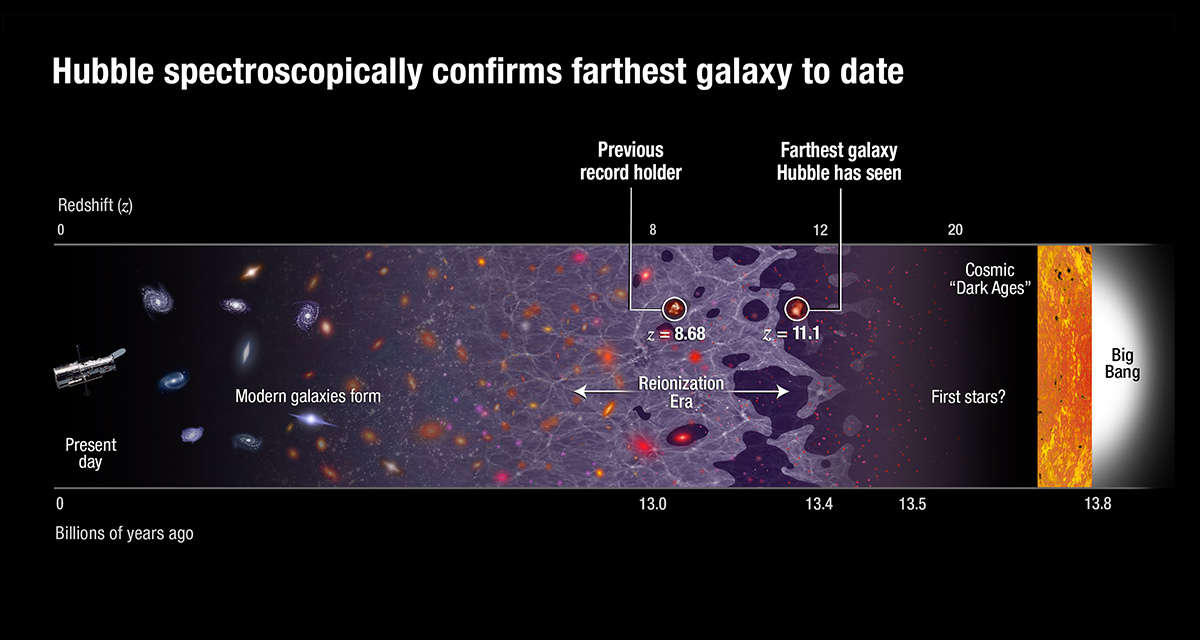
Here's another example, a galaxy was observed with z=11.

GNz11-FarthestGalaxyObservedByTheHST-20160303.jpg


That's kind of a fluke that happens inside some pocket of reionization.

In the standard model, that galaxy has a co-moving distance of something like 30 billion light years, and is very lonely.

In my model, that galaxy is actually 61 billion light years away, and has an awful lot of friends waiting to meet us.

 
Well, say there's the Milky Way there, and then make a ring around it at a radius of 15 billion light years.

That would contain all the supernovae data.

Now if we make a larger ring an additional 15 billion light years out, we should be at a radius of 30 billion light years.

Is the amount of galaxies in the outer ring equal to double the galaxies in the inner circle?
Yes. Have you the foggiest idea why that is? I bet you don't.
 
That's putting a lot of faith in the assumption we already observe the bulk of the universe.

JWST launches in October.

This is prediction made by the hypothesis.


Even if your prediction is right, your hypothesis will still be wrong for all the other reasons.
 
Even if your prediction is right, your hypothesis will still be wrong for all the other reasons.


The other reasons are "the universe doesn't work that way."

At which point, we should be thinking "maybe that's how the universe works."

On the other hand, the lambda-CDM model has objectively failed.
 
On the other hand, the lambda-CDM model has objectively failed.

Where did that happen? And what is the alternative? Tired light woo? Only pushed by crackpots these days? That is trivially shown to be wrong? Long since? Anything else? Electric universe? Creationism? The failing MOND 'models'?
Show us the superior model to LCDM. Where is it? What evidence supports it? If there was a superior model, with supporting evidence, it would be adopted. That is how science works. It is why we have the BB and LCDM models - they are far superior to what went before. And the evidence supports them.
 
Show us the superior model to LCDM. Where is it? What evidence supports it? If there was a superior model, with supporting evidence, it would be adopted. That is how science works. It is why we have the BB and LCDM models - they are far superior to what went before. And the evidence supports them.

Let's say you were presented with an alternative interpretation of the redshifts.

If that hypothesis were to explain the redshifts, but not explain the ultimate birth and fate of the entire universe along with calculations for how much of each element should be in the universe, that interpretation of the redshifts is automatically a failure, correct?
 
In a roundabout way.

Let's say light reaches us with a redshift z=1.

It will have half the energy that it did when it left.

My thinking is, if we apply the conservation of energy, then the energy lost through redshifting has to be somewhere.

And that energy will presumably try to reach an equilibrium with its surroundings.

And that's the CMB.

Complete gibberish. What distance are your galaxies at? Why is all of their light reaching us at a specific wavelength in microwave? Has that light, presumably from different distances, somehow managed to get tired lighted into the one wavelength? How did that happen? Why is it showing a temperature that is constant to 1 part in 100 000? The most perfect blackbody known to us. Galaxies will not show such a blackbody spectrum. Not even close. How many do you need to cover the whole sky in this one wavelength, one temperature radiation?

Sorry, it's a dumb argument, long since debunked. Here, try this from an actual astrophysicist;

Can the CMBR be redshifted starlight? NO!
http://www.astro.ucla.edu/~wright/stars_vs_cmb.html

Mind you, you shouldn't need a PhD in astrophysics to figure out why it is a dumb argument.
 
Let's say you were presented with an alternative interpretation of the redshifts.

If that hypothesis were to explain the redshifts, but not explain the ultimate birth and fate of the entire universe along with calculations for how much of each element should be in the universe, that interpretation of the redshifts is automatically a failure, correct?
No. What you described is not a failure. It becomes a failure when that explanation for redshift is proven wrong for other reasons. Your alternative explanations don't just fail to explain things, they are known to be wrong.
 
Let's say you were presented with an alternative interpretation of the redshifts.

If that hypothesis were to explain the redshifts, but not explain the ultimate birth and fate of the entire universe along with calculations for how much of each element should be in the universe, that interpretation of the redshifts is automatically a failure, correct?

Right now I'd settle for an alternative interpretation of the redshifts that explains everything else we also see besides the redshifts, and doesn't make predictions we can see are wrong.

Hit those milestones first, and then we'll talk about whether your hypothesis has anything to say about the very early universe.
 
It's not.

It is. That is why it is called the cosmic microwave background. Any alternative explanation will have to explain why we see it at that wavelength, and not any other/s.
The properties of the CMB tell us that it comes from one place at one specific time. If the radiation had travelled further in time (and therefore distance), then it would be stretched to longer wavelengths. If it was from closer in time and space, it would be at shorter wavelengths.

That's not what I claimed.

It is hard to tell what you are claiming. Only that it seems to bear little resemblance to known science.
 
Status
Not open for further replies.

Back
Top Bottom