Have you also considered that, given your larger universe, more of that light will end up in other places, and not here? That is, it will be spread out?
Sure.
I'm having a hard time seeing how you are expecting to get a higher energy density of light arriving here from far off galaxies than from more nearby galaxies.
Well, say there's the Milky Way there, and then make a ring around it at a radius of 15 billion light years.
That would contain all the supernovae data.
Now if we make a larger ring an additional 15 billion light years out, we should be at a radius of 30 billion light years.
Is the amount of galaxies in the outer ring equal to double the galaxies in the inner circle?
It actually goes up by 4x.
And if we were talking volume in 3d, it'd go up by 8x.
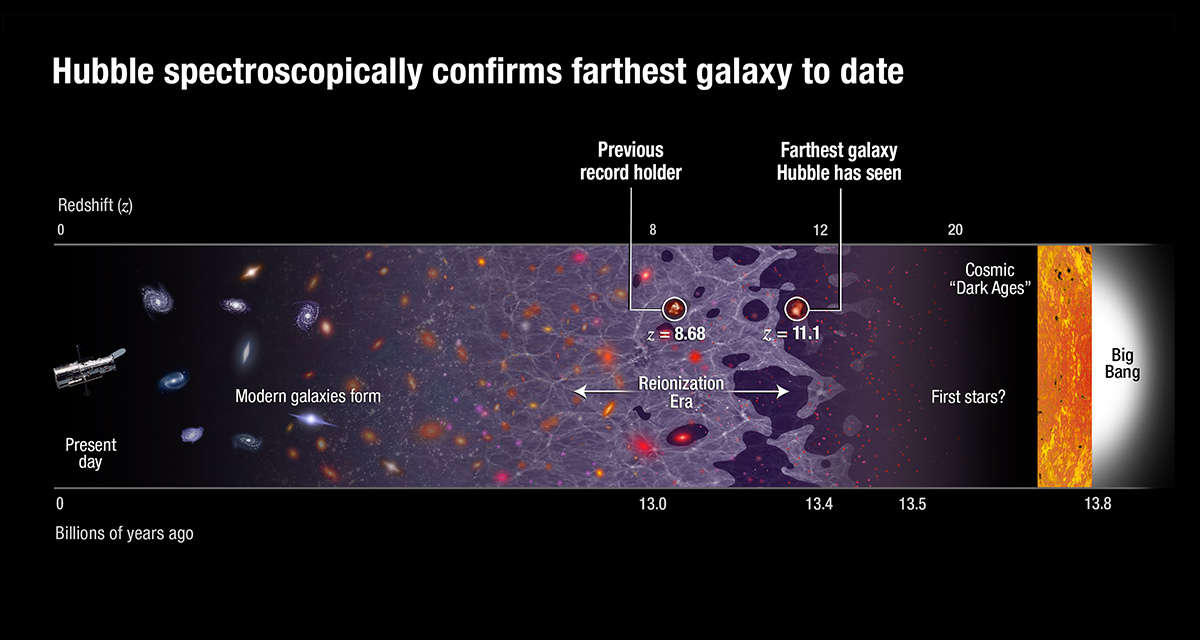
In the standard model, that puts you out to about z=25, where the dark ages are and there should be no more galaxies.
That's it, that's all.
In my model, that distance puts you at z=4.
It just grows exponentially from there.
Here's another example, a galaxy was observed with z=11.
That's kind of a fluke that happens inside some pocket of reionization.
In the standard model, that galaxy has a co-moving distance of something like 30 billion light years, and is very lonely.
In my model, that galaxy is actually 61 billion light years away, and has an awful lot of friends waiting to meet us.