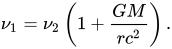
I don't think space is expanding.

Status
Not open for further replies.
You know what produces an increasing travel time?

Yes. A photon traveling at less than c.

*edit* I suppose you mean over successive trips.

The point is, nothing makes the distant clock's appear to run slow. They are slow.

In this universe, only nearby clocks run at full speed.
 
Last edited:
"The principle of the constancy of the speed of light can be kept only when one restricts oneself to space-time regions of constant gravitational potential." - Michael Scott, I mean Albert Einstein

https://en.wikipedia.org/wiki/Variable_speed_of_light#Einstein's_early_proposal_(1911)

I think I'm doing another cart before the horse move here.

Does the gravitational potential define how fast the clock moves?

Or does the clock motion define gravitational potential?

The move I'm describing is much more basic than the other VSL's mentioned on that page.

Premise 1. Clocks that are stationary to each other tick at the same rate
Premise 2. Redshift is observed at cosmological distances
Conclusion: Clocks separated by cosmological distances are not stationary

That's the expanding interpretation.

Premise 1. Clocks that are stationary to each other tick at the same rate
Premise 2. Redshift is observed at cosmological distances
Conclusion: Clock that are separated by cosmological distances do not tick at the same rate.

That's the "relativistic decelerating photon hypothesis."

Light leaving our galaxy decelerates.

Light approaching our galaxy accelerates.

What’s so special about our galaxy? You’re not a geocentrist are you?

Clocks separated by cosmological distances do not tick at the same rate you say: which ones tick faster and which ones slower? Why?
 
What’s so special about our galaxy? You’re not a geocentrist are you?

Nothing in particular. It's where we are, so D=0 here.

Clocks separated by cosmological distances do not tick at the same rate you say: which ones tick faster and which ones slower? Why?

At z=1, our clock is twice as fast.

A distant event that would take 1 second of the distant clock's time, would take half a second to our clock. *edit* two seconds.

This version of the hypothesis expects the time dilation of supernovae light curves.
 
At z=1, our clock is twice as fast.

A distant event that would take 1 second of the distant clock's time, would take half a second to our clock. *edit* two seconds.
And what do the aliens who own the distant clock see when they look at us?

This version of the hypothesis expects the time dilation of supernovae light curves.
This version explains the time dilation of supernovae light curves by positing that clocks run slower a long way from us putting us in a privileged location. You are a geocentrist!
 
And what do the aliens who own the distant clock see when they look at us?

They see our clock's running twice as slow as there's.


This version explains the time dilation of supernovae light curves by positing that clocks run slower a long way from us putting us in a privileged location. You are a geocentrist!

I think you misunderstand.

This applies for all observers.

The hypothesis is clocks run slower as their distance from you grows.
 
They see our clock's running twice as slow as there's.


I think you misunderstand.

This applies for all observers.

The hypothesis is clocks run slower as their distance from you grows.
I thought you were capable of illogical nonsense but this takes the biscuit.
 
I thought you were capable of illogical nonsense but this takes the biscuit.

We both agree that distant clocks are ticking slower, right?

And the standard explanation is that they're moving away from us.

This hypothesis is that they are just slower.

Clocks don't keep up with your clock as they stretch out to infinity.
 
Say:

v=c/(1+HD)2
From the simulations I do of this, at z=1, v=0.5c, at z=2, v=0.333c. So:

v = c / (1 + z).

c / (1 + z) = c/(1+HD)2
1 + z = (1+HD)2
sqrt(1 + z) = 1 + HD

That seems to check out.

That's your "acceleration" of the universe.
 
Yes. A photon traveling at less than c.

*edit* I suppose you mean over successive trips.

Yes. Obviously.

The point is, nothing makes the distant clock's appear to run slow. They are slow.

If they are slow, then that can't be a symmetric situation. And we're back to inhomogeneity and dark negative mass, which you earlier tried to deny.

Your ideas are consistently failures. You don't know any physics, why do you expect anything else?
 
If they are slow, then that can't be a symmetric situation. And we're back to inhomogeneity and dark negative mass, which you earlier tried to deny.

I think the hypothesis says that time itself is inhomogenous.

Place a clock in space every 1 million light years.

Assuming they're not moving, they're just distant, we assume that the clocks will tick at the same rate as our clock out to infinity, right?
 
I'm talking about space, not time. I have no idea what hypothesis you're even referring to.

The hypothesis is that the speed of a photon is c/(1+HD)2, where D is the distance of the photon from the observer.

This would imply that placing clocks farther and farther out in space will eventually run noticeably slower, and this is observed as the redshifted universe.

The clocks should fall off at 1/(1+z), which is also 1/(1+HD)2.
 
The hypothesis is that the speed of a photon is c/(1+HD)2, where D is the distance of the photon from the observer.

This would imply that placing clocks farther and farther out in space will eventually run noticeably slower, and this is observed as the redshifted universe.

The clocks should fall off at 1/(1+z), which is also 1/(1+HD)2.

You've got no idea what your own ideas imply.

Again, this requires (not implies) SPATIAL inhomogeneity, and if GR is to be believed (and you claim you don't want to throw it away), a hell of a lot of negative mass concentrated coincidentally where we are.
 
You've got no idea what your own ideas imply.

Again, this requires (not implies) SPATIAL inhomogeneity, and if GR is to be believed (and you claim you don't want to throw it away), a hell of a lot of negative mass concentrated coincidentally where we are.
He’s a geocentrist and he doesn’t even realise it.
 
You've got no idea what your own ideas imply.

Again, this requires (not implies) SPATIAL inhomogeneity, and if GR is to be believed (and you claim you don't want to throw it away), a hell of a lot of negative mass concentrated coincidentally where we are.

I think I get what you're saying.

That if the universe was a rubber sheet, that we would have to be at the heaviest part?

Maybe it could be something more like this:

59c83b2b13c2851ade8af4c6204afe9166f02bc5


https://en.wikipedia.org/wiki/Varia...heories_as_an_alternative_to_cosmic_inflation

This is what Einstein suggested at one point:

58b2afa39144b63888016e67cc30167d890f9787
 
I think I get what you're saying.

That if the universe was a rubber sheet, that we would have to be at the heaviest part?

Maybe it could be something more like this:

https://wikimedia.org/api/rest_v1/media/math/render/svg/59c83b2b13c2851ade8af4c6204afe9166f02bc5

https://en.wikipedia.org/wiki/Varia...heories_as_an_alternative_to_cosmic_inflation
No. These are proposals as alternatives to inflation. They are variations of physical parameters which are usually taken to be constant in time, and the proposal is that they vary only during the inflationary epoch, and are the same at all locations at any time (homogeneous space). They are carefully designed not to break physical laws and the relationships between the speed of light, the gravitational constant and mass are maintained.

Whereas your idea is that the speed of light varies in space, is different from one location to another, therefore predicts an inhomogeneous and geocentric Universe, continues to vary after the inflationary epoch right up to the present and breaks every known physical law and well-supported theory in physics. Apart from that your idea and the VSL hypotheses are identical. Well, not really - they have no parallels at all.
 
Well yeah.

Any light you interact with will be moving at c.

What about light other observers are interacting with? How fast would observers in GZ-11 see light from their own galaxy moving? How fast would observers in a z=1 galaxy from earth see that light moving as it arrived?

Does light ever move, anywhere for any observer, at a speed other than c? If not, what is left of your proposal?
 
Status
Not open for further replies.

Back
Top Bottom