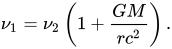
"The principle of the constancy of the speed of light can be kept only when one restricts oneself to space-time regions of constant gravitational potential." - Michael Scott, I mean Albert Einstein
https://en.wikipedia.org/wiki/Variable_speed_of_light#Einstein's_early_proposal_(1911)
I think I'm doing another cart before the horse move here.
Does the gravitational potential define how fast the clock moves?
Or does the clock motion define gravitational potential?
The move I'm describing is much more basic than the other VSL's mentioned on that page.
Premise 1. Clocks that are stationary to each other tick at the same rate
Premise 2. Redshift is observed at cosmological distances
Conclusion: Clocks separated by cosmological distances are not stationary
That's the expanding interpretation.
Premise 1. Clocks that are stationary to each other tick at the same rate
Premise 2. Redshift is observed at cosmological distances
Conclusion: Clock that are separated by cosmological distances do not tick at the same rate.
That's the "relativistic decelerating photon hypothesis."
Light leaving our galaxy decelerates.
Light approaching our galaxy accelerates.