
Mike Helland
Philosopher
- Joined
- Nov 29, 2020
- Messages
- 5,244
The scientific commumnity says that there is a tension between the CMB based measurement and the standard candle and other local methods. And you can't resist turning that into a claim that the CMB-based method is wrong (and that therefore we have to throw out lamda-CDM and the whole space expansion thing). It's at best a mistaken reading of what the community is saying and at worst a deliberate misrepresentation.
Not sure who you've been listening to.
Were it not for the CMB measurements, the Hubble constant would probably be considered a solved problem, and researchers would move on to other projects. But the CMB results are highly compelling despite the fact they are not direct measurements of H0. Instead, they are predictions of what H0 should be, given known conditions in the early cosmos and how the universe’s main ingredients influence cosmic expansion.
https://astronomy.com/magazine/2019/06/tension-at-the-heart-of-cosmology
The extrapolations from the early universe are based on the simplest cosmological theory — called lambda cold dark matter, or CDM — which employs just a few parameters to describe the evolution of the universe. Does the new estimate drive a stake into the heart of CDM?
“I think it pushes that stake in a bit more,” Blakeslee said. “But it (CDM) is still alive. Some people think, regarding all these local measurements, (that) the observers are wrong. But it is getting harder and harder to make that claim — it would require there to be systematic errors in the same direction for several different methods: supernovae, SBF, gravitational lensing, water masers. So, as we get more independent measurements, that stake goes a little deeper.”
https://news.berkeley.edu/2021/03/08/how-fast-is-the-universe-expanding-galaxies-provide-one-answer/
In any case.
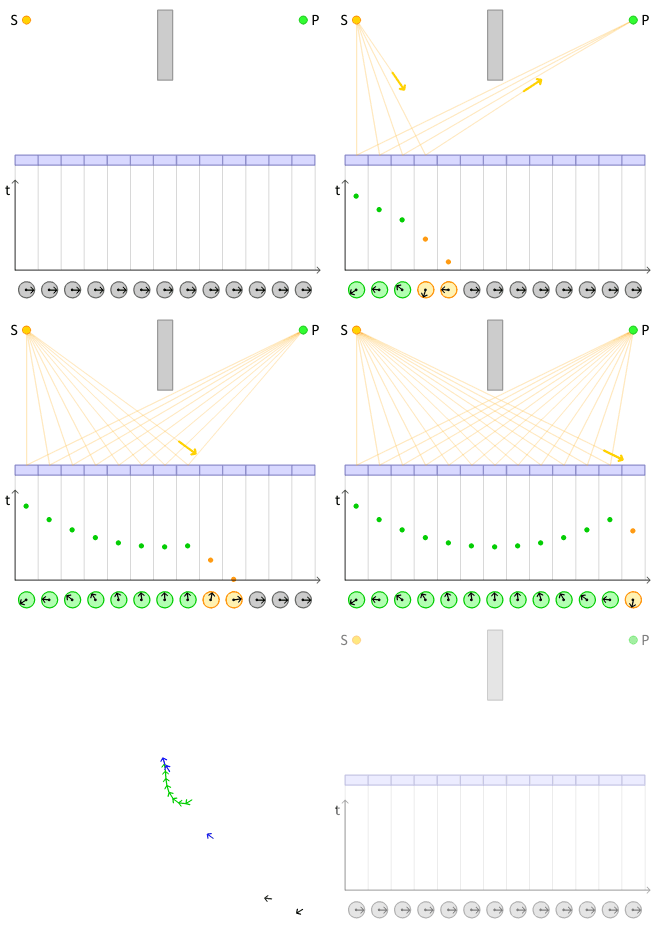
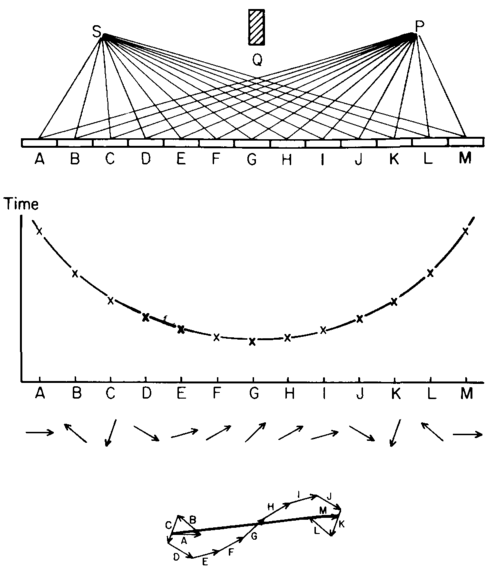
I'm stuck on the Feynman path integrals.
When a photon travels I add the number of nm traveled to a running total (this includes both the x and y directions). The nm traveled is always 2.997..., the speed of light divided by 1017.
I'm setting the clock dials to x=cos(total) and y=sin(-1*total), for no other reason than this starts the clocks pointing west and rotate counterclockwise like the cartoon.
When the total distance is 360 or some multiple, the clock points back where it started. So this would be for a photon with a wavelength of 360 nm.
I take all the clock hands when finished, and stick them end to end based on the direction they end up pointing.
I think that's probably wrong.
Because doing that, if I start the clocks pointing in a different direction, or spin them a different way, the final output S shape is the same, but pointing in a different direction.
And that makes sense. If the clocks in the center are pointing in a certain direction when the photon's are finished, that's the direction the red line at the end points. But that seems pretty arbitrary. Move the boundary some and the final S points in a wildly different direction.
You can see it run here, it only takes a couple seconds to finish.
https://mikehelland.github.io/hubbles-law/other/reflection_nm.htm
Here's the output



 .
. ! The overwhelming physical evidence that the universe is expanding still makes your idea into a fantasy.