I don't think space is expanding.

Status
Not open for further replies.
I don't think space is expanding. I think the light slows down.

Suppose that happened. Since wave fronts cannot disappear, what happens to those wave fronts? They get closer together. In other words, the frequency stays the same, and the wavelength decreases.

If I can show that the clock thingies allow a decelerated photon to reflect properly without changing the angle, will you lighten up a bit?

But you cannot show that, and you won't be able to. This is pure delusion, which you cling to because of your profound and impenetrable ignorance.
 
Suppose that happened. Since wave fronts cannot disappear, what happens to those wave fronts? They get closer together. In other words, the frequency stays the same, and the wavelength decreases.

Ok.

r=vt

Lower v, lower radius of secondary wave.

Right?


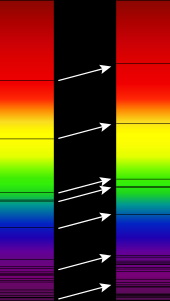
When we talk about redshifts:

170px-Redshift.svg.png


Are we talking about photon arrival rates, or photon energy?
 
On the other hand, "not moving at all" is wrong by 100%.

If we were staring at cars in front of us in a traffic jam, given the variety of tail lights, we could more or less judge their distance on what kind of car they have, and how big the tail light appears.

As you type, it is the photon that holds the atoms in your finger together, and atoms in my keyboard, and make the finger press the key down, typing a number, with photons pushing electrons to make the letter appear on your screen, and transmit it to me.

That interaction provides most of what makes up your every day life. If you were an astronaut, even more.

We can use the tail light method, and that works well, out to about 100 million light years and we notice something interesting.

The road is expanding!

II used to believe that. I really did.

Now I think the electromagnetic force is not infinite in range.
 
Ok.

r=vt

Lower v, lower radius of secondary wave.

Right?

Secondary wave? What secondary wave? Nothing I said has anything to do with primary versus secondary, whatever that distinction is supposed to be.

When we talk about redshifts:

[qimg]https://upload.wikimedia.org/wikipedia/commons/thumb/6/6a/Redshift.svg/170px-Redshift.svg.png[/qimg]

Are we talking about photon arrival rates, or photon energy?

Wow. After all this time, and you're still confused about this. That's just sad.

Figure it out, Mike. I'm done holding your hand.
 
Secondary wave? What secondary wave? Nothing I said has anything to do with primary versus secondary, whatever that distinction is supposed to be.


You were saying the wavefronts get closer together.

That's a result of r=vt.

Wow. After all this time, and you're still confused about this. That's just sad.

Figure it out, Mike. I'm done holding your hand.

I'm not confused. I'm trying to be clear.

You said the frequency stays the same and the wavefronts get closer together.

That's a different kind of frequency than photon energy.
 
You were saying the wavefronts get closer together.

That's a result of r=vt.

OK. You don't need Huygens for that, but it applies there as well.

I'm not confused.

You most certainly are.

I'm trying to be clear.

Perhaps. You are doing a bad job at it.

You said the frequency stays the same and the wavefronts get closer together.

That's a different kind of frequency than photon energy.

No, Mike. It isn't. The photon frequency which determines the energy is equal to the frequency at which wave fronts arrive. These are not different kinds of frequencies, they are exactly the same.
 
No, Mike. It isn't. The photon frequency which determines the energy is equal to the frequency at which wave fronts arrive. These are not different kinds of frequencies, they are exactly the same.

I don't understand. (Shocker.)

A single photon arrives, and delivers its energy in a single event.

How could a single photon's energy be based on multiple events?
 
I really do appreciate the patience and knowledge you and others here demonstrate.
No you don’t. If you did you’d be more humble about your errors, instead of barely admitting them before moving on to the next one, or returning to one that was thoroughly debunked half a gazillion pages back. You think you’re in a debate between equals. Everyone else can see that you’re not because you know nothing. You show no real desire to learn - you’re just searching for poorly understood concepts that you think will support your hopelessly wrong idea.
 
Ok.

So we need a new hypothesis. One that resolves the Hubble tension.

And there is an active search for a solution, and alternatives to the standard cosmological model. Correct?

And not like there was ten years ago. The Hubble tension really became clear a few years ago and sharper since then. Correct?
Yes, all of that is true except that what is searched for is not necessarily or even primarily an “alternative to the standard cosmological model”, but more likely a refinement. What is needed is an explanation that resolves the tension and it cannot and will not be your idea.
 
Yes, all of that is true except that what is searched for is not necessarily or even primarily an “alternative to the standard cosmological model”, but more likely a refinement. What is needed is an explanation that resolves the tension and it cannot and will not be your idea.


https://arxiv.org/abs/1903.07603

Large Magellanic Cloud Cepheid Standards Provide a 1% Foundation for the Determination of the Hubble Constant and Stronger Evidence for Physics Beyond LambdaCDM

We summarize independent tests which show this discrepancy is not readily attributable to an error in any one source or measurement, increasing the odds that it results from a cosmological feature beyond LambdaCDM.

I see almost no risk of exploring other options.

If nothing else, I'll have made some cool pictures.

Does the direction or starting point on the clocks matter? Or just the rate the hands move?

 
I don't understand. (Shocker.)

A single photon arrives, and delivers its energy in a single event.

How could a single photon's energy be based on multiple events?

You say "event" like it's a specific infinitesimal time. It isn't. Photons are not point-like particles. They are waves, they are spread out in space, both in the direction they travel and perpendicular to that. In general, they have multiple wave fronts. Photon arrival is in fact spread out over a time interval. If you knew anything about quantum mechanics (which of course you don't), you'd immediately recognize why this MUST be so, why photon arrival CANNOT be an infinitesimal time.
 
Doesn't the evidence do that?
Yes, the evidence on which the well established theory is built is what is ultimately appealed to. But well-established theories are the bedrock of physics because they encapsulate and codify all those millions of observations and predict behaviour in novel situations. It’s what distinguishes physics from stamp collecting. We know that electromagnetic theory is an accurate description of electromagnetism, and we know that the speed of light c falls directly out of the Maxwell equations. That falsifies any idea which depends on the speed of light not being c or being more than one value here and now, unless and until you come up with a theory of electromagnetism which allows the thing you need AND explains all of the rest of electromagnetism as well as the current theory.

Nothing that we know is true for thousands of light years is guaranteed to be true for trillions of light years.
But we are not talking here about thousands or trillions of light years away. We are observing that the behaviour of light here and now falsifies your idea.
The evidence makes me skeptical that light really does go to infinity
Your skepticism is rendered impotent by your ignorance.
I don't think space is expanding. I think the light slows down.
We have demonstrated in multiple ways that this wrong. You are just too ignorant and pig-headed to accept it.

If I can show that the clock thingies allow a decelerated photon to reflect properly without changing the angle, will you lighten up a bit?
The clock thingies?! Geez. I’m pretty sure you don’t even understand what they represent. I mean, you were asking me whether the arrow length is the wavelength not long ago.

You won’t show what you hope to show with the “clock thingies” - I already know what the answer is because I understand the physics. I won’t lighten up because I am frustrated with your attitude. You come here and display one truly fundamental misconception about physics after another, and you can’t do simple trigonometric sums. Then you have the gall to lecture people who have paid their dues learning physics and maths to levels inconceivable to you, and worked in the field for decades, about what constitutes falsification and how much of a failure the measurements of the Hubble constant have been. You know so little that you can’t see why your idea is a crock, even after it’s been pointed out to you dozens of times, and yet you still think you can get one over us by sitting in your armchair googling words that you just heard for the first time yesterday. If that’s not unjustified arrogance, I don’t know what is.
 
We have demonstrated in multiple ways that this wrong. You are just too ignorant and pig-headed to accept it.

If a cosmologically redshifted photon is treated as regular light, sure.

In that case, the universe must be expanding, it must be accelerating, it must have inflated, and we need new physics.

If a cosmologically redshifted photon is treated with new physics, we can skip a bunch of steps.

Don't get too worked up over it. I'm not worth it.
 
Does the direction or starting point on the clocks matter? Or just the rate the hands move?
Are you sure you understand what the “clock thingies” are meant to represent, or what any result you get means physically? Asking these kind of questions would make me think not.

It doesn’t matter what direction they start as long as they all start with the same direction. They rotate 2pi per wavelength travelled.
 
You say "event" like it's a specific infinitesimal time. It isn't. Photons are not point-like particles. They are waves, they are spread out in space, both in the direction they travel and perpendicular to that.

Yeah, but there's really no time a photon is "halfway in" an electron.

Schro's cat is either dead or alive, but half dead isn't an option, afaik.

If you're standing in a body of water, a wave can come towards you. At some point the crest of the wave can be at you, and then the trough.

Does that apply to quantum particles?

A particle absorption could take a non-zero, non-infinitesimal, finite amount of time, but it's still a single event, is it not?

In general, they have multiple wave fronts. Photon arrival is in fact spread out over a time interval.

When does the photo multiplier go off?

When a photon has completed its interaction?

How do we know when the interaction begins?
 
If a cosmologically redshifted photon is treated as regular light, sure.
How else would you treat light under QM. You are currently hoping that playing with Feynman’s cartoon, you can demonstrate that slowed down photons will reflect without violating Snell’s law. But I know you are doomed to fail (again), because, having a crystal ball understanding the physics, I already know that you will show that it does violate Snell’s law. But do carry on.
 
Q. Why can't we measure the expansion rate of the distance between us and a car?

A. We can.

A cop with a radar gun gets one value from measuring the timing of the radar return.

A driver in another car making an estimate based on their own speedometer reading gets another value.

A bystander counting the seconds as the car passes each streetlight gets yet another value.

But they all agree that the car is definitely moving. Nobody thinks that because the bystander's streetlight estimate is way off (due to him miscalculating how far apart the streetlights are) from the other two, the car might not be moving and perhaps something else is going on.

They also can see the car from different angles.

In our case, we only ever see the tail lights.

Light drops off with an inverse square.

And I'm suggesting, that's nested in an even larger inverse square using Hubble's constant (with units inverse distance).

You completely ignored the point. We can measure the expansion of the universe. The fact that different methods give slightly different answers doesn't mean we can't measure it, it means that at least one of those measurements has an error that is larger than we think.

Given the complexity of the task and the number of confounding factors that could lead to those errors, it's not that surprising if it turns out we missed something in at least one of these measurement schemes.

theprestige's analogy actually captures this very well. Your remark about different angles is completely tangential to that point. Did you miss the point, or were you deflecting?
 
The fact that different methods give slightly different answers doesn't mean we can't measure it, it means that at least one of those measurements has an error that is larger than we think.


Model independent measuresment gives 74.

Lambda-CDM predicts 67.

I think it's pretty obvious which one to doubt.
 
Status
Not open for further replies.

Back
Top Bottom