I don't think space is expanding.

Status
Not open for further replies.
It's up for discussion. But that discussion needs to have more than just: 'There are some unsolved problems with the standard model, therefore whatever I prefer to believe instead.'


Sure.

I believed in the big bang and the expanding universe when I was kid and up to adulthood.

It could be right, but now I'm not so sure.

My hypothesis is basically this:

1. We observe redshift, which is a decrease in frequency
2. the speed of a wave is frequency times wavelength
3. a decrease in frequency means a decrease in speed

I then propose several mathematical formulations of that conjecture, with the prominent one being the speed of a photon is c - H * D. I show how this relates to the standard model, and that it deviates in the same way from the standard model that observations behind the Hubble tension do.

You can read a lot more about it here:

https://mikehelland.github.io/hubbles-law
 
1. We observe redshift, which is a decrease in frequency
2. the speed of a wave is frequency times wavelength
3. a decrease in frequency means a decrease in speed

3 is wrong. Changes in velocity do not produce changes in frequency, but only in wavelength.
 
What's missing from this 'crisis in cosmology'? The idea that space is not expanding at all.

Yeah.

Obviously my opinion is that alternate forms of Hubble's Law should be on the table.

My version of it resolves Hubbles tension. Here's my hypothesis (green) vs the standard model (white dots) at H=74

graph_h74.png
 
3 is wrong. Changes in velocity do not produce changes in frequency, but only in wavelength.

a = b * c

If b goes down, a goes down.

v = frequency * wavelength

The standard model says the observed frequency decrease leads to an increase in wavelength.

My hypothesis says a decrease in frequency leads to a decrease in velocity.

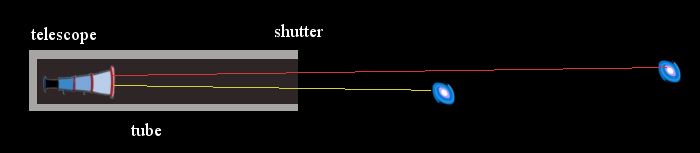
This can be tested by putting a telescope in space, and placing a shutter a fair distance from its lens. When the shutter is closed, any redshifted light should stick around after the normal light disappears if its moving slower.

If both normal galaxies and highly redshifted galaxies disappear from view at the same time, my hypothesis would be falsified.
 
a = b * c

If b goes down, a goes down.

Or c goes up. You can't tell by that equation alone.

My hypothesis says a decrease in frequency leads to a decrease in velocity.

Your hypothesis is wrong.

This can be tested by putting a telescope in space, and placing a shutter a fair distance from its lens. When the shutter is closed, any redshifted light should stick around after the normal light disappears if its moving slower.

If both normal galaxies and highly redshifted galaxies disappear from view at the same time, my hypothesis would be falsified.

There's an easier way to tell, which has already been done. If velocities are different, then the Doppler shift due to the motion of the earth around the sun will be different for different sources.

It isn't.
 
Your hypothesis is wrong.

I think I'll the experiment decide that.

There's an easier way to tell, which has already been done. If velocities are different, then the Doppler shift due to the motion of the earth around the sun will be different for different sources.

That doesn't test the hypothesis at all.

The red-shifted light should be red-shifted by Hubble's law.
 
I think I'll the experiment decide that.

It already has.

That doesn't test the hypothesis at all.

The red-shifted light should be red-shifted by Hubble's law.

And there would be an additional red shift or blue shift due to earth's orbit, and that shift would reverse as the earth's direction reverses. It would be a larger effect the slower the light is.

But that's not what astronomers actually see. It's the same for all sources.
 
I think I'll the experiment decide that.


That doesn't test the hypothesis at all.

The red-shifted light should be red-shifted by Hubble's law.

Ziggurat specifically referred to the annual-cycle Dopper shift due to the earth's motion around the sun. Which has nothing to do with the cosmological red shift. Nor with any other possible sources of redshift (e.g., galactic rotation, proper motion, etc.)

The magnitude of that shift will go approxmiately as the quotient of the earth's orbital speed and the speed of incoming light. Any variation in the latter between sources would produce variations in the observed Doppler shift of light from those sources.
 
Last edited:
Thank you. Unfortunately, while all answers are responses, not all responses are answers. Your post in no way answered my question.

What is the benefit to proposing something with no way of knowing whether it is true or not?

That there is more to the universe than what is in the observable region is neither an original idea by me nor exclusive to my hypothesis.
 
It already has.


And there would be an additional red shift or blue shift due to earth's orbit, and that shift would reverse as the earth's direction reverses. It would be a larger effect the slower the light is.

But that's not what astronomers actually see. It's the same for all sources.


You do know what when we observe the night sky, we're pointing our telescopes away from the sun?

Our line of sight at night is perpendicular to our motion around the sun.
 
Do you think everything in the universe can be observed from earth?
That doesn't answer my question either. Why are you so resistant to answering a question?

In good faith, I will answer yours. No, I don't. I expect that beyond our light horizon there is essentially more of the same, until we reach the wavefront of the expansion of the universe, which has to be out there somewhere. But there is no way of knowing whether that's true or not so I don't feel the urge to spend a great deal of intellectual energy thinking about it.
 
That doesn't answer my question either. Why are you so resistant to answering a question?

In good faith, I will answer yours. No, I don't. I expect that beyond our light horizon there is essentially more of the same, until we reach the wavefront of the expansion of the universe, which has to be out there somewhere.

Ok.

As I said in my first reply, in standard cosmology, there's this thing called Hubble Limit/Length/Volume/Sphere:

https://en.wikipedia.org/wiki/Hubble_volume

The idea that our observable region is not the whole universe is widely accepted and uncontroversial.
 
You do know what when we observe the night sky, we're pointing our telescopes away from the sun?

Our line of sight at night is perpendicular to our motion around the sun.

You do know that the night sky is pretty much a hemisphere, right? And that we can look at stars in the direction the earth is orbiting just fine? They're right there on the horizon.

"Line of sight" smh
 
You do know that the night sky is pretty much a hemisphere, right? And that we can look at stars in the direction the earth is orbiting just fine? They're right there on the horizon.

"Line of sight" smh

True, but I'm talking about space telescopes, because the ancient light can't have interacted with the atmosphere.

And if the Hubble telescope gets less than 50 degrees away from the sun it breaks.
 
True, but I'm talking about space telescopes, because the ancient light can't have interacted with the atmosphere.

But neither me nor Ziggurat was; we were talking about measuring the red/blue shifts of the light from celestial objects and how they change over the course of the year. If light from different celestial objects were coming in at different speeds, the change in their red shifts and blue shifts over the course of the year would also be different. They aren't.

So the hypothesis you have in mind has already been tested, just by a different experiment.

And if the Hubble telescope gets less than 50 degrees away from the sun it breaks.

Which means it can look at stars in a 260 degree arc, and not just a 180 degree arc. That's still not a "line of sight" perpendicular to the earth's motion, in fact its even less of one.
 
But neither me nor Ziggurat was; we were talking about measuring the red/blue shifts of the light from celestial objects and how they change over the course of the year. If light from different celestial objects were coming in at different speeds, the change in their red shifts and blue shifts over the course of the year would also be different. They aren't.

If the light is traveling through the atmosphere, it will be traveling at the speed of light in that medium.

In v = c - H * D, the c and H are constant. The D is distance.

----

The photon's distance from where it was emitted is crucial to keep in mind at all times. Consider light that has traveled billions of years to reach your telescope. The light enters the lens, gets focused to the eyepiece, and then into your eyeball.

Seems pretty straightforward. But at some level, some type of interaction with the light and the lens must be focusing the light. At the quantum level, the photon will have been absorbed by atoms in the lens. Then it is re-emitted (or an entirely new photon is emitted), and focused to your telescope's eyepiece.

The photon may have traveled great distances from its source before it encountered your telescope, but the light inside the telescope will be very close to its source: the lens that focused it. The distance to the source of the photons in the telescope will be less than a meter, not millions of light years.

In that case the refreshed photon will be traveling at c, which now results in an elongated wavelength when calculated.

Tests
Test 1: measure the speed of a cosmologically red-shifted photon

This is the first obvious test of the hypothesis.

But it would take thousands or millions of years to perform a fully controlled experiment where light is emitted with a known energy at a known time and travels across a known distance to see the effects of red-shift.

Using light that has already traveled millions of years seems to be the only choice.

But interacting with the photon will cause it to reset its distance and speed, as mentioned in the previous section. The task then is to come up with a clever way to measure the speed of ancient light without disturbing the photon.

Consider a long tube in space with a telescope at one end and an open shutter at the other. The telescope has a nearby galaxy and a highly red-shifted galaxy in its sight.

What happens when the shutter is closed?

Prediction: Because the red light is moving slower than the yellow light, first the nearby galaxy will disappear from view, then the distant one.

Obviously the longer the tube is the better the experiment would be. A few kilometers at least, a light second would be great. If we use a predictable and fast enough object in space as the shutter, that might work just as well. The shutter must not reflect any light. The moon may be too bright and too slow to work.

experiment1.png
 
Status
Not open for further replies.

Back
Top Bottom