• Security incident: ISF was recently accessed by intruders. Please change your password, and change it anywhere else you used it. Read more

How the banks create money

The theoretical maximum increase of the money supply is 9x based upon repeated lending and depositing.

False.

Banks don't loan out deposits, they invent money and loan it out. The deposits must equal one tenth of loans. That means for every $1 deposited the bank can invent and loan out $10. The immediate increase possible is therefore on the order of 900%. We're already at your "theoretical maximum", and that's before the first loan ever gets put back into the bank as a deposit, and ignoring that the bank also invents "interest" debt every time they make a loan, but never create the money to pay that interest, only the principal. Really the sky is the limit, since every $1 deposited into a bank spawns $10 in potential loans. The fractional reserve system just keeps them from exploding the money supply even faster. And every time they invent money they set in motion a chain of events that leads to direct and irreversible transfer of wealth directly to the banking industry.

So, your assertion that a bank can have $10K and, by itself, lend $100K based on that 10, is wrong.

False.

If this seems like an insane rigged game that you can never win, that's only because it is.
 

Haha, for somebody that repeatedly tells people to "read Modern Money Mechanics" you sure do like to ignore the bits in it you don't like/understand!

Once again, for those in the cheap seats:

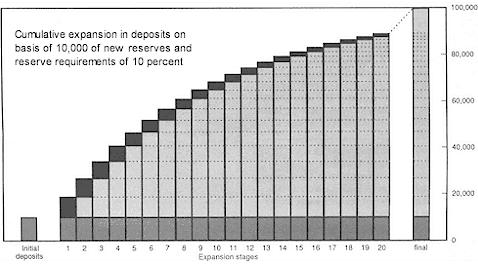
The total amount of expansion that can take place is illustrated on page 11. Carried through to theoretical limits, the initial $10,000 of reserves distributed within the banking system gives rise to an expansion of $90,000 in bank credit (loans and investments) and supports a total of $100,000 in new deposits under a 10 percent reserve requirement. The deposit expansion factor for a given amount of new reserves is thus the reciprocal of the required reserve percentage (1/.10 = 10). Loan expansion will be less by the amount of the initial injection. The multiple expansion is possible because the banks as a group are like one large bank in which checks drawn against borrowers' deposits result in credits to accounts of other depositors, with no net change in the total reserves.

Modern Money Mechanics, page 8
 
Once again, for those in the cheap seats:

Note that the passage you cite says "the initial reserves", not "the initial deposits". It states plainly in black and white:

The deposit expansion factor for a given amount of new reserves is thus the reciprocal of the required reserve percentage (1/.10 = 10).

Stated openly, right in front of your eyes, "the deposit expansion factor...is...10". That means the bank can invent ten times the amount of deposits and loan that out. That money goes into banks where it is then seen as a "deposit", which leads to another 10X expansion. It's very simple, you just quoted it, read it.

[ETA -

Read Modern Money Mechanics, it's not long.

]
 
Last edited:
Note that the passage you cite says "the initial reserves", not "the initial deposits".


Oh, gee I'm sorry. I forgot the heading of the paragraph for you:

How Much Can Deposits Expand in the Banking System?

and the title:

Deposit Expansion

Perhaps you prefer pictures rather than words?

image001.gif


Modern Money Mechanics, Page 12. Please note the "original deposits" on the graph.


the deposit expansion factor...is...10".

Please take note of the operative word, factor. Meaning, under fractional reserve lending (in the US), $10K can become $100K (in total) after 20 successive transactions. "Successive transactions" being loans/deposits.

That means the bank can invent ten times the amount of deposits and loan that out.

Incorrect, as already explained (approaching ad nauseum).

That money goes into banks where it is then seen as a "deposit", which leads to another 10X expansion. It's very simple, you just quoted it, read it.

Incorrect.

Read Modern Money Mechanics, it's not long.

Not long, but apparently far, far too difficult for you.
 
Last edited:
Meaning, under fractional reserve lending (in the US), $10K can become $100K (in total) after 20 successive transactions.

This would be the case, if banks loaned out deposits. They do not loan out deposits, they invent the money that they loan. The deposits remain untouched, and the bank is legally allowed to invent and loan out ten times what they carry in deposits. If this didn't take place, if the bank only loaned out what was deposited the money supply would never increase.

The cartoon graph you show in no way represents the legal capacity of banks to create money, it's a sleight-of-hand trick to distract you from the words on the paper. The word on the paper state flatly that banks invent the money the loan out and are legally allowed to invent ten times their deposit receipts. This is horrible enough as it is, since the banks charge interest for which there is never any money to repay.

It's further compounded (to infinity if we'd let them) by the fact that all loans from all banks go back into banks as deposits, and are indistinguishable from "initial deposits" used to calculate reserves. So, therefore, every dollar a bank gets in deposits turns into ten dollars in loans which turns into ten dollars in deposits which turns into one thousand dollars in loans and so on. It's all explained in the words, you'll need to do more than look at the picture to understand how banks invent money and the (lack of any meaningful) legal constraints on it.
 
It's further compounded (to infinity if we'd let them) by the fact that all loans from all banks go back into banks as deposits, and are indistinguishable from "initial deposits" used to calculate reserves. So, therefore, every dollar a bank gets in deposits turns into ten dollars in loans which turns into ten dollars in deposits which turns into one thousand dollars in loans and so on. It's all explained in the words, you'll need to do more than look at the picture to understand how banks invent money and the (lack of any meaningful) legal constraints on it.

How is it that this hasn't collapsed the system? With every dollar ballooning to a thousand, you would expect it to fall apart in short order, wouldn't you?

Does this count as a testable hypothesis?
 
The cartoon graph you show in no way represents the legal capacity of banks to create money, it's a sleight-of-hand trick to distract you from the words on the paper. T

Oh right, so Modern Money Mechanics isn't the be-all and end-all? Why did you keep telling people to read it if it's just a sleight-of-hand?

It's OK, I just discovered you are also a 911 conspiracy theorist. Welcome to ignore :)
 
How is it that this hasn't collapsed the system?

The system is routinely collapsed. It's happened many times in my lifetime. We just saw an example of that, complete with trillion dollar "bailouts" of the banks. Why did they need to be bailed out? How is it possible money just vanished out of the system? Does somebody have those trillions in their piggy bank or under their mattress, or maybe they withdrew it in cash and spent it all on thai hookers and heroin. This debt forgiveness is essential to the scam. Governments blame the banks to appease the people, banks blame the people to appease the government, the media foists that lie on the public at large (both the "winners" and "losers" of the game). Always the blame is pushed onto the shoulders of those who have the least influence on the system as a whole, it's like blaming a pile of corks for causing a tidal wave.

With every dollar ballooning to a thousand, you would expect it to fall apart in short order, wouldn't you?

There are limiting factors that slow down the planned, cyclical self-destruction. And like a phoenix the system rises from its own ashes. Limiting factors are varied but the most important one is demand for debt. The demand is only so high really, in practice this limits the amount of money banks can invent. Only being able to invent ten dollars for every dollar of deposits also limits the growth rate, but nothing puts an absolute limit on the amount of money banks can invent, when their collusion is factored in.

Does this count as a testable hypothesis?

No, this is not a hypothesis, any more than it's a hypothesis that the Earth exists. The Federal Reserve states in their own documents that this is how the system operates.

  1. All new money generation incurs debt that can never be repaid.
  2. Banks invent new money every time they make a loan, they don't borrow from their deposits, they keep that as the "reserve" and invent the money they loan out.
  3. Nothing prevents the loans from coming back to the banks as deposits, so there is no upper limit to the amount of money they can invent.

Eventually, like you pointed out, it all flies apart. If it isn't halted by control of the money supply, it crashes and burns. Once the halt begins, it's hard times for anyone who's not cash-rich, because there is no more credit. And there continues to be no credit until all the banks settle up, decide who fails and who goes on to the next round, then they hand each other more monopoly money and the game starts again.

 
3. Nothing prevents the loans from coming back to the banks as deposits, so there is no upper limit to the amount of money they can invent.

That is not correct. The reserve ratio limits the maximum amount of money that can be created through loans. As it states on page 8 of MMM:
The deposit expansion factor for a given
amount of new reserves is thus the reciprocal of the required
reserve percentage (1/.10 = 10). Loan expansion will be
less by the amount of the initial injection. The multiple
expansion is possible because the banks as a group
are like one large bank in which checks drawn against
borrowers' deposits result in credits to accounts of other
depositors, with no net change in total reserves.


It is bad debts that result in money being lost. Even if the banks don't fold, ultimately it is the "ordinary" people who will end up paying for it in one form or another.

Transaction accounts should not be subject to the same sort of risks as investment accounts but that would mean full reserve banking and at this point everybody here yells out "CT!!!"
 
BTW the reason why the money supply is endlessly expanding is because the Fed is constantly creating new money (reserves) thanks to the bonds created by the government to cover its budget deficits. When this new money filters through to the banks the multiplier effect comes into being.
 
Actually, I couldn't find anything like that on page 6. What I did find was the following:


Still doesn't support it. Here they are saying that f the bank actually hand over cash no new money is created (because no new deposit is created) If that cash were redeposited by someone else down the line, it would of course create a new deposit and therefor create money.
 
transaction accounts should not be subject to the same sort of risks as investment accounts but that would mean full reserve banking and at this point everybody here yells out correctly identifies that as "ct!!!" and as a crackpot theory.

ftfy.
 
Still doesn't support it. Here they are saying that f the bank actually hand over cash no new money is created (because no new deposit is created) If that cash were redeposited by someone else down the line, it would of course create a new deposit and therefor create money.
I was going to suggest that you and Arthur Mann are as bad as each other but you are not banned so that isn't true anymore (I can't see anything that Arthur has posted in this thread that would make him bannable but that is somebody else's business). Nevertheless, you both attribute words to MMM that simply are not written there.

On page 2 MMM defines money to include "currency (paper money and coins in the pockets and purses of the public); demand deposits (non-interest-bearing checking accounts in banks); and other checkable deposits,". They also include "travelers checks" in the definition of money. "This transactions concept of money is the one designated as M1 in the Federal Reserve's money stock statistics."

Clearly, under this definition, it would make no difference whether the bank loaned out cash or made credit entries to a borrower's transaction account because it is all M1 money. (Similarly, depositing cash into a bank account would not create money because it is just converting one form of M1 money to another form of M1 money).

So what do they mean by the statement, "Of course, they do not really pay out loans from the money they receive as deposits. If they did this, no additional money would be created."? MMM doesn't expand on this but we know that giving the depositor and borrower access to the same money at the same time is what leads to money creation. If it was the depositor's money that was lent out then the depositor would no longer have access to that money.
 
Last edited:
On page 2 MMM defines money to include "currency (paper money and coins in the pockets and purses of the public); demand deposits (non-interest-bearing checking accounts in banks); and other checkable deposits,". They also include "travelers checks" in the definition of money. "This transactions concept of money is the one designated as M1 in the Federal Reserve's money stock statistics."

Clearly, under this definition, it would make no difference whether the bank loaned out cash or made credit entries to a borrower's transaction account because it is all M1 money. (Similarly, depositing cash into a bank account would not create money because it is just converting one form of M1 money to another form of M1 money).

No, that is completely wrong. When a bank deposits a loan directly into someone’s account M1 money is created because the bank still has the cash (currency).

If the person takes the loan in cash instead, the bank no long has that currency so the M1 money supply remains the same until such a time as that money is deposited in an account. When that happens the depositor still has M1 money, but in the form of a demand deposit rather then cash while the bank gets the actual cash. Thus there is no new M1 money created until a deposit is made.
 
You are entitled to disagree with MMM and the Federal Reserve if you wish.


I didn't disagree with them I told you that your interpretation of what they are saying is clearly completely wrong and explained why it's wrong
 
If the person takes the loan in cash instead, the bank no long has that currency


This is not stated in MMM. What actually happens is that the bank's reserves are reduced.

so the M1 money supply remains the same until such a time as that money is deposited in an account.


Wrong. The total money in the transaction accounts remains the same but the borrower also has the cash (also part of M1) so the total supply of M1 money goes up.

When that happens the depositor still has M1 money, but in the form of a demand deposit rather then cash while the bank gets the actual cash an increase in its reserves.


Pretty much what I said: "converting one form of M1 money to another form of M1 money".

Thus there is no new M1 money created until a deposit is made.


I think you are not distinguishing between "new cash" as created by the federal reserve and "existing cash" as held by bank depositors.
 
Last edited:
This is not stated in MMM. What actually happens is that the bank's reserves are reduced.

Please attempt to use some common sense. When you get a loan you can take the money in cash, it's not convenient for anyone but you can do it and the effect is as I described. The passage you are quoting reflects the fact that it's not convenient and the money is usually deposited to an account without ever being paid out in cash.

This is all it's saying and it's something that doesn't change the process at all, the result is and must be the exact same as taking the money in cash then depositing it someplace.
 
This is not stated in MMM. What actually happens is that the bank's reserves are reduced.


When a bank pays out cash it's reserves are reduced, this should be obvious...

Wrong. The total money in the transaction accounts remains the same but the borrower also has the cash (also part of M1) so the total supply of M1 money goes up.

No. If a bank givens you cash you do not get to keep that money in your account. If they given you cash when you take out a loan the money never makes it to your account and no new demand deposit is created, therefor no new money is created.

I think you are not distinguishing between "new cash" as created by the federal reserve and "existing cash" as held by bank depositors.

Not in the slightest
 

ISF - Join now!

Every member here is approved by hand. No bots, no spam, just people who care about evidence and honest debate.

Membership is free!

Create your free account

Back
Top Bottom