• Security incident: ISF was recently accessed by intruders. Please change your password, and change it anywhere else you used it. Read more

How the banks create money

I don't understand what you are disagreeing about. Anybody who understands year 1 mathematics can figure this out:
- When a bank lends money it credits the borrower's account.
- The bank doesn't drag anything out of its vault during this process.
- The bank doesn't remove this credit from anybody else's account.
- The bank and the borrower are dealing with money that didn't exist before the loan.
- This is money creation that didn't involve the bank's reserves in any way.

The banks reserves are necessary for the bank's day to day cash transactions and some other requirements. Bank reserves set a limit to the amount of money a bank can create and even then the bank is unlikely to lend out the limit at once.

- The bank doesn't remove this credit from anybody else's account.

This is wrong, and everything following is wrong.

Here's how it works. Back to the example, with even more detail. ....

I deposit $10,000. That $10,000 appears on the banks books in the bank's own account. It transfers $1000 to its reserve account. It still has $9000 on its own account, this money can be loaned. When it loans the money to X, it bumps X's account and decrements its own account. The books balance.

Here's the fact, a bank cannot load money that has not been deposited.
 
The MMM statement is perfectly clear and wrong.

I disagree (on both). Lets say a bank lends you money in cash, I.E. they take currency out of their vault and hand it to you in the value of the loan. The question is whether at that point in time has money been created, and the answer is no this transaction doesn't create money.

Now you could certainly go down the street and deposit that cash in another bank and at that point money would have been created but this occurs on the deposit and/or what you with the cash after you borrow it. My interpretation is that MMM is discussing only the loan itself in which case the statement is perfectly correct.

Here's the fact, a bank cannot load money that has not been deposited.

On this we agree completely. The bank is absolutely not "creating money to deposit into the account"
 
Last edited:
I disagree (on both). Lets say a bank lends you money in cash, I.E. they take currency out of their vault and hand it to you in the value of the loan. The question is whether at that point in time has money been created, and the answer is no this transaction doesn't create money.

Now you could certainly go down the street and deposit that cash in another bank and at that point money would have been created but this occurs on the deposit and/or what you with the cash after you borrow it. My interpretation is that MMM is discussing only the loan itself in which case the statement is perfectly correct.


On this we agree completely. The bank is absolutely not "creating money to deposit into the account"

Well, let's look at the quote line by line ....

Of course, they do not really pay out loans from the money
they receive as deposits.


That is exactly what they do. They cannot loan money that was not deposited.

If they did this, no additional money would be created.

As I showed in excruciating detail, if I deposit $10,000 cash the bank can create an additional $90,000 using FRB, all the while loaning out money that was deposited in the bank. This is the magic of FRB. So, this statement too is wrong.
 
$90K is the theoretical maximum that $10K can become through fractional lending. A bank can’t create $90K by itself based on $10K of deposits.
 
- The bank doesn't remove this credit from anybody else's account.

This is wrong, and everything following is wrong.
OK then, let us look at your "example with even more detail. ..."

I deposit $10,000. (in notes and coins presumably).
That $10,000 appears on the banks books in the bank's own account. (labeled "notes and coins". My bank account is credited with the $10,000 deposited).
It transfers $1000 to its reserve account. It still has $9000 on its own account, this money can be loaned. (OK, let's assume this is true).
When it loans the money to X, it bumps X's account and decrements its own account.
Whoa! Did X get the money in notes and coins or did he get the money deposited into his bank account? You can't do both at the same time!.

If X takes the money out in cash then either the bank handed the cash directly to X in which case the bank's "own account" is decremented (because cash has been removed) but X's account is not touched or the bank credits X's account with an extra $9,000 then X withdraws the $9,000. In the latter case, the bank's "own account" is not touched until X makes the withdrawal because this account measures how much cash is in the bank's vault. After the withdrawal, X's account balance goes back to what it was before the loan.
So a cash loan ultimately does not affect the balance in X's account.
(Question: after the withdrawal, would the total amount of money in circulation decrease as Iomiller would have you believe?)

If X gets the loan in his account instead of cash then this can be done directly. In that case, nothing gets taken out of the bank's "own account" because it still has the cash. Alternatively, the bank could hand out $9000 in cash to X (bank's "own account" is decremented by $9000 but X's account is bypassed) then X deposits this money into his bank account (both the bank's "own account" and X's account are increased by $9000).
So when a loan is credited to a borrower's account, the balance in the bank's "own account" is ultimately not affected.

So if the loan is credited to the borrower's account and no other account is involved, where did the money come from?

Here's the fact, a bank cannot load money that has not been deposited.
Obviously if the bank has zero in reserves then the theoretical limit to how much it can loan is $0. Don't forget that the bank's reserves consist of more than just customer deposits.
 
$90K is the theoretical maximum that $10K can become through fractional lending. A bank can’t create $90K by itself based on $10K of deposits.

Well, I'm pretty sure that's right. In fact I posted exactly that just a few posts back. But, I just checked wiki for the definition of reserves and it says ....

Bank reserves are banks' holdings of deposits in accounts with their central bank (for instance the European Central Bank or the Federal Reserve, in the latter case including federal funds), plus currency that is physically held in bank vaults (vault cash).

So, from that definition, if I deposit $10,000 cash in a bank, I've just increased the banks reserves by $10,000. Now , the bank has a deposit of $10,000 so it has to set aside $1000 to cover my account. But, it has $9000 additional reserves, so, what is to prevent it from loaning out $90,000 as it has the necessary reserves. I claim it can only lend deposited money, but, I don't have a reference.
 
Last edited:
So, from that definition, if I deposit $10,000 cash in a bank, I've just increased the banks reserves by $10,000. Now , the bank has a deposit of $10,000 so it has to set aside $1000 to cover my account. But, it has $9000 additional reserves, so, what is to prevent it from loaning out $90,000 as it has the necessary reserves. I claim it can only lend deposited money, but, I don't have a reference.

Because the requirement says the bank may lend 90% of its reserves, not 900% ;)

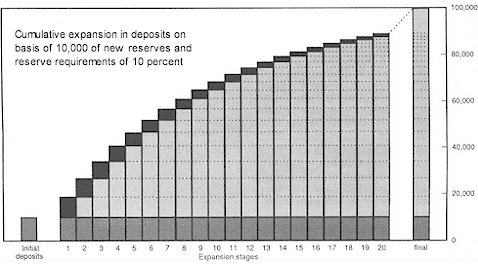
For $10K to become $90K, it must be lend/deposited about 20 times (I forget the exact amount, but its nicely represented in a graph in MMM and earlier in this thread).
 
Here you go

image001.gif
 
so, what is to prevent it from loaning out $90,000 as it has the necessary reserves. I claim it can only lend deposited money, but, I don't have a reference.
I have a reference - MMM.
The lending banks, however, do not expect to retain the deposits they create through
their loan operations. Borrowers write checks that probably will be deposited in other
banks.
. . . .
If the lending banks expect to lose these deposits - and an
equal amount of reserves - as the borrowers' checks are paid, they will not lend more
than their excess reserves.
​
 
Because the requirement says the bank may lend 90% of its reserves, not 900% ;)

For $10K to become $90K, it must be lend/deposited about 20 times (I forget the exact amount, but its nicely represented in a graph in MMM and earlier in this thread).

Yep, I detailed the process in an earlier post.

But, I see I'm a little foggy on the definition of reserves.

Just for fun, let's wiki ....

Bank reserves - Bank reserves are banks' holdings of deposits in accounts with their central bank (for instance the European Central Bank or the Federal Reserve, in the latter case including federal funds), plus currency that is physically held in bank vaults (vault cash).

Excess reserves - In banking, excess reserves are bank reserves in excess of the reserve requirement set by a central bank. They are reserves of cash more than the required amounts (Sag - incorrect). Holding excess reserves is generally considered costly and uneconomical as no interest is earned on the excess amount. Therefore, many banks minimize their excess reserve amounts by putting them to more productive use.

For banks in the U.S. Federal Reserve System, this is accomplished by making short-term (usually overnight) loans on the federal funds market to banks who may be short of their reserve requirements. However, some banks may choose to hold their excess reserves in order to facilitate upcoming transactions or meet contractual clearing balance requirements. (They forgot about making loans to businesses, LOL ! - Sag)

The minimum reserves and the excess reserves of private (commercial) banks are held as FRB (Federal Reserve Bank) credit in FRB accounts. The total amount of FRB credit held by private banks and the amount of FRB credit that the US government holds in its FRB account, together with all currency and vault cash form the monetary base.
 
I have a reference - MMM.
The lending banks, however, do not expect to retain the deposits they create through
their loan operations. Borrowers write checks that probably will be deposited in other
banks.
. . . .
If the lending banks expect to lose these deposits - and an
equal amount of reserves - as the borrowers' checks are paid, they will not lend more
than their excess reserves.
​

So, a bank lends its excess reserves. There it is. That is it lends money deposited, minus the reserve requirement. Thass what I've been saying for 10 posts !
 
So, a bank lends its excess reserves. There it is. That is it lends money deposited, minus the reserve requirement. Thass what I've been saying for 10 posts !
The operative word in that quote is "IF". Contrary to your previous assertions, there is no physical limit to the amount of money a bank can lend (it is only making bookkeeping entries) - only the practical consideration that the lent money is likely to end up in a different bank's account.
 
The operative word in that quote is "IF". Contrary to your previous assertions, there is no physical limit to the amount of money a bank can lend (it is only making bookkeeping entries) - only the practical consideration that the lent money is likely to end up in a different bank's account.

LOL. I'm going to shoot myself now !
 
But wait ! Suppose a bank has a big loan it wants to make, but no excess reserves. What to do? The bank can borrow the money from another bank. Borrowed money is just like a new deposit. If it borrows the money from a commercial bank, then the total money in banks in not increased. But, what if it borrows the money from the Fed?

So, the question is, can a Fed Bank print money, i.e. create the money it lends to a bank out of thin air, and, what is the bookkeeping involved? Or, where does a Fed Bank get the money it loans?
 
So, the question is, can a Fed Bank print money, i.e. create the money it lends to a bank out of thin air, and, what is the bookkeeping involved? Or, where does a Fed Bank get the money it loans?
The answers to these questions can be found in MMM (and MMM probably explains it better than I can) but the money to fund the Fed's bond buying activities originate entirely within the Fed (ie it is created). If the Fed buys bonds, it increases the money supply and if it sells bonds then it decreases the money supply.

I don't know the name of the internal account the Fed uses to record its bond trading activities (it is probably a set of accounts - maybe the Fed's auditors know) but this account is the source of the money the Fed uses when buying bonds. Although money from the sale of bonds will find its way back into the account, no external money is involved so this account is a measure of how much money the Fed has created to buy bonds.

The transaction process is almost certainly entirely electronic. However, it is easier to see what happens if the Fed writes a cheque to pay for the bonds it buys. The bond seller would deposit this cheque at his bank which in turn exchanges this cheque with the Fed for credits into its reserve bank account. Now the bank has excess reserves and the money multiplication process takes place. The bank can exchange some of its reserve credits for treasury issued notes and coins if it needs more cash in its vault.

The reverse takes place if the Fed sells bonds. The bond buyer writes a cheque to pay for the bonds which the Fed uses to reduce the credits in the bond buyer's bank's reserve account. The bank's reserve account and its bond buyer's account both have their balances reduced but now the bank has insufficient reserves and has to reduce the amount of money it has out in loans.
 
Last edited:
But wait ! Suppose a bank has a big loan it wants to make, but no excess reserves. What to do? The bank can borrow the money from another bank. Borrowed money is just like a new deposit. If it borrows the money from a commercial bank, then the total money in banks in not increased. But, what if it borrows the money from the Fed?

So, the question is, can a Fed Bank print money, i.e. create the money it lends to a bank out of thin air, and, what is the bookkeeping involved? Or, where does a Fed Bank get the money it loans?

When the Fed monetizes government debt, it credits the bond dealer's bank with electronic money, by a computer keystroke, and carries the asset on its balance sheet. Similarly when it issues credit, it creates money out of the ether and it appears in its member bank's account with the Fed. As far as I know when loans are repaid to the Fed the principal disappears into the monetary black hole whence it came, and the interest is remitted to the Treasury less Bernanke's salary, and other operating costs (a couple billion annually).
 
When the Fed monetizes government debt, it credits the bond dealer's bank with electronic money, by a computer keystroke, and carries the asset on its balance sheet. Similarly when it issues credit, it creates money out of the ether and it appears in its member bank's account with the Fed. As far as I know when loans are repaid to the Fed the principal disappears into the monetary black hole whence it came, and the interest is remitted to the Treasury less Bernanke's salary, and other operating costs (a couple billion annually).

So, a bank in need of reserves can borrow them from other banks, or, if that fails, can borrow them from the Fed who creates them out of thin air.

If that is the case, then the bank is for all practical purposes creating money out of thin air, even though its books balance by showing the money coming in from the other bank or Fed, and going out to the borrower.

If the bank borrows money from another bank, then no new high powered* money is created. But if it borrows from the Fed, new high powered money is created.

Time for a definition - high powered money, aka the monetary base .... is the money held in commercial banks' reserve accounts in the Fed plus the coin and paper money in circulation.

So, the remaining question is can a bank always borrow from the Fed, or are there restrictions? What is the interest rate known as? How much bank borrowing is bank to bank (at the discount rate I think and how much Fed to bank?

I am thinking that it would be a good thing to understand the Fed balance sheet, which can be seen here ....

http://www.federalreserve.gov/monetarypolicy/bst_fedsbalancesheet.htm

and here ....

http://www.federalreserve.gov/releases/h41/current/h41.htm#h41tab9

* I erroneously called high powered money 'hot money' in an earlier post, hot money is something else.
 
Last edited:
So, a bank in need of reserves can borrow them from other banks, or, if that fails, can borrow them from the Fed who creates them out of thin air.

If that is the case, then the bank is for all practical purposes creating money out of thin air, even though its books balance by showing the money coming in from the other bank or Fed, and going out to the borrower.

If the bank borrows money from another bank, then no new high powered* money is created. But if it borrows from the Fed, new high powered money is created.

Time for a definition - high powered money, aka the monetary base .... is the money held in commercial banks' reserve accounts in the Fed plus the coin and paper money in circulation.

This is mostly accurate, although it's important to point out that the member bank is not creating any money out of thin air, the Fed is. The member bank has to pay the discount rate for the use of the money. I suppose one could argue they are benefiting from seigniorage to the extent that their cost-of-capital is partially subsidized, however.

So, the remaining question is can a bank always borrow from the Fed, or are there restrictions? What is the interest rate known as? How much bank borrowing is bank to bank (at the discount rate I think and how much Fed to bank?

The federal funds rate is the rate that banks typically pay to lend amongst themselves. The discount rate is set by the Fed, and is the rate banks pay to borrow from it. I'm not aware of any restrictions at the discount window, or whether the Fed has any discretion.

I am thinking that it would be a good thing to understand the Fed balance sheet, which can be seen here ....

http://www.federalreserve.gov/monetarypolicy/bst_fedsbalancesheet.htm

and here ....

http://www.federalreserve.gov/releases/h41/current/h41.htm#h41tab9

* I erroneously called high powered money 'hot money' in an earlier post, hot money is something else.

If Bloomberg is right, there are $9.7 trillion in off-balance sheet transactions done by the Fed, which would make analysis of it's balance sheet myopic. Nevertheless, it's balance sheet is huge, unprecedented at $2.3T.
 
Last edited:
This is mostly accurate, although it's important to point out that the member bank is not creating any money out of thin air, the Fed is. The member bank has to pay the discount rate for the use of the money. I suppose one could argue they are benefiting from seigniorage to the extent that their cost-of-capital is partially subsidized, however.


The federal funds rate is the rate that banks typically pay to lend amongst themselves. The discount rate is set by the Fed, and is the rate banks pay to borrow from it. I'm not aware of any restrictions at the discount window, or whether the Fed has any discretion.


If Bloomberg is right, there are $9.7 trillion in off-balance sheet transactions done by the Fed, which would make analysis of it's balance sheet myopic. Nevertheless, it's balance sheet is huge, unprecedented at $2.3T.

Thanks, yes, I see the rate between banks is called the interbank rate and the Fed to bank rate is called the discount rate.

I would also like to get a handle on Bloomberg article....

http://www.bloomberg.com/apps/news?pid=washingtonstory&sid=aGq2B3XeGKok

Apparently the breakdown on the 9.7 trillion is ...

The promises are composed of about $1 trillion in stimulus packages, around $3 trillion in lending and spending and $5.7 trillion in agreements to provide aid.

So, the $1T is govt. spending, the $3T is on the books at the Fed?, and the 5.7T is ..... what?

For example, the article says ...

The government is already backing $301 billion of Citigroup Inc. securities and another $118 billion from Bank of America. The government hasn’t yet paid out on any of the guarantees.

What does that mean? Does it appear on any balance sheet? Is it formal or informal ????

I don't know, I'm not in a position to analyze the Fed's off-balance sheet activity, because it's opaque. I would imagine that "backed" in the case of Citi and BoA means that they've swapped out their bad assets for good assets, like US Treasuries.
 

ISF - Join now!

Every member here is approved by hand. No bots, no spam, just people who care about evidence and honest debate.

Membership is free!

Create your free account

Back
Top Bottom