• Security incident: ISF was recently accessed by intruders. Please change your password, and change it anywhere else you used it. Read more

High Speed Rail in California hits a pot hole

You need certain population densities to make it worthwhile. It makes a lot of sense on the East and West Coasts, it kinda makes sense in the Rust Belt and the Gulf Coast, and the no sense in the Square States in the Middle. But since the SSITM get disproportionate Senate representation, it is easy for the automobile and airline industries to pay off the necessary number of Senators to keep HSR and Amtrak hobbled.

It also doesn’t help that saying out loud that the East and West Coast should get high speed rail while the SSITM get nothing is… politically difficult, even if the math makes sense.

CAHSR demonstrates that it doesn't really make sense on the West Coast either, there some dense cites but it's also a really big state.
 
I'm not going to tell you there will be worthwhile lines to Montana and Wyoming or Hawaii

And I'm not going to tell you there will be worthwhile lines to southern California. It seems you can be realistic about high speed rail, after all. Just not when it comes to California, for some reason.
 
Everywhere that tries high speed rail overbuilds. Why? Because it's a feature, not a bug. Politicians do it because it's an excuse to funnel public money to favored contractors, who then kick back money to those politicians. In democratic states, the kickbacks are laundered as campaign donations so it's all perfectly legal, but overbuilding isn't some accident, it's by design.

And California is doing it too.

It's actually the opposite problem. Corporate interests and the politicians they own are working to slow the project down at every turn. That's how a certain party in this country works.

Except in the case of China, they actually put a bunch of trucks back on the road because of decreased freight rail capacity, which hurts the environment. And a lot of Chinese passengers were going by conventional rail, which is both cheaper and more environmentally friendly than high speed rail.

Because China built a lot of its HSR between locations that don't have a lot of business travel. Leisure travelers won't care as much.

Calculations of the environmental benefits of California high speed rail are as reliable as initial estimates of the cost.

especially when Ford and Exxon can have their say.
 
And I'm not going to tell you there will be worthwhile lines to southern California. It seems you can be realistic about high speed rail, after all. Just not when it comes to California, for some reason.

Yes, but one of us is wrong. And since you agree with my statement about not putting lines between rural locations...
 
The question is, how much of a public benefit is it to get from one side of the country and is it a public benefit or is it a benefit for a particular group of people?

And of course, each proposed line would have a different cost to benefit rail. Something that rail enthusiasts often gloss over from what I can tell.

Are there any highspeed rail lines that go across countries the size of the US?

It's OK. The benefits trickle down to everyone.
 
It's actually the opposite problem. Corporate interests and the politicians they own are working to slow the project down at every turn. That's how a certain party in this country works.

California is completely dominated by the Democratic party. Nothing about the HSR failure there has anything to do with Republicans. And the primary external delays have been from environmentalists, not "corporate interests". Corporate interests have inflated the prices of construction, but again, that's a feature of high speed rail, not a bug.

Because China built a lot of its HSR between locations that don't have a lot of business travel. Leisure travelers won't care as much.

A lot of the stations in California's rail plan won't have a lot of travelers of any kind. Yet the train has to stop at those places anyways. This is a common feature of high speed rail.

especially when Ford and Exxon can have their say.

Yeah, no. First off, the failure of California HSR isn't their fault. Secondly, what kind of mark actually believes the crap that HSR advocates are saying? I'll give you a specific example. From the official California government HSR website, they claim that air travel from San Francisco to Anaheim produces 390 lbs of green house gasses per passenger. I haven't checked that, but let's accept that as a given.

Then it says that taking HSR saves 389 lbs of green house gasses per passenger compared to taking the plane or car. If we pick a plane, that would mean that taking the train only produces 1 lb of green house gas per passenger, which is complete bull ****, and cannot even be excused on the basis of renewable electricity generation since marginal electricity generation is all fossil fuels.

Now, their car numbers are higher than their plane numbers, so maybe the comparison is supposed to include cars in some unspecified manner. But examining the car numbers still shows it's a bull **** number. Going San Francisco to Los Angeles (slightly shorter than to Anaheim) keeps the plane emissions the same, cuts the car emissions from 524 to 497, but cuts the emissions savings from 389 to 349 lbs. Apparently, going a bit farther costs 27 lbs more in emissions for a car, but HSR saves you 40 lbs more. Which means going a bit farther somehow refunds you 13 lbs of emissions. That last leg must be magical, as it appears to actually generate electricity.

So no, the claimed environmental benefits being bull **** have nothing to do with Ford or Exon.

 
Last edited:
I'm bumping this thread because I heard a story in the news about it, 18 years after passing, not a mile of track laid yet. Now with a reduced scope the projected costs will be 4x the original estimate. The original estimates were a fraud though, independent estimates had it at 3x the official estimate. Also, it was supposed to finished 6 years ago.
 
I'm bumping this thread because I heard a story in the news about it, 18 years after passing, not a mile of track laid yet. Now with a reduced scope the projected costs will be 4x the original estimate. The original estimates were a fraud though, independent estimates had it at 3x the official estimate. Also, it was supposed to finished 6 years ago.
The obvious fix is to spend more taxpayer money.
 
I still can't figure out who the ridership for this is supposed to be. LAX-SFO only services about 7.5k people daily. That doesn't seem like enough air travelers to make an HSR alternative worthwhile to anyone.

Is it supposed to open floodgates of intrastate tourism or something?
 
I still can't figure out who the ridership for this is supposed to be. LAX-SFO only services about 7.5k people daily. That doesn't seem like enough air travelers to make an HSR alternative worthwhile to anyone.

Is it supposed to open floodgates of intrastate tourism or something?
Ridership doesn't matter. Hell, actually laying track doesn't matter either. The money got spent. That's what matters.

From the perspective of Sacramento, California HSR has already been a fantastic success.
 
I'm bumping this thread because I heard a story in the news about it, 18 years after passing, not a mile of track laid yet. Now with a reduced scope the projected costs will be 4x the original estimate. The original estimates were a fraud though, independent estimates had it at 3x the official estimate. Also, it was supposed to finished 6 years ago.


Sixty minutes did a story about it a few months ago, Why America Can’t Build High-Speed Rail.
 
What reason(s) did they give, in the story?

How do they justify "can't"?
I don't know about them, but one of the reasons is that it costs 3x more to build track in the US than it does anywhere else. the other reason, nimbyism, takes almost no effort to shut a project down for mostly "environmental" reasons.
 
I don't know about them, but one of the reasons is that it costs 3x more to build track in the US than it does anywhere else. the other reason, nimbyism, takes almost no effort to shut a project down for mostly "environmental" reasons.
Even the UK?
 
From what I've read yes, and that's just the average so places like CA, even more.
Not according to this:
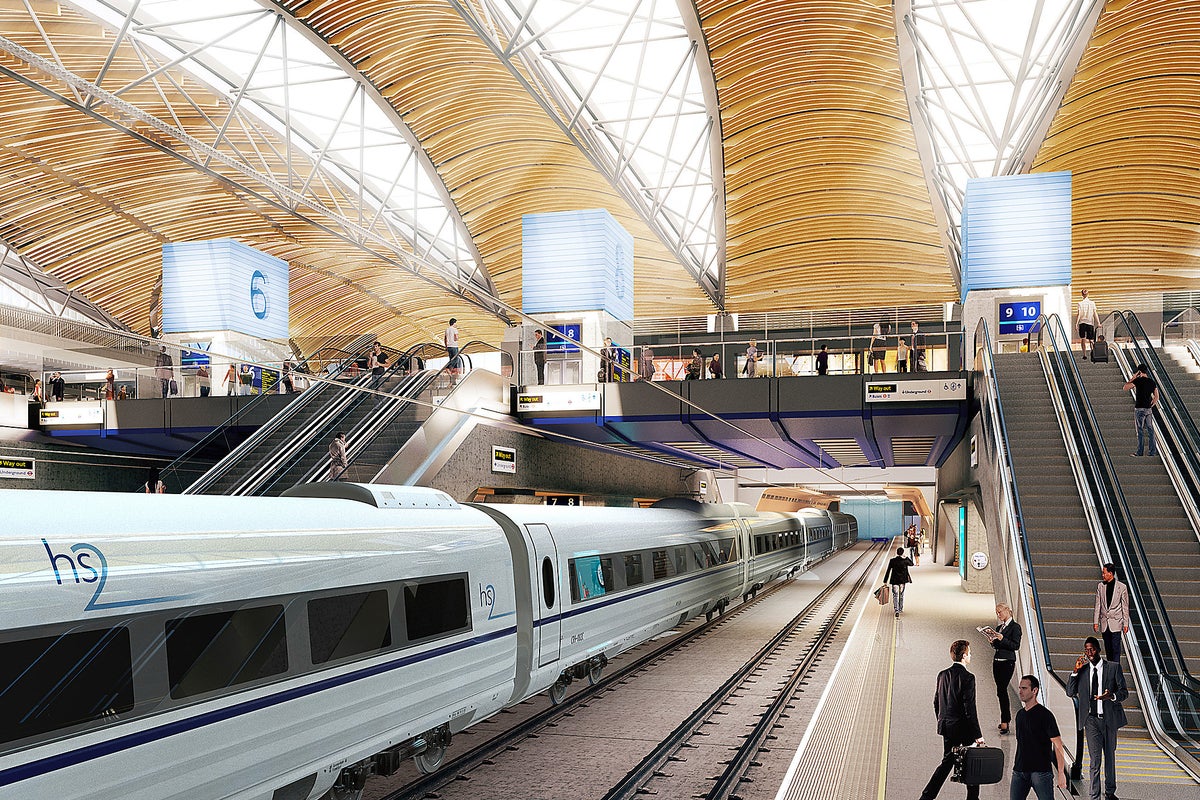
"With its first — and now only — phase currently costed at between $58.4 billion and $70 billion by the UK government, Britain’s High Speed 2 (HS2) rail project now costs an eye watering $416 million per mile.

It’s a metric that gives it the dubious honor of being the world‘s most expensive railway project.

Only the equally troubled $128-billion California High Speed Rail project in the United States comes close to matching HS2’s soaring costs, with some estimates suggesting that it could top out at $200 million per mile.

For comparison, the Tours-Bordeaux TGV line in France cost around $32-$40 million per mile in the mid-2010s — although much of that line runs through sparsely populated agricultural regions."

Or here:

Unless its got more expensive while the world wasn't looking.
 
It's a dubious honor, and I mourn with the UKians over their misfortune at receiving it.

At least the proposed London-Birmingham route looks relatively straight and flat, and seems to serve two cities within reasonable distance from each other, along an easement that already exists. It's a shame such a train-centric society like the UK, with a successful HSR project already in its CV, couldn't make something like this work.

At least with the California project, all you have to do is look at a map and consider the larger context, and you'd realize the project was absurd from the get-go.
 
Last edited:
Here's an all-day sucker on how the CHSR lost $4 billion in federal funding. Note that although California politicos have blamed Trump, it's pretty clear that they screwed up. First they missed a 12/31/24 deadline to execute a contract to buy trains:

In sworn court filings, High-Speed Rail assured a federal judge that it would execute a train contract by Dec. 1, 2025 — and that doing so would keep the project on schedule.

But High-Speed Rail missed that deadline too — canceling the board meeting where the train contract was expected to be approved.

Multiple sources familiar with the procurement process and litigation said missing the revised deadline undercut California's legal argument that it could be trusted to meet future deadlines and complete the project on time.

The authority had already missed the original deadline in its federal funding agreement, and now it had missed the revised deadline it had promised the court it would meet.
 

ISF - Join now!

Every member here is approved by hand. No bots, no spam, just people who care about evidence and honest debate.

Membership is free!

Create your free account

Back
Top Bottom