• Security incident: ISF was recently accessed by intruders. Please change your password, and change it anywhere else you used it. Read more

High-speed biplanes

First, let me agree with the others. Second, if I'm reading your post right, I'm not sure you've really grokked induced and parasite drag.

Entirely possible

Biplanes are notorious for having high parasite drag, which is exactly the wrong thing for high speed. By having (usually) more wing area, they operate at a lower lift coefficient (CL), so they have lower induced drag but, as you say, induced drag isn't so important at high speed.


Err, OK, to illustrate the point I was trying to make, let's take a tandem plane instead of a biplane. That way the fuselage can be of the same forward area as a monoplane and there's absolutely no rigging between the wings. There's also no interference between the wings.

Also, biplanes don't necessarily have higher induced drag simply because they have more wingtips. Induced drag is primarily due to wing shape (planform) and CL. If you made monoplane and biplane versions of an airplane, and both planes had the same total wing area and the same wing shapes (the individual wings would have to be smaller on the biplane), they'd have the same induced drag, to first order. [q/uote]

Would the same hold with the tandem plane example? If the wing area is identical, the chord length is the same, camber is the same, airfoil cross-sections, all ceteris paribus, then surely the tandem design will have greater induced drag than the monoplane for the same reason that short stubby wings have more induced drag than long thin ones?

But in such a scenario the tandem plane's wings would be much stiffer because they would be shorter. This sounds good for high speed flight because it saves on weight and prevents aeroelasticity and control reversal and other nastiness. There would also be a fairly substantial reduction of the plane's frontal area, which again, sounds good for high speed flight. The additional wetted area won't be that much greater either; just the wing tips.

What am I missing here? Why isn't this configuration better? Interference drag from all the additional wing roots?
 
Tandem wings do influence each other. The rear wing is flying in the wake of the front wing.
 
...to illustrate the point I was trying to make, let's take a tandem plane instead of a biplane. That way the fuselage can be of the same forward area as a monoplane and there's absolutely no rigging between the wings. There's also no interference between the wings.

For discussion purposes, we can assume there's no interference, but as TjW said, there's likely to be quite a bit of it. The rear wing is flying in air that's been disturbed by the front wing, so it's seeing some turbulence and the air will be coming at it from a different angle.

If the forward wing has movable surfaces (flaps, ailerons, spoilers), then the interactions with the rear wing will change dramatically when those controls are used. And if the forward wing doesn't have flaps, then the plane will have a high take-off and landing speed despite all the wing area, which is the worst of both worlds.

A classic tandem (offhand I know of only 3 examples, and none were successful. Okay, I have a thing for unusual airplanes) doesn't have a separate horizontal stabilizer, so if the craft is to be passively stable, the plane will have to have some decalage between the front and rear wings, which aggravates the induced drag problem.

Oddly, Wikipedia's definition of decalage is much narrower than mine.

Anyway,

Also, biplanes don't necessarily have higher induced drag simply because they have more wingtips. Induced drag is primarily due to wing shape (planform) and CL. If you made monoplane and biplane versions of an airplane, and both planes had the same total wing area and the same wing shapes (the individual wings would have to be smaller on the biplane), they'd have the same induced drag, to first order.

Would the same hold with the tandem plane example? If the wing area is identical, the chord length is the same, camber is the same, airfoil cross-sections, all ceteris paribus, then surely the tandem design will have greater induced drag than the monoplane for the same reason that short stubby wings have more induced drag than long thin ones?

It would certainly have more induced drag for the reason you cited. In my example, I assumed that the wings would not be stubbier.

But in such a scenario the tandem plane's wings would be much stiffer because they would be shorter.

I'd look at it as "the tandem plane's wings could be made lighter for the required stiffness." Bearing in mind, of course, that the monoplane's wing would have to be substantially stiffer than the tandem's.

This sounds good for high speed flight because it saves on weight and prevents aeroelasticity and control reversal and other nastiness. There would also be a fairly substantial reduction of the plane's frontal area, which again, sounds good for high speed flight.

Why would the frontal area be smaller? I thought we were assuming the same size fuselage.

The additional wetted area won't be that much greater either; just the wing tips.

That was one of the going-in assumptions, but if you actually lay out a configuration, it may be difficult to keep the fuselage from growing quite a bit when you go to the tandem if there's still a horizontal stab.

What am I missing here? Why isn't this configuration better? Interference drag from all the additional wing roots?

Actually, interference drag can be pretty significant, so, yes, that's a real issue. But I think the wing interaction problems are probably worse.

So: Stubby-wing tandem pros:
Lighter wings

Stubby-wing tandem cons:
Wing interaction issues
Control surface restrictions
High induced drag
Fuselage torsional stiffness (I didn't cover it above, but it may make up for the weight savings in the wing)
Longer fuselage (if there's a separate stab) or decalage-related induced drag & larger total wing area.

Obviously, I've touched on a number of issues without really diving into them, and this is already a long post. But it's an interesting subject.

ETA: When I said that I knew of only 3 tandem aircraft, I was talking about full-sized planes. I know of several in the model aircraft world. FWIW, I don't know that any of those have been terribly successful, either. Certainly mine weren't, though I keep meaning to build a third. The Mystery Tailless is said to be a good flyer.

 
Last edited:
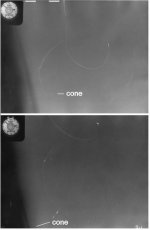
Watching our trailing cone on the Tristar.... 150' of nylon tubing with a calibrated tube orifice to get a true measure of the static airpressure, with any rudder deflection, it would do a dance.
You could see the wave from the rudder tip go along the tube, and really jerk the sensor end around. Definitely an E-ticket ride!
If there were too many rudder deflections, the tubing could be broken and get tangled up, or the whole tube might get tossed away.
We left several around the SoCal area. :)
The point being, there's a lot of disturbed air that comes off the tips of a deflected control surface. Both ends.
A control surface on a canard or the front wing of a tandem would have a major effect on the trailing wing.
And I believe that's why there's never a movable surface in front of an engine inlet.
Compressor stalls are noisy! :)
 

Attachments

  • L-1011TrailingCone-01.jpg
    L-1011TrailingCone-01.jpg
    17.2 KB · Views: 5
  • L-1011-1157-04.jpg
    L-1011-1157-04.jpg
    39.1 KB · Views: 2
  • L-1011-1176-10.jpg
    L-1011-1176-10.jpg
    63.7 KB · Views: 2
Last edited:
Thanks all, that does help.

I had a brain fart and was thinking that you could put one wing directly in front of the other and save on frontal area. You've all made it obvious why that won't work.

AIUI a lot of the canard fighter designs (gripen, typhoon, etc.) have the canards placed such that the wash from them does interact with the main wing. The idea is to re-energize the boundary layer to improve high-alpha performance; or some aerodynamic-ese for "black magic that prevents stalls."

I had not considered the issue of additional stiffness of the fuselage required to support tandem wings.
 
What an ugly airplane.

I guess what they said about the F4 is even more applicable here: "with enough power, even a brick can fly".
 
What an ugly airplane.

I guess what they said about the F4 is even more applicable here: "with enough power, even a brick can fly".

Exhibit A:
800px-Loening_OA-1A_USAF.jpg


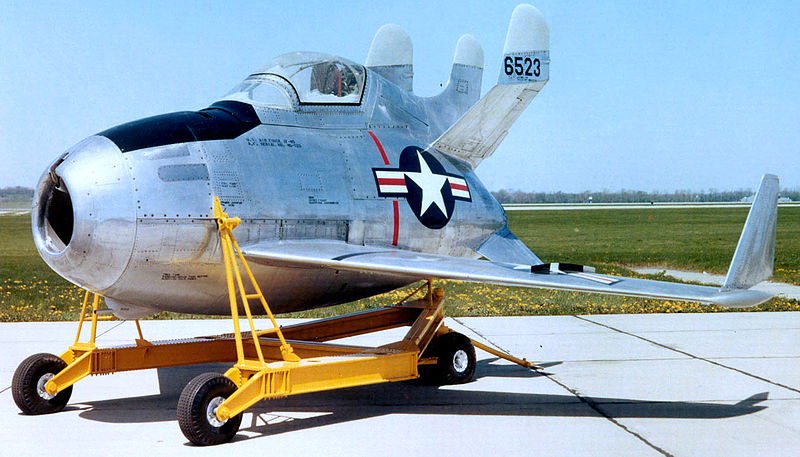
Exhibit B:
800px-McDonnell_XF-85_Goblin_USAF_%28Cropped%29.jpg


Exhibit C:
PZL.30.jpeg


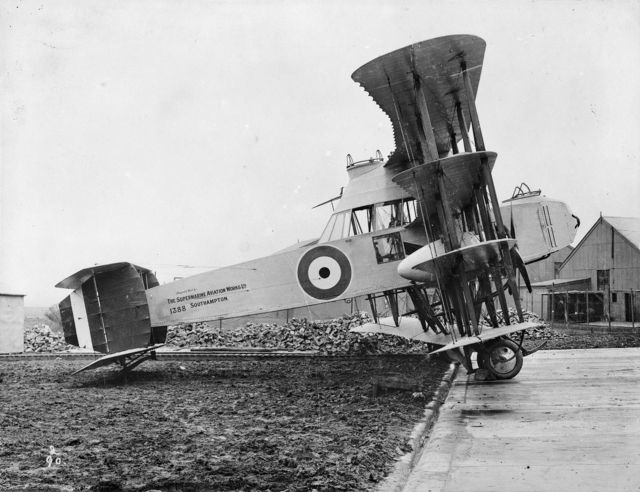
Exhibit D (it actually looks worse from other angles):
Supermarine_P.B.31E_Nighthawk.jpg


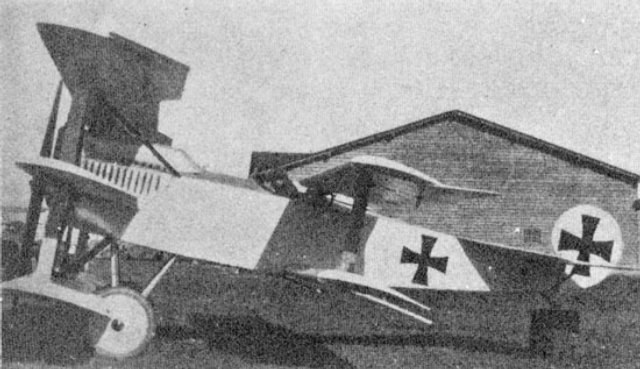
Exhibit E:
Fokker_V.8.jpg


(perhaps mercifully, Wikipedia doesn't have a picture of the Bleriot 73)
 
Here is a working model of an earlier design.


iex2010PeterHaasHimmelsleiter-065byMichielNiessen.jpg


0-241.jpg


Sent from the far side
 
Last edited:

ISF - Join now!

Every member here is approved by hand. No bots, no spam, just people who care about evidence and honest debate.

Membership is free!

Create your free account

Back
Top Bottom