Has consciousness been fully explained?

Status
Not open for further replies.
It is amazing what SRIP can do when running on the correct substrate internal to the correct substrate. Biology is wonderful. Computers, or pebbles on the sand? Not so much.
 
Hey, Pixy! :)

It wouldn't matter; that's the Church-Turing thesis in a nutshell.

Yup. Weird, ain't it. Substrate-independence (not that it's not true, just... weird).

No, representation wouldn't matter. It doesn't matter in computer programs either - lossless compression (the kind you're talking about) is invisible.

Right. Algorithms' implementation-independence (not so weird as substrate-independence, I don't think).

Actually, matter and energy shape space and time. Spacetime is not a static, independent, pre-existing framework; it is something that stretches and shifts according to the laws of physics.

Of course. Spacetime is just the most familiar dynamic metric with which we frame the frothy vacuum; didn't mean to imply otherwise.

There must be something to relate. Consciousness is a physical process, not an abstract concept.

I agree (under physicalism). It's an open question, for me at least, whether the "something" that is related can be anything (including simulated things).

To be technically correct, computationalists assert that consciousness is relations between relations between things, not just relations between things.

That is, there is (at least one ) extra level of relation on top of the base level of relation.

So really the question is whether or not a relation between relations between real things is ontologically different from a relation between relations between simulated things.

Well put.

1. I'm not sure why it would matter what the medium was, computer, banging cans, etc. But I don't know. I think it's easier to see this with ions flowing through channels and electrons through gates because we are used to thinking about the constraints on the systems and can visualize the movements to some extent.

Yes. Though I suppose it's irrelevant, to test my own belief, I like to take it the other way: for the simulation argument, make the medium as dissimilar as possible to the brain's, to make sure I'm not being pulled in by superficial similarities (if we do pull back the curtain and find wizards banging cans, I'll be surprised, but... what are you gonna do). Otoh, for understanding, similarity sure helps.

2. I don't know enough about it to answer your second point, but I would guess that there are many ways to skin a cat. For the purposes of the discussion I think it is easier to see consciousness in a one-to-one correspondence.

Yes, easier to see. Though the only necessary one-to-one correspondence is between the output of the simulation and the reality being simulated, I think.

3. Yes. And I don't know much about all that stuff.

Just another mind-frick; sorry. :o There are issues of computability and how much of our reality is to iron out; but if something is computable, then even the kludgiest code, so long as it's within specs for synchronization, resource use, etc., will do the job.

4. I would tend to say that ultimately there has to be something there to relate or relation is not possible. But the weird thing thing that others have brought up in the past with this discussion is that maybe it really is turtles all the way down and relation is all there is? I mean, what is energy after all? Something that can relate to itself? Something that can vibrate at different frequencies in different dimensions to produce different effects?

It's assumed to be a vibration of something (in 'seas' of quantum or spacetime foam, in one field theory); and while that is a sensible assumption, I think (a simple, material basis to avoid the infinite library of Plato's Ideas or the absurdity of a nihilist ontology)... who knows?

Here's one of the problems I have with it all -- whatever instructions we give the hardware will have to be carried out by electrons through gates, but the actions that anything in a simulation will carry out will also be electrons moving through gates; so both the rules and what happens will be the same type of process in the computer. That seems kind of strange to me and might be a very big problem. It is certainly nothing like what we see in the 'real world', except that everything seems to be either energy or space-time and somehow they are tied together?

I guess like any computer, the simulator will have to demarcate: curtain off "assembly" (break down input into machine instructions, prepare data for output) from "output", which will be the simulation. Within the simulation, there will be nothing but relations between data which has been interpreted by the program as output, virtual "things" within the simulation, which certainly sounds different from our conception of physical reality, doesn't it: maybe just hard to get one's head around, or maybe a real difference between physical and virtual "consciousness"? Hmm... :eusa_think:
 
Actually, no, they don't. They do have multiple clumps of nerve cells that control their bodies, but they don't have centralised organised brains like vertebrates or the more complex invertebrates.

Well they sort of do, they don't have a cortex, they just have ganglion knots.
 
Correct, it is just sloppy terminology and I apologize for using it; the point being that there are localized increases in order that use energy and that is one of the many things that are needed for life and for making a computer (or any other man-made object).

Um, you can't just say 'This is local entropy', that is the point.

:)
 
I think the point was that life is able to closely control what subsystems have a local decrease or increase of entropy.

Yes metabolism represents a local increase of entropy, but if you localize metabolism away from the celluar subsystems that use the energy from metabolism, you see that those subsystems in fact have a net entropy decrease.

Nothing in the universe does this kind of thing to the extent that life does.

ETA: wow wasp beat me to the punch by like 53 seconds

Then you have the wrong defintion, life can not decrease entropy, ever, it creates entropy by being life, always.

There is not really, "This local entropy", it gets the energy from another system.

Life does some cool things, but reversing entropy is not one of them. When you grow new things it comes at the expense of a lot of entropy, especially growing babies and children.

They can not reverse entropy, ever.
 
Just another mind-frick; sorry. :o There are issues of computability and how much of our reality is to iron out; but if something is computable, then even the kludgiest code, so long as it's within specs for synchronization, resource use, etc., will do the job.
Which is a question that's been brought up before. Will it?

Given we get to the point where the simulation is possible, built and coded, and connected to a (human-emulating) simulacrum, which occurs first; the computations cause simulacrum to begin to raise its' arm to catch the ball thrown to it, or heat death of the universe?

Catching the ball would be nicer, though.
 
Then you have the wrong defintion, life can not decrease entropy, ever, it creates entropy by being life, always.

There is not really, "This local entropy", it gets the energy from another system.

Life does some cool things, but reversing entropy is not one of them. When you grow new things it comes at the expense of a lot of entropy, especially growing babies and children.

They can not reverse entropy, ever.

I don't understand.

I thought the statistical defintion of entropy had to do with the possible available/reachable number of microstates within a macrostate.

Why can't one say that life decreases the possible available/reachable number of microstates in a macrostate?

It seems quite clear that the number of possible states a random assortment of nucleotides with no constraints can enter is larger than the number of possible states those nucleotides can enter when constrained as segments in a polynucleotide.

Right?
 
You are not understanding me, so I'm not getting across what I mean. I'll try again.

Disembodied doesn't mean there is no physical substrate. Disembodied means that the pattern of relationships can move around independently of the atoms/electrons that comprise it at any moment. ...

Do you mean, for example, the switch sequences which are interpreted by the simulating program as "the effect of particle x with a certain energy being at a certain distance from particle y with a certain energy" may not be at that distance and have those energies (almost certainly aren't, unless by chance)? Iow, a physical relationship has been coded into a logical relationship whose physical translation [into switches] doesn't necessarily preserve the original physical relationship?

Which is a question that's been brought up before. Will it?

Given we get to the point where the simulation is possible, built and coded, and connected to a (human-emulating) simulacrum, which occurs first; the computations cause simulacrum to begin to raise its' arm to catch the ball thrown to it, or heat death of the universe? ...

There's a patch for that (download at whaddyameanheatdeathoftheuniverse.com). :scarper:
 
Last edited:
blobru said:
Which is a question that's been brought up before. Will it?

Given we get to the point where the simulation is possible, built and coded, and connected to a (human-emulating) simulacrum, which occurs first; the computations cause simulacrum to begin to raise its' arm to catch the ball thrown to it, or heat death of the universe? ...

There's a patch for that (download at whaddyameanheatdeathoftheuniverse.com).
Ha Ha. Close relative? :p

And, no, there isn't.

Given:

http://www.sciencedaily.com/releases...6891734808,0

A typical healthy human brain contains about 200 billion nerve cells, or neurons, linked to one another via hundreds of trillions of tiny contacts called synapses.

Anyone care to try providing an actual answer to my original question as to compute power needed for 'real-time' response?
 
Do you mean, for example, the switch sequences which are interpreted by the simulating program as "the effect of particle x with a certain energy being at a certain distance from particle y with a certain energy" may not be at that distance and have those energies (almost certainly aren't, unless by chance)? Iow, a physical relationship has been coded into a logical relationship whose physical translation [into switches] doesn't necessarily preserve the original physical relationship?
No.
 
I can account for it.

"Emotion" and "feeling" are really just modifiers that affect the two fundamental things going on in one's mind -- thoughts and sensory perception.

Emotion and feeling simply change the nature of your thoughts and the way thoughts lead to other thoughts -- there is nothing inexplicable there, it is all mathematically describable.

Emotion and feelings also simply change the nature of your sensory perception -- certain percepts increase or decrease in intensity. Again, nothing inexplicable there, it is all mathematically describable.

If you want to get more complex you can break it down further, and also mix and match those two fundamentals for example if you have a memory of smiling etc. when you feel "happy." Memory is a thought and the physical feeling of smiling is a percept.

But at any rate there is nothing magical about it.

Why is happy in quotes?
 
If they are actually iterating through the steps of a finite state machine, then quite possibly, yes. Which is rather the point of the cartoon.

Er, yes - if you'd consider a snapshot of the state of a live brain to be conscious...

But I suspect you wouldn't. Consciousness is a process.

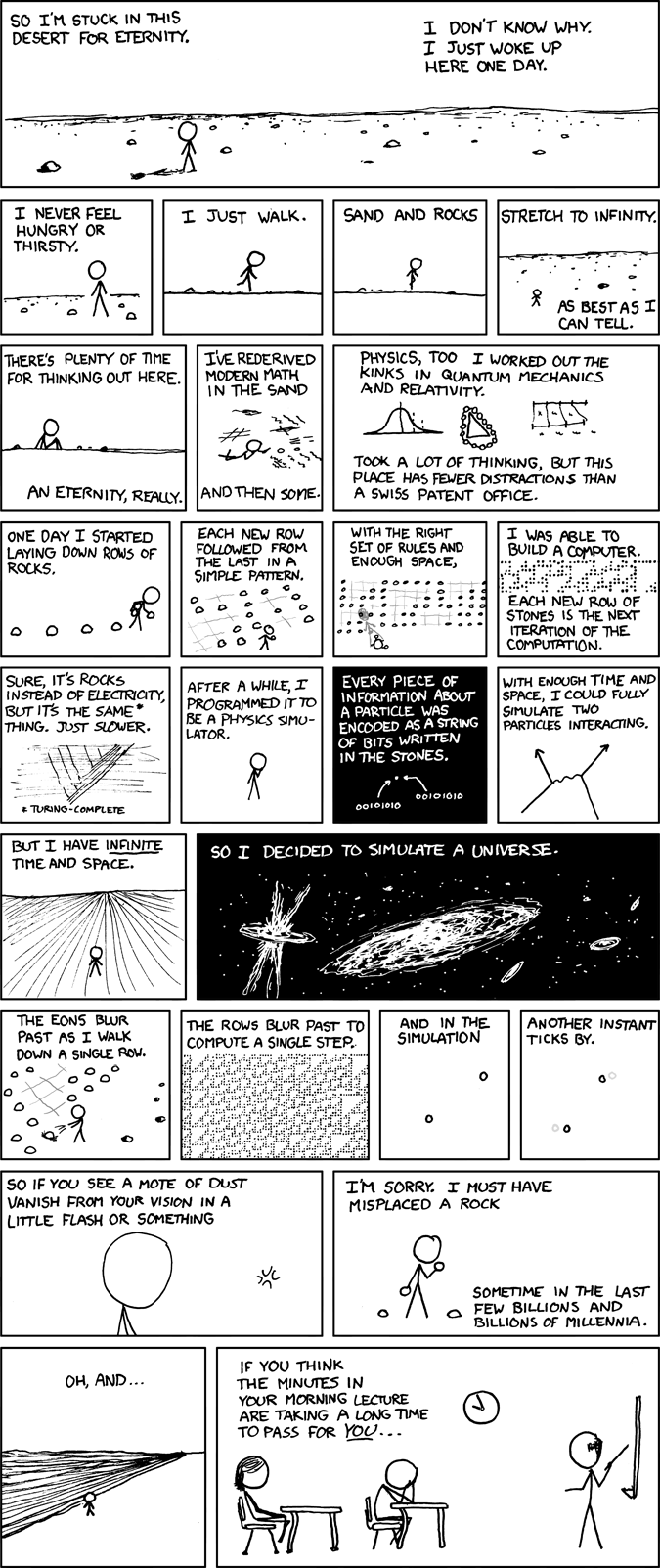
I think you aren't quite understanding what the strip is depicting. Here it is again (for those were too lazy to click on the link earlier!):

a_bunch_of_rocks.png


Look up Wolfram's "A New Kind of Science" if you're not familiar with it - perhaps rule 110 in particular (even though the Alt-text associated for the above strip referred to rule 34).

The entire pattern of rocks (strictly infinite in extent) is not a snapshot of a single moment but in fact the full history of the entire computation. A single row of rocks (representing another "step" in the processing) would be more like a snapshot of the "universe" at some point. In other words there are multiple conscious beings, plus dinosaurs, and the moons of Jupiter (plus quite a bit of other stuff) all being simulated in that pattern when viewed in it's entirety!

The point I was trying to raise (which was possibly also missed by PixyMisa in an earlier reply to my first post) was that a static pattern like that (of rocks in this case) can still be interpreted as a complete simulation. Or do you think that something actually has to be in the process of placing more rocks for the simulation to actually be considered to be "running"?

Could it be that even the abstract possibility of that particular pattern somehow generates a whole universe throughout it's entire history? Perhaps that is all we are, here in this particular universe, a "simulation" created by virtual of nothing more than the possibility of the appropriate "pattern" being interpreted in the appropriate way. If this was true, then the substrate for "reality" is nothing more than pure mathematics, which is the basically how I understand Max Tegmark's ideas (and also the explanation of "everything" that fits best in my head most of the time).

Here's another interesting read (quite long and written in a somewhat unusual style) that touches on the same kind of issue - amongst other things it considers whether a very large meteor shower when interpreted in just the right way might not also represent a simulation of a brain!
 
I think you aren't quite understanding what the strip is depicting. Here it is again (for those were too lazy to click on the link earlier!):

http://imgs.xkcd.com/comics/a_bunch_of_rocks.png

Look up Wolfram's "A New Kind of Science" if you're not familiar with it - perhaps rule 110 in particular (even though the Alt-text associated for the above strip referred to rule 34).

The entire pattern of rocks (strictly infinite in extent) is not a snapshot of a single moment but in fact the full history of the entire computation. A single row of rocks (representing another "step" in the processing) would be more like a snapshot of the "universe" at some point. In other words there are multiple conscious beings, plus dinosaurs, and the moons of Jupiter (plus quite a bit of other stuff) all being simulated in that pattern when viewed in it's entirety!
Yep. It's iterating through the steps of a finite state machine - more specifically, a cellular automata grid.

The point I was trying to raise (which was possibly also missed by PixyMisa in an earlier reply to my first post) was that a static pattern like that (of rocks in this case) can still be interpreted as a complete simulation.
Okay, if that was the point you were making, then I missed it, because it's wrong.

Perhaps that is all we are, here in this particular universe, a "simulation" created by virtual of nothing more than the possibility of the appropriate "pattern" being interpreted in the appropriate way. If this was true, then the substrate for "reality" is nothing more than pure mathematics, which is the basically how I understand Max Tegmark's ideas (and also the explanation of "everything" that fits best in my head most of the time).
As far as I can tell, none of that actually meant anything. Pure mathematics is an abstract notion; it can't be a substrate. Information, maybe. Computation, maybe. Mathematics itself? No.

Here's another interesting read (quite long and written in a somewhat unusual style) that touches on the same kind of issue - amongst other things it considers whether a very large meteor shower when interpreted in just the right way might not also represent a simulation of a brain!
That was self-serving drivel of the first order, an intellectually dishonest defence of incoherent ideas.
 
Status
Not open for further replies.

Back
Top Bottom