Hey, Pixy!

It wouldn't matter; that's the Church-Turing thesis in a nutshell.
Yup. Weird, ain't it. Substrate-independence (not that it's not true, just... weird).
No, representation wouldn't matter. It doesn't matter in computer programs either - lossless compression (the kind you're talking about) is invisible.
Right. Algorithms' implementation-independence (not so weird as substrate-independence, I don't think).
Actually, matter and energy shape space and time. Spacetime is not a static, independent, pre-existing framework; it is something that stretches and shifts according to the laws of physics.
Of course. Spacetime is just the most familiar dynamic metric with which we frame the frothy vacuum; didn't mean to imply otherwise.
There must be something to relate. Consciousness is a physical process, not an abstract concept.
I agree (under physicalism). It's an open question, for me at least, whether the "something" that is related can be anything (including simulated things).
To be technically correct, computationalists assert that consciousness is relations between relations between things, not just relations between things.
That is, there is (at least one ) extra level of relation on top of the base level of relation.
So really the question is whether or not a relation between relations between real things is ontologically different from a relation between relations between simulated things.
Well put.
1. I'm not sure why it would matter what the medium was, computer, banging cans, etc. But I don't know. I think it's easier to see this with ions flowing through channels and electrons through gates because we are used to thinking about the constraints on the systems and can visualize the movements to some extent.
Yes. Though I suppose it's irrelevant, to test my own belief, I like to take it the other way: for the simulation argument, make the medium as dissimilar as possible to the brain's, to make sure I'm not being pulled in by superficial similarities (if we do pull back the curtain and find wizards banging cans, I'll be surprised, but... what are you gonna do). Otoh, for understanding, similarity sure helps.
2. I don't know enough about it to answer your second point, but I would guess that there are many ways to skin a cat. For the purposes of the discussion I think it is easier to see consciousness in a one-to-one correspondence.
Yes, easier to see. Though the only necessary one-to-one correspondence is between the output of the simulation and the reality being simulated, I think.
3. Yes. And I don't know much about all that stuff.
Just another mind-frick; sorry.

There are issues of computability and how much of our reality is to iron out; but if something is computable, then even the kludgiest code, so long as it's within specs for synchronization, resource use, etc., will do the job.
4. I would tend to say that ultimately there has to be something there to relate or relation is not possible. But the weird thing thing that others have brought up in the past with this discussion is that maybe it really is turtles all the way down and relation is all there is? I mean, what is energy after all? Something that can relate to itself? Something that can vibrate at different frequencies in different dimensions to produce different effects?
It's assumed to be a vibration of something (in 'seas' of quantum or spacetime foam, in one field theory); and while that is a sensible assumption, I think (a simple, material basis to avoid the infinite library of Plato's Ideas or the absurdity of a nihilist ontology)... who knows?
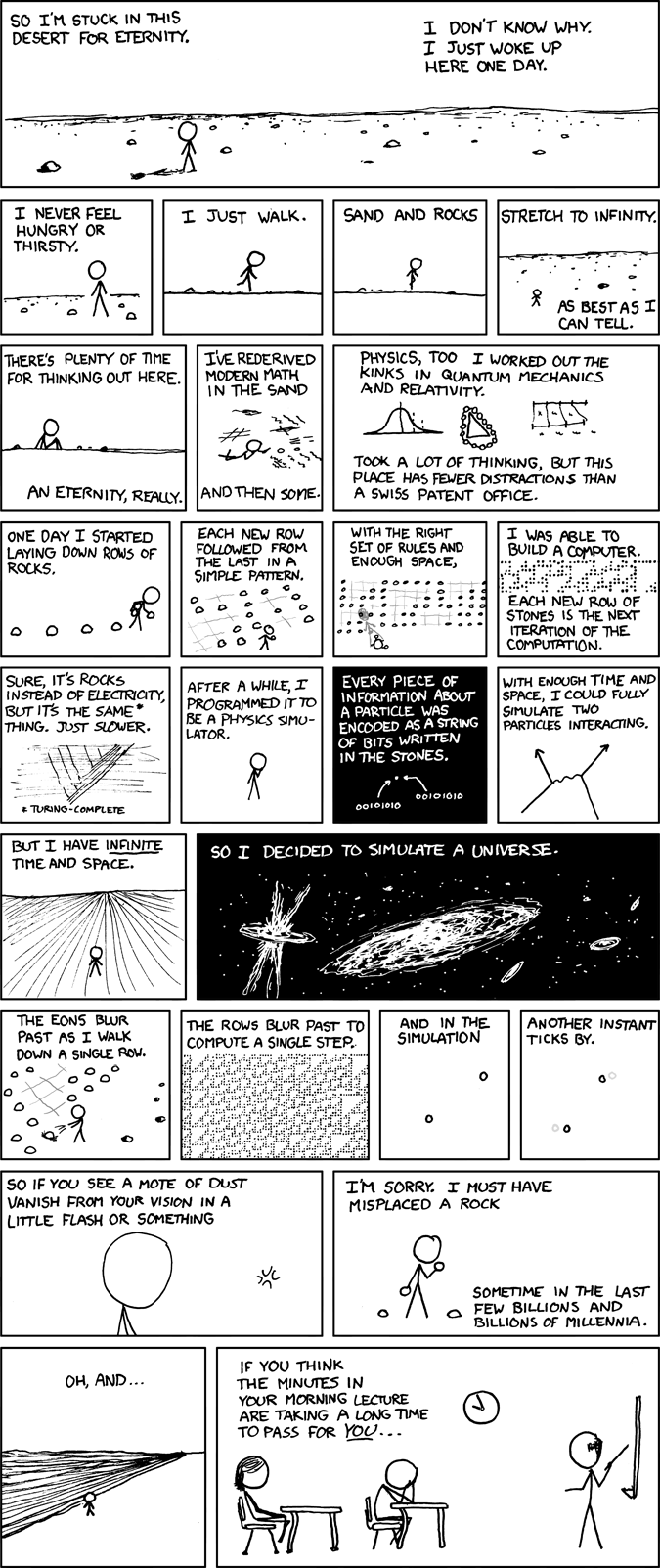
Here's one of the problems I have with it all -- whatever instructions we give the hardware will have to be carried out by electrons through gates, but the actions that anything in a simulation will carry out will also be electrons moving through gates; so both the rules and what happens will be the same type of process in the computer. That seems kind of strange to me and might be a very big problem. It is certainly nothing like what we see in the 'real world', except that everything seems to be either energy or space-time and somehow they are tied together?
I guess like any computer, the simulator will have to demarcate: curtain off "assembly" (break down input into machine instructions, prepare data for output) from "output", which will be the simulation. Within the simulation, there will be nothing but relations between data which has been interpreted by the program as output, virtual "things" within the simulation, which certainly sounds different from our conception of physical reality, doesn't it: maybe just hard to get one's head around, or maybe a real difference between physical and virtual "consciousness"? Hmm...