Global warming "truthers" would self-ignite; Permafrost Results

And for the 2000th post in the thread, and back on topic;

[imgw=640]http://nsidc.org/data/seaice_index/images/daily_images/S_timeseries.png[/imgw]

Looks like a warm summer in Antarctica. I wonder what is happening to the permafrost there?
 
I tend to discount Antarctic sea ice level as it's complicated by accelerated glacial outflows. Net mass balance is a far better indicator for land surrounded by ocean. ( Greenland and Antarctica )

Arctic ice cover is a much different matter..

World's glaciers melting faster, scientists say

The Associated Press
January 29, 2009 at 12:38 PM EST

ZURICH, Switzerland — The world's glaciers thinned by an average of almost 29 inches (74 centimetres) in 2007, indicating that they are melting twice as fast this decade as during the 1980s and 1990s, Swiss scientists said Thursday.

more
http://www.theglobeandmail.com/servlet/story/RTGAM.20090129.wglaciers0129/BNStory/Science/home
 
....Consider Las Vegas. OK, Las Vegas itself is screwed, but it's an example of an entirely artificial community that we engineered. We can do it again, sustainably, and we will when we have to. All we need is energy, and there's no shortage of available energy even without fossil-fuels. We're not harnessing much of it yet, but we will.
This comment I just chanced upon. Wrong, Capel. California is screwed. Nevada (say: Las Vegas) has the Hoover Dam, excess power is sold to .... California.

Try again?
 
This comment I just chanced upon. Wrong, Capel. California is screwed. Nevada (say: Las Vegas) has the Hoover Dam, excess power is sold to .... California.

Try again?

Power isn't the issue, but water is. And without water from Lake Mead there's no power anyway. Of course there's plenty of desert around Las Vegas so they can generate power from concentrated solar energy and from wind. As can California.
 
I tend to discount Antarctic sea ice level as it's complicated by accelerated glacial outflows. Net mass balance is a far better indicator for land surrounded by ocean. ( Greenland and Antarctica )

Arctic ice cover is a much different matter..


more
http://www.theglobeandmail.com/servlet/story/RTGAM.20090129.wglaciers0129/BNStory/Science/home

The comments there are predictable. Deniers pointing at the few glaciers that are advancing, fantasies about earlier times, accusations of cherry-picking, Al Gore of course - I'm only surprised there's nothing about the glaciers on Mars.

Arctic sea-ice is the main feature, to my mind. It'll be maxing-out in six to eight weeks, and I notice there's a lot of young ice between the North Pole and Siberia. That's one to watch.
Yes, and some of us have got money on the min later in the year. :D

PS I'm disappointed you didn't pick up on my thread about the Mad Monk, aka Mendacious Munchkin, aka Potty Peer. Shame the "sceptics" didn't leap in to defend his latest magnum opus. ;)
 
Last edited:
Hoover dam is not likely to run many Hoovers much longer....

21water600.1.jpg


High Chances of Lake Mead Drying Up

By Alice Turner
16:24, February 13th 2008 97 votes
Vote this story

news_13975.JPG
Lake Mead, the largest man-made lake and reservoir in the United States, could dry up by 2021 according to researchers at San Diego's Scripps Institution of Oceanography. There is reportedly a 50 percent chance for the Lake Mead to disappear by that date and, also, there is a 10 percent chance that it will run out of usable water by 2014.
The few glaciers that ARE gaining mass are doing so due to the increased moisture in the atmosphere.....hmmmm now WHERE did that moisture come from......:rolleyes:
 
Last edited:
Power isn't the issue, but water is. And without water from Lake Mead there's no power anyway....
Oh, so now in your Alarmist fantasy Lake Mead will dry up? Now that's rich. Please explainify this odd curiosity. No, wait, go get educated on the hydrology of western US first.
 
The comments there are predictable. Deniers pointing at the few glaciers that are advancing, fantasies about earlier times, accusations of cherry-picking, Al Gore of course - I'm only surprised there's nothing about the glaciers on Mars.

Arctic sea-ice is the main feature, to my mind. It'll be maxing-out in six to eight weeks, and I notice there's a lot of young ice between the North Pole and Siberia. That's one to watch.

I predict this year will be a near record at least.

http://nsidc.org/arcticseaicenews/

"In this month's entry, we offer a review of the 2008 year in Arctic sea ice. First, however, we discuss the noticeable pause in ice growth from December 12 to 19, apparently caused by an anomalous atmospheric pressure pattern combined with unusually warm ocean surface temperatures in the Barents Sea."

Warm?

In the Barents?

In DECEMBER?

[imgw=800]http://nsidc.org/data/seaice_index/images/daily_images/N_timeseries.png[/imgw]

Trending right with 2007 at present.

Now, unless the paid oil company shills here want to claim that the ice volume is going to continue to grow after the Ides of March, or that the diminished area of ice that has formed is of unusual thickness, we have a continued downward trend in actual ice volume even if we only MATCH the 2007 trend line.

Because remember that extent is just area, and it is volume that matters most once melting starts! 20,000 square miles of six inch new ice is not the same as 20,000 square miles of 2 meter thick aged multi-season ice for several reasons beyond the matter of volume;

Old ice is less salty and melts at a higher temperature than new ice.

Old ice has a lot of included air which makes it float higher and insulates it.

Old (thick) ice has a higher albedo than new (thin) ice and so new ice cannot resist insolation.

So - we start each year will less actual ice regardless of the extent until one year you can sail from Nanisivik to Dudinka by August.

 
Feet on the ground at Everest....watch the video.

http://www.youtube.com/watch?v=enJ9F8WKXVU

http://solveclimate.com/blog/20090119/video-everests-melting-glaciers

New data collected by scientists at the Jawaharlal Nehru University has shown that glaciers in the Himalayas are retreating faster than anywhere else in the world. Together with those on the neighbouring Tibetan mountain plateau, the Himalayan glaciers make up the largest body of ice outside the Polar regions.

The Energy and Resources Institute (TERI)’s scientist, professor Syed Hasnain, in a recent study claimed that “All the glaciers in the middle Himalayas are retreating, and they could disappear from the central and eastern Himalayas by 2035.”

••••

glacier_thicknessgraphNSIDC.gif


http://climaticidechronicles.org/2008/11/18/thirsty-yet-alpine-glaciers-in-full-retreat/

MuriGlaciercontrast.jpg

Muir Glacier, Alaska. Photo on the left taken on August 13, 1941. Photo on the right taken on August 31, 2004.
 
Last edited:
Oh, so now in your Alarmist fantasy Lake Mead will dry up? Now that's rich. Please explainify this odd curiosity. No, wait, go get educated on the hydrology of western US first.

http://www.nytimes.com/2008/02/13/us/13mead.html

http://ucsdnews.ucsd.edu/newsrel/science/02-08LakeMead.asp

http://www.livescience.com/environment/080212-dry-lake-mead.html

And there are plenty more such articles. It's not exactly an "alarmist fantasy". Of course the notion that everything is always going to be just fine no matter what could be considered a fantasy.

http://www.lasvegassun.com/photos/2008/mar/12/3357/

Since it is a reservoir, water level is dependant on snow falling on upstream mountains. Higher regional temperatures means more water in the air, more snow and precip (since the air does moves upslope). There are decadal variations of course.

Next you'll be telling us that the Great Lakes could go bone dry due to Global Warming. Wait...Ben has already tried that, but would not pursue the subject when questioned.

It is worth noting that Australia would be quite lush, if it had a mountain range going up to 10-15000 feet down the middle.

Power isn't the issue, but water is. And without water from Lake Mead there's no power anyway. Of course there's plenty of desert around Las Vegas so they can generate power from concentrated solar energy and from wind. As can California.

Actually you are proving the reverse of what you think you are. That these areas are not using solar shows that even in the best of areas, it is an economic loser. Nonwithstanding that, the recent economic problems caused a flight from solar investments, such that at the recent San Diego conference on renewable energy, it was flat stated that the investment capital available for solar was not higher than $85M. That is compared to some $500M estimated just a few months prior.

As for wind, the adjacent areas to Las Vegas and the Mojave desert area on the CA side are not to my knowledge good for wind. Usually that takes some ridgelines, or a plateau.
 
Last edited:
Next you'll be telling us that the Great Lakes could go bone dry due to Global Warming.

You claimed it was CapelDodger's "alarmist fantasy". All I did was offer a few sources that show there is some basis for these concerns - not just someone's alarmist fantasy. The only claim I made is that you're delusional if you're absolutely confident that everything will always be just fine.

Here's a fun fact for you: everything will most definitely not be just fine. At some point in time the Earth will undergo EXTREME changes. It might be this year, or it might be a million years off. Yosemite could blow and create an extreme ice-age, an asteroid could hit and cause the same effect, man-made global warming could wreak havoc on our climate, water supply etc., natural cycles could send us into climates of either extreme, or we might be lucky enough to wait for the Earth to simply run out of steam and become a dead planet like Mars (but being that lucky seems extremely unlikely).
 
Indeed we have many terrestrial waters drying up and that is not alarmist in the slightest!

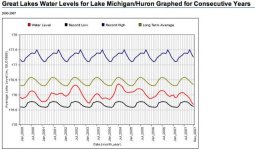
For example here is a graph of water levels in Lake Michigan/Lake Huron. The upper sinusoidal line is the monthly historic maximum.

The bottom sinusoidal line is the monthly historic minimum.

The middle sinusoidal line is the all-time historic average for this lake system.

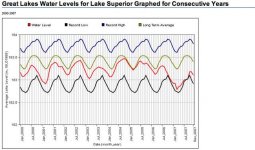
As you can see, we are near record lows, and the next graph is Lake Superior and as you can see we set a record low there in 2007.
 

Attachments

  • Snapz Pro XScreenSnapz024.jpg
    Snapz Pro XScreenSnapz024.jpg
    42 KB · Views: 3
  • Snapz Pro XScreenSnapz025.jpg
    Snapz Pro XScreenSnapz025.jpg
    42.7 KB · Views: 2
those annoying "observations" AGAIN :garfield:

Drought warning as the tropics expand

19:05 01 February 2009 by Catherine Brahic

California's governor, Arnold Schwarzenegger, warned on Thursday that his state "is headed toward one of the worst water crises in its history"

.........

The climate models quoted by the Intergovernmental Panel on Climate Change predict that the Mediterranean region and the south-west of the US are heading towards devastating droughts.

Reichler says this latest study suggests this is a result of the poleward march of the tropics.

Southern California is already subtropical in the summer. But with climate change, dry conditions could spread to areas like northern California, Washington and Utah, which now get far more rain and snow.

According to a recent survey by the California Department of Water Resources, the snowpack on California's mountains is currently carrying only 61% of the water of normal years. The Sierra snowpack alone provides two-thirds of California's water supply, and these mountains have so far only received one-third of the expected annual snowfall, despite December and January normally being the wettest months.

Journal reference: Geophysical Research Letters (DOI: 10.1029/2008GL036076, in press)

complete article.
http://www.newscientist.com/article/dn16516-drought-warning-as-the-tropics-expand.html


of course dry and hot tend to go together

Bay sees record heat and maybe driest January
Henry K. Lee,Steve Rubenstein, Chronicle Staff Writers
Tuesday, January 13, 2009

(01-12) 18:00 PST SAN FRANCISCO -- High-temperature records fell like imaginary raindrops in the Bay Area on Monday, among the warmest mid-January days ever.

It's also shaping up to be one of the driest Januarys ever - if not the driest. There's been almost no rain this month, and none is in sight, the National Weather Service says.
http://www.sfgate.com/cgi-bin/article.cgi?f=/c/a/2009/01/12/BA3C157RFN.DTL

January Heat Wave Sets Los Angeles Record

http://www.nbclosangeles.com/weather/stories/January-Heat-Wave-Sets-Los-Angeles-Record.html
 
Last edited:
Great Lakes....remarkable display of ignorance of basic climate physics....

More moisture in the atmosphere - more snow and rain.......

Toronto Officially Sets Wettest Year Record As Slick Streets Lead To Hundreds Of Accidents

Wednesday December 10, 2008
CityNews.ca Staff
There's nothing like breaking a record to give a city some pride.

And so it is with humble aplomb that GTA residents can now ruefully tell their grandchildren that they've lived through the wettest year in recorded history.

remarkable coincidence that....

Of course diminishing ice cover on Superior makes for additional evaporation....

Lake superior has been warming even faster than the climate around it since the late 1970s. Its ice cover could completely vanish by the winter of 2040//, according to a study by professors at the University of Minnesota Duluth. A popular tourist spot,it is the largest freshwater lake in the world by surface area.

Summer surface temperatures on this famously cold lake have increased about 4.5 degrees since 1979, compared with about a 2.7-degree increase in the region's annual average air temperature, the researchers found. The lake's "summer season" is now beginning about two weeks earlier than it did 27 years ago.

Must be all them heat islands in the lake Martha....
 
Last edited:

ISF - Join now!

Every member here is approved by hand. No bots, no spam, just people who care about evidence and honest debate.

Membership is free!

Create your free account

Back
Top Bottom