• Quick note - the problem with Youtube videos not embedding on the forum appears to have been fixed, thanks to ZiprHead. If you do still see problems let me know.

Moderated Global Warming Discussion

Status
Not open for further replies.
More shipping started through the Arctic, and given the benefits one might imagine that this will pick up quickly over the next decade.

"The Northern Sea Route to China across the Arctic is shorter than routes through the Suez Canal. According to the partners, the route has the potential to generate significant savings for both cargo and ship owners, and in addition during this voyage there is no threat of piracy.

The fuels savings alone add up to approximately US$180,000, according to Christian Bonfils, managing director of Nordic Bulk."

http://www.bairdmaritime.com/index....hrough-the-arctic-to-china&catid=67&Itemid=58
 
One more huge ship makes it through as well.

http://www.theage.com.au/world/russian-tanker-conquers-arctic-passage-20100903-14ubk.html

''Never before has a ship of this size passed via the north-east sea passage,'' Captain Alexander Nikiforov said.

Experts estimate it could be four times cheaper in terms of fuel and charter time than the conventional route.

Not only is it free from pirates who plague the African coast where ships tend to refuel, but ships are escorted by a fleet of nuclear ice-breakers to clear the passage.

This is where Russia aims to make its money, providing an indispensable service guiding ships through the passage with specialist divers and oil spill clean-up equipment

Interesting History
"Named the North-East Passage when Britain still thought itself the centre of the world, the route first thwarted Sir Hugh Willoughby in 1553. An explorer sponsored by the Company of Merchant Adventurers to New Lands, he tried to discover if a trade path existed, but his ship stuck in the ice and the crew froze to death.

William Barents, a Dutch hopeful, also saw his ship crushed in the ice and ended up living in a driftwood hut surviving on polar bear meat, before perishing in 1597. At least he had the Barents Sea named in his honor."
 
Solar Wind, Planetary Warming and Convection

There is a theory that cosmic rays might have an effect on the earth's climate, its not a very popular theory, but its summarised here.
http://www.viewzone.com/magnetic.weather.html

Mr Svensmark claims that the number of cosmic rays hitting the Earth changes with the magnetic activity around the Sun. During high periods of activity, fewer cosmic rays hit the Earth and so there are less clouds formed, resulting in warming.

Low activity causes more clouds and cools the Earth.

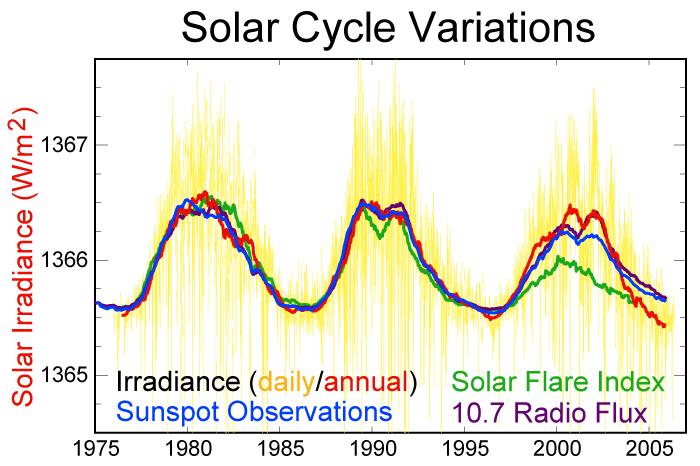
You can see here a chart of the solar cycles showing peak radiance corresponding with peak sunspots, peak flares and presumably peak solar wind. During peak solar wind, cosmic rays are minimised.

Does the solar wind deliver energy (or warmth) to the outer layers of the Earth's atmosphere through a conductive mechanism independent of radiation levels (or rather not so tightly constrained as radiation peaks seem to be)? If such an effect existed, how could it be quatitated?
 
Whatever it is it will be much less than the energy delivered by the photons by several orders of magnitude.

IOW Most of the energy from the sun comes from the light by a huge margin.

Now you phrased your question really poorly, when you say "conductive mechanism independent of radiation levels" that is very confusing because there are different kinds of radiation and you don't really specify what you are talking about.


1380 Watts/meter2 seems to be a common figure for the amount of photon energy coming from the sun at the earth’s distance, although you have to adjust for the spherical nature of the atmosphere.

The amount of solar wind radiation is harder to find, and a lot of it would be deflected by the earth’s magnetic field.
 
That was what the paper says, the climatologists didn't consult statisticians, that is why they wrote this paper. In writing it, they didn't consult with any climatologists, made fundamental mistakes, and so the paper is a waste of time.

The problem with using statisticians is that they can only use data provided by others, right or wrong. They, the statisticians, stand a probability themselves of being wrong just because they are not experts in any field except a mathematics. This is a problem in itself by using information they supply.

The fact that things are changing without a good reference makes a climatologists opinion suspect as well. The only historical evidence which anyone can reference with any certainty that isn't in recorded history comes from ice core samples and fossils which provide indications of climates. None give exact answers, nor do they give clues as to weather patterns. The increases in temperatures the world is looking at are basically an unknown to science. There will be conjecture and speculation but, the fact remains, it is an unknown future.

I think investing in insulated and climate controlled clothing is a good option though along with portable power sources that use really common fuel sources.
 
There will be conjecture and speculation but, the fact remains, it is an unknown future.

You are very wrong in your unspoorted statement.

C02 levels have a known impact on the planetary energy budget and this is confirmed, experimentally, by observation both in the current time frames and paleo.

It is far from "unknown".

We know what the orbital driver situation is. ( Milankovich ) - we are in a minor drift to cooler from an orbital standpoint and that drift changed about 4300 years ago with the onset of industrial civilization..

We know within a range what a given level of C02 and it's accompanying water vapour feedback will drive atmospheric temperatures to.

We know what paleo tells us about similar conditions/temperatures.

The unknowns are the speed at which various other geosphere systems will respond to the increases inb retained energy....cryosphere notably, major circulation like monsoons, and ocean circulation related like ENSO/NAO.

The latter are all shifting energy within the system.
Fossil C02 is the primary driver with water vapour the magnifying feedback.

Onset and range of anomalies remain uncertain.
The role of particulates and land use ( also Anthro influences ) in changing the timing, range of swings and degree of warming also remains unclear.

What is in no way unclear...

It's getting warmer
We're primarily responsible due to release of fossil carbon

The physics is rather straight forward.
What to do about it?? Far from straight forward.
 
There is a theory that cosmic rays might have an effect on the earth's climate, its not a very popular theory, but its summarised here.
http://www.viewzone.com/magnetic.weather.html
"Solar activity and terrestrial climate: an analysis of some
purported correlations" by Peter Laut


CLOUD's site, an experimental facility set up at CERN to investigate the microphysics between galactic cosmic rays and clouds under controlled conditions.
You can see here a chart of the solar cycles showing peak radiance corresponding with peak sunspots, peak flares and presumably peak solar wind. During peak solar wind, cosmic rays are minimised.

Does the solar wind deliver energy (or warmth) to the outer layers of the Earth's atmosphere through a conductive mechanism independent of radiation levels (or rather not so tightly constrained as radiation peaks seem to be)? If such an effect existed, how could it be quatitated?
I suppose you use "conductive mechanism" meaning that solar wind carries energy on its own and I think that's true. But think in a "typical" proton with a 100keV energy -just to make some quick calculations-. That energy is about 1/100000th of the energy equivalent for proton mass. The sun is supposed to have lost just a small fraction of its mass as solar wind, what I guess is some one, two or three orders of magnitude below the mass loss as radiation. Besides, Earth's magnetic field takes care of most charged particles. Then my 'provisional' conclusion is that solar energy carried by solar wind has a negligible effect in the Earth's energy budget. It is as charged particles and nuclei formation that these particles are studied as a factor in Earth's climate.
 
Scraping the bottom of the discounted AGW denier barrel.

Gavin deals with it

RealClimate: 'Cosmoclimatology' – tired old arguments in new clothes
9 Mar 2007 ... Svensmark must have adjusted the cloud data too. Shown below is a figure from a previous paper where he justified an adjustment from a break ...
http://www.realclimate.org/index.ph...imatology-tired-old-arguments-in-new-clothes/

RealClimate: Still not convincing
But Svensmark et al. also fail to make reference to another relevant paper by Erlykin et al. (published January 2009), which argues that any effect on ...

one never knows...LGR might just catch up to current science if continues to poke in the dustbin. :garfield:

http://www.realclimate.org/index.php/archives/2009/08/still-not-convincing/

Next...:rolleyes:
 
From the other thread in Social Issues and Events that just got closed:

The last interglacial was 5 degrees warmer, 130 000 years ago. And that was due to natural causes. Just saying.

No it wasn't.

http://www.globalwarmingart.com/wiki/File:Ice_Age_Temperature_Rev_png

The interglacial periods have remained pretty much constant, ie. reaching our preindustrial temperatures and not much beyond, for at least 800,000 years, and likely as far back as 1.5 million according to some of the latest proxy reconstructions. You have to go back to 3 million years to see even a 3 degree rise and get an idea of how the planet responds to such a rise.

Beyond an average increase in global temperature we can't predict what will happen with local weather patterns. The IPCC says it's likely we will see more extreme weather events, but "acts of god" remain just that. How many extreme events are a result in the increase in CO2 or how many are simply because we've altered the albedo in certain areas is unknown.

Simply put, using the threat of increased droughts due to global warming is a red herring. We survive droughts, and when they do occur, whether due to "natural causes" or due to Global Warming is irrelevant, they happen and we need the infrastructure in place to mitigate their effects.

You're talking about weather events, we're talking about climate trends. As the planet warms then the likelihood of drought prone areas to experience warmer temperatures and lower rainfall increases and as such the incidences of more frequent and more severe drought also increases.

In respect to SE Australia, here is what BOM had to say about the matter:
http://www.bom.gov.au/announcements/media_releases/ho/20071004_de.shtml

Many parts of Australia are in the grip of a protracted drought — but is it evidence of climate change?

Researchers from the Bureau of Meteorology have been exploring the connection between the drought and climate change in research presented at the GREENHOUSE 2007 conference in Sydney.

"We've had three of the warmest years on record in the past five years, combined with an exceptionally dry decade, in southern and eastern Australia. The temperature patterns certainly fit with the pattern of global warming; however the rainfall signal is less clear" said Dr Mike Coughlan, head of the Burea's National Climate Centre.

"The observed trend in recent years to lower rainfall across much of southern Australia does show some level of consistency with climate projections that foreshadow general drying across southern Australia."

"The combination of low rainfall and record high temperatures over southeast Australia for the past two severe drought years (2002 & 2006) is without precedent in the past 100 years."

"Low rainfall combined with record high temperatures leads to increased evaporation and less available water — it's a double-edged setback for water storages and bushfire risk."

"Rainfall will continue to vary due to natural influences, as it may well do due to human influences." said Dr Coughlan. "This past decade of low rainfall, together with record warm temperatures is perhaps giving us a preview of our future climate."
 
You can see here a chart of the solar cycles showing peak radiance corresponding with peak sunspots, peak flares and presumably peak solar wind. During peak solar wind, cosmic rays are minimised./quote]

This is uncontentious. Svensmmark argues that cosmic rays affect coud cover, but sadly lacks any observations to support his claim. He came up wit the idea and then went looking for evidence, which is technically known as cul-de-sac science. His (and his acolytes') efforts to extract signal from noise have long passed the desperate stage. A footnote in history, and at most a short entry in the index.

Does the solar wind deliver energy (or warmth) to the outer layers of the Earth's atmosphere through a conductive mechanism independent of radiation levels (or rather not so tightly constrained as radiation peaks seem to be)?

Of course moving particles ramming into the atmosphere impart energy to it, by the same kind of "conductive mechanisms" that make car-crashes so interesting. It's a paltry amount compared to direct radiation from the Sun, which you can actually feel on your skin on a sunny day.

If such an effect existed, how could it be quatitated?

If such an effect mattered a lot of people would have noticed. It would have posed a question. No such question having been posed it remains completely imaginary.
 
Whatever it is it will be much less than the energy delivered by the photons by several orders of magnitude.

IOW Most of the energy from the sun comes from the light by a huge margin.

Now you phrased your question really poorly, when you say "conductive mechanism independent of radiation levels" that is very confusing because there are different kinds of radiation and you don't really specify what you are talking about.


1380 Watts/meter2 seems to be a common figure for the amount of photon energy coming from the sun at the earth’s distance, although you have to adjust for the spherical nature of the atmosphere.

The amount of solar wind radiation is harder to find, and a lot of it would be deflected by the earth’s magnetic field.

David, I have no doubt I have used all kinds of wrong terminology - I ask these questions seeking information only.

We know, for example, that the Maunder Minimum was a period of almost no sunspots but also a period of very cold temperatures.
http://en.wikipedia.org/wiki/Maunder_Minimum

We also know that there is not a very large variation in solar irradiance between sunspot cycles.
Solar-cycle-data.png

Around 0.1% difference between peak and the base of the cycle. We also know that solar flares and solar wind peak at the peak of the sun spot cycle. What I am asking is what is the mechanism by which the Maunder Minimum and absence of sun spots resulted in a mini ice age - it would not appear to be due to solar irradiance which looks tightly constrained. So several orders of magnitude less energy from solar wind would still be very significant if these variation went from a minimum of zero to a peak - because solar radiation is so constant.

Could it be, therefore, some kind of energy transfer by solar wind that insulates the outer layers of the atmosphere and so reduces the rate of heat loss?

Or what else might be the mechanism?
 
Could Global Warming be a Good Thing?

Radical climate change has happened before and we have our own existence to thank for it. At one time in the Earth's history, the atmosphere was unbreathable because there was not enough oxygen in the air. The abundance of early plant life changed that.

Then at one time the Earth was heavily oxygenated. And it was this high concentration of oxygen that fueled the more active dinosaurs metabolisms.

But I would like to call your attention to occurrence that have led to mass extinctions and could pose an even greater threat to mankind than global warming -- it is something that we should be grateful towards global warming for bringing to an end. I am talking about Ice Ages. It would be a good thing, for us humans, if there were no more Ice Ages. It would be a good thing if man made global warming brought an end to the occurrence of Ice Ages.

If have never heard of it before, I suggest you do some reading of one particular Ice Age that was so severe it wiped out all but the smallest and toughest microbial life on Earth. It was called "Snowball Earth" and it was when the glaciers advanced to the point where the glaciers from the south pole met the glaciers from the north at the earth's equator. If it was not for a fluke of volcanic activity, our planet would be like that today.

Preventing that from happening again would be a good thing.

What is more is this. If all the glaciers melted on Earth it would be bad for a lot of people. It would be bad for the people who rely on glances for fresh water. It would be bad for about 100 million people who live in coastal areas. But this would be temporary problems. Human beings would just have to adapt.

There is a good side. First of all, not all the melting ice would raise sea levels. Ice floating in water does not raise water level as it melts. Just do an experiment. Put ice in a glass of water and watch.

Secondly, all the ice melting from Antarctica and Greenland and the northern regions of Canada and Asia would free up vast areas of land. This land gain would more than make up for the land lost to flooding. This land could be used for farming and living. In a sense, it would ease over-population and make the world a better place.

I am wondering if this is just another change that will happen to the Earth for our long term benefit. Life has shaped and changed the planet. Once, the atmosphere was toxic. That is how it was "naturally" before plant life changed it and set the groundwork for animal life. Maybe we are changing things for the better. Changing the planet so that there will never again be an Ice Age is to our benefit. Freeing up more land for the production of food and perhaps ending world hunger is also to our benefit.
 
David, I have no doubt I have used all kinds of wrong terminology - I ask these questions seeking information only.

We know, for example, that the Maunder Minimum was a period of almost no sunspots but also a period of very cold temperatures.
http://en.wikipedia.org/wiki/Maunder_Minimum

We also know that there is not a very large variation in solar irradiance between sunspot cycles.
[qimg]http://upload.wikimedia.org/wikipedia/commons/0/0d/Solar-cycle-data.png[/qimg]
Around 0.1% difference between peak and the base of the cycle. We also know that solar flares and solar wind peak at the peak of the sun spot cycle. What I am asking is what is the mechanism by which the Maunder Minimum and absence of sun spots resulted in a mini ice age - it would not appear to be due to solar irradiance which looks tightly constrained. So several orders of magnitude less energy from solar wind would still be very significant if these variation went from a minimum of zero to a peak - because solar radiation is so constant.

Could it be, therefore, some kind of energy transfer by solar wind that insulates the outer layers of the atmosphere and so reduces the rate of heat loss?

Or what else might be the mechanism?
As pointed out here there may well be other factors influencing the climate at the time of the LIA. There doesn't appear to be one convincing explanation for it, so it's likely that it was a combination of factors.
 
Could Global Warming be a Good Thing?
...

Arguing that advancing glaciations are as bad or worse than epochs of extinction level warming into the discussion of the realities of global warming presents what is otherwise known as the fallacy of false dilemma. We were not in a situation of imminent threat from a cooling climate, but rather an extended mild, moderate climate that fostered the development of modern civilization and to the best of our understandings would have continued in that relatively mild and moderate state for some tens of thousands of years without our unintentional interventions. No one is advocating climate control or even the alteration of natural climate conditions, what is being advocated is the ceasation and reversal of our own unintentional climate interventions.
 
Status
Not open for further replies.

Back
Top Bottom