
• Quick note - the problem with Youtube videos not embedding on the forum appears to have been fixed, thanks to ZiprHead. If you do still see problems let me know.

Moderated Global Warming Discussion

Status
Not open for further replies.
BV
Now please can you explain why this argument exists that if solar variance were a factor we should have seen cooling in the latter part of the 20th century when in fact we were still seeing some of the highest output since record keeping began? Wouldn't we continue to see more heating because the period persisted with higher than average output, not lower which would
be required to see a reversal?

Sunspots only loosely co-orelate with irradiance. Your graph shows numbers of sunspots not irradiance. The solar constant if anything has drifted down a tad and indeed the planet warmed against the slight downward drift.
Sunspot numbers are a marginal guide at best.
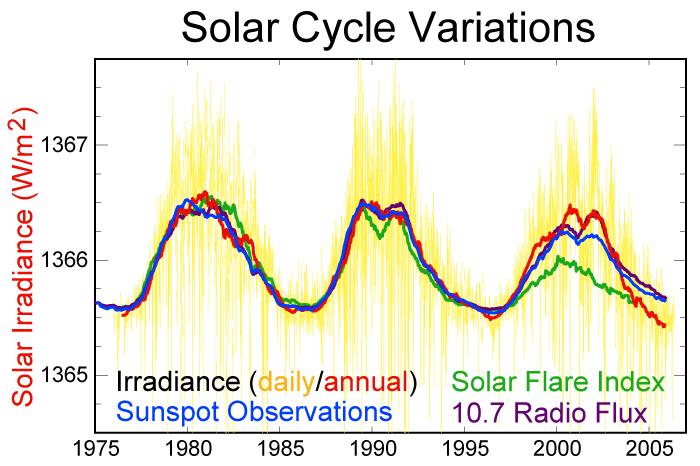
Solar-cycle-data.png


wiki image

The influence of the cycles is a magnitude below the forcing of GHG/AGW so while it's clearly there it's just an overlay.
Once more you are urged to read the science instead of covering ground already covered off in this thread many time.
 
How is that a logical argument? More solar output=hotter earth, right? Why else do they bother keeping track of these peaks?


Why do you have to view only the solar variations since 1975 to dismiss this as no influence on the trend, when data is available going back over 400 years? Are we only discussing climate change since 1975?

[qimg]http://i353.photobucket.com/albums/r384/batvette/maunderminimum_zps99faf332.jpg[/qimg]

Now please can you explain why this argument exists that if solar variance were a factor we should have seen cooling in the latter part of the 20th century when in fact we were still seeing some of the highest output since record keeping began? Wouldn't we continue to see more heating because the period persisted with higher than average output, not lower which would
be required to see a reversal?
Why don't you explain exactly the confirmation for sunspots and the correlation to solar luminescence/energy out out?
 
How is this not contradictory to the fact the Maunder minimum is accepted?

First of all it’s not accepted that solar activity was responsible. If it were you would see cooling more or less globally, which isn’t the case. Cooling was primarily confined to Europe and Parts of North America. While other climate effects were felt elsewhere, cooling was much less or non-existent.

Second, cooling during the LIA WAS small. There was 0.3 – 0.4 deg C cooling over several hundred years where as currant warming is a litter under 0.2 deg C PER DECADE
How much if the earth's warming is provided by man? None.

Nearly 100% of the warming since 1950 can be attributed to human activity. From 1900 – 1950 ~0.3 deg C worth of warming can be attributed to natural influences like solar and volcanic activity.

http://journals.ametsoc.org/doi/pdf/10.1175/1520-0442(2004)017<3721:CONAAF>2.0.CO;2
How is that a logical argument? More solar output=hotter earth, right? Why else do they bother keeping track of these peaks?

People keep track of many things that are not overly useful. In this case however it turns out that sunspot numbers are a lot more useful for understanding how the Sun works than how the Earth’s climate works.

Why do you have to view only the solar variations since 1975 to dismiss this as no influence on the trend, when data is available going back over 400 years? Are we only discussing climate change since 1975?


We’ve only been able to measure solar output since the mid 70’s. Sunspot numbers correlate somewhat be we have no way to know how this relationship changes over time. In the 11 year sunspot cycle peak sunspot activity – near zero sunspot activity the Suns output only changes by 0.2%.
 
How is this not contradictory to the fact the Maunder minimum is accepted to have caused a little ice age?
It is not so accepted. It is accepted as a contributory factor.

How much if the earth's warming is provided by man? None.
How much by the sun? All.
Therefore what? By "warming" you presumably mean energy, which does come from the Sun. The recent and continuing warming of the climate is primarily (if not entirely) caused by human activity.

Why so quick to dismiss variations when they are unprecedented?
What are these variations of which you speak?

We can calculate the effect on the energy budget of solar variations, and it is on the order of a few parts per thousand. Not terribly signficant.
 
How is that a logical argument?
There is no trend in solar variation over the last fifty years or so, while there has been a warming climate trend. If one thing has no trend and another thing does have a trend the former thing is not the cause of the latter.

More solar output=hotter earth, right?
And less means cooler, in both cases very marginally. The variations are in both directions in recent decades, with no trend.

Why else do they bother keeping track of these peaks?
People have always observed the Sun. It does demand attention, lets face it. Understanding the Sun is still a major scientific attraction, it gets access to the best technology and it gets funding - patronage, in less modern times. It's what people do.

Why do you have to view only the solar variations since 1975 to dismiss this as no influence on the trend, when data is available going back over 400 years?
Because this is about AGW, and the relevant trends go back at the earliest to the Industrial Revolution and more reasonably to 1975 - since more than half of emmissions have occurred since then. There's no trend in solar activity but there is a trend in climate. The former, therefore, does not explain the latter.

Are we only discussing climate change since 1975?
The post you quote from was doing just that.
 
Have climatologists considered how increased CO2 might affect moisture in the air and cloud cover? We know from the several days after 9-11 that cloud cover reduces ground air temperatures.

If there any chance that increased CO2 will lead to more clouds?
 
Now please can you explain why this argument exists that if solar variance were a factor we should have seen cooling in the latter part of the 20th century when in fact we were still seeing some of the highest output since record keeping began? Wouldn't we continue to see more heating because the period persisted with higher than average output, not lower which would
be required to see a reversal?

Your argument suggests that even if solar output remains at this level warming will continue ad infinitum. In fact a new equilibrium will quickly be reached (it's a direct input of energy, not a gradual accumulation like in AGW), certainly by now. The recent low output will have had a cooling influence but it's not easy to discern.

There's no refuge in the Sun, I'm afraid.
 
BV

Sunspots only loosely co-orelate with irradiance. Your graph shows numbers of sunspots not irradiance. The solar constant if anything has drifted down a tad and indeed the planet warmed against the slight downward drift.
Sunspot numbers are a marginal guide at best.

[qimg]http://upload.wikimedia.org/wikipedia/commons/0/0d/Solar-cycle-data.png[/qimg]

wiki image

That is not an accurate assessment of the issue. Sunspot activity is scientifically accepted as a general indication of solar output, thus the maunder minimum accepted to cause a little ice age.
The influence of the cycles is a magnitude below the forcing of GHG/AGW so while it's clearly there it's just an overlay.
Once more you are urged to read the science instead of covering ground already covered off in this thread many time.

You're backpedaling from the position earlier stated that there is no influence.

The Tom Cruisesque "read the science/do the research, Matt!" argument is a dodgy attempt at discrediting the opponent's argument that doesn't address the argument- and you may think it's been "covered" in this thread but that doesn't mean anyone was right about what they wanted to suppress.

It's obvious there is a persistent desire to blame only man here, we're being assured this position has been arrived at via pure science and fact, if that were the case we wouldn't be seeing such dodgy presentation of underlying factors such as solar variance.

The question to discuss here is that it's possible that forced warming by solar variance can cause conditions which mimic GGE on the part of man. Are the poles melting solely because of human activity or did solar variance begin a snowballing effect which man is just a part of? Is it a mistake to merely look at C02 as if it's been all created by man when a lot of it may be just an indication of global warming through other factors?

It's reasonable to assume some damage by human activity but frustrating to see that's all some people want to pretend is going on.
 
Why do you have to view only the solar variations since 1975 to dismiss this as no influence on the trend, when data is available going back over 400 years? Are we only discussing climate change since 1975?

We can discuss it from earlier if you wish. It turns out that global temperatures correlate quite well with vulcanism. Around 1000CE, for instance there was very little activity, while more average service was resumed in the 13thCE and things were very active in the 17th and 19th. The Maunder and Dalton Minumums just happen to fit into those periods.

In the 20thCE activity was remarkably low, and in the early decades there was warming which peaked out in the 30's. That was somewhat cooler than the Medieval Warm Period, but a thousand years of a falling trend will get you there. Then a new source of aerosols and airborne ash emerged to complicate matters. Eventually the inexorable greenhouse signal emerged from the noise.

The increase in solar activity also took place in the early 20thCE. It may havemade a contribution, but it's hard to discern. It was way too easy to discern the air over 70's Los Angeles and Tokyo though.
 
How is this not contradictory to the fact the Maunder minimum is accepted to have caused a little ice age?
batvette, you need to do some simple research before making invalid, unsupported assertions.

It is not contradictory for the simple reason that the Little Ice Age is accepted to have several possible causes. The Maunder minimum happened in the middle of the Little Ice Age which suggests that it did not cause the Little Ice Age but did contribute to its severity.

Climate scientists have looked at the effects of a new Maunder minimum.
Are we heading into a new Ice Age?
The warming effect from more CO2 greatly outstrips the influence from changes in the Earth's orbit or solar activity, even if solar levels were to drop to Maunder Minimum levels.
Further explained at How would a Solar Grand Minimum affect global warming? (a drop of "no more than 0.3°C" with CO2 cuasing a rise of over 3.7°C)

"How much if the earth's warming is provided by man?"
A lot!
Humans have basically driven the CO2 levels up by emitting many gigatonnes of CO2 every year for decades. To suggest that this increase in CO2 levels caused by humans had no effect on temperatures is ignorant. The greenhouse effect is well understood. Increasing CO2 = increasing temperatures.
Are humans too insignificant to affect global climate?

"How much by the sun?"
Let see - the output from the Sun has been constant (or even decreased a bit) since the 1970's. Global temperature has increased since the 1970's.
Can you see the contradiction, batvette?
Solar activity & climate: is the sun causing global warming?
In the last 35 years of global warming, the sun has shown a slight cooling trend. Sun and climate have been going in opposite directions. In the past century, the Sun can explain some of the increase in global temperatures, but a relatively small amount.

"Why so quick to dismiss variations when they are unprecedented?"
Why so quick to state the fantasy that variations are dismissed, batvette?
Climate scientists know about natural variations and do not dismiss them. They know that in general they cancel out on the time scales of climate change and so can be neglected. Then they check that they are right :eek:!
Foster and Rahmstorf Measure the Global Warming Signal
Foster and Rahmstorf (2011) have published a paper in Environmental Research Letters seeking to extract the human-caused global warming signal from the global surface temperature and lower troposphere temperature data. In order to accomplish this goal, the authors effectively filter out the effects of solar activity, the El Niño Southern Oscillation (ENSO), and volcanic activity.
 
Have climatologists considered how increased CO2 might affect moisture in the air and cloud cover? We know from the several days after 9-11 that cloud cover reduces ground air temperatures.

If there any chance that increased CO2 will lead to more clouds?

Yes, climate scientists study this extensively.

CO2 increases temperature,
Increased temperature means more water vapor in the atmosphere
Water vapor is also a greenhouse gas so increased water vapor also warms the atmosphere.


Clouds are more complicated but it appears in a warming planet they result in no more than a minimum cooling effect or possibly even a mild additional warming effect. The overall impact of water in the atmosphere enhances warming.

This shows up in both the models and the paleo-climate record where this enhancing effect is required to explain the advance and retreat of glaciers. Without this enhancing effect you need the earth’s climate to be MUCH more sensitive to CO2 and other greenhouse gases to explain glaciations.
 
We can't? What about the maunder minimum/little ice age?

What about it? Correlation doesn't mean causation.

Sunspot activity drops to near zero every 11 years without measureable effect on global temperatures so why would a drop in sunspot activity 300 years ago when people could barely measure it accurately mean anything?
 
More solar output=hotter earth, right?
And a constant or decreasing solar output=cooler Earth.
That is what we have measured the Sun to be doing since 1975".
But we have also measured that global temperatures have been increasing since 1975.

The logical argument is that something else caused the temperature changes since 1975. That something else is the CO2 that we have added to the atmosphere.

No one says that variations in solar output has no influence on the trend. What climate science says is
In the last 35 years of global warming, the sun has shown a slight cooling trend. Sun and climate have been going in opposite directions. In the past century, the Sun can explain some of the increase in global temperatures, but a relatively small amount.

please can you explain why this argument exists that if solar variance were a factor we should have seen cooling in the latter part of the 20th century when in fact we were still seeing some of the highest output since record keeping began?
That is easy to explain - that argument does not exist :jaw-dropp!
Some climate change deniers have a delusion where they ignore the science and think that global temperatures have only one cause (the Sun in this case).

People who do not deny climate science know that global temperatures have multiple causes. The data shows that global warming caused by CO2 increases has become dominant over the effect of the solar output.
 
That is not an accurate assessment of the issue. Sunspot activity is scientifically accepted as a general indication of solar output, thus the maunder minimum accepted to cause a little ice age.
Non sequitur of epic proportions. Really awesome.

You're backpedaling from the position earlier stated that there is no influence.
Quite the opposite : the position that recent influence is cooling while the world warms is what you have been arguing against.

I
t's obvious there is a persistent desire to blame only man here ...
That desire is entirely of your own imagination. Our real desire is to understand what's going on.

... we're being assured this position has been arrived at via pure science and fact, if that were the case we wouldn't be seeing such dodgy presentation of underlying factors such as solar variance.
"Dodgy presentation", that is rich following your previous paragraph and "The Tom Cruisesque "read the science/do the research, Matt!" argument is a dodgy attempt at discrediting the opponent's argument ...". As if you'd actually made any kind of argument.

The question to discuss here is that it's possible that forced warming by solar variance can cause conditions which mimic GGE on the part of man. Are the poles melting solely because of human activity or did solar variance begin a snowballing effect which man is just a part of?
No. Warming by AGW and by increased direct energy input have different signatures, and the one we're seeing is consistent with AGW but not with solar influence.

The only reason to bring up this "what if" scenario is as displacement activity.

Is it a mistake to merely look at C02 as if it's been all created by man when a lot of it may be just an indication of global warming through other factors?
Do you think scientists haven't checked? Imaginary factors are not called upon to explain the warming which was predicted. Your fantasies have to be summoned to explain it after the fact, presumably because the fact is too awful to contemplate.

It's reasonable to assume some damage by human activity but frustrating to see that's all some people want to pretend is going on.
And there's the "pretend", the malicious intent of conspiracist ideation.

Perhaps you should spend less time whining and more making some kind of case, and not for magical thinking. Something substantial.

And once again, the Maunder Minimum did not cause the Little Ice Age as the single cause. I don't think you're pretending to believe that, you really do, but you are wrong.
 
Have climatologists considered how increased CO2 might affect moisture in the air and cloud cover? We know from the several days after 9-11 that cloud cover reduces ground air temperatures.

If there any chance that increased CO2 will lead to more clouds?

Yes. In fact the very first time the AGW hypothesis was put forward, in 1896, it factored in water vapour feedback.
Yes and no, low level clouds during the day have a cooling effect, but at night have a warming effect, high level clouds have a warming effect.
Yes

Adding more of a greenhouse gas, such as CO2, to the atmosphere intensifies the greenhouse effect, thus warming Earth’s climate. The amount of warming depends on various feedback mechanisms. For example, as the atmosphere warms due to rising levels of greenhouse gases, its concentration of water vapour increases, further intensifying the greenhouse effect. This in turn causes more warming, which causes an additional increase in water vapour, in a self-reinforcing cycle. This water vapour feedback may be strong enough to approximately double the increase in the greenhouse effect due to the added CO2 alone.

Additional important feedback mechanisms involve clouds. Clouds are effective at absorbing infrared radiation and therefore exert a large greenhouse effect, thus warming the Earth. Clouds are also effective at reflecting away incoming solar radiation, thus cooling the Earth. A change in almost any aspect of clouds, such as their type, location, water content, cloud altitude, particle size and shape, or lifetimes, affects the degree to which clouds warm or cool the Earth. Some changes amplify warming while others diminish it. Much research is in progress to better understand how clouds change in response to climate warming, and how these changes affect climate through various feedback mechanisms

http://www.ipcc.ch/publications_and_data/ar4/wg1/en/faq-1-3.html

It's complicated but climatologists definitely consider cloud cover, here's a paper from science in 2010 concluding that clouds have a small positive effect http://geotest.tamu.edu/userfiles/216/dessler10b.pdf
 
How is that a logical argument? More solar output=hotter earth, right? Why else do they bother keeping track of these peaks?


Why do you have to view only the solar variations since 1975 to dismiss this as no influence on the trend, when data is available going back over 400 years? Are we only discussing climate change since 1975?

http://i353.photobucket.com/albums/r384/batvette/maunderminimum_zps99faf332.jpg

Now please can you explain why this argument exists that if solar variance were a factor we should have seen cooling in the latter part of the 20th century when in fact we were still seeing some of the highest output since record keeping began? Wouldn't we continue to see more heating because the period persisted with higher than average output, not lower which would
be required to see a reversal?

***sigh***

This is the umpteenth time someone tries to sell solar cycles as a major climate driver in times of man-made pollute-engeenering of the atmosphere.

See if this is simple enough for you to understand:


Add to that dozens of other natural and man-made causes, with their own curves and intensities, plus natural variability and you get the actual temperature record -"hockey stick" included-. Greenhouse gases is the major driver nowadays, not only because how intense it is but mainly because it is a driver with one sole direction; the direction people wanted to give it, by ignorance, by neglect, by ambition or simply because it's fun smashing glasses and looking the pieces fall when the windows are unattended.

That was clear as water from the very beginning, but epistemological hedonists can make anything from everything and with a twist of moral defect they can also argue that "it's the sun" because temperature record shows a steep climb and then it "stopped". What? Let's see it again, because temperature record shows a steep climb and then it "stopped":


Yep, pretty much like crapping the bed and complaining about the ****** sheets and pointing fingers.

Anyway, it's not the sun that made the current step in the escalator. Or more properly, mainly, it's not the sun.

About the crappy solaresque line of argumentation, I considered my job done here last decade with that Georgieva paper.
 
The latest meta analysis. I couldn't find this posted earlier:

http://www.theage.com.au/environmen...change-doubt-science-says-20130515-2jmup.html

Having doubts over climate change and the role of humans? You're unlikely to find many scientists who share your uncertainty.
That is the finding of a University of Queensland-led study that surveyed the abstracts of almost 12,000 scientific papers from 1991-2011 and claims to be the largest peer-reviewed study of its kind.
Of those who a stated a position on the evidence for global warming, 97.1 per cent endorsed the view that humans are to blame. Just 1.9 per cent rejected the view.
The report's lead author, John Cook, a fellow at the University of Queensland's Global Change Institute and founder of the website skepticalscience.com, said the scientific consensus was overwhelming, growing and had been around since the early 1990s.

Where's the doubt?
 
Status
Not open for further replies.

Back
Top Bottom