• Quick note - the problem with Youtube videos not embedding on the forum appears to have been fixed, thanks to ZiprHead. If you do still see problems let me know.

Moderated Global Warming Discussion

Status
Not open for further replies.
sigh
Here's my question:

If CO2 levels have increased 25%, how come average yearly temperatures have not?

That is called climate sensitivity and it would be appreciated by all concerned that you do some basic reading about climate if you are going to participate in a science forum and in a moderated climate science thread.
This is not a linear relationship and there is a delay as these are large systems - atmospheric temperatures are transient. The GHG level changes and the radiative balance has to be regained. That takes time and is mostly engaged by the heating or cooling of the ocean as a result of increase or reduction of GHG levels. This is a normal part of the carbon cycle but we have altered that by adding fossil CO2 bringing the level to a point not seen for millions of years. We just crossed the 400 ppm threshold.

Robert Kunzig
National Geographic News
Published May 9, 2013

An instrument near the summit of Mauna Loa in Hawaii has recorded a long-awaited climate milestone: the amount of carbon dioxide in the atmosphere there has exceeded 400 parts per million (ppm) for the first time in 55 years of measurement—and probably more than 3 million years of Earth history.


The last time the concentration of Earth's main greenhouse gas reached this mark, horses and camels lived in the high Arctic. Seas were at least 30 feet higher—at a level that today would inundate major cities around the world.

The planet was about 2 to 3 degrees Celsius (3.6 to 5.4 degrees Fahrenheit) warmer. But the Earth then was in the final stage of a prolonged greenhouse epoch, and CO2 concentrations were on their way down. This time, 400 ppm is a milepost on a far more rapid uphill climb toward an uncertain climate future.
more

http://news.nationalgeographic.com/news/energy/2013/05/130510-earth-co2-milestone-400-ppm/

P
perhaps the "CO2 changes cause average temperature increases & decreases" theory is flawed?
no - it is very firmly established by experiment and observation and has been for over a century. When will you actually provide some useful science based information or scientifically literate questions instead of speculative leading questions.
 
Here's my question:

If CO2 levels have increased 25%, how come average yearly temperatures have not?

Perhaps the "CO2 changes cause average temperature increases & decreases" theory is flawed?

Can you tell us what you think the AGW theory consists of?
 
Here's my question:

If CO2 levels have increased 25%, how come average yearly temperatures have not?

Perhaps the "CO2 changes cause average temperature increases & decreases" theory is flawed?

Are you in a fishing expedition?

If we are to consider your question to have been made with a curious mind and a honest heart, I ask you, why temperature drops by night 5, 10 or 20 degrees if CO2 levels have increased 25%? and why temperature raises 5, 10 or 20 degrees by day if CO2 levels have increased 25%? Think it a little and come back to us with a fresh question.

(Were you implying temperatures should have raised some 25%? 25% of what?)

Oh, wait! You said it all here «Perhaps the "CO2 changes cause average temperature increases & decreases" theory is flawed?». It looks like your question is just the prologue of a wished conclusion. If that's the case, keep expecting that, comfortably sit. I you pray intensely and long enough, god will make real what you pray for. If you repeat your notion intensely and long enough, that theory will be flawed. None is the way the world works, including climate.

Your comments here so far boil down to "as I don't know or understand how climate works, this is not happening; it's just happening what I believe and accept it is happening". Additionally, this is not a chat room, this is a forum. The subject doesn't start the minute you arrive. Your questions have been explained redundantly before in this thread and many different ones. Use the built in search engine to locate it.
 
Here's my question:

If CO2 levels have increased 25%, how come average yearly temperatures have not?

Perhaps the "CO2 changes cause average temperature increases & decreases" theory is flawed?

Because no one ever said that there was a direct link of percentage of CO2 content in the atmosphere to the temperature as measured relative to the freezing point of water.

The conventional way to define the connection is 'climate sensitivity'. How much does the temperature rise for a doubling of CO2, and makes a lot more sense.

Relating change to surface temperature is also not a good enough on it's own, we also have sea level rise and ocean heat content that also indicate how much more energy is being absorbed into the earth's total climate system, which includes the ocean, which is a massive heat sink.

http://www.realclimate.org/index.ph...-the-wind-the-warming-went-into-the-deep-end/
 
Here's my question:

If CO2 levels have increased 25%, how come average yearly temperatures have not?

Temperatures have increased as much as expected.

Beyond that I'm not quite sure what you are saying. Why would temperatures increase by the same % as CO2 concentration? What does that even mean to you given that using different temperature scales would yield different results. Sure you are not suggesting a 25% increase in CO2 should result in a 25% greater global temperature in deg K?
 
I don't think I have to to offer that if the climate is going to change it would be a prudent thing to try and mitigate the negative effects as best you can. This means storing and moving water to where it is needed and away from where it is not, a well as a possible change in the types of crops you grow.

It's just science, not hard to figure out. :boggled:

Hi, you earlier compared this to building the highway system ,which is just silly. First off, I am not usre that there is enough water to irrigate the Midwest, even in the Great lakes, over an extended period.

Secondly, you just arm wave the scale away.
28 million acres is the rough amount of farm land in Illinois, and you just think that you can set up some system to irrigate it.
:boggled:

(So what makes a municipal water system work, minus the purification, do you know what that distribution system is like?)

http://www.ag-econ.ncsu.edu/extension/budgets/IrrigationCP81acreElectricGB.pdf

cost/acre = $1,286 x 86 million = $110,596,000,000

$110 billion to just equip the irrigation at the end of the line, not even including the distribution network.

So a family farmer with 2,000 acres is just going to come up with $2,500,000 for the end equipment?
 
Actuallythe figure of 40 years to get CO2 levels back to 280 ppm assumes emissions are reduced to zero.

from the article

That's not what that means. It means annual emission rates don't increase to higher than they are now.

again here is the quote from the articlehttp://grist.org/article/the-climate-solution-got-cows/
If we utilize available lands worldwide, estimating sequestration on the conservative side at 0.5 tons per acre, we are capturing an additional 5 gigatons of carbon per year from the atmosphere, or the equivalent of 2.5 parts per million. If we were to stop pushing carbon upwards, in roughly forty years we would be back to preindustrial levels of 280 ppm.

I can see how you may interpret the bolded part to mean "annual emission rates don't increase" rather than stopping emissions as it is slightly ambiguous. But if we look at the figures, current levels of CO2 are 400 ppm, 120 ppm above pre industrial levels and the claim the article is making is that it's possible to sequester the equivalent of 2.5 ppm CO2 per annum and so it would take 48 years to get back to pre industrial levels if emissions are reduced to zero.
However current levels of emissions are roughly 2 ppm per annum so with no reductions in emissions it would take 240 years.

Of course this also assumes that it is actually possible to continually sequester carbon in 10 billion acres (which is almost a third of the world's land) I had a quick look at the references at the end of the article and found nothing to back this assumption.
 
iomiller
Beyond that I'm not quite sure what you are saying. Why would temperatures increase by the same % as CO2 concentration? What does that even mean to you given that using different temperature scales would yield different results. Sure you are not suggesting a 25% increase in CO2 should result in a 25% greater global temperature in deg K?

that is exactly what he is suggesting which got me into the :dh: mode.
 
Edited by Gaspode: 
Edited for moderated thread.


Anyway the article is out of date. Since the article was written, emissions and thus the net annual total added atmospheric carbon have increased. Still haven't passed what could be sequestered annually in the soil, but they keep rising. If they don't stop rising soon, then even sequestering in the soil won't work. If that happens, instead of a basically free solution, you'll have to do that sequestering in the soil AND also use many other astronomically expensive solutions too.

To me that road is foolish, when all you have to do is use conservation to stop the increases and sequestering in the soil, which actually solves a whole host of other ecosystem services in addition to balancing the carbon cycle.

I realize that is just an OPINION. Certainly there are companies out there willing to wait, because any expensive solution means mega bucks for them. But personally I prefer the simple cheap easy way myself. There is nothing cheaper than simply closing down the CAFOs and using the animals to heal the land with biomimicry. It's a little tougher to convert the rest of our food production to organic. That might slightly increase vegetable food costs. But not nearly as much as some people think. Remember, once economies of scale kick in, all the savings seen in commercial food processing will apply to organically raised food too. It might even end up being overall cheaper than we have now once that happens.
 
Last edited by a moderator:
Hi. I came across this Op-Ed in the Wall Street Journal that makes several claims about CO2:

Harrison H. Schmitt and William Happer: In Defense of Carbon Dioxide

I'll try to summarize the ones I'm interested in in a list. (These are quotes, but for ease of use I am not putting them in quote tags.)

1) Contrary to what some would have us believe, increased carbon dioxide in the atmosphere will benefit the increasing population on the planet by increasing agricultural productivity.

2) The current levels of carbon dioxide in the earth's atmosphere, approaching 400 parts per million, are low by the standards of geological and plant evolutionary history. Levels were 3,000 ppm, or more, until the Paleogene period (beginning about 65 million years ago).

3) For most plants, and for the animals and humans that use them, more carbon dioxide, far from being a "pollutant" in need of reduction, would be a benefit. This is already widely recognized by operators of commercial greenhouses, who artificially increase the carbon dioxide levels to 1,000 ppm or more to improve the growth and quality of their plants.

4) Although C4 plants evolved to cope with low levels of carbon dioxide, the workaround comes at a price, since it takes additional chemical energy. With high levels of carbon dioxide in the atmosphere, C4 plants are not as productive as C3 plants, which do not have the overhead costs of the carbon-dioxide enrichment system.

5) Right now, at our current low levels of carbon dioxide, plants are paying a heavy price in water usage. . . . (snip) . . . Driven by the need to conserve water, plants produce fewer stomata openings in their leaves when there is more carbon dioxide in the air. This decreases the amount of water that the plant is forced to transpire and allows the plant to withstand dry conditions better.

6) We know that carbon dioxide has been a much larger fraction of the earth's atmosphere than it is today, and the geological record shows that life flourished on land and in the oceans during those times.
 
Hi. I came across this Op-Ed in the Wall Street Journal that makes several claims about CO2:

Harrison H. Schmitt and William Happer: In Defense of Carbon Dioxide
The opinion piece is basically a rerun of the usual climate denial myths about CO2.
The commercial greenhouse reference in the article is just ridiculous - the Earth is not a commercial greenhouse :eye-poppi!

Phil Plait's analysis of the article: No Need to Worry About Global Warming, Folks: More Carbon Dioxide Will Be Awesome

I will emphasize that neither of the authors have any expertise in climate science.
Harrison Schmitt is a geologist and Apollo 17 astronaut.
William Happer is a physicist at Princeton University
William Happer appears to have only published one paper on climate change, titled "Climate Science and Policy: Making the Connection."
Note that while the paper appears in Google Scholar, it was published by the George C. Marshall Institute and not by any peer-reviewed journal.
 
I'll try to summarize the ones I'm interested in in a list. (These are quotes, but for ease of use I am not putting them in quote tags.)
Not sure where to start on this one but I'll try this : stand back for a moment and ask yourself "Do plants seem to be gagging for CO2?"

CO2 has already increased by 40%; do you see any signs of plants benefiting?

The authors of this piece went emeritus long ago. To ignore the climate impact of CO2 and such limiting factors as nutrients is simply facile. "Right now, at our current low levels of carbon dioxide, plants are paying a heavy price in water usage" - a heavy price as compared to 1000ppm or as compared to more frequent droughts in the corn-belt? We've seen what that means, but we haven't seen any of this fertilisation benefit.

It's just old guys chewing over old wars, nothing to see.
 
Any warming or cooling from this would be small. Changes in the Sun's output are measured in tenths if a percent, much smaller than current greenhouse forcing.

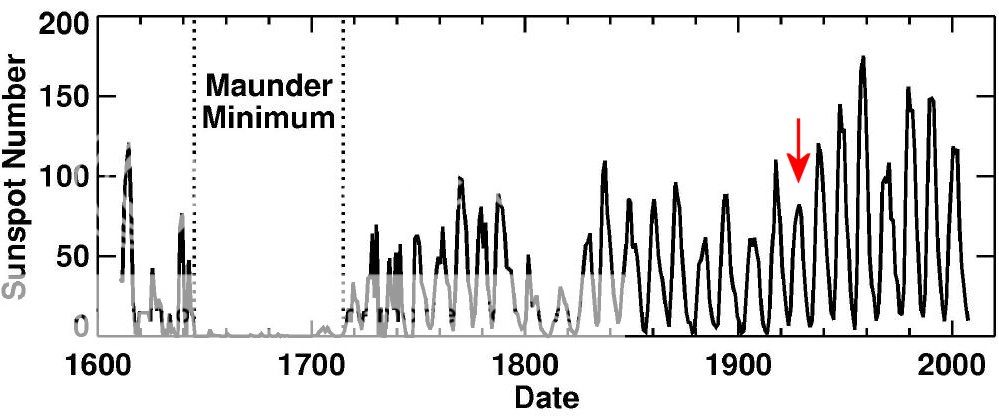
How is this not contradictory to the fact the Maunder minimum is accepted to have caused a little ice age?

How much if the earth's warming is provided by man? None.
How much by the sun? All.
Why so quick to dismiss variations when they are unprecedented?
 
[qimg]http://www.internationalskeptics.com/forums/imagehosting/thum_28149aba360024b2.jpg[/qimg]

Solar has an influence on the fluctuations, but not on the overall trend.


How is that a logical argument? More solar output=hotter earth, right? Why else do they bother keeping track of these peaks?


Why do you have to view only the solar variations since 1975 to dismiss this as no influence on the trend, when data is available going back over 400 years? Are we only discussing climate change since 1975?

maunderminimum_zps99faf332.jpg


Now please can you explain why this argument exists that if solar variance were a factor we should have seen cooling in the latter part of the 20th century when in fact we were still seeing some of the highest output since record keeping began? Wouldn't we continue to see more heating because the period persisted with higher than average output, not lower which would
be required to see a reversal?
 
Hi. I came across this Op-Ed in the Wall Street Journal that makes several claims about CO2:

Harrison H. Schmitt and William Happer: In Defense of Carbon Dioxide

I'll try to summarize the ones I'm interested in in a list. (These are quotes, but for ease of use I am not putting them in quote tags.)

1) Contrary to what some would have us believe, increased carbon dioxide in the atmosphere will benefit the increasing population on the planet by increasing agricultural productivity.

2) The current levels of carbon dioxide in the earth's atmosphere, approaching 400 parts per million, are low by the standards of geological and plant evolutionary history. Levels were 3,000 ppm, or more, until the Paleogene period (beginning about 65 million years ago).

3) For most plants, and for the animals and humans that use them, more carbon dioxide, far from being a "pollutant" in need of reduction, would be a benefit. This is already widely recognized by operators of commercial greenhouses, who artificially increase the carbon dioxide levels to 1,000 ppm or more to improve the growth and quality of their plants.

4) Although C4 plants evolved to cope with low levels of carbon dioxide, the workaround comes at a price, since it takes additional chemical energy. With high levels of carbon dioxide in the atmosphere, C4 plants are not as productive as C3 plants, which do not have the overhead costs of the carbon-dioxide enrichment system.

5) Right now, at our current low levels of carbon dioxide, plants are paying a heavy price in water usage. . . . (snip) . . . Driven by the need to conserve water, plants produce fewer stomata openings in their leaves when there is more carbon dioxide in the air. This decreases the amount of water that the plant is forced to transpire and allows the plant to withstand dry conditions better.

6) We know that carbon dioxide has been a much larger fraction of the earth's atmosphere than it is today, and the geological record shows that life flourished on land and in the oceans during those times.

can we and our plants and animals we Need, adapt to similar climate the Dinos had?
AGW mitigation has not the Goal to scure that life continues on this planet, the Goal is to Keep the climate that we are adapted to, we are used to. So to us, it doesn't even really matter what the climate and CO2 Levels were a Million years ago. we should try to Keep it as Close as possible to the climate we had the last 250 000 years or so.
 
Edited by Gaspode: 
Edited for moderated thread.


Anyway the article is out of date. Since the article was written, emissions and thus the net annual total added atmospheric carbon have increased. Still haven't passed what could be sequestered annually in the soil, but they keep rising. If they don't stop rising soon, then even sequestering in the soil won't work. If that happens, instead of a basically free solution, you'll have to do that sequestering in the soil AND also use many other astronomically expensive solutions too.

To me that road is foolish, when all you have to do is use conservation to stop the increases and sequestering in the soil, which actually solves a whole host of other ecosystem services in addition to balancing the carbon cycle.

I realize that is just an OPINION. Certainly there are companies out there willing to wait, because any expensive solution means mega bucks for them. But personally I prefer the simple cheap easy way myself. There is nothing cheaper than simply closing down the CAFOs and using the animals to heal the land with biomimicry. It's a little tougher to convert the rest of our food production to organic. That might slightly increase vegetable food costs. But not nearly as much as some people think. Remember, once economies of scale kick in, all the savings seen in commercial food processing will apply to organically raised food too. It might even end up being overall cheaper than we have now once that happens.

You are basically continuing with advertising.

You are not claiming now that soil carbon sequestration is the panacea, but you hold it is cheaper than "any other expensive solution" meaning "mega buck for them". That is utter BS!

You, like many others in so many a subject, chose to follow figureless scienceless categorical analysis with nice premises chained in the way of wishful thinking. The fact is that increasing soil carbon decreases production. Of course you can use other technologies to increase production at the same time, but that is not the same as saying that increasing soil carbon implies more production and you just have to address a few additional costs and a cultural change.

Sequestering carbon in soils itself has a huge cost that has to be collected by the farmers. You, Red Baron Farms, dare to claim that other methods, like forcing natural gas and coal producers to pump carbon dioxide into depleted gas reservoirs, and make them to pay for it, that, it would be "mega business". C'mon! It's pretty transparent what you are trying to do here: you're favouring a world where people have to pay more for food in order to keep using polluting energy and pay almost the same for it instead of a world where people have to pay almost the same for food and more for using polluting energy. It's similar to proposing to address illegal drugs traffic by increasing expenditures in hospices to deal with wasted addicts, whith you providing cheap health care instead of "big business" providing law enforcement. You don't realize how ridiculous it looks, in spite of wasted addicts treatment having to be pursued anyway.

A burglar is a person who finds his or her money in other person's pocket. The fact that almost everybody gets their money in a pretty similar way is why it's so difficult to spot a burglar among other people. Anyway, here, we don't chew broken glass for breakfast, so stop casting your opinions into facts. This is a science forum.
 
How is that a logical argument? More solar output=hotter earth, right? Why else do they bother keeping track of these peaks?


Why do you have to view only the solar variations since 1975 to dismiss this as no influence on the trend, when data is available going back over 400 years? Are we only discussing climate change since 1975?

[qimg]http://i353.photobucket.com/albums/r384/batvette/maunderminimum_zps99faf332.jpg[/qimg]

Now please can you explain why this argument exists that if solar variance were a factor we should have seen cooling in the latter part of the 20th century when in fact we were still seeing some of the highest output since record keeping began? Wouldn't we continue to see more heating because the period persisted with higher than average output, not lower which would
be required to see a reversal?

how come we cannot see those solar cycles in the temperature record?
 
Hi. I came across this Op-Ed in the Wall Street Journal that makes several claims about CO2:

Harrison H. Schmitt and William Happer: In Defense of Carbon Dioxide

I'll try to summarize the ones I'm interested in in a list. (These are quotes, but for ease of use I am not putting them in quote tags.)

1) Contrary to what some would have us believe, increased carbon dioxide in the atmosphere will benefit the increasing population on the planet by increasing agricultural productivity.

2) The current levels of carbon dioxide in the earth's atmosphere, approaching 400 parts per million, are low by the standards of geological and plant evolutionary history. Levels were 3,000 ppm, or more, until the Paleogene period (beginning about 65 million years ago).

3) For most plants, and for the animals and humans that use them, more carbon dioxide, far from being a "pollutant" in need of reduction, would be a benefit. This is already widely recognized by operators of commercial greenhouses, who artificially increase the carbon dioxide levels to 1,000 ppm or more to improve the growth and quality of their plants.

4) Although C4 plants evolved to cope with low levels of carbon dioxide, the workaround comes at a price, since it takes additional chemical energy. With high levels of carbon dioxide in the atmosphere, C4 plants are not as productive as C3 plants, which do not have the overhead costs of the carbon-dioxide enrichment system.

5) Right now, at our current low levels of carbon dioxide, plants are paying a heavy price in water usage. . . . (snip) . . . Driven by the need to conserve water, plants produce fewer stomata openings in their leaves when there is more carbon dioxide in the air. This decreases the amount of water that the plant is forced to transpire and allows the plant to withstand dry conditions better.

6) We know that carbon dioxide has been a much larger fraction of the earth's atmosphere than it is today, and the geological record shows that life flourished on land and in the oceans during those times.

1) CO2 might be good for some plants but not all http://www.skepticalscience.com/co2-plant-food.htm

2) The current levels of carbon dioxide in the earth's atmosphere, approaching 400 parts per million, are high by the standards of human evolutionary history

3) Comparing commercial greenhouses to the natural biosphere is just silly

4)&5)
C4 plants have a competitive advantage over plants possessing the more common C3 carbon fixation pathway under conditions of drought, high temperatures, and nitrogen or CO2 limitation. When grown in the same environment, at 30°C, C3 grasses lose approximately 833 molecules of water per CO2 molecule that is fixed, whereas C4 grasses lose only 277 water molecules per CO2 molecule fixed. This increased water use efficiency of C4 grasses means that soil moisture is conserved, allowing them to grow for longer in arid environments.
http://en.wikipedia.org/wiki/C4_carbon_fixation

6) Totally irrelevant, noone is saying an increase in atmospheric CO2 will end life on earth

Of course this isn't the first time that W. Happer has publicised his opinions on climate science, here's an actual climate scientist's response to a previous, but very similar, article http://www.climatesciencewatch.org/...About-Greenhouse-Gases-and-Climate-Change.pdf

Would it be considered an ad hom to point out that he's the chair of the right wing fossil fuel funded George C Marshall institute ? http://sourcewatch.org/index.php?title=George_C._Marshall_Institute
 
Status
Not open for further replies.

Back
Top Bottom