• Quick note - the problem with Youtube videos not embedding on the forum appears to have been fixed, thanks to ZiprHead. If you do still see problems let me know.

Moderated Global Warming Discussion

Status
Not open for further replies.
Useless statement unless you tell us your definition of “reliable” is in this context. The scientists who actually research climate consider models to be reliable for some things and less reliable for others.

My suspicion is that for the scientific community already considers both models and measurements highly reliable for the things you have in mind since you won’t tell us it’s difficult to say for sure. At this point your whole argument seems to be that no one can read your mind to figure out what you are trying to say so you can never be proved wrong.

What don't you understand? If I spend $2500 on initiatives to reduce CO2 what effect will they have? What happens if I spend the money but you don't? How long can I expect to foot the bill to fix this problem?

This is how you address a problem. Not by making outrageous threats about what might happen. Our local sewer system is in need of repair. It's going to cost X to fix it, take Y years to do so, my taxes will increase Z for the next 10 years. I'm not really prepared to write a blank check because if it isn't fixed a giant sink hole will devour the whole block and hundreds of kids will die.
 
Not really - what's in the system now has already altered the climate and will continue to alter the climate until a new radiative equilibrium is reached somewhere a thousand years out.

Even if we stop now it's not going to "return" to say the Holocene average for 100k years.

No scientist I am aware of thinks it will flatten our under 2 degrees C by 2100 - we're past that short of active removal of C02.

4-6 C more like it.

Devastating in many areas.

Yes, all true, thank you. In the back of my mind I imagine somewhere, some place, Craig Venter is perfecting his c02 eating organisms, playing God, coding genomes on computer.

I have some questions I'm trying to find answers to. Imagine the difference between a) magically going carbon zero today and having some luck bringing down c02 and b) letting the market do it wants. Between those two extremes, imagine the maximum amount of suffering caused by b) in a thousand years. There are two questions to be answered. 1. What is the difference in suffering between a and b? 2. What can we do to get as close as we can to the ideal of a) and how hard should we try for those benefits?

If you could prove the world was going to end and all people had to do was go carbon-free and support radical c02 removal r&d they would do it instantly.People just need to know what the costs, risks and benefits are and they will literally do anything to get to a happy world. This cynicism of people mention doesn't fool me at all it's just a ploy by the modular mind :p I have faith in humanity as a whole.

Being a little green ;) I admit the best answers I have are "it's a lot" and "go green and try as hard as we can"

Clearly we need answers to these questions if we are to settle the issue of how much people should be emotionally disturbed and what they should be doing. That's really the issue and I suppose that it can never be studied and presented comprehensively enough.
 
The world we were born into has already disappeared, the worlds of +6º C, +10º C and 10º+ C will be significantly different from the current one, and from each other, but they are on our current climate path. in the coming decades and centuries.

Pure science fiction.

It represents an alternate reality where the entire planet shucks all responsibility and continues without any scientific advancement for the next 300 years.
 
The temperature increase over the last 150 years is so small it's taken 20 years or so to measure properly ...

The temperature increase was noticed some time ago, which led to the Little Ice Age concept. Relative to today 150 years ago was frickin' cold, but then volcanic activity was high by the same relation.

... and the actual contribution from manmade sources and natural variability are indistinguishable.

No, they're not. "Natural variablilty" doesn't mean "variation without cause", and we know the causes of climate change in the last 150 years. There is no hidden influence on a world so closely monitored as ours has been in that period.

You couldn't physically detect the difference nor could you read it off an average thermometer.

At what time on what day of the year would you read this off a thermometer?

That's the very definition of "slight".

Not according to the OED, nor according to common understanding.

Nobody really cares about temperature, they care about what temperature does. Your "slight increase" is melting glaciers, ice-caps and permafrost, and has expanded the tropics, with impacts on how climate zones interact with populations (of many species). That isn't slight, that's significant. And there's more to come.

Don't expect natural variability to come to your rescue. Solar activity was as low as it gets for the last few years with a very slight impact, and vulcanism on the 19thCE scale would have nasty implications all of its own. What else have you got?
 
The really interesting thing to me is that the source of this image, Rodomiro Ortiz and the Centro Internacional de Mejoramiento de Maı´z y Trigo are actively developing wheat cultivars and agriculture strategies that will do exactly that [Ortiz et al (2008), Climate change: Can wheat beat the heat?]. That's the problem with data out of context.

Presumably Ortiz et al answered the question in the affirmative, which seems to me a little premature given that these cultivars are still in development. So is fusion power, after all.

Agriculture strategies presumably involve changing crops, which is fine if you go from wheat to rice but not so good if you go from wheat to goat-fodder. Mesopotamia went along the latter trajectory, from world-power to doss-house. Picture that on a global scale and no amount of air-conditioning is going to help much.
 
The Texas Two Step

Climate has been changing for 4.5 billion years.

Climate has been warming for 17,000 years.

Humans have been increasing the rate of warming by how much for 100 years?

When the change from AGW to climate change is made while claiming people who have questioned the degree of recent human contribution are in fact questioning the fact of 4.5 billion years of climate change is politically astute but fundamentally dishonest, deceptive and befitting the behavior of only politicians not human beings.
 
I skimmed the first article and didn't find anything relevant. Perhaps you could point out which ones you think address the issue I mentioned?

The first offering was more in addressment to the nature of your confusions, rather than addressment to your specific confusions. The other four are filled with the types of information you requested, though most rely upon best case senarios with regards to what we can expect from climate change and so should be taken with a healthy does of salt, they do approach the types of calculations and assements needed to accomplished a reasonable economic analysis of climate change. If this isn't what you were requesting then please state your request in a more cogent manner and I will see if there is anything handy which fits your requested data.
 
No, they're not. "Natural variablilty" doesn't mean "variation without cause", and we know the causes of climate change in the last 150 years. There is no hidden influence on a world so closely monitored as ours has been in that period.

Nonsense. The climate has varied more by natural causes than it has be human influence in the last 150 years. That's a fact.

Nobody really cares about temperature, they care about what temperature does. Your "slight increase" is melting glaciers, ice-caps and permafrost, and has expanded the tropics, with impacts on how climate zones interact with populations (of many species). That isn't slight, that's significant. And there's more to come.

It must be a Canadian thing, but we tend to rejoice when ice melts. YMMV.

Don't expect natural variability to come to your rescue. Solar activity was as low as it gets for the last few years with a very slight impact, and vulcanism on the 19thCE scale would have nasty implications all of its own. What else have you got?

I don't need rescuing. That's just you projecting your own fears onto the situation.
 
Pure science fiction.

Science fiction as in "it can't happen?" or merely based upon personal fantasies you'd prefer to continue holding as valid? Both the PETM and the Eocene Optimum exceeded 10ºC for extended periods of time and ironically largely due to massive influxes of previously sequestered carbon over short time-frames.

It represents an alternate reality where the entire planet shucks all responsibility and continues without any scientific advancement for the next 300 years.

nah, just for the next few decades would probably suffice, but it sounds like what you are advocating, why should I expect such advocacies to fail?

As things are currently going (and you seem to wish to maintain), we can expect between 5.5ºC and 7.1ºC of Global average temperature by 2100, and this is just the accelerating start. It is not at all "science-fiction" to reasonably consider that if things continue as they are, that our planet will experience sustained average temps of 10+ºC within the next 2 centuries and that such will likely stay above that level for many millenia if we allow them to occur.

and none of this considers what the dumping of the currently thawing calthrates and reversal of carbon sinks is going to add to the problem.
 
Climate has been changing for 4.5 billion years.

irrelevent and indicative of disingenuous distortion on its way.


Climate has been warming for 17,000 years.

generally and specifically incorrect.

increasing trends did not really come to dominate planetary temps until near the end of what is typically known as the Younger Dryas and this was a short but extreme warming, followed by a plateau that has held relatively steady (with a gradual decline) until the last half century or so. Again, however, almost entirely irrelevent to AGW.

Humans have been increasing the rate of warming by how much for 100 years?

More than any other natural forcing that we know of in the history of the planet.

When the change from AGW to climate change is made while claiming people who have questioned the degree of recent human contribution are in fact questioning the fact of 4.5 billion years of climate change is politically astute but fundamentally dishonest, deceptive and befitting the behavior of only politicians not human beings.

Then why did you just engage in that behavior?
 
Climate has been changing for 4.5 billion years.

Indeed. Much has changed in 4.5 billion years.

Climate has been warming for 17,000 years.

It was very cold 17K years ago. The climate was cooling for a good few thousand years before recent times, since the Holocene Maximum.

Humans have been increasing the rate of warming by how much for 100 years?

Enough to make an obvious difference. The long-term cooling expected in the later stages of an interglacial has been completely blown away. Yay for us - humanity really is that potent.

When the change from AGW to climate change is made while claiming people who have questioned the degree of recent human contribution are in fact questioning the fact of 4.5 billion years of climate change is politically astute but fundamentally dishonest, deceptive and befitting the behavior of only politicians not human beings.

Well there's a thing. How do you think the climate is changing, up or down?

A chap called Luntz (IIRC), who prepares soundbites for Republicans, suggested in the first Cheney/Rove term that "Climate Change" was less threatening than "Global Warming", which is true. Throughout the "Bush" years it was "Climate Change" all the way from the White House, but long before that there was the foundation of the IPCC. What do you imagine the "CC" stands for?

Margaret Thatcher called it Global Warming when she brought the matter onto the world stage, brutal honesty being her thing. (OK, I kid, but in this case she was right on the mark.) It was toned down to "Climate Change" by the usual UN diplomatic process.

What hasn''t happened in those 4.5 billion years you take comfort in is an industrialised human society, apart from the last couple of hundred. Since the Age of Steam, effectively. And just look what we've managed to do inn those two centuries. We really have changed the world.

Yay for us, I say.
 
Climate has been changing for 4.5 billion years.
Yes.

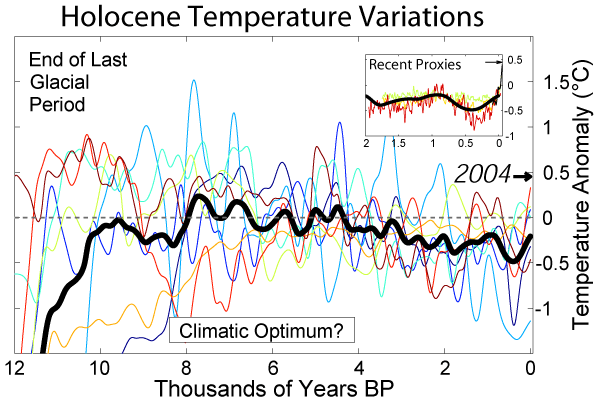
Climate has been warming for 17,000 years.
No. http://en.wikipedia.org/wiki/File:Holocene_Temperature_Variations.png

Holocene_Temperature_Variations.png


Humans have been increasing the rate of warming by how much for 100 years?
The arrow labelled '2004' on the right axis of the above graph gives some indication of how much.
 
Hi. First post on this forum; tell me if I'm doing anything wrong :)

I was hoping I could get your opinion on an argument in the AGW debate which I have come up with.
It is about the argument which states that today's rise in CO2-concentration is just natural variations, and has nothing to do with human activity.

We have accurate measurements of the CO2-concentration in the atmosphere for over 700 000 years back. We see that today's concentration is much higher than it has ever been during this period.
If it was true that the rise in CO2 levels is independent from human activity it means that the CO2-concentration could have sky-rocketed any time during this 700 000 year period, and that it is only a coincidence that it happened at the same time as the industrial revolution.
Then we could calculate the probability of these two events correlating to the same century, which would simply be : 100/700 000 = 1/7000.
Thus, the chance of todays CO2-concentration sky-rocketing independently of human activity is 1/7000.

Is this argument sound?
 
The final word on "Trick" and "Hide the Decline"

How....

I’ve just completed Mike’s Nature trick of adding in the real temps to each series for the last 20 years (ie from 1981 onwards) and from 1961 for Keith’s to hide the decline.

became...

"Let's use Mike’s trick to hide the decline"

 
1. What is the correct temperature?

Correct for what?

For our civilisation to continue to thrive, an average global temperature similar to the one which has prevailed for about the last 10,000 years - during which it developed, and to which it has therefore adapted - is preferable; anything else and locations of cities, for example, might soon prove to be less than optimal. We can, of course, relocate as our ancestors did in response to climate change, but moving a city of millions of inhabitants is a much more daunting proposition than moving a small collection of mud huts.

2. When has climate not changed?
Pretty much never. The relatively steady temperatures of the last 10,000 years are actually the exception rather than the rule. So we're either going to have to adapt to climate change eventually, or develop technologies to keep it within a range that suits us. Technology which actually makes matters worse is obviously to be avoided, though in our defence the realisation that our technology was making it worse took a long time to dawn. Indeed, some people still haven't got it into their heads.
 
Science fiction as in "it can't happen?"

You're not familiar with difference between science fiction and fantasy are you? Generally speaking science fiction can happen and fantasy can't.

or merely based upon personal fantasies you'd prefer to continue holding as valid?

This is your fantasy, this +10C world you've been mongering.

Both the PETM and the Eocene Optimum exceeded 10ºC for extended periods of time and ironically largely due to massive influxes of previously sequestered carbon over short time-frames.

Yes, Land of The Lost is fantasy, not science fiction :D

nah, just for the next few decades would probably suffice, but it sounds like what you are advocating, why should I expect such advocacies to fail?

Advocating? What are you talking about? Nobody advocated anything. I'm at a complete loss as to what you're talking about now. :boggled:

As things are currently going (and you seem to wish to maintain), we can expect between 5.5ºC and 7.1ºC of Global average temperature by 2100,

This is just made up. If you have evidence to prove this this is the thread in which to do so. Right now we are "maintaining" a 1% increase in CO2 levels each year, but this is not "the way it's going". You seem to confuse the past with the future. The times they are a changing.

It is not at all "science-fiction" to reasonably consider that if things continue as they are, that our planet will experience sustained average temps of 10+ºC within the next 2 centuries and that such will likely stay above that level for many millenia if we allow them to occur.

What an absurd position. Then again, I suppose when fire was discovered someone said "If we keep burning these trees like this there won't be any left in 200 years" And I'm sure some ship builder in the 1400's said "If we keep building ships like this there won't be any ocean left to fit them in 200 years".

Of course in this day and age we have enough information and history behind us to know nothing stays the same for 200 years.

The technology already exists for us to be able to begin sequestering CO2 from the atmosphere. If we really needed to we could begin tomorrow. Likewise we could begin reversing the effects of CO2 and begin cooling the planet tomorrow if we needed to. We just don't wanna.

Why you would fantasize about what would happen in 200 years if nothing changed is beyond me. I think you really need to look at what things were like 150 years ago.

and none of this considers what the dumping of the currently thawing calthrates and reversal of carbon sinks is going to add to the problem.

I agree with this however, some of the positive feedback is concerning. I feel this could be a real wild card. However, history has shown us we have a habit of assuming the worst. I saw an interesting program on Nova? about Mt. St. Helens the other day. The "experts" has assumed it would take decades for the ecosystem to rebound from the eruption. It took significantly less time all because of one little plant and one little mole. :)
 
You're not familiar with difference between science fiction and fantasy are you? Generally speaking science fiction can happen and fantasy can't.


This is your fantasy, this +10C world you've been mongering.


Yes, Land of The Lost is fantasy, not science fiction :D


Advocating? What are you talking about? Nobody advocated anything. I'm at a complete loss as to what you're talking about now. :boggled:


This is just made up. If you have evidence to prove this this is the thread in which to do so. Right now we are "maintaining" a 1% increase in CO2 levels each year, but this is not "the way it's going". You seem to confuse the past with the future. The times they are a changing.


What an absurd position. Then again, I suppose when fire was discovered someone said "If we keep burning these trees like this there won't be any left in 200 years" And I'm sure some ship builder in the 1400's said "If we keep building ships like this there won't be any ocean left to fit them in 200 years".

Of course in this day and age we have enough information and history behind us to know nothing stays the same for 200 years.

The technology already exists for us to be able to begin sequestering CO2 from the atmosphere. If we really needed to we could begin tomorrow. Likewise we could begin reversing the effects of CO2 and begin cooling the planet tomorrow if we needed to. We just don't wanna.

Why you would fantasize about what would happen in 200 years if nothing changed is beyond me. I think you really need to look at what things were like 150 years ago.


I agree with this however, some of the positive feedback is concerning. I feel this could be a real wild card. However, history has shown us we have a habit of assuming the worst. I saw an interesting program on Nova? about Mt. St. Helens the other day. The "experts" has assumed it would take decades for the ecosystem to rebound from the eruption. It took significantly less time all because of one little plant and one little mole. :)
Plenty of strawmen in there.

We've already got to 0.8 deg C with another 0.7C even if we were in trhe (silly) position to stop now. Even if the human race were unanimous in moving toward that goal it would only be physically achiveable in the scale of decades. We are already committed to +2C, by the time we overcome the inertia applied to the politicians than chances are we are committed to a whole lot more than 2C. 10C may be at the high end (as we view it at the moment) but is NOT unrealistic.
 
Hi. First post on this forum; tell me if I'm doing anything wrong :)

I was hoping I could get your opinion on an argument in the AGW debate which I have come up with.
It is about the argument which states that today's rise in CO2-concentration is just natural variations, and has nothing to do with human activity.

We have accurate measurements of the CO2-concentration in the atmosphere for over 700 000 years back. We see that today's concentration is much higher than it has ever been during this period.
If it was true that the rise in CO2 levels is independent from human activity it means that the CO2-concentration could have sky-rocketed any time during this 700 000 year period, and that it is only a coincidence that it happened at the same time as the industrial revolution.
Then we could calculate the probability of these two events correlating to the same century, which would simply be : 100/700 000 = 1/7000.
Thus, the chance of todays CO2-concentration sky-rocketing independently of human activity is 1/7000.

Is this argument sound?

The "soundness" isn't an issue but there isn't much that is compelling about it. 700,000 years is a microblip in the geological record, there are many events that occur at frequencies much longer than this, so the fact that it hasn't happened in 700,000 years isn't terribly compelling evidence that the current rise isn't due to a relatively rare natural occurence.

Much better evidences are that we have economic records indicating with great precision the quantity of carbon fuels burned over the last 200 years and it is relatively simple to calculate how much CO2 is released from the open-cycle combustion of that fuel. Moreover, long sequestered carbon (due to being isolated from the atmosphere for tens/hundreds of millions of years has a much different isotopic ratio content from carbon that is involved in the active carbon cycle. Direct analysis of the CO2 in the air demonstrates that the atmospheric ratios are directly reflective of the steadily increasing influx of CO2 from previously sequestered carbon fuels.

http://www.grida.no/publications/other/ipcc_tar/?src=/climate/ipcc_tar/wg1/095.htm

http://ptonline.aip.org/journals/doc/PHTOAD-ft/vol_58/iss_5/16_1.shtml?bypassSSO=1

http://www.bgc.mpg.de/service/iso_gas_lab/publications/PG_WB_IJMS.pdf

http://www.ipcc.ch/publications_and_data/ar4/wg1/en/ch2s2-3.html

let me know if you have any problems with these papers, I'm sure there are some reputable, more casual discussion of these papers and issues elsewhere on the internet, but I try to stick to the actual science where-ever possible.
 
I agree with this however, some of the positive feedback is concerning. I feel this could be a real wild card. However, history has shown us we have a habit of assuming the worst.

The history of resource depletion and environmental degradation shows exactly the opposite, and that is a significant part of history in general.

I saw an interesting program on Nova? about Mt. St. Helens the other day. The "experts" has assumed it would take decades for the ecosystem to rebound from the eruption. It took significantly less time all because of one little plant and one little mole. :)

The area around Mt St Helens hasn't returned to the state it was in before the eruption. Certain foundation species have established more quickly than estimated but we are often surprised by such things, whether they go more quickly or more slowly than predicted. Permafrost melt and Arctic sea-ice loss have also surprised scientists by their rapidity. (Both of those are positive feedbacks on AGW, of course.)

The "nothing going on here, move along" position is already untenable and is going to become more obviously so in the very short term. I'm sure you'll stick with it for a good while yet though.
 
Status
Not open for further replies.

Back
Top Bottom