• Quick note - the problem with Youtube videos not embedding on the forum appears to have been fixed, thanks to ZiprHead. If you do still see problems let me know.

Geoengineering Y/N

Do you support using Geoengineering solutions to limit Global Warming?

  • Yeah, why not?

    Votes: 16 43.2%
  • No, bad idea.

    Votes: 12 32.4%
  • Don't know / don't care.

    Votes: 6 16.2%
  • On Planet X, the climate is already perfect (or at least as God intended)

    Votes: 3 8.1%

  • Total voters
    37
  • Poll closed .
I voted "yeah" but I want to say that it is a cautious "yeah". Any geoengineering option will need to be thoroughly researched and modelled, and tested extensively before being deployed globally. Even then, I'm sure there will be unintended consequences.

And Earth would have problems with "foreign species" like Australia does. "Cane toad algae" and "Jackrabbit fungus" anyone?
The problem of invasive species is certainly not unique to Australia.
 
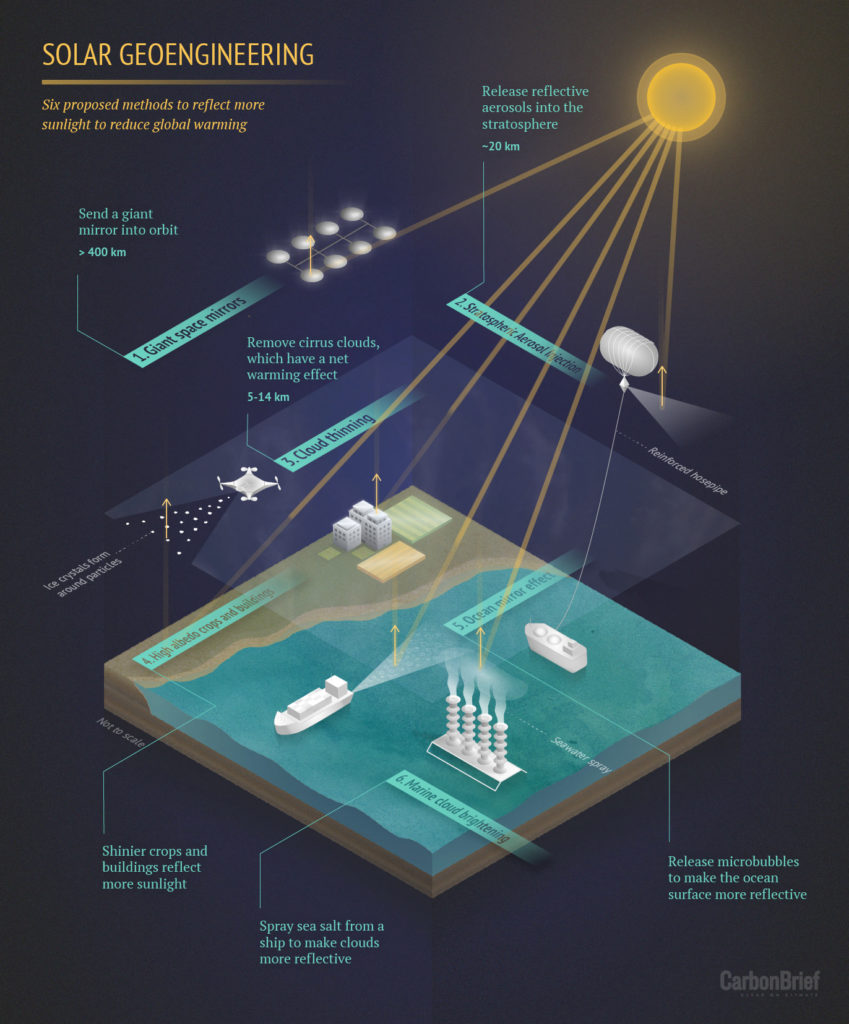
solar-geoengineering-849x1024.jpg


Easier to comment.

Aerosols will work - are cheap and very destructive ...think acid rain. We already did that experiment 1950-1980 ....it did offset AGW and wrecked a lot of lakes and forests. SO2 = Acid rain....look up Global Cooling.
Easy to control the amount.

Space based mirrors.....costly tho energy concerns for manufacture and launch etc are miniscule. Recently dimming via that route got some negatives for vegetation impacts. Very hard to control.

Cloud ships and micro bubbles. Both might be a feasible approach. Increasing albedo is certainly a valid approach and either is easy to scale.

Cloud thinning might have some knock on effects but have not seen enough info.

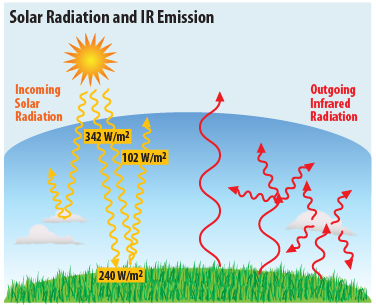
Because of the way AGW works reflection at the ocean surface is ideal before the infra-red gets going. Idf you can bounce the shortwave back to space before it is absorbed and re-emitted as long wave which gets trapped by the atmosphere

The more we can bounce directly back to space the less gets transformed to longwave which is the problem as it's absorbed by greenhouse gases and the atmosphere retains this heat.

solar%20radiation-01_1.jpg


good explanation here.
http://ete.cet.edu/gcc/?/globaltemp_teacherpage/

Personally I think a combination of albedo management and active carbon removal will slow things down and manybe turn it around.
 
Last edited:
^ Any chance you could resize those graphics?

But the gist of that tech is still that we carry on regardless and fix the outcome with the tech, rather than rein in our excesses.

In other news, I was reading The Economist the other day (a weighty, serious mag) where it was discussing India's devotion to coal. Per capita, India's CO2 output is quite low compared to 'developed' countries, but it's steadily growing and there are a lot of 'capitas' over there ;)

We're stuffed. Humans are selfish, short-sighted idiots, devoted - on the grand scale - to personal gain and **** the future.

Clean coal! (Remind me ... who said that recently?)
 
But the gist of that tech is still that we carry on regardless and fix the outcome with the tech, rather than rein in our excesses.
I don't think that's the gist of that tech, it's certainly not what anyone is proposing. Every time I've seen geoengineering proposed (including the OP article) emphasis is put on the fact that it must be done in combination with reduction in CO2 output.


We're stuffed. Humans are selfish, short-sighted idiots, devoted - on the grand scale - to personal gain and **** the future.

I find it an odd juxtaposition that on the one hand you complain about the geoengineering approach because it will let us rest on our laurels and on the other say that there's nothing we can do. If the traditional ways of mitigating climate change aren't going to work, we need to be looking at other solutions as well.
 
I voted no, as it would be easier to stop burning coal.

Unless by geoengineering you mean building a bunch of desalination plants and foresting the Sahara, that might help.
 
Will the world's biggest industrialized nations ever agree to collectively slow down their economies, make some trillion-dollar sacrifices to do this? It's depressing.
 
Will the world's biggest industrialized nations ever agree to collectively slow down their economies, make some trillion-dollar sacrifices to do this? It's depressing.
It is not required actually.

Project drawdown has quantified the economics of what it would take to take the entire planet into a drawdown negative carbon footprint. Most of the solutions actually improve the economies, ecologies, and carbon footprint simultaneously.

The list is comprised primarily of “no regrets” solutions—actions that make sense to take regardless of their climate impact since they have intrinsic benefits to communities and economies. These initiatives improve lives, create jobs, restore the environment, enhance security, generate resilience, and advance human health.[1]

Counter-intuitively, slowing down the economies would likely actually increase emissions as countries struggle to maintain standard of living with antiquated obsolete systems.

I am no expert on all the solutions described by Project drawdown. But in my field this principle still holds.

Lets take for example SRI rice. This form of paddy rice production has a vastly different carbon footprint.
The System of Rice Intensification (SRI)…
… is climate-smart rice production

SRI creates a triple-win situation for agriculture, climate security, and food security because it:
1. Sustainably increases rice production and farmer incomes (greater crop productivity)
2. Strengthens crops’ resilience to climate change and variability (facilitates adaptation)
3. Reduces rice production’s contribution to climate change (helps promote mitigation)

It's a win win win for everybody from the barefoot farmer up to the international markets, and every single one in between. There are no losers here. This myth that we must sacrifice to mitigate or reverse AGW is simply a rumor started by the merchants of doubt.

Mitigating AGW would actually probably lower taxes, fire up economies, reduce poverty and hunger, improve efficiency.

The people spreading myths that this needs sacrifice are nothing more than Neo-Luddites.

Neo-Luddism - Wikipedia
Neo-Luddism or new Luddism is a philosophy opposing many forms of modern technology.[1] The word Luddite is generally used as a derogatory term applied to people showing technophobic leanings.[2] The name is based on the historical legacy of the British Luddites, who were active between 1811 and 1816

They simply can't accept that solar, wind, geothermal, hydroelectric and nuclear are the future technologies; and fossil fuels are the antiquated obsolete buggy whips on the way out.
Same thing with agriculture. The mere thought that we can replace living systems with abiotic agrochemicals is becoming more and more an increasingly absurd and futile idea.

Both sides of the carbon cycle that we humans are negatively influencing and are causing AGW are currently being subsidized massively by all the world's governments to try and prevent their failure and replacement by the new more efficient sustainable systems. There is your problem right now.
 
Will the world's biggest industrialized nations ever agree to collectively slow down their economies, make some trillion-dollar sacrifices to do this? It's depressing.

There is zero reason to slow an economy to go carbon neutral ....even the US has divorced GDP growth from electricity use.
If anything going carbon neutral stimulates job growth and refitting housing and public buildings is only a good thing and a job creator.

Eliminating coal would help but not enough and I think I'm informed enough to suggest that geo-engineering. carbon sequestration and a strong commitment to reduce greenhouse gas emissions will be required to retain even a semblance of the current climate.

Already nasty feedbacks in the Arctic may take it out of our hands entirely.
 
I think some social engineering could be put to good use here as well.

We are on track to reach 9 billion people by 2030. With food security already in jeopardy we need ways to cut down our need for energy.
 
I think some social engineering could be put to good use here as well.

We are on track to reach 9 billion people by 2030. With food security already in jeopardy we need ways to cut down our need for energy.

We have food abundance.
 
We have food abundance.

Food abundance and food security are two different things.

Yes indeed we are awash in excess food. So much excess food we actually have to find new and creative ways to "destroy" it in order to maintain market prices.

But all this comes at a cost, both in energy and in land degradation.

It costs 10 calories of fossil fuels to obtain 1 calorie of food!
10 Calories in, 1 Calorie Out - The Energy We Spend on Food

Soil degradation is even worse at 100 tonnes soil lost per ton food produced and fully 1/3rd of all the soils worldwide are acutely degraded by agriculture. Not to mention at least 133 billion tonnes of carbon missing from the soils that are left.

Third of Earth's soil is acutely degraded due to agriculture

World’s soils have lost 133 billion tonnes of carbon since the dawn of agriculture, study estimates

Environmental and Economic Costs of Soil Erosion and Conservation Benefits

Only 60 Years of Farming Left If Soil Degradation Continues

Soil Erosion Threatens Food Production

Land Degradation: An overview

so as you can see, just flooding the markets with excess food, doesn't mean they are secure at all. In fact our food security has been declining at the inverse rate our food excess has been growing!

The Great Acceloration

If this was a bank account or a trust fund or any other form of financial note, then we would immediately see that we are spending beyond our means and will retire in utter bankruptcy and poverty. But since this is the world food supply we turn our heads and pretend all is ok? Really?:eye-poppi
 
Last edited:
Food abundance and food security are two different things.

Yes indeed we are awash in excess food. So much excess food we actually have to find new and creative ways to "destroy" it in order to maintain market prices.

But all this comes at a cost, both in energy and in land degradation.

It costs 10 calories of fossil fuels to obtain 1 calorie of food!
10 Calories in, 1 Calorie Out - The Energy We Spend on Food

Soil degradation is even worse at 100 tonnes soil lost per ton food produced and fully 1/3rd of all the soils worldwide are acutely degraded by agriculture. Not to mention at least 133 billion tonnes of carbon missing from the soils that are left.

Third of Earth's soil is acutely degraded due to agriculture

World’s soils have lost 133 billion tonnes of carbon since the dawn of agriculture, study estimates

Environmental and Economic Costs of Soil Erosion and Conservation Benefits

Only 60 Years of Farming Left If Soil Degradation Continues

Soil Erosion Threatens Food Production

Land Degradation: An overview

so as you can see, just flooding the markets with excess food, doesn't mean they are secure at all. In fact our food security has been declining at the inverse rate our food excess has been growing!

The Great Acceloration

If this was a bank account or a trust fund or any other form of financial note, then we would immediately see that we are spending beyond our means and will retire in utter bankruptcy and poverty. But since this is the world food supply we turn our heads and pretend all is ok? Really?:eye-poppi

Reminds me of something I read years ago. A proposed way to grow food. In cities you build skyscrapers. These hold farms. These would need energy in form of light for the plants. Then fertilisers, just like any other farm.

The energy could be off peak electricity. In the fossil free energy future there will be massive quantities of off peak electricity available at certain times. Then the same fertilisers would be needed as any other farm. So what seamed like a crazy idea to me might actually work.

The advantages of growing food like this include
1. Food is grown very close to where it is consumed, so no transport costs and the food is fresh.
2. Not dependant on weather, so production would be reliable.
3. Pests would have problems getting to the crops.
3. Food where you get a high $ value per unit area could be grown this way.
4. Workers could live in the city.
5. Much less land is needed to grow the food.
 
Reminds me of something I read years ago. A proposed way to grow food. In cities you build skyscrapers. These hold farms. These would need energy in form of light for the plants. Then fertilisers, just like any other farm.

The energy could be off peak electricity. In the fossil free energy future there will be massive quantities of off peak electricity available at certain times. Then the same fertilisers would be needed as any other farm. So what seamed like a crazy idea to me might actually work.

The advantages of growing food like this include
1. Food is grown very close to where it is consumed, so no transport costs and the food is fresh.
2. Not dependant on weather, so production would be reliable.
3. Pests would have problems getting to the crops.
3. Food where you get a high $ value per unit area could be grown this way.
4. Workers could live in the city.
5. Much less land is needed to grow the food.

There are trials.

What really gets me is that in Japan, a Fujitsu semiconductor fab has been converted to growing high quality food.
 
Reminds me of something I read years ago. A proposed way to grow food. In cities you build skyscrapers. These hold farms. These would need energy in form of light for the plants. Then fertilisers, just like any other farm.

The energy could be off peak electricity. In the fossil free energy future there will be massive quantities of off peak electricity available at certain times. Then the same fertilisers would be needed as any other farm. So what seamed like a crazy idea to me might actually work.

The advantages of growing food like this include
1. Food is grown very close to where it is consumed, so no transport costs and the food is fresh.
2. Not dependant on weather, so production would be reliable.
3. Pests would have problems getting to the crops.
3. Food where you get a high $ value per unit area could be grown this way.
4. Workers could live in the city.
5. Much less land is needed to grow the food.

What's the cost/square meter of space in a skyscraper? What's the cost per square meter of space on a farm?
 
less people would mean less minds to solve the world's problems.
Got to agree with you this time. Counter-intuitively overpopulation is not directly linked to population increases, but rather the systems we use to support that population. Human beings passed that stage where the two are directly linked over 10,000 years ago or so.

What this means is that decreasing population almost never actually decreases overpopulation. Instead to reduce overpopulation we can change those fundamental foundations supporting our society like agriculture and energy to sustainable systems and this will directly reduce overpopulation.

Technology is not a problem, we already have it. We know how to recycle, to use renewable energy like solar wind hydroelectric etc, and use regenerative agriculture. This means we could support our population with sustainable systems rather than the ones we use now.

Almost as an afterthought or unintended but beneficial side effect; if we did that, AGW would also vanish in just a few decades.

Or you can say we can fight global warming and almost as an afterthought or unintended but beneficial side effect we would also dramatically reduce overpopulation and poverty and greatly increase food security. (and a host of other environmental problems also vanish)

Either way you say it, the results are the same. Its the classic systems science solution to complex problems, change the system to something sustainable and multiple problems get solved!
 
What's the cost/square meter of space in a skyscraper? What's the cost per square meter of space on a farm?

Meaningless....the question is what is the productivity per sq meter.

Most vertical farms use hydroponics or aeroponics, soil-free methods in which nutrients are dissolved in water and circulated into a plant’s bare roots. And with proper engineering, water can be easily conserved. In fact, Crop One says it will use 1/2500th the water of an equivalently sized soil operation. Energy is a little trickier, as the plants still require light. LEDs are fairly energy-efficient, compared with older lighting systems, but you need an awful lot of them.

One way to counteract the large energy footprint of vertical farms is to set up a clean energy source. Crop One told CNN that it will be using a mix of power grid energy and solar; Dubai does not currently get very much of its energy from solar power but has announced ambitious plans to ramp up solar power in the next few years. Its target by 2050: 75 percent of Dubai’s energy will come from solar.

The Crop One facility will primarily grow greens, which do very well in systems like this and aims to harvest 6,000 pounds of greens per day. Those will be going, not surprisingly given its co-owners, to in-flight and airport lounge meals starting in December of 2019. Crop One has not announced plans to grow anything besides leafy greens, but more variety is certainly possible; squash, peppers, and some fruits (like strawberries) have proven able to handle vertical farming.


Read more: https://www.smithsonianmag.com/inno...-vertical-farm-180969655/#VdmpGJgV6eECFtOH.99
Give the gift of Smithsonian magazine for only $12! http://bit.ly/1cGUiGv
Follow us: @SmithsonianMag on Twitter

We also have a LOT of sunshine for solar energy to power the farms.


And vertical farming is already in place in some areas

https://www.eater.com/2018/7/3/17531192/vertical-farming-agriculture-hydroponic-greens

https://www.queenslandcountrylife.com.au/story/5315082/farm-in-a-container-comes-to-brisbane/

http://www.abc.net.au/news/2018-06-11/vertical-farming-seed-to-harvest-in-28-days/9845544

and in Queensland we've got LOTS of ground area but water is a challenge. Having produce actually produced right in the area where it is consumed offers enormous benefits plus very highly controlled growing conditions, need for little or no pesticide, no herbicides, year round production and easily shifted product variety.
 
Last edited:

Back
Top Bottom