• Security incident: ISF was recently accessed by intruders. Please change your password, and change it anywhere else you used it. Read more

Forum Birdwatching 2012

Enormously jealous. I have wanted to see this species for years, but I've never had the opportunity to be in the area where it lives...

I'm not positive that it was a Heermann's. It was an unusually dark gull, but I couldn't get near it; the pictures I took were backlit so it's hard to judge the beak colors. Going through Sibley's, the Heermann's gull looked like the most likely match, and I am in their range, so I can make a decent case for it, but I can't be certain like I am for most of the others.
 
Here's a picture of some Mute Swan cygnets seen today in Hampshire, UK
picture.php
 
Last edited:
I don't really know anything about birds but I just set up an automatic bird camera in my backyard yesterday and had a couple of decent pics this morning. I'd never spotted one of these in the neighborhood. Is that a cardinal? I'm used to them being redder and having the pointy crest. Maybe this is a female?

1-WSBC0008.jpg


1-WSBC0006.jpg


Here is the feeder/camera setup.
1-IMG_1283.jpg
 
I don't really know anything about birds but I just set up an automatic bird camera in my backyard yesterday and had a couple of decent pics this morning. I'd never spotted one of these in the neighborhood. Is that a cardinal? I'm used to them being redder and having the pointy crest.

It sure looks like a cardinal to me. The wings and back are often a bit more drab than the front. I think the crest is merely folded down

Maybe this is a female?

No, this is a male. The females are mostly brown.
 
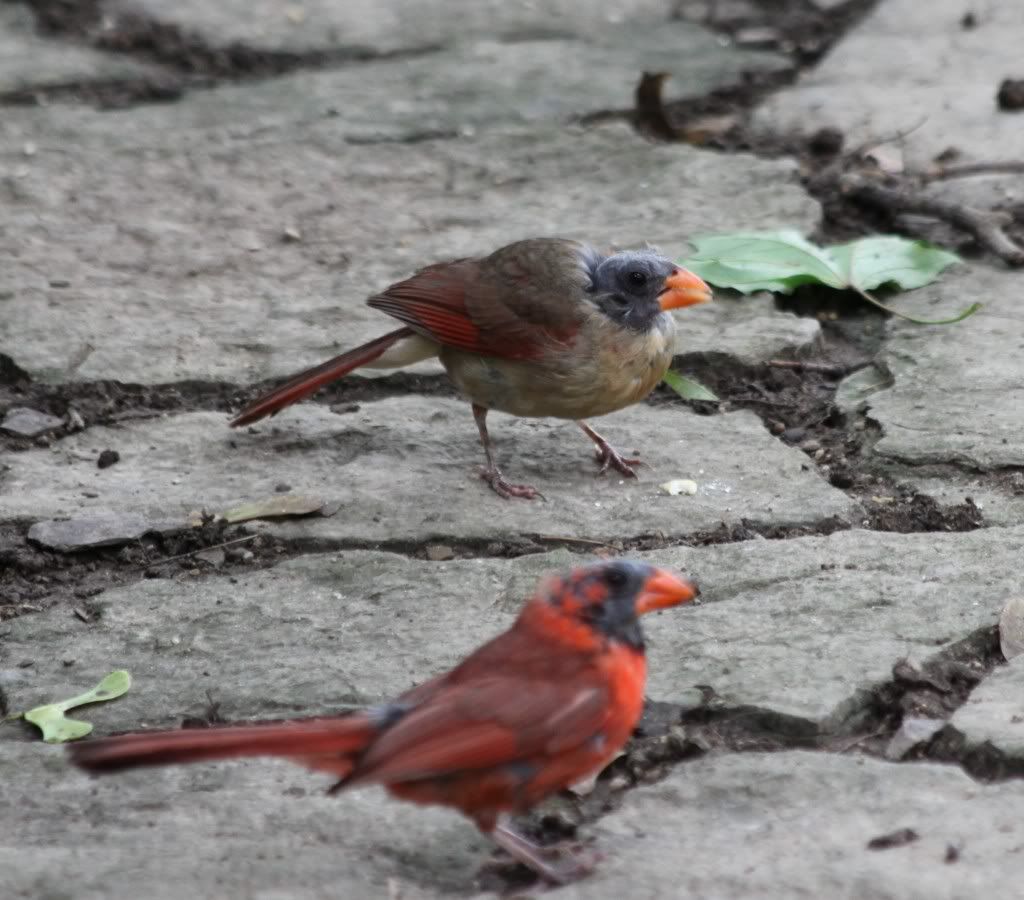
He is molting on his head as well, which might be part of why his crest isn't so cresty. At least he isn't one of the ones whose head feathers all drop at once (or one with mites), leaving a disgusting, vulture-looking songbird. With a sunflower seed feeder, you'll be seeing him plenty. :)
 
He is molting on his head as well, which might be part of why his crest isn't so cresty. At least he isn't one of the ones whose head feathers all drop at once (or one with mites), leaving a disgusting, vulture-looking songbird.

Like these?
IMG_1874crop.jpg


Taken a few years ago in Ohio. It seemed like all the cardinals in the area were affected. Fortunately, the population seems to have recovered.
 
Yep. Apparently it can be caused either by mites or by genetics. There are some birds that lose all of their head feathers at one time when they molt and others who lose them gradually. I can see how losing them all might help with parasites, since they can effectively preen the rest of their bodies, losing all of their head feathers might be advantageous in that it periodically removes the last place feather mites can live. Apparently blue jays get this as well, but the color difference for cardinals is striking. They're like Skeksis.
 
Thanks for the info, people. Very interesting.
I've been second guessing myself on the sunflower seeds. Would I get a wider variety of birds with a mixed bird seed? LOL, I guess I could give it more than one day.
 
Thanks for the info, people. Very interesting.
I've been second guessing myself on the sunflower seeds. Would I get a wider variety of birds with a mixed bird seed? LOL, I guess I could give it more than one day.

You'll probably get a better variety with mixed seed, yes.

Another possibility is suet. My mother lives in Ohio, so she probably has about the same backyard birds as you, and the she puts out both mixed seed and suet. The suet attracts very different birds, including nuthatches and woodpeckers. I grew up there and didn't know those birds were around until I saw them going for the suet.

May also depend on how much you want to spend on the neighborhood birds.
 
Like these?
[qimg]http://i1263.photobucket.com/albums/ii637/das_miller/IMG_1874crop.jpg[/qimg]

Taken a few years ago in Ohio. It seemed like all the cardinals in the area were affected. Fortunately, the population seems to have recovered.


I have a pair that come to my feeder that look like that. The female has just a couple of her crest feathers. Looks like a little plume hat.
 
Nuthatches will go for sunflower seeds too. The main problem with going for mixed seed is that you'll wind up getting swarmed by house sparrows along with the birds you'd actually like to see. At least that has been my experience. You will get a wider variety of birds with a wider variety of food for sure though. I get a lot of woodpeckers eating the peanuts out of the mix that I use.
 
I got to go birdwatching for the first time in about a month. I managed to miss the vast majority of the migration season, but still got to see a few warblers around today.

The high point was watching a pair of tree swallows play with a feather. One would carry a piece of fuzz up about 30 feet, then drop it. It would float down toward the water's surface, then at the very last second the other swallow would swoop in and snatch it out of the air. This went on for a good 10 minutes before one of them let it hit the water and the game ended. I've never seen small wild birds play like that. If it had been crows or someone's parrot maybe, but swallows?
 
The main problem with going for mixed seed is that you'll wind up getting swarmed by house sparrows along with the birds you'd actually like to see. At least that has been my experience.

Yeah, that's my experience too. ~95% of the birds that I get with mixed seed are English sparrows, house finches, or rock doves. And of those, the sparrows and doves aren't even native species.

Aside from those 3 species, I get the occasional scrub jay, white-crowned sparrow, or other varieties of dove/pigeon. I sometimes see other species in my yard (mockingbirds, black phoebes, crows, starlings, blue-gray gnatcatchers, hummingbirds, and that sharp-shinned hawk. Once I saw a parakeet. Seagulls frequently fly over, but never land) but they don't seem interested in the feeder.
 
Killdeer, central Illinois, USA...

165878_3955092566363_887382121_n.jpg

Just because I got a pretty decent photo a couple days ago.
 
A couple of different birds caught on the camera. Let's see if my ID's, using the Birds Of Pennsylvania Field Guide by Stan Tekiela, are correct.

Male & female House Finch?
WSBC0141.jpg


Male House Sparrow?
WSBC0250.jpg


Whatever they are they emptied the feeder today.

Anyone interested in seeing the highlights of the birdcam is welcome to visit my Birdcam Photobucket Album.
 
Spot on. Your second picture on page 2 is worth taking a look at as well. You've got a bunch of juvenile house sparrows there. You can see that at least one of them is taking its own seed, but it also looks like one is peeping to be fed still. The parents pick up the seed and stick it into the baby's mouth, even though it's perfectly capable of doing the job itself. I always find that amusing when I see it.

Glad to see that you're enjoying it.

ETA: Other birds you might keep an eye out for, especially on the ground under the feeder, are mourning doves, blue jays, cowbirds, starlings, and grackles. The smaller birds often dig out a bunch of seeds then the larger birds wind up cleaning up their mess below.
 
Last edited:
Walking down the street today, I got "swooshed" by a couple of ravens, making a lot of noise!
Looking around I saw a juvenile in a pine tree..apparently on its first trip away from the nest.
The older birds were quite agitated, one was tearing the ends off the branch it was sitting on, and tossing them at me.
One actually hit me! :D
I'd seen the same behavior a year ago, but the close passes overhead from behind were new.
 

Attachments

  • JuvenileRaven-060512-01.jpg
    JuvenileRaven-060512-01.jpg
    38.8 KB · Views: 0
  • JuvenileRaven-060512-02.jpg
    JuvenileRaven-060512-02.jpg
    134.5 KB · Views: 0
  • JuvenileRaven-060512-03.jpg
    JuvenileRaven-060512-03.jpg
    49.5 KB · Views: 0
The adult birds are not flying aggressively now, but when I walk near the tree where the juvenile is, the adults fly in from someplace and watch me.
 
A Virginia Rail came out of the grass during my walk Sunday at Tualatin NWR in Sherwood Oregon. Stood around just long enough for me to snap this.

picture.php

Virginia Rail (Rallus limicola)
 
Last edited:

ISF - Join now!

Every member here is approved by hand. No bots, no spam, just people who care about evidence and honest debate.

Membership is free!

Create your free account

Back
Top Bottom