• Security incident: ISF was recently accessed by intruders. Please change your password, and change it anywhere else you used it. Read more

Forum Birdwatching 2010

I saw a hairy woodpecker and a downy woodpecker today in Macedonia, OH, USA. I was amazed at how easy they were to tell apart side by side.

Hairy woodpecker – Picoides villosus
Downy woodpecker – Picoides pubescens
 
During my trekking through The Dandenong Ranges (Victoria, Australia) over the last few months, I came across a female and then a male lyrebird in consecutive weeks. Prior to that I hadn't seen one for a couple of decades. I don't take my camera on these treks because it is a digital SLR and too heavy to carry and run downhills with.

Therefore, on the strength of those concesutive sightings, I purchased one of those indestructible waterproof automatic slimline digital cameras.

Unfortunately I have not seen them again in the past few weeks.

Stay tuned.
 
Last edited:
Bit hard to tell from the picture, but feather mites are typically about a tenth of the size of whatever it is that's on the beak. They don't seem to have any appendages of any kind, and those are typically visible on mites that size. On the other hand, the area around the beak is the most tick-infested area of a bird in my experience (1), so there is a possibility that they might be ticks. I don't understand what they'd be doing on the actual beak, though.

---
(1) Though there is a bias in that the head is the only part of a bird I regularly search manually.

Thanks for the response Kotatsu. I had no idea that feather mites were that small. What is the size range of feather mites? Have you written papers on your mites? I think I'd like to read some more about them. ETA: It now seems likely that the objects on the bird's beak were probably cracked seed shells from a nearby bird feeder.

During my trekking through The Dandenong Ranges (Victoria, Australia) over the last few months, I came across a female and then a male lyrebird in consecutive weeks. Prior to that I hadn't seen one for a couple of decades. I don't take my camera on these treks because it is a digital SLR and too heavy to carry and run downhills with.

Therefore, on the strength of those consecutive sightings, I purchased one of those indestructible waterproof automatic slimline digital cameras.

Unfortunately I have not seen them again in the past few weeks.

Stay tuned.

Holy cripes, there are lyre birds near you? That's cool. What kinds of sounds have you heard the birds making?
 
Last edited:
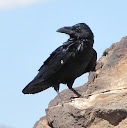
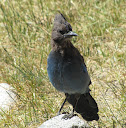
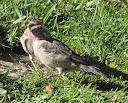
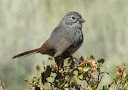
We recently took a small vacation in the California High Sierra. Here are a few pics from that trip:

From the Fossil Falls site. This guy was keeping his mouth shut so I didn't hear him say never more, but even without that it looks like a raven to me. Raven factoid: According to the Wikipedia article the common ravens might be paraphyletic and the California birds might be different enough to make up a separate species.


A stellar jay from near our Glacier Lodge cabin. This was a common bird here and other places that we went in the eastern Sierra.


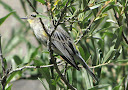
unknown bird from near our Glacier Lodge cabin (west of Big Pine). I was hoping somebody might have a suggestion. There were lots of small birds that were too skittish and too small for me to identify or photograph. I just took a picture of these guys to see if I couldn't figure out what some of them were.


Fox sparrow I think. It looks a lot different than other fox sparrow images on the web. The Wikipedia article suggested that the Fox sparrow might be divided up into as many as four species. Maybe it doesn't look like the other fox sparrows on the web because it really is a different fox sparrow species than the ones people have posted pictures of on the web?


Yellow-rumped warbler from near Rainbow Falls


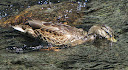
Male mallard in eclipse plumage. This guy was the lone duck in the 8700 foot high Shadow Lake (In the Mammoth area). He had positioned himself at the Shadow Lake outfall and was foraging either by filter feeding on the output of the lake as it went by or by feeding on the plants and algae that were perhaps more common here because of the increased flow of nutrients passed this point. One thought was that all his buddies had left when their flight feathers had fully developed after the molt and he was stuck here waiting for his feathers to come in. Or maybe he was a juvenile and he wasn't going to get breeding plumage this year?
 
Holy cripes, there are lyre birds near you? That's cool. What kinds of sounds have you heard the birds making?

It's about an hours walk to the base and another hour to the top and the birds were both seen about another half hour along the top, so I guess they're about 20km from where I live.

These particular two didn't make a sound but, from time to time over the past couple of years, I have been suspicious of their presence because of sounds of cars and chain saws coming out of the bush.

One time when I heard a chain saw I looked down towards a clearing where the sound seemed to be coming from and thought I saw one ducking out of the clearing and into the bush. I couldn't be quite sure though.
 
3 Oct 2010, Sepulveda Basin (near LA), CA

Saw the usual suspects (coots, egrets, mallards, etc) but had 4 new (for me) sightings:

Green Heron, butorides virescens
Sora, porzana carolina
Say's Phoebe, sayornis saya
Belted Kingfisher, Ceryle alycon

umm . . . okay, I'm not positive that it's the first time I've seen some of those, but I'm happy to pretend.
 

Attachments

  • Says Phoebe.jpg
    Says Phoebe.jpg
    74.2 KB · Views: 1
  • Sora.jpg
    Sora.jpg
    71.5 KB · Views: 2
  • Green Egret.jpg
    Green Egret.jpg
    72.1 KB · Views: 2
  • Belted Kingfisher.jpg
    Belted Kingfisher.jpg
    72.6 KB · Views: 1
Saw a second bald eagle today. It was odd, just sitting in the middle of a recently cut soybean field near Upper Sandusky, OH, US. I pointed it out to my wife, expecting her to take a better look (I was driving) and inform me that it was a white pipe sticking out of the ground with a garbage bag wrapped around it, but my first impression was correct, it seems. It was pretty far away but I could even see the yellow beak as we went by and I took a second look. Fun times.

ETA: Not that it matters dasmiller, but if you are particular about your image files, the picture of the green heron you uploaded is titled green egret. It's the sort of thing that would bug me if it were on my computer that way. :)
 
Last edited:
Saw a second bald eagle today. It was odd, just sitting in the middle of a recently cut soybean field near Upper Sandusky, OH, US. I pointed it out to my wife, expecting her to take a better look (I was driving) and inform me that it was a white pipe sticking out of the ground with a garbage bag wrapped around it, but my first impression was correct, it seems. It was pretty far away but I could even see the yellow beak as we went by and I took a second look. Fun times.


Although bald eagles have been breeding in central Illinois for several years now, there are only a handful of nests around here. The vast majority we see here come from further north in the winter and head back there in the spring. I saw my first bald eagle of the fall a couple days ago. It was soaring a few hundred feet above a sizable shopping center. More of them are staying in the area every year, and it's getting more common to see them over the middle of town and not just along the river. I imagine this one was a local. It's way too early to expect any migrants.
 
Thanks for the response Kotatsu. I had no idea that feather mites were that small. What is the size range of feather mites? Have you written papers on your mites? I think I'd like to read some more about them. ETA: It now seems likely that the objects on the bird's beak were probably cracked seed shells from a nearby bird feeder

I think most mites on birds are about 0.1-0.5mm, but I'm guessing there might be even smaller ones, as well as perhaps larger ones. Of course, if you include ticks (which are also mites), the upper size range in increased. We found some gigantic turtle ticks in Turkey this summer (now probably at the Grigore Antipa Museum of Natural History in Bucharest), and they would probably ahve measured about 8mm empty, and were well over 1.5cm when filled with blood. Horrible creatures.

I haven't written anything on them, but if you have any specific questions, i could have a look around and send you some articles. I have about 1500 articles on lice, and about as many on other animals in my room here at the university, as well as untold numbers on the computer, so I guess I could find something, at least.

By the way, the most horrible mite I know of from birds is Knemidokoptes jamaicensis which infests Red Crossbill Loxia curvirostra in North America. They supposedly burrow into the legs underneath the scales and will, eventually, cause the toes or feet to simply fall off, and there is very little the bird can do to stop this once it starts. Benkman et al. 2005 suggested that infestation of these mites is actually strong enough to drive evolution of the male beaks away from the optimum for foraging.

---
Benkman, Colquitt, Gould, Fetz, Keenan, Santisteban (2005). Can selection by an ectoparasite drive a population of Red Crossbills from its adaptive peak? Evolution 59, 2025-2032.

 
I don't consider myself a serious birder (yet) but I've gotten more and more interested since buying our house a few years ago. Here's the list of the birds I've identified at and around the house:

Peters Creek (Chugiak), Alaska, 1/1/2010–10/4/2010
  • American Robin, Turdus migratorius
  • Bald Eagle, Haliaeetus leucocephalus
  • Black-capped Chickadee, Poecile atricapillus
  • Black-billed Magpie, Pica pica
  • Bohemian Waxwing Bombycilla garrulus
  • Boreal Chickadee, Poecile hudsonicus
  • Common Raven, Corvus corax
  • Common Redpoll, Acanthis flammea
  • Dark-Eyed Junco (Slate-colored form), Junco hyemalis
  • Downy Woodpecker, Picoides pubescens
  • Hairy Woodpecker, Picoides villosus
  • Hermit Thrush, Catharus guttatus
  • Northern Flicker (Yellow-Shafted), Colaptes auratus
  • Red-breasted Nuthatch, Sitta canadensis [photo]
  • Steller's Jay, Cyanocitta stelleri [photo] [home video]
  • Tree Swallow, Tachycineta bicolor
  • Varied Thrush, Ixoreus naevius
  • Wilson's Warbler, Wilsonia pusilla
  • Yellow-Rumped Warbler (Myrtle form), Dendroica coronata
Homer, Alaska (including Kachemak Bay), 6/6/2010–7/25/2010:
  • Black-legged Kittiwake, Rissa tridactyla
  • Common Murre, Uria aalge
  • Glaucous-winged Gull, Larus glaucescens
  • Horned Puffin, Fratercula corniculata
  • Pelagic Cormorant, Phalacrocorax pelagicus
  • Pigeon Guillemot, Cepphus columba
  • Tufted Puffin, Fratercula cirrhata
Various locations in Alaska ranging from the Kenai Peninsula to the Matanuska-Susitna Valley Borough, 1/1/2010–10/4/2010:
  • Bald Eagle, Haliaeetus leucocephalus
  • Belted Kingfisher, Megaceryle alcyon
  • Canada Goose, Branta canadensis
  • Common Loon, Gavia immer
  • Golden Eagle, Aquila chrysaetos
  • Mallard, Anas platyrhynchos
  • Red-necked Grebe, Podiceps grisegena
  • Rock Pigeon, Columba livia
  • Trumpeter Swan, Cygnus buccinator
  • Willow Ptarmigan, Lagopus lagopus
 
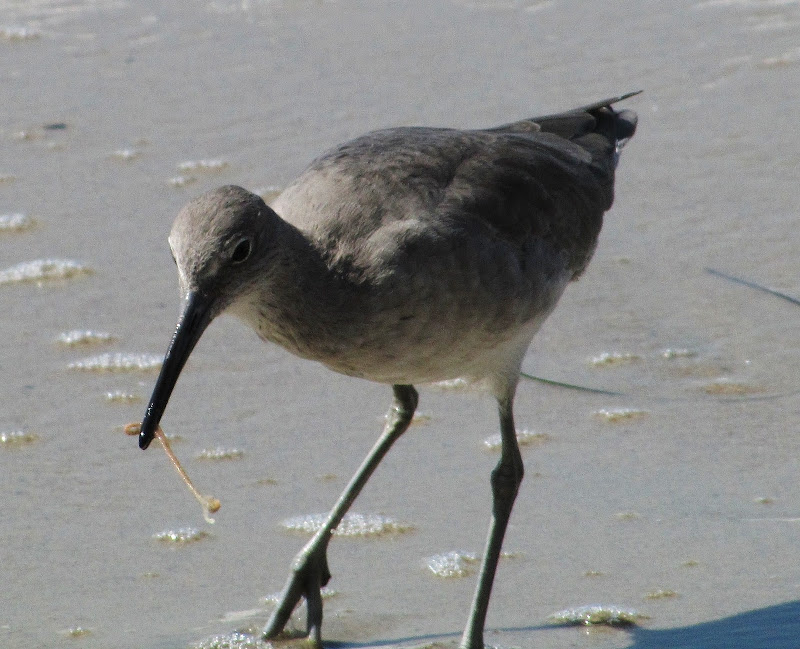
willet food?

This is a willet (Tringa semipalmata) at Laguna Beach, CA. (October 7, 2010)


Does anybody know what it's eating? This is one of the two pictures I took of Willets that day where it is eating this worm like animal. Although sand crabs were common in the sand I never saw a willet eat one. But I probably wouldn't have noticed if they were eating the smaller ones.
 
Last edited:
Seen and photographed on Oct. 11 near Natural Bridge, Yellowstone National Park, Wyoming, USA.

Great Grey Owl Strix nebulosa

 
Testing out my new Canon Rebel XS 1000D. I got the package with a 75-300mm lens. Here's a Cooper's Hawk seen in my yard today October 16, in Central Illinois, USA. It was probably about 75 feet away.

coopershawk01.jpg

It's getting easier to spot these guys now that the leaves are falling off the trees. Without a doubt we'll have some of them around until next spring. The doves and sparrows that come to our feeders are easy pickin's for these Cooper's Hawks.
 
Today I received Trevor Carnaby's Beat about the bush: Birds. It will take a while to read (it's about 750 pages!) but a first look reveals that it will be at least as enjoyable as his book on mammals. It's about Southern Africa birds, so anyone with an active interest in the birdlife of the area should enjoy it!
 
A Turkey Vulture (Cathartes aura) seen in central Illinois, USA, on October 30, 2010. These are very common around here through most of the year, but they head south when we get steady freezing overnight temperatures. In about a month they'll all be gone for the winter. As soon as temperatures are consistently above freezing in the spring, they'll be back.

vulture001.jpg
 
A Turkey Vulture (Cathartes aura) seen in central Illinois, USA, on October 30, 2010. These are very common around here through most of the year, but they head south when we get steady freezing overnight temperatures. In about a month they'll all be gone for the winter. As soon as temperatures are consistently above freezing in the spring, they'll be back.

That is a very nice picture GeeMack. I have been trying, without success, to take a good picture of a turkey vulture for a few years now ever since one soared past me at eye level.

In our area they are permanent residents. It is surprising to me how common they are, since I would expect the amount of dead animals even in our wild areas to be small because of the dry climate and because of nearby developments. I may overestimate how common the vultures are though. If there is a turkey vulture within a few miles you'll probably see it, but there might be hundreds of wrens near you and you'd be lucky to catch a glimpse of one.
 

ISF - Join now!

Every member here is approved by hand. No bots, no spam, just people who care about evidence and honest debate.

Membership is free!

Create your free account

Back
Top Bottom