• Security incident: ISF was recently accessed by intruders. Please change your password, and change it anywhere else you used it. Read more

Forum Birdwatching 2010

On another forum someone is looking for help identifying a bird that they saw in Southern Finland. They posted some pictures of it in flight.

I can't help them out but I wondered if anyone here recognised it.

That link seems to require a login.

(In the interest of full disclosure, I've never been to Finland and, in fact, I've spent very little time anywhere in Europe so I'm unlikely to be much use identifying Finnish birds. I was just curious about the pictures.)
 
Of any quiet summer evening, a tree in the backyard hosts thousands of skeeter-looking insects.
Sometimes the bats and birds will reduce the ranks.
Hummingbirds don't just suck nectar...
And in the daytime, dragonflies come around on the downwind side...
 

Attachments

  • fcBUGS-01.jpg
    fcBUGS-01.jpg
    131.8 KB · Views: 3
  • fcBUGS-02.jpg
    fcBUGS-02.jpg
    75.5 KB · Views: 3
  • fcBUGS-03.jpg
    fcBUGS-03.jpg
    50.5 KB · Views: 4
  • IMGP6650.jpg
    IMGP6650.jpg
    77.1 KB · Views: 3
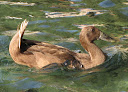
Weird duck

Any thoughts on what kind of a duck this is?


The bird was by itself, although there were a variety of mallard/domestic cross birds in the pond (Laguna Lake, Fullerton, CA).

I lean to the idea that it was a mallard/domestic duck cross, mostly because the Birds of Orange County site, didn't have a picture of any duck that looked like it http://nathistoc.bio.uci.edu/birds/index.htm

Still, if it was a cross, it is the most distinctive cross I have seen. Mostly even though the crosses look very different than the wild birds, you can still see enough similarities that you can make out that they are a cross. Here the beak and tail are like nothing I have seen in any other crosses.
 
das TAMbirds

Henderson, Nevada (next to Las Vegas), at the "Henderson Bird Viewing Preserve", 7 July 2010.

They have contolled access to the preserve, with a gate that they open remotely, mandatory sign-in & sign-out, etc. Also, they close at noon. This isn't a problem; I got there at ~7:30, and by 8:45 it was ~90F (32C, if I converted right) under a brutal sun.

So, what I saw:
American Avocet, Recurviostra americana - my first
Black Necked Stilt, Himantopus Mexicanus
Double Crested Cormorant, Phalocrocorax auritus
Ruddy Duck, Oxyura jamaicensis
Black Crowned Night Heron, Nycticorax nyticorax
Clark's Grebe, Aechmophorus clarkii - my first
American Coot, Fulica Americana
Killdeer, Charadrius vociferus
Black Phoebe, sayornis nigricans
Great-Tailed Grackle, Quiscalus mexicanus
Violet-Green Swallow, tachycineta thalassina - my first

I included a dragonfly picture because there were scads of dragonflies there and it was a good chance to try out my 100MM macro lens.

Higher-quality versions of the pictures (except the last one) are on Flickr:
Avocet
Stilt in flight
Dragonfly
Killdeer
. . . be warned that I linked to the original-size pictures.

For the last picture - I didn't notice this bird when I was there, but I took a few pictures of groups of birds in the distance, and this one was standing on the shore. So far, my best identification is "some sort of duck, or something like that." Of course, the picture quality is pretty poor, which doesn't help. Any ideas?

 

Attachments

  • IMG_5587 crop Ruddy Duck.jpg
    IMG_5587 crop Ruddy Duck.jpg
    95.3 KB · Views: 2
  • IMG_5592 crop adj.jpg
    IMG_5592 crop adj.jpg
    99.2 KB · Views: 1
  • IMG_5626 crop.jpg
    IMG_5626 crop.jpg
    88.4 KB · Views: 1
  • IMG_5714 crop.jpg
    IMG_5714 crop.jpg
    117.3 KB · Views: 1
  • IMG_5668 piece.jpg
    IMG_5668 piece.jpg
    81.5 KB · Views: 3
Here are a couple of Wild Turkeys (Meleagris gallopavo) seen in central Illinois, USA on July 13...

​

The big tom was intent on showing off his stuff. He strutted around for maybe 10 minutes fluffing and displaying before heading off to the woods to catch up with the hens and chicks.
 
As a sign of how poorly my birdwatching has gone in 2010, here are some new sightings for me for 2010. It's been some time since I've seen anything new (other than a beautiful lark that I saw dead in a Taco Bell parking lot...) so this was a bit of a nice change.

7-22-2010 - Kelley's Island, OH, USA
Bank swallow - Riparia riparia
Double-crested cormorant - Phalocrocorax auritus
Great egret - Ardea alba
Herring gull – Larus argentatus

7-21-2010 - Avilla, IN, USA
Purple martin - Progne subis
 
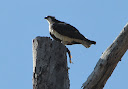
I was at Sepulveda Basin taking pictures again today, and though there wasn't a huge variety of birds out there, there were 3 ospreys having some sort of dispute that may have involved the fish that this one was carrying (it's there, look closely).

Anyway, this was the best look I'd ever gotten at a wild osprey, and I even got a few good pictures, so I'm pretty geeked about it.

Bigger version on Flickr
 

Attachments

  • Osprey with prey cropped for JREF.jpg
    Osprey with prey cropped for JREF.jpg
    48.5 KB · Views: 2
I was at Sepulveda Basin taking pictures again today, and though there wasn't a huge variety of birds out there, there were 3 ospreys having some sort of dispute that may have involved the fish that this one was carrying (it's there, look closely).

Anyway, this was the best look I'd ever gotten at a wild osprey, and I even got a few good pictures, so I'm pretty geeked about it.

On the subject of ospreys
This is the first time I've seen one in this area. One little factoid that I thought was interesting is that there is only one species of osprey throughout the world. There are several subspecies but according to the Wikipedia article these divisions are close and are not "unequivocally separable".


ETA: I just took a look at the larger version of your image Dasmiller and I saw that it's carrying a fish also. Pretty big coincidence that we'd both take a picture of an osprey within less than a week that had a fish.

And a few other sightings that were out of the norm for me:

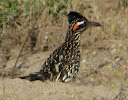
Greater roadrunner
This is the only time I've ever seen a roadrunner in this area. But my buddy who lives in this area says he sees them often. I was surprised at the striking color pattern. I guess I was a little too heavily influence by the Warner Brothers roadrunner as to what I expected them to look like.


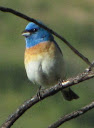
Lazuli bunting
I saw this guy on a couple of different days. The first time I didn't get a picture and I didn't trust my recollections. The color looked turquoise but I thought maybe my mind was playing tricks and I had really just seen a western blue bird.


Osprey Pandion haliaetus
August 11, 2010 Santiago Oaks Park, Orange, CA, USA

Greater roadrunner Geococcyx californianus
June 24, 2010 Near Villa Park Dam, Orange, CA, USA

Lazuli bunting Passerina amoena
May 1, 2010 Near Villa Park Dam, Orange, CA, USA
 
Last edited:
...

At my local watering hole I saw 7 Egyptian Geese,

Where is that Mr Clingford, if I might ask?

... the Canadas have dark legs, the Greylags pink and the Egyptians pinker still. I wonder what causes such differences in the colours?

I've wondered about stuff like that also. Of course one possibility is that nearly all genetically based physical changes that become established promote the survival of the species. We just don't always know what the purpose is.

Another idea is that animals have a fashion sense vaguely like that of humans where for reasons that aren't clear we just decide as a group that some physical characteristic or style is better than some other. The process seems a bit random and isolated populations develop different ideas about this that can seem bizarre to people outside the particular population. Anyway the idea is here, that birds just get into some sort of a group think mode about how desirable a particular physical characteristic is and all of a sudden a particular population is doing selective breeding on itself favoring some particular trait that isn't related to survival.
 
Last edited:
Egyptian geese

I just (I swear I'm not making this up) saw a flock of six Egyptian geese in Bandera, Texas - on (where else?) the Medina River.

I am SO stupid that I didn't think to get my BlackBerry out of the trunk of the car and take a picture. Damn, damn, damn!
 
mites on the beak?

I just (I swear I'm not making this up) saw a flock of six Egyptian geese in Bandera, Texas - on (where else?) the Medina River.

I am SO stupid that I didn't think to get my BlackBerry out of the trunk of the car and take a picture. Damn, damn, damn!

I wish you'd got your picture too. The spread of Egyptian geese in the US seems to be going on pretty fast and it is interesting to hear about new places they are moving to.

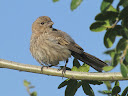
I took this picture of what I believe is a female house finch today:


The interesting thing to me was that there appear to be mites living on the beak. I wonder if Kokatsu or somebody else might be able to tell if they are some sort of parasite or just random detritus that happened to be on this bird.
 
The interesting thing to me was that there appear to be mites living on the beak. I wonder if Kokatsu or somebody else might be able to tell if they are some sort of parasite or just random detritus that happened to be on this bird.

Bit hard to tell from the picture, but feather mites are typically about a tenth of the size of whatever it is that's on the beak. They don't seem to have any appendages of any kind, and those are typically visible on mites that size. On the other hand, the area around the beak is the most tick-infested area of a bird in my experience (1), so there is a possibility that they might be ticks. I don't understand what they'd be doing on the actual beak, though.

---
(1) Though there is a bias in that the head is the only part of a bird I regularly search manually.
 
Oh, great! Fantastic news! (Just the sort of thing that happens after someone has given homoeopathy or something, that "proves" it works.)

I can't see the webcam because it keeps telling me I don't have the right plugin for Forefox, unfortunately.

Rolfe.

I would think that many homeopathic remedies would be quite effective for treating dehydration.
 
Not much bird activity here during the summer, but tonight I did hear a Great Horned Owl, Bubo Virginianus, quite a distinctive hoot. I still haven't seen one in the wild, but they're out there.
 
My short video showing a closeup of the head and face of a Wild Turkey (Meleagris gallopavo), seen in Central Illinois, USA, early September 2010...

​
 

ISF - Join now!

Every member here is approved by hand. No bots, no spam, just people who care about evidence and honest debate.

Membership is free!

Create your free account

Back
Top Bottom