• Security incident: ISF was recently accessed by intruders. Please change your password, and change it anywhere else you used it. Read more

Forum Birdwatching 2010

May 7, 2010
Kansas City, Missouri, USA

Male indigo bunting
Male Baltimore oriole
Male and female common house finches
Male and female goldfinches

The bird feeders in the back are brimming with color and life. I love this time of year.

Hmpf. All I get are English sparrows. Don't get me wrong, they're rather handsome (if noisy) birds. But they're really not "brimming with color."
 
My bird feeders are amazing. Half a dozen goldfinches, also greenfinches, chaffinches and three varieties of tits as well as sparrows.

Incredibly colourful.

Oh apart from the rook I saw this morning.

Rolfe.
 
Pretty much every spring at least a few White-Crowned Sparrows (Zonotrichia leucophrys) stop through here in central Illinois on their migration north. Anywhere from a couple to a small flock usually spend a week or so scavenging spilled seeds around the feeder. This year we've had two hanging around since about May 1.

​
 
Pied-billed grebes and other things

GeeMack's video
I really enjoyed your movie GeeMack. It was quite amazing how the music transformed such a mundane little video into a little moment of joy. (And the choice of font for the title was nice also).

A little moment of misdirected sadness inspired by Rolfe's dead duck story
There's been a black phoebe, probably a male, chirping away in our yard on off for a few weeks. I can relate to his efforts win fair maiden but I'm thinking he's dealing with a lot of rejection because the ladies are looking for digs without a resident cat, but he keeps trying. Our cat is a rescued feral cat and the wild has never left it. Mostly it gets lizards, (some of which I've rescued and photographed) and some rats (more previously, they seem to have left for safer environs now). Well it got a bird the other day and there was so little left that I couldn't identify it, but I thought it might have been our visiting phoebe. Alas yesterday, I think I saw the phoebe back so maybe my sadness was not justified.

Pied-billed grebe encounter
My wife and I watched a pied-billed grebe and her chicks at a small pond (Laguna Lake, CA) near our house the other day. Here's a few pictures:


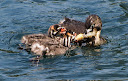
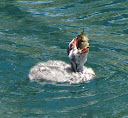
In the first image you can see where the legs have been torn off the crayfish. What seemed to happen was that the mother would offer the crayfish to the chicks, the chicks would attempt to swallow it, the crayfish would escape, the mother would capture it again but as it did that the chicks would pick at it. Eventually the crayfish had had all its legs removed and at that point one of the chicks would succeed in swallowing the whole thing.

If anybody would like to see all twelve of the images I posted you can see them here:
http://picasaweb.google.com/davefoc/PiedBilledGrebes#

<Camera issues digression> These were the most difficult images that I have taken. There were a number of problems. The biggest was that the water has this green algaecide in it that really screws up the metering system in my camera so that the images are over exposed in varying amounts, so I found myself manually changing exposure compensation on each image. An experience photographer that was taking pictures at the pond suggested that I switch to evaluative metering. This helped a bit and spot metering mode seemed to help more. But the biggest improvement came after I realized that there were just some angles and locations that produced too many weird reflections to get a decent picture. I found with a little practice I could see the problem situations and just change location or angle to improve the picture.

I also did some experiments with editing RAW images for the first time. So far it doesn't seem like I got better results doing that than just editing the JPG images.

And on a note of interest to nobody unless you happen to own a Canon SX1 IS, I found out that there is a bug in the upload where you can't upload pictures if there are too many images on the card. The operating system reports a communication error with the camera and it won't connect to it beyond that. The solution is to delete some images off the camera.
</Camera issues digression>

 
A few more spring arrivals here:

An American Woodcock, scolopax minor,

A Common Flicker, colaptes auratus

The Ospreys, pandion haliaetus, are back to Lake Champlain.

And for a special treat, it appears that our own little pond is host not only to a pair of mallards, but to a nesting pair of Wood Ducks, aix sponsa. The female seems to be nesting on the bank, and Mr. Duck patrols back and forth. He's quite majestic, his crest like a colorful admiral's hat. The mallards appear from time to time, and I think their nest may be in the swamp below the pond's dam. Anyway we hope mightily for ducklings of one sort or another!
 
Those are outstanding - thanks!

Thank you dasmiller.

Another note on the photography: Another thing that made taking those photographs difficult, was the reflections off the birds themselves. I've noticed this before when I've tried to take pictures of black birds. It is difficult to deal with the range of intensities from the bird. The black feathers are very dark in places and super bright in others where the sun hits with just the right angle. As I write this I am wondering if this isn't the kind of thing a polarizing filter might help.

ETA:
One other thing, that we had the pleasure of seeing was how adept the bird was at swimming underwater. Occasionally it would swim in water that was shallow enough that we could see it clearly as it chased small fish. After watching how efficient it was at catching fish and crayfish I wondered what kept all the fish and crayfish in this pond from being cleaned out by the birds. Besides the pied-billed grebes, this pond is also regularly visited by great egrets, great blue herons, night capped herons, and lots of cormorants. And it also has a resident population of red-eared turtles. This is also the pond where they found a snapping turtle when it was drained a few years ago. http://www.freerepublic.com/focus/f-news/1212119/posts


May 7, 2010 Laguna Lake, CA
pied-billed grebe Podilymbus podiceps
 
Last edited:
Hmpf. All I get are English sparrows. Don't get me wrong, they're rather handsome (if noisy) birds. But they're really not "brimming with color."

Doing our bit to help the declining sparrow population, the kids and I built a 3-compartment birdbox, specifically recommended to appeal to house sparrows. No dice. All we got was one family of bluetits in the north-facing compartment.

This year we moved the box higher (from halfway up the 2-storey wall to right up under the eaves) to see if that would attract the sparrows, and put a webcam inside the north compartment. Wouldn't you know it, the bluetits are back, but this year in the south compartment. :rolleyes:
 
Interesting. A couple of times now, a hummingbird has had its beak stuck through my screen and I've had to (very gently) push it out. I never thought about going to the outside of the screen and pulling it out, thinking I would put it into even more of a panic.

Linda
.
Pushing is probably best.
The bird had already tried pulling, I bet. :)
 
Doing our bit to help the declining sparrow population, the kids and I built a 3-compartment birdbox, specifically recommended to appeal to house sparrows. No dice. All we got was one family of bluetits in the north-facing compartment.

This year we moved the box higher (from halfway up the 2-storey wall to right up under the eaves) to see if that would attract the sparrows, and put a webcam inside the north compartment. Wouldn't you know it, the bluetits are back, but this year in the south compartment. :rolleyes:

Are English sparrows and house sparrows the same thing? They are pretty much of a pest for us (in San Clemente, CA). We own an old apartment building with Spanish tile roofs and in the past the birds have used the niches created by the arc of the tile for nesting areas. The problem is that they nest very close together and they make a lot of noise. Their nests also are something of a fire hazard. There's a lot of flammable material in them and they tend to just push the old nests farther up under the tile so that after awhile there can be a lot of dry flammable material under a tile roof.

My understanding is that they are out competing native species. The two advantages they have are that they are more willing to nest close together than most native species of song birds and they will destroy the eggs of nearby non-house sparrow song birds.

Modern tile roofs have bird stops which block the roof holes so that birds can't nest in it. It is difficult to install the bird stops in a roof that didn't have them to begin with. The solution we came up with was to install wire mesh in the holes. The birds are very tenacious at getting around the mesh and if the mesh isn't installed quite right the birds can use even a very small hole to get past the mesh to build their nests.

I wondered why old roofs were built without bird stops. I think it's possible that the house sparrows weren't a problem eighty years ago when this apartment was built. Maybe the birds hadn't reached California from the east where they were first released.
 
The English Sparrow was imported to the US in 1850.
It's now ALL OVER the place!
It can co-exist with the native species, by exploiting the environment where they don't.
I see mixes of the ES and the House Finch here all the time.
 
The English Sparrow was imported to the US in 1850.
It's now ALL OVER the place!
It can co-exist with the native species, by exploiting the environment where they don't.
I see mixes of the ES and the House Finch here all the time.

The English sparrow is easily the most common bird in my neighborhood (here in the LA area), with house finches probably 2nd. It's easy to confuse the two from a distance, and it's even easier to confuse the females.

I have a picture with ~50 sparrows in my backyard. Most of them were under a birdfeeder, snapping up the spilled seeds.
 
Are English sparrows and house sparrows the same thing?
Yes, they appear to be, according to WP:
http://en.wikipedia.org/wiki/House_Sparrow

They are pretty much of a pest for us (in San Clemente, CA). We own an old apartment building with Spanish tile roofs and in the past the birds have used the niches created by the arc of the tile for nesting areas... The solution we came up with was to install wire mesh in the holes. The birds are very tenacious at getting around the mesh and if the mesh isn't installed quite right the birds can use even a very small hole to get past the mesh to build their nests.
We have the same problem with birds getting under our tiles, but here it's starlings, not sparrows. Sparrows were the commonest of birds when I was a kid, but they've declined severly over the years. I understand they've virtually disappeared from London.
 
The English Sparrow was imported to the US in 1850.
It's now ALL OVER the place!
It can co-exist with the native species, by exploiting the environment where they don't.
I see mixes of the ES and the House Finch here all the time.
I think the English (house ) sparrow issue is not so much their effect on the finches, but on the other sparrows. I think it's the chipping and other sparrows that are suffering from the onslaught.

Add to our list a sighting today of a couple of Common Ravens, corvus corax. Not always easy to distinguish from big crows unless they stand on top of a bust and intone "nevermore", but these guys gave us a good look at their rounded tails, so ravens they are.
 
GeeMack's video
I really enjoyed your movie GeeMack. It was quite amazing how the music transformed such a mundane little video into a little moment of joy. (And the choice of font for the title was nice also).

A little moment of misdirected sadness inspired by Rolfe's dead duck story
There's been a black phoebe, probably a male, chirping away in our yard on off for a few weeks. I can relate to his efforts win fair maiden but I'm thinking he's dealing with a lot of rejection because the ladies are looking for digs without a resident cat, but he keeps trying. Our cat is a rescued feral cat and the wild has never left it. Mostly it gets lizards, (some of which I've rescued and photographed) and some rats (more previously, they seem to have left for safer environs now). Well it got a bird the other day and there was so little left that I couldn't identify it, but I thought it might have been our visiting phoebe. Alas yesterday, I think I saw the phoebe back so maybe my sadness was not justified.

Pied-billed grebe encounter
My wife and I watched a pied-billed grebe and her chicks at a small pond (Laguna Lake, CA) near our house the other day. Here's a few pictures:
[qimg]http://lh4.ggpht.com/_WI4_0Bta7RM/S-YuImmPUDI/AAAAAAAACMk/3L_HTLtmtbU/s128/IMG_6798.JPG[/qimg]

[qimg]http://lh6.ggpht.com/_WI4_0Bta7RM/S-YuMme5CuI/AAAAAAAACM4/X04c8tDZ554/s128/IMG_6807.JPG[/qimg]

In the first image you can see where the legs have been torn off the crayfish. What seemed to happen was that the mother would offer the crayfish to the chicks, the chicks would attempt to swallow it, the crayfish would escape, the mother would capture it again but as it did that the chicks would pick at it. Eventually the crayfish had had all its legs removed and at that point one of the chicks would succeed in swallowing the whole thing.

If anybody would like to see all twelve of the images I posted you can see them here:
http://picasaweb.google.com/davefoc/PiedBilledGrebes#

<Camera issues digression> These were the most difficult images that I have taken. There were a number of problems. The biggest was that the water has this green algaecide in it that really screws up the metering system in my camera so that the images are over exposed in varying amounts, so I found myself manually changing exposure compensation on each image. An experience photographer that was taking pictures at the pond suggested that I switch to evaluative metering. This helped a bit and spot metering mode seemed to help more. But the biggest improvement came after I realized that there were just some angles and locations that produced too many weird reflections to get a decent picture. I found with a little practice I could see the problem situations and just change location or angle to improve the picture.

I also did some experiments with editing RAW images for the first time. So far it doesn't seem like I got better results doing that than just editing the JPG images.

And on a note of interest to nobody unless you happen to own a Canon SX1 IS, I found out that there is a bug in the upload where you can't upload pictures if there are too many images on the card. The operating system reports a communication error with the camera and it won't connect to it beyond that. The solution is to delete some images off the camera.
</Camera issues digression>

Those are wonderful pictures, despite the problems you cite. I am still only beginning to get to grips with my camera (I am a slow learner, I know :)) and I am soooo impressed by some of the pictures you all manage to take. One day I will get such images :) Meantime all of you, please keep them coming. I love to see them. And the video was great too!
 
I think the English (house ) sparrow issue is not so much their effect on the finches, but on the other sparrows. I think it's the chipping and other sparrows that are suffering from the onslaught.

Add to our list a sighting today of a couple of Common Ravens, corvus corax. Not always easy to distinguish from big crows unless they stand on top of a bust and intone "nevermore", but these guys gave us a good look at their rounded tails, so ravens they are.
.
I've seldom seen crows and ravens in the same location.
Down below near the ocean, lots of crows.
Out here in the desert, almost no crows, ravens all over the place.
 
.
I've seldom seen crows and ravens in the same location.
Down below near the ocean, lots of crows.
Out here in the desert, almost no crows, ravens all over the place.
We get them pretty much all over the place here in Vermont (inland, farm country, woods and hills), though crows are more common and generally appear in larger numbers together. It's not always easy to spot the difference, because the crows can get very big too. Tail shape is diagnostic, but they don't always oblige.
 
...
Add to our list a sighting today of a couple of Common Ravens, corvus corax. Not always easy to distinguish from big crows unless they stand on top of a bust and intone "nevermore", but these guys gave us a good look at their rounded tails, so ravens they are.

:)

I'm never sure what's a raven and what's a crow. Sounds like I've been wasting my time looking at the tails, and beaks. I'll just start listening for nevermore.
 
:)

I'm never sure what's a raven and what's a crow. Sounds like I've been wasting my time looking at the tails, and beaks. I'll just start listening for nevermore.

If it's perched on a bust of Pallas, it's a raven.
If it's hanging around at night with a moody guy who wears a lot of black, it's a crow.
If it's vaguely cool and classy during the day, it's a raven.
If it's in one of Aesop's fables or some obscure bit of Americana, it's probably a crow.
If it's the color of attractive dark-haired woman's hair, it's a raven.
If it's feet look like the corners of my eyes, it's a crow.
If it has a grating, unpleasant voice, it's a raven, unless it's a crow.
 
Last edited:

ISF - Join now!

Every member here is approved by hand. No bots, no spam, just people who care about evidence and honest debate.

Membership is free!

Create your free account

Back
Top Bottom