• Security incident: ISF was recently accessed by intruders. Please change your password, and change it anywhere else you used it. Read more

Forum Birdwatching 2010

Don't forget, though, that Ravens are bloody enormous (for corvids) and consider themselves royalty, so only hang out at the Tower of London.

I find rooks and crows more difficult to distinguish, but I love how chatty rooks are. Jackdaws only have one name and call it the whole time i.e. Jack. But I like their silvery grey cloak because it makes them easy to identify.
 
Ravens aren't as skittish as crows.
One locally would fly over and verbally abuse me when it would see me out walking.
It had a lot of fun doing that. :)
 

Attachments

  • Display-91.jpg
    Display-91.jpg
    147 KB · Views: 10
  • Display-12.jpg
    Display-12.jpg
    147.4 KB · Views: 11
it was the very early morniing in Scotland: what do you think the temperature would be ....;)
 
Swallows in Kent last week and a Little Egret in east London last night.

I can't recall seeing a Little Egret out my way before (though quite possibly a few in the lower river systems hearabouts.

I need to post some of my Oz photos (and list).
 
Non-Native birdies...
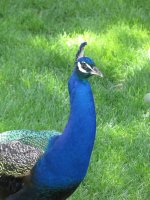
Pavo cristatus
.
Several at the Exotic Feline Breeding Compound in Rosamond CA.
Noisy damn things.
I've seen one way out in the boonies, escaped or something..
 

Attachments

  • jrPeacock-01.jpg
    jrPeacock-01.jpg
    81.6 KB · Views: 7
  • jrPeacock-02.jpg
    jrPeacock-02.jpg
    149 KB · Views: 7
  • jrPeacock-03.jpg
    jrPeacock-03.jpg
    57.1 KB · Views: 7
Dunno about early morning, but it was bloody snowing here at lunchtime.

Rolfe.

Snowed last night in Denver, too. Heck, if it's that cold, then you should go ahead and chow down. I doubt that there's any diseases that cooking it thoroughly won't kill. Lots of people in the US eat wild duck, though they usually bag them with a shotgun rather than their car. I even ate some myself once. I'm not sure if it was mallard or some other species, because I didn't see it until it was cooked, and they all look pretyy much alike in that state. It was quite tasty, and not nearly as fatty as domestic duck.
 
It's not entirely dead fowl round here, but yesterday I had to work at a different centre, and not long before I was due to go home, one of the secretaries came in with a tiny dead goldcrest in her hand. She said she'd found it under a large window, and it had probably flown straight into the glass. I was quite relieved because when I first saw it I thought it was another post mortem submission. (I'd had to do a couple of fancy chickens earlier and I hate poultry!)

On a happier note, I seem to have a positive flock of goldfinches in my garden.

Rolfe.
 
Nothing new here, but on a little nature trail with a fast-flowing stream nearby, I did get to see a merganser zipping down the current, when suddenly she dipped her head in and came out with a fish. Pretty cool.

Meanwhile Mr. and Mrs. Wood Duck continue to nest on the far bank of our pond, so our hope for a brood of ducklings grows. No fish in the pond, only frogs, so I hope wood ducks aren't carnivorous. We like our frogs.
 
They aren't carnivorous, or at least not overly so. They mostly eat whatever plants they can find along with seeds and nuts, the occasional bug/slug/snail, and a little fish or two from time to time. They might snarf a tadpole though, I guess...
 
They aren't carnivorous, or at least not overly so. They mostly eat whatever plants they can find along with seeds and nuts, the occasional bug/slug/snail, and a little fish or two from time to time. They might snarf a tadpole though, I guess...
We're not really worried, of course, but it does seem that a host of different beasts come and gobble up the poor froggies. It's a good thing they're as prolific as they are nutritious or we'd have nobody to sing us to sleep on a summer night.
 
We have worked hard to create an environment in which there is abundant wildlife. We have planted trees, bushes, and other plants that provide food and cover for birds. We added 3 small ponds, more like water pools, that maintain a constant year round water supply. Although we have seen 50 or 60 species on our property since we moved in we are told that there are probably over 130 species that visit our place. We just need to be better observers. I stink at birding, but there is a large variety of habitats. An important part of our children's education is an appreciation for the variety of life that surrounds us.
 
An exciting day for me as I saw my first breeding colony of 4 or 5 nests of Grey Heron (Ardea cinerea). This is the first time that I have seen at least 8 herons at the same time.
 
This afternoon my kids got to see 2 red tailed hawks up close. These were injured animals that are being cared for and used to educate people about hawks. Seeing the markings up close was a very nice treat for everyone.
 
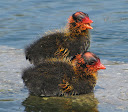
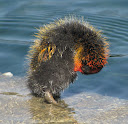
American coot chicks

We saw two American coot pairs with chicks in a pond near us (Laguna Lake, Fullerton, CA).

Each pair had two chicks. Both the male and female coots seem to participate about equally with the feeding.


There's a few more coot pictures here:
http://picasaweb.google.com/davefoc/AmericanCoots#

<Camera issues digression>These pictures were my second attempt at photographing these birds. On the previous day I'd taken several pictures of these birds but they came out poorly. Part of the problem was an issue that I'd never thought much about, luminosity range. Even though it seemed like I had the camera set up for about the right exposure many areas in the image seemed significantly over exposed. Both the adult and juvenile coots had areas that were very reflective which caused localized areas of over exposure in the image and blooming in places. In reading a little about this issue on the web, it seems like this is something a recognized problem in digital photography and maybe photography in general. One thing I found out was that some digital cameras have settings where the overall range of intensities can be compressed a bit to address the problem. In the case of the camera I own, a Canon SX IS, a feature called Icontrast can be enabled. It had been off on my camera previously. I put the Icontrast setting to auto for these images. It wasn't a very good test in that I didn't shoot the same images with the setting on and off but my general sense was that the images were improved on the second day and enabling Icontrast mode might have helped.</Camera issues digression>

May 15, 2010 Laguna Lake, CA
American coot Fulica americana adults and chicks
 

ISF - Join now!

Every member here is approved by hand. No bots, no spam, just people who care about evidence and honest debate.

Membership is free!

Create your free account

Back
Top Bottom