BigAl
Philosopher

- Joined
- Jun 9, 2007
- Messages
- 5,397
big al,
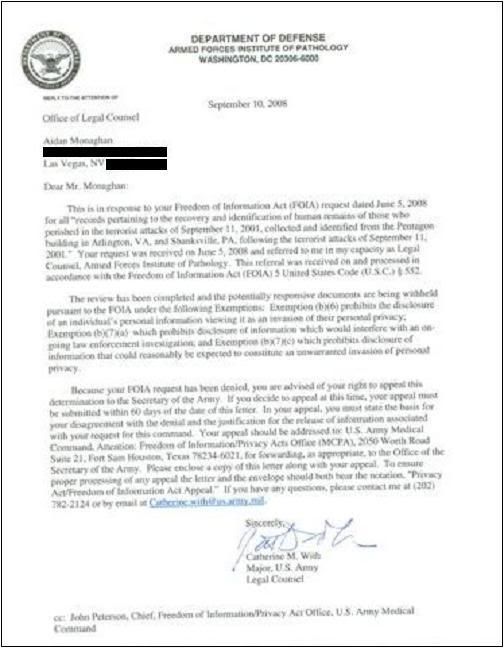
DNA. I invite you to post up your proof that DNA positively identified people. I do not know of any. I do know, for instance, that wikipedia has a statement about DNA identification that may or may not be limited to Flight 77 that states that "citation needed." In other words, that while the DNA claim has been made, it hasn't been proven.
Please give a citation for your claim that DNA positively identified people. Note: Newspaper accounts are not valid as proof. The AFIP report was not a forensic report and said so and also said it made no claim of positive identification, or words to that effect, if I recall correctly. You've made your claim, big al, now kindly source it.
Here we go.
Operation Noble Eagle: Forensic and psychosocial aspects of the Armed Forces Institute of Pathology's response to the September 11 Pentagon attack
Military Medicine | September 1, 2002 | Wagner, Glenn N | CopyrightAssociation of Military Surgeons of the United States Feb 2009.
The Armed Forces Institute of Pathology (AFIP) responded to the tragic vents of September 11 by providing a multidisciplinary team of more than 50 forensic specialists, scientists, and support personnel to the Dover Air Force Base morgue. This team conducted one of the most comprehensive forensic investigations in U.S. history. AFIP staff also deployed to the Pentagon Family Assistance Center to establish a DNA reference collections operation, and to Somerset County, Pennsylvania, to collect tissue specimens recovered from the crash site for DNA analysis. All DNA analysis took place at the.
Wagner, Military Medicine September 1, 2002 (you have to access it from a university or library)
And this. See below for Flight 93.
---Experts ID 184 Pentagon Fatalities (Jan 2002)
by Christopher C. Kelly Public Affairs, Armed Forces Institute of Pathology
The Mercury [an Army Medical Department publication]
January 11, 2002
What some experts have called "the most comprehensive forensic investigation in U.S. history" ended Nov. 16 with the identification of 184 of the 189 who died in the terrorist attack on the Pentagon.
A multidisciplinary team of more than 50 forensic specialists, scientists and support personnel from the Armed Forces Institute of Pathology played a major role in Operation Nobel Eagle investigations, officials said. AFIP is an executive agency of the Army surgeon general.
Many of the Pentagon casualties were badly burned and difficult to identify, an official said. Of the 189 killed, 125 worked at the Pentagon and 64 were passengers on American Airlines Flight 77. Only one of those who died made it to the hospital; the rest were killed on site. For some victims, only pieces of tissue could be found.
AFIP's team of forensic pathologists, odontologists, a forensic anthropologist, DNA experts, investigators and support personnel worked for more than two weeks in the mortuary at Dover Air Force Base, Del., and for weeks at the Armed Forces DNA Identification Laboratory in Rockville, Md., to identify victims of the attack.
"Our staff represented every branch of service," said Navy Capt. Glenn N. Wagner, AFIP director. "We also received tremendous support from the doctors, nurses and technicians stationed at Dover who participated in the investigation."
AFIP used a well-designed and tested system for identifying the Pentagon victims. When remains arrived at Dover Air Force Base, a scanning device searched for the presence of unexploded ordnance or metallic foreign bodies. FBI experts collected trace evidence to search for chemicals from explosive devices and conducted fingerprint identifications.
Forensic dentistry experts then performed dental charting and comparison with existing dental records. Full-body radiographs followed to document skeletal fractures and assist in identification, followed by autopsy inspection. At autopsy, forensic pathologists determined the cause of death, and a forensic anthropologist determined race, sex and stature of victims when necessary.
An epidemiologist managed the tracking system for data collected during the autopsy process, and tissue samples were collected for DNA identification and further toxicology studies. Forensic photographers documented injuries and personal effects. Finally, mortuary specialists embalmed, dressed and casketed remains.
For eight days a full complement of AFIP forensic specialists worked 12-hour shifts to complete the identification system.
From DNA samples sent to the Armed Forces DNA Identification Laboratory, scientists there generated DNA profiles of the victims. Their work also included the victims of United Airlines Flight 93, which crashed in Somerset County, Pa.
The DNA lab's entire staff of 102 DNA analysts, sample processors, and logistics and administrative personnel worked 12-hour shifts, seven days a week to complete the work.
DNA identifications for Flight 93 victims were sent to the Somerset County Coroner's Office for release. The Department of Defense released identification of Pentagon victims. All but four who worked in the Pentagon were identified. AFIP identified all but one of the passengers of Flight 77.
From the January 2002 Mercury, an Army Medical Department publication.
http://911review.org/Wget/www.armymedicine.army.mil/news/releases/afip.htm