• Security incident: ISF was recently accessed by intruders. Please change your password, and change it anywhere else you used it. Read more

Explosions in Tianjin, China

As has been pointed out, this is completely incorrect; it is quite the opposite of the truth.

Nope. The purpose of air-bursting munitions is to spread the blast force more evenly over a larger area. However an impact burst munition concentrates higher blast force at ground zero. That's why Eizō Nomura survived the bombing of Hiroshima despite being only 170m from the hypocenter.

This is basic munitions theory, that guides the design of all types of munitions from cluster bombs to ICBMs. It's why munitions designed for "soft" targets or large area targets are air burst, while munitions designed for "hard" targets are not.
 
Nope. The purpose of air-bursting munitions is to spread the blast force more evenly over a larger area. However an impact burst munition concentrates higher blast force at ground zero. That's why Eizō Nomura survived the bombing of Hiroshima despite being only 170m from the hypocenter.

This is basic munitions theory, that guides the design of all types of munitions from cluster bombs to ICBMs. It's why munitions designed for "soft" targets or large area targets are air burst, while munitions designed for "hard" targets are not.

You've got this wrong. I think you need to talk to Col. Leslie Groves.
 
Nope. The purpose of air-bursting munitions is to spread the blast force more evenly over a larger area.

Which in turn means it does more damage.

However an impact burst munition concentrates higher blast force at ground zero.

You really don't need to create higher blast force at ground zero, unless you're trying to use it as a bunker buster (a scenario which doesn't apply to Hiroshima or most nuke targets). Otherwise, the fact that you didn't destroy something heavily protected near ground zero is more than offset by all the additional things you destroyed farther away. So yes, nukes are usually detonated as air bursts in order to increase the damage relative to a ground burst.
 
You've got this wrong. I think you need to talk to Col. Leslie Groves.

Let's have a look... (all my bolding)

The higher the burst altitude, the weaker the shock wave is when it first reaches the ground. On the other hand, the shock wave will also affect a larger area. Air bursts therefore reduce the peak intensity of the shock wave, but increase the area over which the blast is felt. For a given explosion yield, and a given blast pressure, there is a unique burst altitude at which the area subjected to that pressure is maximized. This is called the optimum burst height for that yield and pressure.
Source.

The net result is that at both Hiroshima and Nagasaki, you had lower burst heights than were optimal. The effect on the ground is that while the 5 psi blast radius didn’t go quite as far out as it might have ideally, the range of radiation effects and radiation around Ground Zero was significantly increased, and the maximum overpressures around Ground Zero were substantially higher. Overall, it is interesting to see that they were apparently, even after Trinity, still being pretty un-optimistic regarding the explosive yields of the bombs, calibrating their burst heights to half or even one quarter of what the actual blasts were. For a “soft” targets, like Hiroshima and Nagasaki, this doesn’t matter too much, as long as the fireball is above the altitude which produces local fallout, but for a “hard” target, where the goal is to put a lot of pressure in one spot, this would be a serious miscalculation.
Source

Incidentally this article explains that the A-Bombs were designed at a height intended to maximise the area of 5psi of overpressure, which is the level at which civilian structures are severely damaged and injury is universal. Based on their calculations, as they explain, it appears the Trinity programme underestimated the bomb yields significantly as the bombs detonated at well below optimum height for 5psi overpressure.

Surface Burst. A surface burst is an explosion in which a weapon is detonated on or slightly above the surface of the earth so that the fireball actually touches the land or water surface. Under these conditions, the area affected by blast, thermal radiation, and initial nuclear radiation will be less extensive than for an air burst of similar yield, except in the region of ground zero where destruction is concentrated. In contrast with air bursts, local fallout can be a hazard over a much larger downwind area than that which is affected by blast and thermal radiation.
Source

Page 16 of this lecture provides comparison of a 500KT Air Burst (at 1.1Mi) versus a 500KT Surface Burst explosion. You will note that lower pressure air blast extends further for an Air Burst detonation but higher pressure air blast extends further for a Surface Burst. Distances are as follows (air burst, ground burst)

30psi (0.4Mi, 0.9Mi)
20psi (0.6Mi, 1.1Mi)
10psi (2.2Mi, 1.5Mi)
5psi (3.2Mi, 2.2Mi)
2psi (5.8Mi, 3.6Mi)
1psi (8.8Mi, 5.8Mi)

And so on...

It's also illustrated by the actual employment of munitions, both Nuclear and Conventional. Munitions designed to be employed against soft targets are normally designed to detonate before impact, whereas munitions designed to be employed against hard targets are normally designed to detonate on impact. This has been the case with munitions design for decades.
 
Which in turn means it does more damage.

You really don't need to create higher blast force at ground zero, unless you're trying to use it as a bunker buster (a scenario which doesn't apply to Hiroshima or most nuke targets). Otherwise, the fact that you didn't destroy something heavily protected near ground zero is more than offset by all the additional things you destroyed farther away. So yes, nukes are usually detonated as air bursts in order to increase the damage relative to a ground burst.

This is exactly what I said - air burst spreads the blast damage more evenly over a larger area, so is preferred for soft targets like cities, people, airfields, etc. Ground burst concentrates more blast damage in a smaller area, so is preferred for hard targets like reinforced positions, underground facilities, dams, and so on.
 
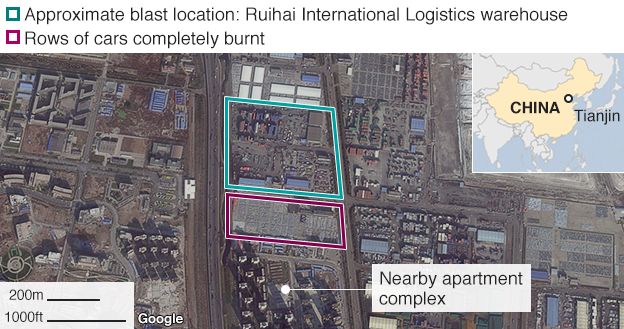
_84867162_china_blast_624_v7.png

BN-JW294_0815cb_M_20150815113911.jpg


So from these two images I'd say that from the road on the left to the one on the right is roughly 400 meters (roughly 1300 feet) and it looks like the crater is at least 1/8th of that distance (maybe 1/7th but to be conservative), so it is about 50 meters across (164 feet). I'm pretty sure 50 meters is in the right ballpark.

I found a paper with an equation:
http://cimec.org.ar/ojs/index.php/mc/article/viewFile/713/675

D[m] = 0.61W[kg]^1/3

So for D[m] = 50, I get 125,000/0.61 = ~205,000 kg. (someone check my math)

There are actually 2 equations in the paper, one for when the explosives are sitting on the surface and another one for when they are half buried. I assumed the latter case but the other equation is D[m] = 0.42W[kg]^1/3. In that case it's ~300,000 kg.

So if my calculations are right here, we're talking the equivalent of at least 200 tons of TNT.
 
This is exactly what I said - air burst spreads the blast damage more evenly over a larger area, so is preferred for soft targets like cities, people, airfields, etc. Ground burst concentrates more blast damage in a smaller area, so is preferred for hard targets like reinforced positions, underground facilities, dams, and so on.

But this contradicts what you said in post 85, which is the point. Nothing you said in that post was about concentrating damage, you just said airburst did less damage. And it does not, except in a narrow sense which post 85 did not indicate. Airburst does more total damage, and that is what people mean if they do not further specify, as you originally did not.
 
OK, located the spot on Google Earth:
39° 2'31.35"N
117°44'13.41"E

Hans
 
If the blast excavated enough to get below the water table then yes, it would probably fill to the level of the water table.

I don't think there'd be much pressure behind it.

The water table is quite high in the area, note all the drainage channels. Any hole of even fairly shallow depth would fill with water. Plus, some water mains must have been broken.

Hans
 
Mmm, could those discussing the effect of nuclear blasts, etc. perhaps open a thread for the purpose?

Hans
 
The water table is quite high in the area, note all the drainage channels. Any hole of even fairly shallow depth would fill with water. Plus, some water mains must have been broken.

Hans


Yeah. That's normally the case in coastal areas that aren't rock.

When I was living in and working around Annapolis, MD pretty near any excavation more than ten feet deep had to have a sump pump to keep it from filling up.
 
Yeah. That's normally the case in coastal areas that aren't rock.

When I was living in and working around Annapolis, MD pretty near any excavation more than ten feet deep had to have a sump pump to keep it from filling up.

One more reason I like being 552 feet/168 meters above sea level. I used to work below sea level when I was in the Navy. (I worked in the part of the ship they aimed torpedoes at.)
 
Yeah. That's normally the case in coastal areas that aren't rock.

When I was living in and working around Annapolis, MD pretty near any excavation more than ten feet deep had to have a sump pump to keep it from filling up.

The whole area, actually all the way to and including Beijing, is one vast sediment plain, with very little elevation.

Hans
 
The map and the satellite view are somewhat out of sync... The map is showing everything up and to the right from the actual picture.

[conspiracy] You sure that isn't back and to the right? [/conspiracy]
 
I don't think so. Even within the immediate area of the blast destruction wasn't "total", not in the sense of the Atomic Bombs, and at distances of 2-3km the damage was incredibly minor - we're talking shattered windows and things.

I've been to Hiroshima and its museum. This China explosion is impressive considering that it wasn't a military strike, but it's nothing compared to a nuke.
 
I've been to Hiroshima and its museum. This China explosion is impressive considering that it wasn't a military strike, but it's nothing compared to a nuke.

there is no such thing as "compared to a nuke". A "nuke" is a nuclear explosion.

There were nukes as low as 50 tons of TNT created (tactical nukes).


btw, the crater is larger than 50 meters wide.

in the photo used for calculating it´s size, notice the building left of it.

the building is exactly 50 meters wide when measured at GoogleEarth or GoogleMaps.

The building is 85 PIXELS wide at the photo.

The crater is 163 pixels wide

Thus the crater is about 100 meters wide at it´s largest extent.

That counting ONLY the black area (water?). From looking at the photo zoomed in, there is at least 10-20 meters wide rim of depressed ground AROUND the area filled with water. (just measured it WITH the depressed ground rim around... 205 pixels)

17ZYxoj.jpg
 
location and size of crater

you guys can compare with the aerial photos above.

notice that the crater appears to be located exactly at the entrance area of the trucks.
K3JPbKf.jpg
 
Last edited:

ISF - Join now!

Every member here is approved by hand. No bots, no spam, just people who care about evidence and honest debate.

Membership is free!

Create your free account

Back
Top Bottom