Electrical power stuff is weird and interesting.
When I moved in here, the place had a two-phase setup, probably dating back to the 1940's.
From memory, each of the two phases was a 60 amp connection. The second phase was only used for the water heater, (which was separately metered) but I've heard of other similar homes which had a two phase setup for their oven, bathroom water heater, and also a 'laundry boiler'.
When I applied for solar panels, the power distributor 'upgraded' my connection to single phase 100 amp.

A clarification for the US posters- thats NOT the same as a US 'split phase' in any way...
In Australia, we have 3 'street phases' ie 3 Actives and a Neutral/Earth on the powerlines in the street in a 'star' or wye configuration with all three phases to neutral being 230v nominal (called by the public 240v still, but its been 230v nominal for over twenty years now) and each phase is electrically 120 degrees out of phase with its two neighbours... The US system is actually a two phase system (incorrectly called a split phase) into the house with two phases 180 degrees in separation, and each phase a direct reversal of the other...
A single phase house in Australia (limited to 60A in the older houses made before 2000 basically in most places) had the street phase and the neutral run to the house...
If electrical demand was too high for that single 60A feed to handle, then a second phase and 'upgraded neutral' was added- unlike the US system (which has their household neutral derived from a single phase tap from the phase being used for their 'local transformer')

So if you have aerial powerlines (ie on top of poles rather than underground) you will see this out in the street

4 cables instead of the 3 of a delta... (that pole also has a 'light duty 'streetlight' cable mounted lower as well)
If demand was even higher again, a third Active cable was run in from the street and you had '3 phase' available ie all three phases and the street neutral/earth came in...
The US system is actually quite 'lossy' if they attempt to use the other two phases for 'splitting the load' as is done in Australia (and most of the world actually)- you have to have 'local transformers' (not a 'thing' here- you have a single substation that delivers 230v/400v three phase to an entire suburb or town, rather than 'local to your house' sub transformers) and as the Neutral is also tied to the earth, unless they are spread out widely geographically, you get 'standing currents' circulating from the various neutrals through the earth because those neutrals aren't actually at the same voltage potential!!!! Basically the US system wastes power in heating up the dirt!!!!
Here houses are 'split' to make the line loadings approximately equal across all three phases- ie your house may be on Phase 1 and Neutral on the pole (or pit lol) while your neighbour is on Phase 2 and Neutral, and the next house down on Phase 3 and Neutral... And as the Neutral cable has an 'Earth dropper' every few poles, the return neutral current is 'shared' mostly by the cable but some by the earth itself, meaning that the neutral isn't carrying the 'sum total' of the currents...
Indeed the Australian system is known as MEN or Multiple Earth Neutral, with literally thousands of 'neutral/earth' interlinks in a distribution system, basically one every few hundred metres in a 'ELV household' municipal supply... (every few poles or pits will have a bare steel cable running down the pole to an earth rod driven in right against it- including one in your houses 'fuse box')... So basically you only have the two wires coming in for a single phase house- the Active phase, and the combined Neutral/Earth, which has a MEN interconnection in your fusebox between the Neutral bar and the household Earth bar, which also has an earth 'stake' or mat buried nearby...
https://www.cleantechcontrols.com.a...ectrical-safety-your-guide-to-optimal-safety/
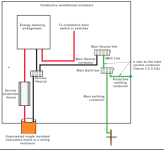
As 'all' N/E interconnects are at the same 'voltage' as each other, you don't have the issues of the US system, where they require to have a minimum 'earth resistance' between neutral points to avoid (well, minimise really) the power losses caused by having multiple neutral/earth points at different voltages (depending on which phase each is on...)