• Security incident: ISF was recently accessed by intruders. Please change your password, and change it anywhere else you used it. Read more

Split Thread Electrical wiring and building codes

bruto

Penultimate Amazing
Joined
Jun 7, 2005
Messages
40,526
Location
Way way north of Diddy Wah Diddy
in my area, to upgrade the ampacity of the box you’d need larger feeders from the utility, which requires them to cut the power and they won’t work with you unless you have a permit. and a permit to upgrade your box can’t be pulled without a master’s license

so you basically have to be or hire a master licensed electrician to do that work.
That's pretty much the case here. We have responsibility for the wiring in the building, but the power company owns its lines as far as the first connection to the building, as well as the meter itself, and makes its own rules as to whether it will energize. Although there's a seal on the meter, a licensed electrician is permitted break the seal and pull it, but I cannot.

A few years ago my lake house was hit with a storm which brought down both the power line and the ancient, outdated service drop. I have an electrician friend who was willing to inspect my work and sign off on it if done right (he has a bad back, and difficulty working in the terrain involved), but ordinarily this would be a job for an electrician. I had to replace the service drop, run it to a new meter box, and thence to the new breaker box, and put in the newly required second ground post, whereupon, after the electrician signed off on it, and the power company seconded it, it was re-energized. At this point, since my town has no building and electrical codes of its own, I am free to do any wiring downstream of the main breaker, but if I need to upgrade the main box, I'll need an electrician to pull the meter, even though in a technical sense I own all the wiring to and from it, and I would need the power company to de-energize the whole system if I need to upgrade the wiring to the meter.

 
Last edited by a moderator:
That's pretty much the case here. We have responsibility for the wiring in the building, but the power company owns its lines as far as the first connection to the building, as well as the meter itself, and makes its own rules as to whether it will energize. Although there's a seal on the meter, a licensed electrician is permitted break the seal and pull it, but I cannot.

A few years ago my lake house was hit with a storm which brought down both the power line and the ancient, outdated service drop. I have an electrician friend who was willing to inspect my work and sign off on it if done right (he has a bad back, and difficulty working in the terrain involved), but ordinarily this would be a job for an electrician. I had to replace the service drop, run it to a new meter box, and thence to the new breaker box, and put in the newly required second ground post, whereupon, after the electrician signed off on it, and the power company seconded it, it was re-energized. At this point, since my town has no building and electrical codes of its own, I am free to do any wiring downstream of the main breaker, but if I need to upgrade the main box, I'll need an electrician to pull the meter, even though in a technical sense I own all the wiring to and from it, and I would need the power company to de-energize the whole system if I need to upgrade the wiring to the meter.
In most countries, all major works (and increasingly ALL electrical works) are required to be done by a licensed electrician
End of story...

Here is Australia, its illegal to do ANY wiring above 60vAC - unless you are a licenced electrical tradesman- NO exceptions... (you can change a lightbulb or fluro tube- thats it, all other electrical work where you pick up a tool is illegal...)

NZ allow 'minor works' on your own property only (changing a lightswitch or powerpoint, inspection by a licensed electrician afterwards, but thats likely to change soon...)

UK is basically the same as NZ 'minor works' on your own property only, but after the 2020 debacle with rental properties when EICR's (electrical installation condition report) became mandatory for all commercial and rental properties- with only 10% being found to be in a 'safe and functional' condition, there's been a push to disallow even minor works repairs to be done at all, and mandatory EICRs to be expanded to include ALL buildings...

Minor works means replacing a lightswitch, lamp base or powerpoint (power outlet) for like for like...

Thats basically it- forget DIY wiring and the like- get caught, and here its a fine for a person ie on your own property- of between $25k to $45k depending on the state you live in, with companies/individual contractors allowing employees to do it 'for payment' of up to quarter of a million dollars- thats just for DOING it...

If said wiring injures or kills someone- penalties can be up to $600000 for individuals, up to $3 million for companies- and up to 5 years in jail for the person who did it...
 
Here, codes and enforcement are largely local. In most of the places I've lived in, new construction must be inspected to get a certificate of occupancy, and that includes wiring. But local codes vary widely in both who can do the work, and what can be done after. When I lived in Connecticut, I had to have an addition to the house inspected, but I had done the interior finishing, including the flooring, insulation, sheetrocking and the wiring and fixtures myself. There was no problem with this.

Where I live now the State has requirements for septic systems and wells, and those must be met in order to get a building permit under the town's zoning laws. If an existing septic system fails, you have trouble, but only if someone knows about it! New permitted construction must get a certificate of occupancy when it's done enough to live in. But once that permit is issued, I'm free to build it, wire it, plumb it, etc. myself. For existing buildings, there are no permits required unless an addition breaches the zoning codes. I can't build on to the front of my house, because it's too close to the road. But I can build onto the back or upward. Some years ago I added a back porch and a dormer, neither of which required a permit.

Of course if I sold the house, it would likely be inspected by the new buyer or their mortgagor, and code violations, etc. would be a problem. It would probably be cheaper to burn the place down.

All of which is kind of a side issue in this thread, of course. The upshot is that I could easily wire up a charging port, either from the house or the shop, each of which has 100 amp service, and I'd be good to go. Much of the shop is wired for 240 already, including a 50 amp sub for the welder and sub feeds for a couple of other outbuildings. Opportunities abound. Whether I end up getting an electric car in the near future is still open, but if I do, I am not too worried about charging it.
The US has always been a mishmash- most countries, the rules are set (and enforced) at the federal level, rather than state level...

Australia has all building works is set by federal rules (Australian Standards) so there is no need to worry about 'different states having different regulations'- they are the same country wide

Owners can 'build' their own house (as indeed I am (slowly) doing myself- assembling a 'kit home') or 'add things'- BUT it MUST be designed and plans drawn and signed off by a competent architect, have a building permit, and my work HAS to be inspected by a building inspector at various points of the building process (and they are a LOT tougher on owner builders than trades builders- because often even after undertaking a mandatory 'prebuilding course' they still aren't at the level of competency of a trade qualified builder who does it for a living AND knows all the regs off by heart...

Even pagolas, sheds etc once they are over a certain size require a building permit and approvals (and thats only in specific areas of the country- ALL sheds (even tiny 'lawn lockers') in cyclone rated areas need them for example

Basically anything bigger than this has to be an approved structure and comes under the A.S regulations...
1792047293875.png
1792047318408.png
10 square metres is about 105 square feet...
5m is 16ft longest wall, 2.4m is 7ft 10" at the highest point of the roof...
And note that is for ALL 'non approval' level structures- want more than one of them or the combined total square metres is over that limit- that needs approval...

Even for an owner/builder- there are parts (wiring, plumbing and sewerage) that can't be done 'DIY' but have to be done by a qualified tradesman...
Even as a trade qualified electrical fitter with an open licence- because I no longer have a current electricians licence (blue card) since I retired (they cost about $600 a year to keep lol) I can't do electrical work 'unsupervised' on my own house (luckily I have a mate who is still working and does my 'supervision', in return for a barby and us having a few beers afterwards each time lol) so at least thats covered without needing a full time sparky to do it all...)
;-)
(I used the Qld ones- only because I live in Queensland and have a copy to hand lol, from the folder on my hdd for the house and shed approvals.. they are the same Australia wide)
 
Last edited:
Electrical power stuff is weird and interesting.

When I moved in here, the place had a two-phase setup, probably dating back to the 1940's.

From memory, each of the two phases was a 60 amp connection. The second phase was only used for the water heater, (which was separately metered) but I've heard of other similar homes which had a two phase setup for their oven, bathroom water heater, and also a 'laundry boiler'.

When I applied for solar panels, the power distributor 'upgraded' my connection to single phase 100 amp.

:)
 
thanks to mods for splitting this off. I know it was a bit of a side track.

Technically the split-phase system here in the US is not two phase even though, since it sort of involves two phases. The split phase works pretty well, providing both 120 and 240 volts out of the same source. One interesting side effect of this is that if you have some electronic gadget putting interference on the line, sometimes changing which side of the circuit you plug into can be useful. Got a light dimmer that causes your radio to buzz? Of course what you should do is turf that dimmer, but in the meantime, plug the radio into a circuit on the other side of the split.

I'm kind of divided about the question of permitting and the like around here. Obviously there's some risk, though it seems to be pretty small. Some places are going to burn down, and people get shocked, and so forth, I guess. At the same time, the secret libertarian that hides under my liberal jacket is pleased that I don't have to go through all that stuff. I learned the basics of safe wiring as a kid, and did considerable maintenance and building work later, and I really don't need an electrician to tell me how to do the job safely. In fact, I've had to fix a few goofs made by licensed electricians.
 
I learned the basics of safe wiring as a kid, and did considerable maintenance and building work later, and I really don't need an electrician to tell me how to do the job safely.
Things change, though. You have to stay on top of code to know what today's understanding of 'safely' means.

Semi-related: I had a guy a few years back who complained that he had lost power in part of his downstairs and the breaker wouldn't stay un-tripped. He didn't understand why I was under the house and looking inside the dead boxes (trying to trace down the fault, obviously). Turned out, he had a large parrot that had chewed through the drywall, pulled a wire out, and stripped the wires clean down to bare copper across a two foot section. I can't believe it wasn't killed. Turns out, the homeowner was aware of this, but didn't realize the significance, or didn't realize that was a live power line. I forget because I was in shock.
In fact, I've had to fix a few goofs made by licensed electricians.
Yep. They run wire all day long, and familiarity breeds yada yada yada. I lost track of how many 3-way switches I've fixed that had a traveler and common reversed, that the homeowner just thought "that's the way it is" when switches had to be oriented 'just so' to freaking work.
 
Things change, though. You have to stay on top of code to know what today's understanding of 'safely' means.

Semi-related: I had a guy a few years back who complained that he had lost power in part of his downstairs and the breaker wouldn't stay un-tripped. He didn't understand why I was under the house and looking inside the dead boxes (trying to trace down the fault, obviously). Turned out, he had a large parrot that had chewed through the drywall, pulled a wire out, and stripped the wires clean down to bare copper across a two foot section. I can't believe it wasn't killed. Turns out, the homeowner was aware of this, but didn't realize the significance, or didn't realize that was a live power line. I forget because I was in shock.

Yep. They run wire all day long, and familiarity breeds yada yada yada. I lost track of how many 3-way switches I've fixed that had a traveler and common reversed, that the homeowner just thought "that's the way it is" when switches had to be oriented 'just so' to freaking work.
Indeed, one does have to keep up, but most of the basic elements have stayed the same, Some of the changes have been to the equipment itself, so for example one no longer uses a three prong oven or dryer plug, but a four prong with a ground. One, which I ran into a few years ago, was the requirement for a second ground point for the system. Others are with regard to added protections and expansion of the need for ground fault and arc fault interrupters. The call for added GFCI protection expands continually, and it's now required for both 120 and 240 volt kitchen appliances, and outdoor power applications beyond just receptacles. All of which is essential for certain things, but does not much influence the basic job of wiring things right.

Fortunately the regulations aren't retroactive, so I'm not going to have to replace all the outlets in my house with tamper proof ones! One of the recent changes is actually rather a boon to the do-it-yourselfer. It is now de rigeur to install an emergency disconnect switch on the outside of a dwelling, so that fire services and the like can shut off without going in or exposing themselves to unguarded meter connections. This also means that one can work on the main breaker box, and even replace it or its breakers if need be, without calling the power company to de-energize! Not going to happen here, but I had to put one on my lake house when I redid it.

Of course, in addition, while many of those code changes are beneficial, and worth keeping up with when one can, they are not legally binding unless your local authority adopts them. Since there is no local authority here at all, my adherence is optional. Which means, indeed, I'll update 240 volt outlets when I can, and install GFCI's when I can (and have done so, because some of my old wiring has no true ground, and a GFCI is requisite for a three prong outlet), and so forth, but I'm not going to go through my complicated and multi-boxed house wiring to replace all the breakers with arc fault detectors, which may not even be available for the old Cutler-Hammer box in the kitchen.
 
Electrical power stuff is weird and interesting.

When I moved in here, the place had a two-phase setup, probably dating back to the 1940's.

From memory, each of the two phases was a 60 amp connection. The second phase was only used for the water heater, (which was separately metered) but I've heard of other similar homes which had a two phase setup for their oven, bathroom water heater, and also a 'laundry boiler'.

When I applied for solar panels, the power distributor 'upgraded' my connection to single phase 100 amp.

:)
A clarification for the US posters- thats NOT the same as a US 'split phase' in any way...
In Australia, we have 3 'street phases' ie 3 Actives and a Neutral/Earth on the powerlines in the street in a 'star' or wye configuration with all three phases to neutral being 230v nominal (called by the public 240v still, but its been 230v nominal for over twenty years now) and each phase is electrically 120 degrees out of phase with its two neighbours... The US system is actually a two phase system (incorrectly called a split phase) into the house with two phases 180 degrees in separation, and each phase a direct reversal of the other...

A single phase house in Australia (limited to 60A in the older houses made before 2000 basically in most places) had the street phase and the neutral run to the house...

If electrical demand was too high for that single 60A feed to handle, then a second phase and 'upgraded neutral' was added- unlike the US system (which has their household neutral derived from a single phase tap from the phase being used for their 'local transformer')
1792128281662.jpeg
So if you have aerial powerlines (ie on top of poles rather than underground) you will see this out in the street
1792128470864.png
4 cables instead of the 3 of a delta... (that pole also has a 'light duty 'streetlight' cable mounted lower as well)

If demand was even higher again, a third Active cable was run in from the street and you had '3 phase' available ie all three phases and the street neutral/earth came in...

The US system is actually quite 'lossy' if they attempt to use the other two phases for 'splitting the load' as is done in Australia (and most of the world actually)- you have to have 'local transformers' (not a 'thing' here- you have a single substation that delivers 230v/400v three phase to an entire suburb or town, rather than 'local to your house' sub transformers) and as the Neutral is also tied to the earth, unless they are spread out widely geographically, you get 'standing currents' circulating from the various neutrals through the earth because those neutrals aren't actually at the same voltage potential!!!! Basically the US system wastes power in heating up the dirt!!!!

Here houses are 'split' to make the line loadings approximately equal across all three phases- ie your house may be on Phase 1 and Neutral on the pole (or pit lol) while your neighbour is on Phase 2 and Neutral, and the next house down on Phase 3 and Neutral... And as the Neutral cable has an 'Earth dropper' every few poles, the return neutral current is 'shared' mostly by the cable but some by the earth itself, meaning that the neutral isn't carrying the 'sum total' of the currents...

Indeed the Australian system is known as MEN or Multiple Earth Neutral, with literally thousands of 'neutral/earth' interlinks in a distribution system, basically one every few hundred metres in a 'ELV household' municipal supply... (every few poles or pits will have a bare steel cable running down the pole to an earth rod driven in right against it- including one in your houses 'fuse box')... So basically you only have the two wires coming in for a single phase house- the Active phase, and the combined Neutral/Earth, which has a MEN interconnection in your fusebox between the Neutral bar and the household Earth bar, which also has an earth 'stake' or mat buried nearby... https://www.cleantechcontrols.com.a...ectrical-safety-your-guide-to-optimal-safety/
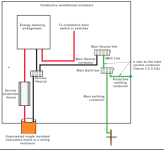
1792129876658.png

As 'all' N/E interconnects are at the same 'voltage' as each other, you don't have the issues of the US system, where they require to have a minimum 'earth resistance' between neutral points to avoid (well, minimise really) the power losses caused by having multiple neutral/earth points at different voltages (depending on which phase each is on...)

 
Indeed, one does have to keep up, but most of the basic elements have stayed the same, Some of the changes have been to the equipment itself, so for example one no longer uses a three prong oven or dryer plug, but a four prong with a ground. One, which I ran into a few years ago, was the requirement for a second ground point for the system. Others are with regard to added protections and expansion of the need for ground fault and arc fault interrupters. The call for added GFCI protection expands continually, and it's now required for both 120 and 240 volt kitchen appliances, and outdoor power applications beyond just receptacles. All of which is essential for certain things, but does not much influence the basic job of wiring things right.

Fortunately the regulations aren't retroactive, so I'm not going to have to replace all the outlets in my house with tamper proof ones! One of the recent changes is actually rather a boon to the do-it-yourselfer. It is now de rigeur to install an emergency disconnect switch on the outside of a dwelling, so that fire services and the like can shut off without going in or exposing themselves to unguarded meter connections. This also means that one can work on the main breaker box, and even replace it or its breakers if need be, without calling the power company to de-energize! Not going to happen here, but I had to put one on my lake house when I redid it.

Of course, in addition, while many of those code changes are beneficial, and worth keeping up with when one can, they are not legally binding unless your local authority adopts them. Since there is no local authority here at all, my adherence is optional. Which means, indeed, I'll update 240 volt outlets when I can, and install GFCI's when I can (and have done so, because some of my old wiring has no true ground, and a GFCI is requisite for a three prong outlet), and so forth, but I'm not going to go through my complicated and multi-boxed house wiring to replace all the breakers with arc fault detectors, which may not even be available for the old Cutler-Hammer box in the kitchen.
The code guys drive you nuts around here. On a 220v household appliance, one year they want the bond between the neutral and ground installed, and the next year they want it removed. One year they want CCST gas piping bonded and grounded, the next they don't. The NEC guys have this principle that any independent electrical system in a residence has to be grounded, which is how we got into independently grounding a ceiling bracket for a light fixture (mounted to a plastic box, and screwed solidly into the already grounded fixture) and grounding the freaking rebar in a footing... which already is a freaking ground. The latter was particularly funny because the ground from.a basement rebar footing would go up to the surface, then clamp onto a 6' ground rod stuck back in the dirt.
 
Yes, phases are funny, and it's really hard sometimes to make Americans understand that split phase is not two phase.

Unfortunately for many, our electrical grid is pretty old, and three phase power is not universal by any means. In many places (mine included) it simply cannot be had. Our town has three phase at one end, provided long ago for a sawmill, and now used by the sawmill and a meat processor, But half the town gets its power from a different line, and this one is single phase and always will be, owing to the infrastructure costs. If you want three phase here, you have to make it yourself.

I did that long ago. There was a time when higher horsepower electric motors were hard to find and expensive. But there was a junkyard nearby which had three phase motors for scrap prices. I bought a couple, and used one big old one as a rotary transformer, to run my bandsaw. It was a clumsy but workable system. Later I was able to get a high enough horsepower single phase motor, and abandoned the three phase setup, but still have the thing in a corner of the shop.
 
you could buy a single phase to 3 phase vfd to run motors if you want to use it
True now. Not so true 40+ years ago when I first had that problem, and a VFD even now costs some bucks. I could also have gotten a capacitor-bank converter which was dedicated to the one motor. Not worth it when I could get the motors for both the bandsaw and the converter for 40 bucks.
 
idk i think it’s a pretty cheap and easy solution to that problem today
It would almost certainly be, today, and has the added advantage as I understand it that a VFD gives you variable speed. It wasn't always. If you have a single big machine that needs it, it's likely the way to go. But if you have multiple three phase machines (not an issue for me these days but I had thoughts of it once) a single rotary transformer can run some or all from that single point. My former father in law had a big furniture shop and a rotary converter that was connected to a whole shop full of three phase machines, which he could turn off and on without fuss. Very handy there. I think it was rated for something like a continuous 10 horsepower but could start more. He turned it on in the morning and off at closing, and it used very little current of its own, since a rotary transformer is running as an unloaded single phase motor.

When I first was doing this, to get even a full horsepower to run the bandsaw was very expensive, and I had less money. I planned for a future with more cheap old 3 phase motors, but moved, and times changed. I ended up with more money and a well wired shop, and the world ended up with cheaper big motors.

But yes, if I came across a 3 phase machine that I really wanted today, I might even not bother to crank up the old converter except to test it out, and end up running it on a VFD.
 
yeah you can control the speed with them and there’s usually a bunch of other functions, they’re pretty customizable as far as how you send the speed signal from on board or remote pots, digital inputs, presets, ethernet, overcurrent protection, ramping up and down, and how integrate them into your process.

even if you have 3 phase power available they’re basically the standard for motor control. but you don’t even need it since there’s plenty of options for single phase input as well.
 
In the US 208V three phase used to be a thing, because it gave 120V to neutral in a wye connection. I don't think it's used much any more but I remember having to design a different wiring setup for a packaging machine that was going to a plant that had that setup at my first job. That was 1973, btw.
 
the plant i work in has 208 3phase, actually you can wire in 220v 3 phase equipment and run it on that which is what we did when my boss bought a drill press and lathe that ran on that. of course we have plenty of 480v 3 phase and idk why he didn't buy equipment that ran on that, guess he didn't think about it when he bought it
 
In the US 208V three phase used to be a thing, because it gave 120V to neutral in a wye connection. I don't think it's used much any more but I remember having to design a different wiring setup for a packaging machine that was going to a plant that had that setup at my first job. That was 1973, btw.
Still is common in US commercial operations- but it then requires 208v equipment if you want to use the 'non neutral' leg of the system...
eg
1792231505836.png
I'd hate to be a US commercial sparky- is this the 120v circuit, the 208v circuit or the 240v circuit??? (or the 3 phase 480v one???)
 
Still is common in US commercial operations- but it then requires 208v equipment if you want to use the 'non neutral' leg of the system...
eg
View attachment 76984
I'd hate to be a US commercial sparky- is this the 120v circuit, the 208v circuit or the 240v circuit??? (or the 3 phase 480v one???)

there’s also 277v for lighting.

however there are industry standards in color coding the wires.
 

ISF - Join now!

Every member here is approved by hand. No bots, no spam, just people who care about evidence and honest debate.

Membership is free!

Create your free account

Back
Top Bottom