Electric universe theories here.

Status
Not open for further replies.
Try using a text editor

FYI Tim, I started a response to you after work, stepped away for awhile to eat and finished it later. When I went to post it, evidently my "token had expired" and it ate my post. I will respond to you again. Please be patient.
I have had similar experiences, losing much work. That's why I now often save copies in a text editor, or compose the entire message off line in a text editor, and just cut & paste when the time comes. You might try that.
 
I know this is late into the game, but here goes. Solid iron cannot possibly exist on the surface of the sun. The melting point is simply too low.

Iron melts at 1800 K and boils at less than 3200 K. The surface of the sun is at nearly 5800 K. There. Empirical, observed evidence. There are no rigid surfaces on the sun because they do not exist. It is physically impossible. I told MM this years ago on Bad Astronomy, and I doubt he'll acknowledge it now.
 
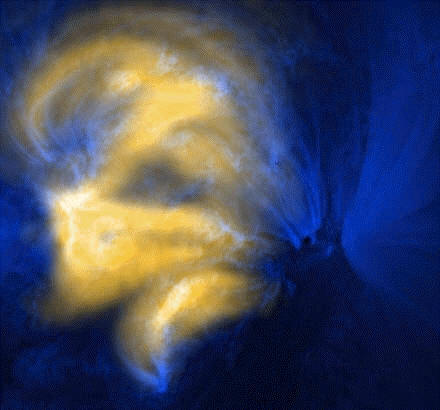
That's not what I asked you. I asked you (others actually): "What is the light source of the *ORIGINAL* 171A images?"


Uh, the "light source" in the source images would be the 171Å emissions from the approximately million degree ejection in the Sun's corona. They call it a coronal mass ejection (CME). I thought you knew that.

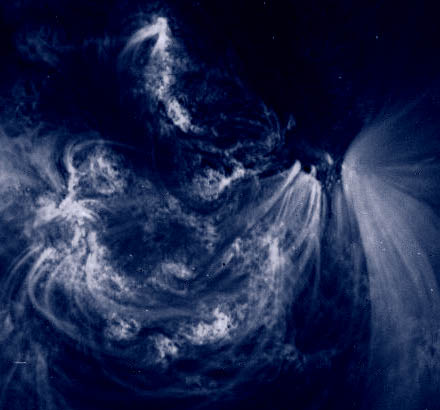
Bull. Not only do the 171A standard and RD images allow us to see deeply enough into the solar atmosphere, so do Kosovichev's doppler techniques which is why we observe persistent features and structures in both images. RD images of clouds change over time. That's what these sorts of images show us in fact. They also demonstrate which regions are NOT changing. In a light plasma, during a CME event, we would expect light plasma to blow around all over the place and for nothing to remain "stable or persistent" for any lengthy duration. Instead we find persistence in these images that is unlike the lifetimes of structures in the photosphere that come and go in roughly 8 minute intervals, but rather we find persistent structures that remain for hours on end in angular patterns like the small angular block at the top of the RD image.


There are no structures. There is no small angular block at the top of the image. It just looks like one to you. There are no bunnies in the clouds. They just look like bunnies. When you ask where the bunny comes from, and people tell you there is no bunny, and you continue to demand that people tell you where the bunny comes from, you look like an idiot.

Also, without helioseismology, we can't see anything deeper than about 400 to 500 kilometers into the photosphere. With helioseismology we can create a chart of the density and movement of mass below that, but it's not a picture in the conventional sense. No light at any wavelength escapes from deeper than that, so we can't optically see it at all. And interestingly enough, Kosovichev's research showed us that there is mass moving at thousands of kilometers per hour upwards, downwards, and sideways, right through your supposedly solid surface, Michael.

They also show us what did not change, even in the middle of significant CME event as witnessed in that video. Plasma ebbs and flows, much like those particles flow in the atmosphere after the CME event.


Anything that didn't change from one source image to the next won't show up in the running difference output. Take an aerial photo of a great bigass mountain like Everest with a little bitty wispy cloud passing over it. Take another photo a few seconds later after that tiny cloud moves a couple hundred meters. Make a running difference image from the two photos. Guess what? That big old mountain, one of the largest geophysical structures on Earth, won't show up in the running difference output because it didn't change or move between the photos.

What will show up is a graphical representation of the change in location of that cloud. There will be a brighter area at the front of the cloud's movement, and a dimmer area behind it. (Or vice-versa, or similar, depending on the actual program producing the output.) It might very well look like a little shaded bump or a piece of rough texture. But sure as you're sittin' there, that cloud isn't solid, and that image doesn't show a bump or feature on the Earth's surface. Certainly no more so than that coronal loop/CME that was the source of your revered running difference image.

Get it? No? Didn't think so.

You did not. You never addressed or explained a single specific detail of this image, not the rigidness or persistence of any of the features in the image, not the "dust in the wind", not the CME itself, not the peeling effect along the right, nothing. Not one single specific detail within the actual image was addressed. If that's his best "analysis" of multimillion dollar satellite images you are capable of, that is completely pathetic. Some "pixel by pixel" analysis.


There are no rigid "features". There is no dust. Nothing is peeling. I addressed every single specific detail. I told you how each pixel is determined in a running difference image. You can't get any more detailed than that. You are a liar.

And... you haven't offered a plausible, rational explanation of the image yourself, yet. :)

Now if you're right and I'm wrong, Michael, why is it that absolutely nobody accepts your feeble claim that there are solid physical structures showing in the image, and everyone seems quite comfortable with my explanation that there aren't? Could it be that you're just a completely incompetent communicator? Could it be that everyone who reads these threads is too stupid to understand you? Or how about the most plausible possibility, that you are simply wrong?
 
I know this is late into the game, but here goes. Solid iron cannot possibly exist on the surface of the sun. The melting point is simply too low.

The surface of the sun is less than 2000 Kelvin. Just as the photosphere is cooler than the chromosphere and the chromosphere is cooler than the corona, so too the layers under the photosphere (silicon and calcium layers) are cooler and more dense than the photosphere. The surface itself is rather cool compared to the photosphere and it would need to be cool enough for solids to form given the gravity conditions that exist at the surface.

Iron melts at 1800 K and boils at less than 3200 K. The surface of the sun is at nearly 5800 K. There. Empirical, observed evidence. There are no rigid surfaces on the sun because they do not exist. It is physically impossible. I told MM this years ago on Bad Astronomy, and I doubt he'll acknowledge it now.

I don't think any of you have ever acknowledged that I have always insisted that the double layers under the photosphere are cooler than the photosphere which is why we often find cooler (and hotter) material rising through the photosphere during sunspot events. When the silicon layer is hot enough, it squirts through the neon plasma of the photosphere and we get sunspots. Never have I suggested that iron is stable at 6K degrees. I wonder if you folks will *EVER* acknowledge that point? How many years has it been now?
 
The surface of the sun is less than 2000 Kelvin.

Uh, no. No it isn't. That's impossible. It must be at least as hot as the part we see, which is around 6000 K. Any cooler and it would be forever heating up, which, well, even you should be able to see why that can't go on forever.

Just as the photosphere is cooler than the chromosphere and the chromosphere is cooler than the corona, so too the layers under the photosphere (silicon and calcium layers) are cooler and more dense than the photosphere.

No. There is a fundamental difference. Both the chromosphere and the corona are mostly transparent. This means that heat from the photosphere can escape past the chromosphere and the corona at a faster rate than heat is absorbed from them. But since the photosphere is NOT transparent, anything under the photosphere CANNOT radiate through the photosphere. So whatever is under the photosphere must be at least as hot as the photosphere.

The surface itself is rather cool compared to the photosphere and it would need to be cool enough for solids to form given the gravity conditions that exist at the surface.

Except that this is impossible (unless you want to violate the 2nd law of thermodynamics) because the photosphere is opaque. So it cannot be cooler than 6000 K, and it cannot be solid.

I don't think any of you have ever acknowledged that I have always insisted that the double layers under the photosphere are cooler than the photosphere

I'm acknowledging it now. And I'm also describing to you why such a scenario is physically impossible without violating the 2nd law of thermodynamics. If people haven't acknowledged it to your satisfaction previously, it's because everyone else already understood why such a thing is impossible. The photosphere is opaque. The chromosphere and the corona are transparent. Transparency of the outer surface is a requirement for the inside to be cooler. Unless you want to violate the 2nd law of thermodynamics.
 
That's not what I asked you. I asked you (others actually): "What is the light source of the *ORIGINAL* 171A images?"
In case I am one of the "others actually":
The "light source" for the images from which the running difference AVI was constructed was the corona in general, the loops & the CME.

The flares & CME are hotter (brighter in UV) than the general corona and changing temperature.
Thus when the running difference is calculated, you see the loops & the CME (i.e. the differences).

Remember that calculating the running differences removes anything that does not change temperature or position from the images. I expect that the original images were taken so that they were of the same area. So features in the original images would not move with the rotation of the Sun or motion of the TRACE spacecraft.
Therefore the features in the resulting running difference are changes in temperature and position. This is mostly changes in temperature (your mythical "mountain ranges") with the addition of the moving CME.
 
Uh, the "light source" in the source images would be the 171Å emissions from the approximately million degree ejection in the Sun's corona. They call it a coronal mass ejection (CME). I thought you knew that.

I thought you were mentally capable of keeping up with our conversation and watching the animations I have provided you with from NASA's website. I have no doubt that *SOME* of these emissions originate in the corona, but no evidence (in fact some evidence to the contrary) that *all* these photons originate in the corona. You are simply *ASSUMING* this to be the case. It's not necessarily the case as the NASA animation demonstrates. If the loops originate *UNDER* the photosphere as in the NASA animation, then it is entirely possible that the loops are visible for many thousands of kilometers below the surface of the photosphere. This is the whole debate.

There are no structures. There is no small angular block at the top of the image.

What would you like to call all those rigid/persistent outlines then?

It just looks like one to you. There are no bunnies in the clouds. They just look like bunnies.

Cloud bunnies move around over time whereas these features remained fixed *throughout* a whole CME event. Some clouds.

Also, without helioseismology, we can't see anything deeper than about 400 to 500 kilometers into the photosphere.

Where do you get that number from as it relate to *THESE SPECIFIC WAVELENGTHS*? Are you claiming *ALL* wavelengths are limited to 400 to 500 KM or just some?

With helioseismology we can create a chart of the density and movement of mass below that, but it's not a picture in the conventional sense.

We also seem to be capable of finding rigid features in these images at a very shallow depth under the photosphere. That is supposed to be an open convection zone, not a rigid layer. What's that angular feature in Kosovichev's Doppler image?


No light at any wavelength escapes from deeper than that, so we can't optically see it at all.

This seems to be "ASSUMED" rather than verified. How about this image?

mossyohkoh.jpg


How come we can see the base of the loops in 171A whereas the x-ray spectrum is limited to the tops of the loops?

http://www.solarviews.com/cap/sun/moss8.htm

And interestingly enough, Kosovichev's research showed us that there is mass moving at thousands of kilometers per hour upwards, downwards, and sideways, right through your supposedly solid surface, Michael.

Well, during our first conversation, I did not realize the importance of volcanic activity. That particular observation does not surprise me in the least. You have electrified tornado like downdrafts and volcanic updrafts through all layers of the sun.

Anything that didn't change from one source image to the next won't show up in the running difference output.

Every area experiences some change from one frame to the next, and the sun itself is rotating between images. You won't get a empty image in a difference image composed of trace images. That is because the sun is rotating between shots, the lighting is shifting slightly between images, and nothing stays exactly the same.

It's getting busy so I'll have to stop here for now. Comparing these images to clouds is silly because there is obvious movement of gases and clouds between images, whereas rigid surface features have a much longer lifetime. The same is true of the sun's atmosphere and surface. The structures in the photosphere come and go every 8 minutes or so. The surface features we see in the RD image are consistent throughout this video and the Doppler video even in the middle of a massive CME event. The mountains will survive such an event whereas plasma gets blown around dramatically as we can observe in that RD image. After the CME we can see "stuff" flying up and to the left. That's the behavior of plasma. It's not solid. It moves in a fluid-like (MHD like) way, as Kosovichev's wave in the photosphere video demonstrates. The rigid features under the wave are angular and irregular and remain consistent and persistent throughout that image just as they remains consistent in the RD image. Why?
 
Last edited:
Uh, no. No it isn't. That's impossible.

Yes it is and it's possible. :)

It must be at least as hot as the part we see, which is around 6000 K.

That's false. By your logic the photosphere cannot be cooler than the chromosphere.

Any cooler and it would be forever heating up, which, well, even you should be able to see why that can't go on forever.

Why isn't the photosphere "heating up" due to the chromosphere? Hint: It's related to density and current flow as well as temperature.

No. There is a fundamental difference. Both the chromosphere and the corona are mostly transparent.

So is the photosphere at some wavelengths, particularly the iron ion wavelengths as that trace/yohkoh images demonstrates.

This means that heat from the photosphere can escape past the chromosphere and the corona at a faster rate than heat is absorbed from them.

Ditto for the more dense silicon layer under the photosphere and the calcium layer under both of those double layers.

But since the photosphere is NOT transparent,

It is transparent to some wavelengths and it's density is much less than layers below the photosphere.

anything under the photosphere CANNOT radiate through the photosphere.

Sure it can. Any more dense layer under the photosphere can interact with the photosphere just like the photosphere acts with the chromosphere. Heat can and does pass through the photosphere from the layers below. Since the photosphere is very light in comparison to deeper plasma layers, heat passes right through it.
 
I have had similar experiences, losing much work. That's why I now often save copies in a text editor, or compose the entire message off line in a text editor, and just cut & paste when the time comes. You might try that.

This site has never eaten a post before. I got lazy. :) I'll take a whack at your posts next.
 
That's false. By your logic the photosphere cannot be cooler than the chromosphere.

Wrong. An inner layer can be cooler only if the layer above it is transparent to the wavelength the inner layer thermally emits at. The chromosphere is transparent to wavelengths the photosphere emits at. The photosphere is not transparent to the wavelengths of thermal radiation below 6000 K.

Why isn't the photosphere "heating up" due to the chromosphere?

It is. But because it can radiate through the chromosphere (because the chromosphere is transparent), it can also cool off. The same is NOT true for anything underneath the photosphere.

So is the photosphere at some wavelengths, particularly the iron ion wavelengths as that trace/yohkoh images demonstrates.

So it's transparent in a range which is relevant if the radiating body is at megakelvin temperatures. Which doesn't help cool something that is below 6000 K. Yeah, um... no. Not gonna do it.

Ditto for the more dense silicon layer under the photosphere and the calcium layer under both of those double layers.

So not only is the silicon going to radiate through the photosphere, despite it being opaque in the relevant bands, but calcium is going to radiate through silicon? No, I don't think so.

It is transparent to some wavelengths and it's density is much less than layers below the photosphere.

Density is irrelevant. It's thick enough that it's opaque throughout the IR, optical, and UV spectrum. Which is the only relevant spectrum for cooling for anything below 6000 K, which you're claiming is the case. So no, the photosphere is not transparent for the relevant frequencies.

Sure it can. Any more dense layer under the photosphere can interact with the photosphere just like the photosphere acts with the chromosphere. Heat can and does pass through the photosphere from the layers below. Since the photosphere is very light in comparison to deeper plasma layers, heat passes right through it.

No. The chromosphere is transparent in the wavelengths that the photosphere emits at. The photosphere is not transparent to wavelength for anything below 6000 K.
 
The surface of the sun is less than 2000 Kelvin. Just as the photosphere is cooler than the chromosphere and the chromosphere is cooler than the corona, so too the layers under the photosphere (silicon and calcium layers) are cooler and more dense than the photosphere. The surface itself is rather cool compared to the photosphere and it would need to be cool enough for solids to form given the gravity conditions that exist at the surface.
Michael - that is about the silliest thing that you have ever written.

Empirical measurements in controlled experiments here on Earth have shown that the radiation given off by objects peak at a frequency that depends on the temperature. Astronomers use this fact to measure the temperature of the visible surface of the Sun (and other stars). They find that the Sun has a radiation spectrum that is roughly that of a black body with a peak of ~550 nanometers corresponding to a temperature of ~6000 K. That radiation is produced by the visible surface of the Sun (the photosphere).

What makes the statement really silly is the "less than" bit. Is the Sun's surface at a temperature of 0 K? What about 273 K?
What is your evidence for < 2000 K other than wishful thinking?

Your last sentence reveals why you are ignoring the empirical measurements in controlled experiments that show that the photosphere has a temperature of ~6000 K: You want solids to exist on the surface of the Sun.
This is typical crackpot behavior. A crackpot says: I have an idea that is obviously right according to me (solid iron on the surface of the Sun). Therefore I will change the universe to fit my idea (ignore the science and assign the photosphere an unknown temperature of < 2000 K).
A scientist says: the universe has presented me with this measurement (the photosphere has a temperature of ~6000 K) and from this I can create a theory to explain the data (stellar model).
 
I thought you were mentally capable of keeping up with our conversation and watching the animations I have provided you with from NASA's website. I have no doubt that *SOME* of these emissions originate in the corona, but no evidence (in fact some evidence to the contrary) that *all* these photons originate in the corona. You are simply *ASSUMING* this to be the case. It's not necessarily the case as the NASA animation demonstrates. If the loops originate *UNDER* the photosphere as in the NASA animation, then it is entirely possible that the loops are visible for many thousands of kilometers below the surface of the photosphere. This is the whole debate.


We understand where the 171Å emissions are in the solar atmosphere. You have been given at least a couple methods for determining this. Apparently you don't get it. And you're wrong about seeing anything thousands of kilometers below the photosphere. If there ever was a debate, it's long over, and you lost.

What would you like to call all those rigid/persistent outlines then?


Well, for one thing there isn't any rigid anything in that image. It's not a picture of something. I'd call them the results of a graphical comparison between two or more images, created for the purpose of visualizing a change over time.

Cloud bunnies move around over time whereas these features remained fixed *throughout* a whole CME event. Some clouds.


Again you misunderstand what you're looking at. First, these CME events are on a huge scale. Second, they can last for days. And third, even though the details of this event have been discussed at length, because of your often demonstrated ignorance of the actual science involved, it seems pretty likely that you don't have the slightest idea what constitutes "fixed throughout a whole CME event" or why it might appear that way in the images.

Where do you get that number from as it relate to *THESE SPECIFIC WAVELENGTHS*? Are you claiming *ALL* wavelengths are limited to 400 to 500 KM or just some?


Yes, all. Near-Infrared imaging can see maybe 400 to 500 kilometers into the photosphere. You need to use helioseismology to "see" any deeper.

We also seem to be capable of finding rigid features in these images at a very shallow depth under the photosphere. That is supposed to be an open convection zone, not a rigid layer. What's that angular feature in Kosovichev's Doppler image?


Yes, it is supposed to be an open convection zone, and nothing leads us (those of us not suffering from your crackpot delusion) to believe it's not. Only you see rigid features where there are none. It's like a bad habit with you. There are explanations for it, but they aren't very flattering. There is also help available for your problem, but you'll probably have to recognize that it is a problem first.

This seems to be "ASSUMED" rather than verified. How about this image?

mossyohkoh.jpg


How come we can see the base of the loops in 171A whereas the x-ray spectrum is limited to the tops of the loops?

http://www.solarviews.com/cap/sun/moss8.htm


That's a 2 dimensional image, Michael. You've been asked to describe how you determine various depths in the 2 dimensional images you wave around. You've never been able to do it. (There are ways. They've been described. You didn't understand.) You're only guessing about tops of loops and bases of loops and the location in the Sun's atmosphere of anything in that picture.

Well, during our first conversation, I did not realize the importance of volcanic activity. That particular observation does not surprise me in the least. You have electrified tornado like downdrafts and volcanic updrafts through all layers of the sun.


Hmmm. Volcanic activity and electrified tornado-like downdrafts now, eh? And just when we though you couldn't get any crazier. If I didn't know you, I'd think you're making this stuff up. But sadly, it's pretty certain you actually believe that nonsense.

Every area experiences some change from one frame to the next, and the sun itself is rotating between images. You won't get a empty image in a difference image composed of trace images. That is because the sun is rotating between shots, the lighting is shifting slightly between images, and nothing stays exactly the same.


Your opinion on running difference images is not supported by reality. Every time you mention them or talk about them you make yourself look like a moron. Please, for the sake of your own dignity, stop.

It's getting busy so I'll have to stop here for now. Comparing these images to clouds is silly because there is obvious movement of gases and clouds between images, whereas rigid surface features have a much longer lifetime. The same is true of the sun's atmosphere and surface. The structures in the photosphere come and go every 8 minutes or so. The surface features we see in the RD image are consistent throughout this video and the Doppler video even in the middle of a massive CME event. The mountains will survive such an event whereas plasma gets blown around dramatically as we can observe in that RD image. After the CME we can see "stuff" flying up and to the left. That's the behavior of plasma. It's not solid. It moves in a fluid-like (MHD like) way, as Kosovichev's wave in the photosphere video demonstrates. The rigid features under the wave are angular and irregular and remain consistent and persistent throughout that image just as they remains consistent in the RD image. Why?


Why is there a bunny in the clouds? There's not a bunny in the clouds, Michael. Remember I told you how you look like an idiot whenever you ask that? Well, you're asking again. There are no bunnies in the clouds and there are no rigid surface features in your precious images.
 
This seems to be "ASSUMED" rather than verified. How about this image?

http://www.thesurfaceofthesun.com/images/mossyohkoh.jpg

How come we can see the base of the loops in 171A whereas the x-ray spectrum is limited to the tops of the loops?
http://www.solarviews.com/cap/sun/moss8.htm
You have probably been given the answer to this many times before. But here is mine.
Firstly you need to realize that that image is a composite image:
The same image as "moss7" but with the co-temporal Yohkoh Soft X-ray Telescope image overlaid. Note that the patches of moss seen in the previous images (See Trace Spacecraft Discovers Moss on the Sun) occur only beneath areas of high intensity soft x-ray emission as imaged by the SXT instrument.
Here is the moss7 image and caption:
moss7.jpg


This image of the solar "moss" was taken by NASA's Transition Region and Coronal Explorer (TRACE) spacecraft May 30, 1998. The image is false color, looking almost directly down over coronal loops, immense magnetic arches of hot gas that are anchored in the Sun's visible surface and could span dozens of Earths laid end to end. The bases of the coronal loops appear as white, feathery objects on the right and left of this image. The moss is the blue, black and white spongy structure between the bases of the coronal loops.
Solar moss consists of hot gas at about two million degrees Fahrenheit which emits extreme ultraviolet light observed by the TRACE instrument. It occurs in large patches, about 6,000 - 12,000 miles in extent, and appears between 1,000 - 1,500 miles above the Sun's visible surface, sometimes reaching more than 3,000 miles high. It looks "spongy" because the patches are composed of small bright elements interlaced with dark voids in the TRACE images. These voids are caused by jets of cooler gas from the Sun's lower atmosphere, the chromosphere, which is at about 10,000 degrees Fahrenheit. The solar moss appears only below high pressure coronal loops in active regions, typically persisting for tens of hours, but has been seen to form rapidly and spread in association with loops that arise after a solar explosion, called a flare.
So the answer is simple.
We can see the "base" of the loops because they are emitting light within the 171 Angstrom filter, i.e. the material at the "base" in this image of the loops is at a temperature of between 160,000 K and 2,000,000 K.
The tops of the loops emit x-rays because they are hot enough to emit X-rays.

Now think about what the image means: coronal loops are hot at their tops and cool down closer to the photosphere. That means at some point they cool down to < 160,000 K and cannot be seen by the TRACE detector. Therefore the "bases" in the image are not the real bases of the loops!
This is where my knowledge of solar physics runs out. I have seen diagrams where the loops cool down to 6000 K at the photosphere. I assume that there other images recording the temperature lower in the loops (maybe on the TRACE web site with different filters used on the instrument).

It seems as you want the "bases" to be at the surface. But this means that there is material on the surface of the Sun at a temperature of at least 160,000 K. This has nasty consequences for your "iron sun" idea, e.g. what is heating the iron up to 160,000 K and how does it remain solid? Alternately these are the "volcanoes" you mention - and your solid iron surface is supported by 160,000 K plasma.
 
Last edited:
Let's start here.

Reference: http://www.catastrophism.com/texts/bruce/era.htm
To start with, I simply note that Bruce does not mention gamma rays at all. So I have no idea what he thought they should look like, or even if he thought about it at all.

I'm not sure they have been observed during his lifetime so for now I guess we'll have to assume that to be the case.

Now, right at the top of the page Bruce says (emphasis mine) ... "The object is to show that all cosmic atmospheric phenomena can be explained as deriving from electrical discharges, resulting from the breakdown of electric fields generated by the asymmetrical impacts between dust particles, such as are effective in terrestrial electrical sand and dust storms and in thunderstorms." What, exactly is the bolded phrase supposed to mean? Does it mean literally everything that happens in the atmosphere? or does it mean only electromagnetic things that happen in the atmosphere? Or perhaps "cosmic" is supposed to refer to connections between processes in the atmosphere and processes in space? I find Bruce's very first sentence rather cryptic.

I find it cryptic as well, and the term "cosmic" seems misplaced, at least at first glance. I guess the only thing I can say is that he realized there were cosmic rays that could in fact impact with the atmosphere. It could mean he expects to observe very large inbound as well as outbound 'rays' like the outbound rays that Birkeland created with his sphere. Presumably these rays could connect with other physical bodies in space.

But clearly he thinks that the same dust mechanism is at the root of the sun's electrical activity, because he says so: (emphasis mine again) ... "It is thus fortunate that we are able to see the details of the sun's atmospheric structure in sunspots, and verify that it conforms to the picture which the discharge theory had led us to expect; that is, a general background atmospheric temperature of around 4,000°K in which electric fields can be built up by asymmetrical impacts between solid particles, just as occurs in terrestrial sand and dust storms and in the ejectamenta above volcanoes."

In answer to your question, I know that Bruce is wrong because his proposed mechanism for generating electric charge is not physically possible.

Quite the contrary IMO, he hit the nail on the head as I see it. IMO those "active regions" are often triggered by volcanic activity. I don't think he actually believed that the sun had volcanoes or a crust, but IMO his words are prophetic none the less.

The maximum temperature that dust grains ("solid particles") can survive is about 2000 Kelvins, half of Bruce's optimistically low 4000 Kelvin background temperature. At photospheric temperatures solid particles would be smashed apart by the high speed collisions, or broken apart by the high ultraviolet photon flux. So I will say that Bruce's hypothesis is simply impossible.

I see signs that it is not only possible, but actually quite probable. Birkeland's arcs were typically congregated at the "bumps" of his sphere, and volcanic activity usually sets off electrical discharges in the Earth's atmosphere. CME's are often "point like" in their emissions of particles, including the one that set off the wave in Kosovichev's video.

Now let us go on.

I do acknowledge that it is one known and verified way to generate gamma rays. But there are other known and verified ways to generate gamma rays too, so why not acknowledge them as well?

Which ones naturally occur in the atmosphere? Cosmic rays and discharges are the two most likely culprits are they not?

It is not reasonable to simply assume that all or most of the gamma rays are generated by one and only one mechanism, that's the process of trying to force nature to bow to our pre-conceptions.

I would say it's more of a matter of watching how nature functions here and applying it there. There is nothing "new under the sun" about discharges in the atmosphere of spheres in space, and those million mile per hour charge particles flying off the sun are a form of "electrical current".

Rather, the reasonable thing to do is look at the gamma rays and let them tell you, by their physical characteristics (line width & line shape, band center & band width, spectral energy distribution, relative line strengths & etc.) how they were generated. Let nature lead the investigation, not prejudice.

Ok, but then we do know of two likely culprits, so there is no need to start making up options on the fly is there?

When we do that we find that the sun generates gamma rays from all manner of sources. There is of course the ubiquitous e-/e+ annihilation line at 511 keV, the neutron capture line at 2.223 MeV, nuclear de-excitation line emission from C, O, Ne, Mg, Si, and Fe, as well as bremsstrahlung from accelerated electrons. The bremsstrahlung is the component that you would assign to "electric discharge", since the narrow line emission obviously is not.

Woah. Wouldn't a powerful discharge through these elements create these specific emissions lines particularly in a z-pinch scenario? Again, I think we should look at the obvious candidate before *assuming* it's due to something exotic and foreign to our own atmosphere?

Electric discharge, as I understand the words, is not physically reasonable. In order to have "electric discharge", you have to mechanically separate charges to build up a strong electric field (that's what Bruce tries to do).

That's what the sun does too IMO.

Then you get breakdown and discharge arcs. Then you have to do it all over again.

Active cycles are full of volcanic events, and the discharge in Birkeland's experiments is *constant* and not only occurs at surface point to point discharges, but also as a discharge process between the sphere (crust) and the heliosphere (sides of his experiment).

It's pretty hard to tell the difference between that scenario and a perpetual motion machine. If the energy we see is all supposed to come from the discharges, then where does the energy come from, and what is the mechanism, that produces charge separation in the first place?

Well, according to Bruce it's a fission process in the core. It could be fusion too I suppose. The sun could have a core that spin significantly faster than the crust and generates induction currents. It could be a lot of things.

And since you are separating charges in an electrically conductive environment, how do you prevent quick discharge, and manage to build up strong electric fields?

You don't prevent it which is why we observe CME's that discharge toward the heliosphere in huge bursts.

It makes far better physical sense to realize that magnetic reconnection will transfer a great deal of kinetic energy directly to the plasma,

This makes absolutely no sense to me. We already know that a discharge will transfer a great deal of kinetic energy to plasma. Why do we need something "exotic" to explain something that is naturally occurring right in our own atmosphere?

and that Faraday's Law will also generate strong (but temporary) electric fields as a result of the ubiquitous and unavoidable dynamo magnetic fields in the photosphere.

That solar wind acceleration process isn't "temporary", it's constant and affects the entire surface.

This completely avoids all of the physical difficulties related to discharge mechanisms, is all completely consistent with known basic physics, and is all completely consistent with the wide variety of observed properties of the sun.

It's rather a funny to hear you say it avoids difficulties. It's difficult for me to imagine why you would select something that does not occur in our own atmosphere naturally over something that does occur naturally and fits all the necessary requirements.

Electrical discharges:

A) Heat plasma to millions of degrees
B) pinch free neutrons from plasma
C) cause plasma in the atmosphere of earth to emit gamma rays.
D) cause plasma in our atmosphere to emit x-ray and other high energy signatures.
E) can generate explosive double layers.
F) generates z-pinch spiraling filaments.
G) generates "Birkeland currents" inside plasma.
H) create "loops" in the atmosphere of a sphere in a vacuum.
I) accelerate particles from the sphere and generate "rays" from the sphere.
J) create jets from Birkeland's sphere.

Why do we need an exotic sort of energy exchange when nature has already provided a "simpler"" explanation that occur in our own atmosphere and we know for a fact it works in a lab?

In short, the mainstream models work well and make physical sense, whereas the electrical discharge mechanism does not work and does not make physical sense.

Not only do Birkeland's ideas "make sense", they actually work in a lab and produces many if not all of the same basic observations, including jets, full sphere particle accleration, high energy atmospheric discharges, etc. Birkeland left nothing to chance. It works and it makes sense.

Mainstream theory on the other hand begins with a foreign process that does not occur in our atmosphere naturally nor any other planet we've visited or studied. Mainstream theory makes no sense unless you describe MR as a 'current' running through the "magnetic line'. That's probably why Alfven called the whole idea of magnetic reconnection "pseudoscience". It "sort of" conveys the actual process, but it's easily misunderstood as being separate from a standard discharge process when it fact it is a discharge phenomenon.

Hence, unless you can come up with far stronger arguments than you have managed to muster thus far, I will stick to the mainstream.
Well Tim, all I can say is that the mainstream theory is *NOT* lab tested, it really doesn't explain why solar wind continues to accelerate as it leaves the surface and it doesn't explain a constant full sphere release of accelerating charged particles. It has all the math of course but the same was true of Chapman's theories and they turned out to be wrong mainly because he never "tested" them in the real world. I'll stick with what I *KNOW FOR A FACT* works in a lab.

 
So the density of the photosphere is significantly less than the density of air at sea level and less than the density of plasma in the plasma ball on my desk if I'm not mistaken. What makes you think you would not see high energy wavelengths inside of such a light plasma?
Just noticed this question so:
What are "high energy wavelengths" and what have they got to do with the density of the plasma?

You may mean the wavelengths of light corresponding to high temperatures such as the million degree corona or 6000 K photosphere.

In that case density has not much to do with the temperature. Temperature is a measure of how fast the electrons and ions in the plasma are moving. A dense plasma can have fast moving electrons and ions, e.g. stellar cores with temperatures of ~10,000,000 K. A diffuse plasma can have slow moving electrons and ions, e.g. aurora have temperature of ~100 K.

It looks like plasma physics is something else you need to learn.
 
You have probably been given the answer to this many times before. But here is mine.
Firstly you need to realize that that image is a composite image:

Your guys posture and act condescending in absolutely bizarre ways. I'm the one that *TOLD *****YOU**** it was a composite Trace/Yohkoh image and I provided the links for you to read all about it. I even identified the color scheme for you. How could I *NOT* realize it's a composite image? Sheesh. What's the point of being condescending at inappropriate times? You look ridiculous.

Here is the moss7 image and caption:
[qimg]http://www.solarviews.com/browse/sun/moss7.jpg[/qimg]

This image of the solar "moss" was taken by NASA's Transition Region and Coronal Explorer (TRACE) spacecraft May 30, 1998. The image is false color, looking almost directly down over coronal loops, immense magnetic arches of hot gas that are anchored in the Sun's visible surface.....

Emphasis mine. Notice that the loops are anchored into, or begin below the photosphere just like the NASA animation I provide you with? What is the average density of the photosphere and what makes you think it blocks all 171A light exactly at the surface of the photosphere?

and could span dozens of Earths laid end to end. The bases of the coronal loops appear as white, feathery objects on the right and left of this image. The moss is the blue, black and white spongy structure between the bases of the coronal loops.

So wherever this peeling moss stuff is taking place it is located at the *BASES* of the arcs/loops which extend down into the photosphere.

Solar moss consists of hot gas at about two million degrees Fahrenheit which emits extreme ultraviolet light observed by the TRACE instrument.

Electrical current would be required to heat it to that temperature too.

It occurs in large patches, about 6,000 - 12,000 miles in extent, and appears between 1,000 - 1,500 miles above the Sun's visible surface,

Ooops. They just got through saying that the bases of the loops are rooted in the photosphere and the moss process takes place at the *BASES* of the loops. It can't occur 1000 miles above the photosphere because the base of the loops begin *UNDER* the photosphere according to NASA.

http://svs.gsfc.nasa.gov/vis/a010000/a010000/a010074/index.html

Something here doesn't add up. If the loops originate under the photosphere, the loops are rooted in the photosphere and the moss occurs at the bases of the loops, then all these moss events occur *UNDER* not over the photosphere.

So the answer is simple.
We can see the "base" of the loops because they are emitting light within the 171 Angstrom filter, i.e. the material at the "base" in this image of the loops is at a temperature of between 160,000 K and 2,000,000 K.
The tops of the loops emit x-rays because they are hot enough to emit X-rays.

http://trace.lmsal.com/POD/TRACEpodarchive4.html
T171_990809_230034_bar_clip.gif


If you notice, the temperature does not drop off with distance as expected, but rather it extends throughout the arc, with the brightest regions being the base of the arc. The loops are "hot" because they are electrically active, particularly at the bases of loops where parts of the surface are being ionized by the discharge process.

Now think about what the image means: coronal loops are hot at their tops and cool down closer to the photosphere.

Or they are hot everywhere, but the bases extend down into the photosphere and therefore the photosphere blocks some of the x-rays. When the tops of the loops reach the corona, they pick up heat from the corona and the light from the loops is not blocked by the photosphere. Your explanation requires the tops of the loops to necessarily be hotter than the bottoms but that other image I provided shows that the brightest and hottest regions are at the based of the loops not the tops. The composite image shows us where the layers of the atmosphere of the sun begin and end. 171A light is visible deep into the photosphere whereas x-rays do not penetrate the photosphere easily and therefore we do not see many x-rays once the arcs are below the photosphere.

That means at some point they cool down to < 160,000 K and cannot be seen by the TRACE detector. Therefore the "bases" in the image are not the real bases of the loops!

How do you know that?

This is where my knowledge of solar physics runs out. I have seen diagrams where the loops cool down to 6000 K at the photosphere. I assume that there other images recording the temperature lower in the loops (maybe on the TRACE web site with different filters used on the instrument).

If that were true, the bases of the arcs would not be the brightest parts of the image.

It seems as you want the "bases" to be at the surface. But this means that there is material on the surface of the Sun at a temperature of at least 160,000 K.

There are pieces of the surface being peeled (melted) away from the surface and ionized in the electrical current. That ionization process is what we observe in these solar moss images and the same thing can be seen in the peeling process we observe in the RD image.

This has nasty consequences for your "iron sun" idea, e.g. what is heating the iron up to 160,000 K and how does it remain solid?

This is like looking at a arc welder from a distance and seeing a hot wavelength and assuming the whole arc welder is at that temperature. It doesn't work that way. Only the material being ionized in the discharge is heated to these temperatures, not the entire surface.

Alternately these are the "volcanoes" you mention - and your solid iron surface is supported by 160,000 K plasma.

Volcanic events on Earth typically trigger discharges in the plume. That's true on the sun too, except it's atmosphere is almost fully ionized so when a plume come up, it's almost instantly ionized.
 
Last edited:
birkelandyohkohmini.jpg


Birkeland actually "predicted" and "simulated' these same loops. His loops originate at the surface of the sphere and rise high into the atmosphere. That's exactly the same process that the sun experiences.
 
Wrong. An inner layer can be cooler only if the layer above it is transparent to the wavelength the inner layer thermally emits at.

What makes you think a neon photosphere is going to absorb silicon emissions?

So not only is the silicon going to radiate through the photosphere, despite it being opaque in the relevant bands,

Why did you assume it was opaque in those specific bands?

but calcium is going to radiate through silicon? No, I don't think so.

Electrons are flowing through all these layers and carrying heat with them. I think so.

Density is irrelevant.

No way. It's certainly relevant. The photosphere is *THIN*. It's not even atmospheric pressure and it's supposedly 75 percent hydrogen according to you folks. There is no way it's going to block all wavelengths of light. Not even a more dense neon layer would block all wavelengths.

It's thick enough that it's opaque throughout the IR, optical, and UV spectrum.

How did you determine this?
 
Michael - that is about the silliest thing that you have ever written.

Ah, the old argument by ridicule routine. Yawn....

Empirical measurements in controlled experiments here on Earth have shown that the radiation given off by objects peak at a frequency that depends on the temperature.

Where does any experiment show that a plasma, particularly a very light and flimsy plasma acts like a black body and emits and absorbs all wavelengths? You surely must realize that this is *GROSS OVERSIMPLIFICATION* don't you?

What makes the statement really silly is the "less than" bit. Is the Sun's surface at a temperature of 0 K? What about 273 K?
What is your evidence for < 2000 K other than wishful thinking?

Well, for one thing it's solid/rigid. That requires a solid and solids wont stay solid much above 2000K. It therefore must be less than 2000K.

Your last sentence reveals why you are ignoring the empirical measurements in controlled experiments that show that the photosphere has a temperature of ~6000 K: You want solids to exist on the surface of the Sun.

I'm not arguing that the photosphere is not 6000K. I don't 'want' solids to be there, I observe them in Doppler and RD images. I'm only seeking to explain these solids.

This is typical crackpot behavior. A crackpot says: I have an idea that is obviously right according to me (solid iron on the surface of the Sun). Therefore I will change the universe to fit my idea (ignore the science and assign the photosphere an unknown temperature of < 2000 K).

Fortunately I didn't go about it that way. Instead I *OBSERVED* solids under the photosphere that form a "stratification subsurface" that is visible in Doppler and RD images. I observe the suns layers are arranged with the highest density and coolest layers below hotter, less dense layers. I see no reason to believe that this process begins or ends at the photosphere. I simply seek to explain what I observe.

A scientist says: the universe has presented me with this measurement (the photosphere has a temperature of ~6000 K) and from this I can create a theory to explain the data (stellar model).

A "scientist" would notice that angular shape in the Doppler image and those rigid angular features in the RD image too, and they'd attempt to explain these details. A crackpot ignores all the details and regurgitates what they've been told regardless of the visual evidence.
 
Status
Not open for further replies.

Back
Top Bottom