thaiboxerken
Penultimate Amazing

- Joined
- Sep 17, 2001
- Messages
- 35,094
BeACH, the whole point of waterboarding is to cause the victim to think they are going die.

I like that you answered my hypotheticals.

Now, can you tell me why you present your absurd hypothetical about torture?

This makes no sense whatsoever.Lot's [sic] of things have been considered impossible (by the majority), yet the folks that looked at hypotheticals made them reality.
Possibly, but yours isn't. Yours is simply an attempt to justify torture. And it works by assuming that torture is effective (that is, it asks me to assume that you will save lives by committing torture--not something it is possible to know when you are making the decision whether or not to commit torture).What is a hypothetical but something to help clarify and explore.
Bull. I'm not hiding anything. I've consistently held the position that I am opposed to torture in any circumstance whatsoever.I think you are just hiding because of what this limiting case might show about your moral compass.
Again, you're asking me to cede that torture is effective in order for you to make an argument based on a hypothetical to support the position that torture is effective. You're begging the question. I will not cede it. That's the very proposition you're trying to support.But suppose you could? Assume that, so we can better understand your views on morality.
But the law doesn't very specifically define serious or prolonged.
Many of us have addressed your hypotheticals over and over again. Telling you that they're impossible and that they're begging the question is indeed addressing them.I've nothing to hide. And I think I proved my point about you, because you haven't addressed my hypothetical even after I answered yours.

Many of us have addressed your hypotheticals over and over again. Telling you that they're impossible and that they're begging the question is indeed addressing them.
BeACH, the whole point of waterboarding is to cause the victim to think they are going die.
But nevertheless, he did.
My point, in any case, is that Bin Laden was well aware that the plot was to attack certain specific targets by crashing airplanes into them around a certain date. And that certain people, like Atta were involved in it. One of them being KSM. That information alone, had it fallen into the hands of US interrogators, would likely have prevented success of the plot.
The same is true in the KSM case. The interrogators were trying to find out what other plots were underway. The targets. The terrorist leaders of those plots. The dates at which they were supposed to occur. That information alone might be enough to have defeated those plots. Apparently, it was.
False.
Self-labeled al-qaeda members said they met with al-Zarqawi in Bagdhad PRIOR to the invasion of Iraq to plan and get funding for the chemical bomb attack in Jordan.
al-Zarqawi had a training camp in Afghanistan before he came to
Iraq (which happened after our invasion of Afghanistan).
I don't think you can convince me that he was allowed to operate that camp in Afghanistan without the approval and cooperation of the Taliban AND al-Qaeda.
Those two groups were joined at the hips ... literally ... with the children of bin Laden and the head of the Taliban even getting married. And besides, you yourself said that al-Qaeda was loosely structured and a franchise.
But this case was tried in a Jordanian court, with witness after witness testifying, with the jury being shown the vehicles, chemicals and explosives the dozen terrorists brought into the country, with the terrorists admitting on video and in the court room to many details of the plot, including it's ultimate purpose, and with the jury convicting the terrorists, including al-Zarqawi. Funny how your side simply dismisses any evidence that doesn't fit your hate-Bush world view.
Quote:
What is a hypothetical but something to help clarify and explore.
Possibly, but yours isn't. Yours is simply an attempt to justify torture.
I'm not hiding anything. I've consistently held the position that I am opposed to torture in any circumstance whatsoever.
"Prolonged" is not part of the original C.A.T. definition, but was part of the U.S.'s ratification reservations and part of the U.S. Code. It talks about the damage being prolonged.
In the case of the people who were beaten (including those who were killed), the case is quite obvious. Scars and death are about as "prolonged" as damage can get.
The U.S. gave specific examples of what it takes to be "severe" when talking about "mental pain".
And again, courts are comfortable addressing terms like "severe" or "reasonable" and so on.
In the case of waterboarding, the US's language clearly covers that since it says that the mental pain can include pain caused by the threat of imminent death.
Confining a phobic person in a box with a bug might be a bit of a grey area.
It is very, very unpleasant.
I could go on, but the fact is that you haven't got a clue about Afghanistan or Al Qaeda or Zarqawi or Jordan or anything you're talking about.
And this was infinitely more lethal.
Waterboarding will prevent more of this.
Sometimes you have to choose the lesser of evils.
Nonsense. The US Code says:I think I've already won this portion of the argument since I've already established that the definition of the phrases "severe" and "prolonged" in the definition of torture aren't written on any tablet or even in any convention or law signed or passed by the US.
(2) “severe mental pain or suffering” means the prolonged mental harm caused by or resulting from—
(A) the intentional infliction or threatened infliction of severe physical pain or suffering;
(B) the administration or application, or threatened administration or application, of mind-altering substances or other procedures calculated to disrupt profoundly the senses or the personality;
(C) the threat of imminent death; or
(D) the threat that another person will imminently be subjected to death, severe physical pain or suffering, or the administration or application of mind-altering substances or other procedures calculated to disrupt profoundly the senses or personality;
I agree interpretation plays a role, but I disagree that there's such "wide latitude" that waterboarding which relies on making the victim think he is about to die can possibly be interpreted not to be the use of "threat of imminent death".Thus, interpretation plays an important role in the law and allows wide latitude as to what acts actually do constitute torture. We've seen that latitude at work over the last few decades.
You're really all over the place with this, aren't you. So now you're leaving the question of the definition of torture and the effectiveness of torture and want to discuss the approach that you think the C.A.T. is bad law and it's bad policy to obey it. Fine.But let's assume for the sake of argument (a hypothetical, if you please) that waterboarding is torture. Even then, I think the CAT and your use of it in setting US policy is fatally flawed.
The likelihood of dying is not a requirement for something to be torture. It is the intentional infliction of severe mental pain, in this case. Can you find experts to testify that confining a person with a bad insect phobia in a box with an insect is NOT severe mental pain? I suspect if this case ever went to court, it would come down to a battle of experts trying to answer that question. (That's one way courts deal with these phrases that are subject to interpretation.)The likelihood of a phobic person dying from fright from a bug is just as high as a person dying while being waterboarded by the CIA under the guidelines it set.
Shock. Hate. Intolerance. Terror.
It spells out the essence of conservative arguments.
The hypothetical of saving millions by torturing one evil person is just another fear-mongering tactic. Do conservatives ever get tired of dishing out fear?


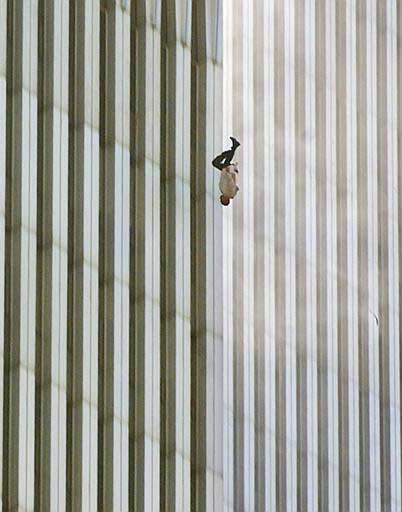
So was this:
[qimg]http://tonyrogers.com/images/wtc/wtc_jump_01_large.jpg[/qimg]
And this was infinitely more lethal.
Waterboarding will prevent more of this.
Sometimes you have to choose the lesser of evils.
