Effectiveness of Torture

BeACH, the whole point of waterboarding is to cause the victim to think they are going die.

 
I like that you answered my hypotheticals.

I've nothing to hide. And I think I proved my point about you, because you haven't addressed my hypothetical even after I answered yours. :D

Now, can you tell me why you present your absurd hypothetical about torture?

I guess you haven't bothered to pay attention to anything else on this thread because I clearly spelled that out prior to your post. I suggest you go back and TRY to understand what I posted. Until such time as you do, I don't think I'll waste any more time on you. :D
 
Your attempt to paint people as having a poor moral compass based on idiotic hypothetical situations has nothing to do with the effectiveness of torture.
 
Lot's [sic] of things have been considered impossible (by the majority), yet the folks that looked at hypotheticals made them reality.
This makes no sense whatsoever.

What is a hypothetical but something to help clarify and explore.
Possibly, but yours isn't. Yours is simply an attempt to justify torture. And it works by assuming that torture is effective (that is, it asks me to assume that you will save lives by committing torture--not something it is possible to know when you are making the decision whether or not to commit torture).

I think you are just hiding because of what this limiting case might show about your moral compass.
Bull. I'm not hiding anything. I've consistently held the position that I am opposed to torture in any circumstance whatsoever.

But suppose you could? Assume that, so we can better understand your views on morality.
Again, you're asking me to cede that torture is effective in order for you to make an argument based on a hypothetical to support the position that torture is effective. You're begging the question. I will not cede it. That's the very proposition you're trying to support.


But the law doesn't very specifically define serious or prolonged.

First of all, you do realize you're trying to conduct two arguments here? In one (the one that's on-topic for this thread) you're trying to argue that torture is effective. In another, you're apparently trying to argue that some of the things that most of us consider to be torture shouldn't be considered torture because you don't think the legal definition of torture isn't clear enough.

So here, you're addressing the second argument. It's off topic, but I'll tackle it a bit.

"Prolonged" is not part of the original C.A.T. definition, but was part of the U.S.'s ratification reservations and part of the U.S. Code. It talks about the damage being prolonged. Depending on what you're arguing about (waterboarding? confining someone with an insect phobia in a box with an insect?), a strong case can be made that something like PTSD is a form of prolonged damage. In the case of the people who were beaten (including those who were killed), the case is quite obvious. Scars and death are about as "prolonged" as damage can get.

As for "severe" the U.S.'s reservations--and similar language that made it into the U.S. Code--is, I believe consistent with the C.A.T. definition. The U.S. gave specific examples of what it takes to be "severe" when talking about "mental pain". It even anticipates situations where the victim experiences no physical pain whatsoever (so this belies the attempt at redefining it offered in the memos you cited). And again, courts are comfortable addressing terms like "severe" or "reasonable" and so on. In the case of waterboarding, the US's language clearly covers that since it says that the mental pain can include pain caused by the threat of imminent death. The very point of waterboarding is to make the victim think/feel as if he is about to die.

Confining a phobic person in a box with a bug might be a bit of a grey area.
I would happily ignore that one rather iffy case if we actually prosecuted the ones that aren't even remotely grey --like waterboarding people over and over or the beatings, the sex stuff, the hanging from the wrists and the cases where the victim was tortured to death.
 
I've nothing to hide. And I think I proved my point about you, because you haven't addressed my hypothetical even after I answered yours.
Many of us have addressed your hypotheticals over and over again. Telling you that they're impossible and that they're begging the question is indeed addressing them.
 
Many of us have addressed your hypotheticals over and over again. Telling you that they're impossible and that they're begging the question is indeed addressing them.

What Joe said.

Torture takes place in real situations, not unrealistic hypotheticals. It's effectiveness has to be measured by its performance across those situations.

Did torture of the Templars elicit useful information? Well, the treasure's still missing, so no it didn't. And the King's men got seriously medieval on their asses.

You believe the CIA and Cheney when they tell you that things which didn't happen would have happened if torture hadn't been applied. They might equally well not have happened anyway. 9/11 remains a one-off after almost eight years, which strongly suggests that the righteous response in Afghanistan did what it was meant to do.

Unless you want to claim that torture has had a 100% success rate at foiling plots for the last eight years. Which seems a little unlikely.
 
But nevertheless, he did.

My point, in any case, is that Bin Laden was well aware that the plot was to attack certain specific targets by crashing airplanes into them around a certain date. And that certain people, like Atta were involved in it. One of them being KSM. That information alone, had it fallen into the hands of US interrogators, would likely have prevented success of the plot.

It isn't lkely at all. More likely is that they'd have been fed a nonexistent plot to direct attention away from the real one. An example would be truck-bombs in underpasses in New York (all those Jews and Wall Street), Hollywood (Jews again, and cultural imperialism) and Washington. That should do it. Then you giggle like a fool when the real thing goes off.

The same is true in the KSM case. The interrogators were trying to find out what other plots were underway. The targets. The terrorist leaders of those plots. The dates at which they were supposed to occur. That information alone might be enough to have defeated those plots. Apparently, it was.

I have a stone in my garden which keeps away elephants. Apparently it works.


Not so.

Self-labeled al-qaeda members said they met with al-Zarqawi in Bagdhad PRIOR to the invasion of Iraq to plan and get funding for the chemical bomb attack in Jordan.

This may be true. What "self-labelled Al Qaeda members" said to Jordanian interrogators at a time that Jordan's close ally and (dare I say it?) patron the US was desperate for a link between Zarqawi (a Jordanian street-fighter unimpressed by any playboy terrorist) and the playboy terrorist's Al Qaeda is not evidence. Jordan is still a Kingdom, remember; they get medieval on you over there.

al-Zarqawi had a training camp in Afghanistan before he came to
Iraq (which happened after our invasion of Afghanistan).

Lots of people had training camps in Afghanistan under the Taliban. That was the problem. It doesn't make them all associates. Zarqawi and bin Laden cannot be more unlike.

I don't think you can convince me that he was allowed to operate that camp in Afghanistan without the approval and cooperation of the Taliban AND al-Qaeda.

The Taliban were not subservient to Al Qaeda. Al Qaeda was useful to them (mostly as a conduit for Saudi money and for their suicide brigades) but that's all. There were Islamists of every stripe from all over.

Al Qaeda is not the monster you imagine it to be. It just happens to be the one that came home to you. Unsurprisingly it came to you courtesy of an entitled playboy.

Bush and bin Laden have quite a bit in common.

Those two groups were joined at the hips ... literally ... with the children of bin Laden and the head of the Taliban even getting married. And besides, you yourself said that al-Qaeda was loosely structured and a franchise. :D

That's not "joined at the hips", that's bin Laden as supplicant. And what the last point is supposed to mean I can't fathom.

The Taliban was a creation of Pakistan from the mujahadeen detritus left behind when the Russians pulled out and the US lost interest. Al Qaeda is a late arrival.

I could go on, but the fact is that you haven't got a clue about Afghanistan or Al Qaeda or Zarqawi or Jordan or anything you're talking about.

But this case was tried in a Jordanian court, with witness after witness testifying, with the jury being shown the vehicles, chemicals and explosives the dozen terrorists brought into the country, with the terrorists admitting on video and in the court room to many details of the plot, including it's ultimate purpose, and with the jury convicting the terrorists, including al-Zarqawi. Funny how your side simply dismisses any evidence that doesn't fit your hate-Bush world view. :rolleyes:

I'm not at all surprised that you suck this up becaue it does fit your world-view, which for you is apparently enough. That and a source of authority, such as a Jordanian court.

I don't have a world view. Imagine that, eh? A disinterested observer with a functioning intellect and time on his hands. Don't try to slander me as biased. I distrust everything, not just circuses in Jordanian courts.

Ease of belief isn't my problem.
 
Quote:
What is a hypothetical but something to help clarify and explore.

Possibly, but yours isn't. Yours is simply an attempt to justify torture.

You can regurgitate that as much as you want, Joe. You are correct in only a very limited sense. Let me explain.

Any rational reader can see that I've been attempting to understand the basis for your definition of torture as compared to the basis for mine. That's because the definition would obviously affect whether we even need to assess the effectiveness of waterboarding an evil person. If waterboarding as used by the CIA is not REALLY torture under current law, then I suppose it's perfectly ok if you and the others continue to ignore what the CIA said with regard to waterboarding's effectiveness. But then it's also perfectly ok if the CIA continues waterboarding very evil terrorists now and then.

I think I've already won this portion of the argument since I've already established that the definition of the phrases "severe" and "prolonged" in the definition of torture aren't written on any tablet or even in any convention or law signed or passed by the US. Thus, interpretation plays an important role in the law and allows wide latitude as to what acts actually do constitute torture. We've seen that latitude at work over the last few decades.

But let's assume for the sake of argument (a hypothetical, if you please) that waterboarding is torture. Even then, I think the CAT and your use of it in setting US policy is fatally flawed. This is where my hypothetical questions concerning morality enter the picture. Since the abhorrence of torture ultimately rests on a sense of morality, understanding your views on morality, compared to mine, is essential to understanding our differing OPINIONS about what US policy should be vis a vis torture.

Personally, I think your (and the CAT's authors') definition and treatment of torture rests on a belief in the moral equivalence between inflicting pain and murder. For that reason, the CAT authors stated that there can be no mitigating circumstances for *torture* (a sentiment that you have repeated ad infinitum). Like you, they must believe that inflicting temporary pain on one person is morally equivalent to allowing a mass murder of immense proportions to take place that one could potentially have stopped by just inflicting temporary pain and discomfort. I think your refusal to answer my hypothetical was an attempt to avoid confirming that in black and white.

I, on the other hand, do not believe in moral equivalence. It's tricky, but I think there can be morally valid justifications for acts that are still to some degree immoral themselves, as long as they serve a greater moral good. Shouldn't one of our purpose here be to increase the overall moral goodness of the universe? Make it a better place? If allowing a mass murder that one could stop is actually much, much worse, morally, than inflicting temporary pain on one person, then the overall moral goodness of the universe will decrease if we follow your and Obama's approach to fighting terror and as a result there are more successful mass casualty attacks.

For this reason, it seems to me (and many others) that laws against torture should take into account the circumstances of the world today ... specifically, the efforts by terrorist groups (for whom deterrence is obviously ineffective) to make WMD-scale attacks on innocent populations, potentially killing millions at a time. That fact could lead to situations where inflicting some temporary pain or discomfort to one very bad person might save large numbers of human lives from horrible deaths.

Which explains why I'm trying to assess the degree to which you believe in moral equivalence. :D

I'm not hiding anything. I've consistently held the position that I am opposed to torture in any circumstance whatsoever.

Then even without specifically answering my hypothetical question you've answered it. You believe in absolute moral equivalence.

If inflicting temporary pain on one person could with 100 percent certainty prevent the otherwise certain destruction of the universe (all I've described is a circumstance and you did say "ANY circumstance WHATSOEVER"), you wouldn't do it. Personally, I think that's insane.

"Prolonged" is not part of the original C.A.T. definition, but was part of the U.S.'s ratification reservations and part of the U.S. Code. It talks about the damage being prolonged.

Nevertheless, "prolonged" isn't defined in US law. And I suppose one could argue that the CAT means that even a nanosecond of severe (whatever that is) pain qualifies as *torture*. Again, I think that's insane.

In the case of the people who were beaten (including those who were killed), the case is quite obvious. Scars and death are about as "prolonged" as damage can get.

But no one is arguing about that case, are they? :D

The U.S. gave specific examples of what it takes to be "severe" when talking about "mental pain".

And yet there is obviously still much disagreement. Obviously whatever language they used is subject to great interpretation. Why else did the 2004 AG memo need to go on and on and on in the "mental" section of the memo and end up saying very little that was was concrete or definitive?

And again, courts are comfortable addressing terms like "severe" or "reasonable" and so on.

Again, all they are doing is interpreting. That can change from one court to the next. After the next big terrorist attack, I bet the courts look at things a little different than now. :D

In the case of waterboarding, the US's language clearly covers that since it says that the mental pain can include pain caused by the threat of imminent death.

There is no threat of imminent death from waterboarding as used by the CIA. You, me and even terrorists worldwide must have heard that waterboarding didn't harm any of those it was used on, certainly not under the guidelines the CIA imposed on itself in its use. We've waterboarded thousands of our own soldiers. Journalists are volunteering to be waterboarded. Obviously, there is no threat of imminent death. So now it seems you are defining torture as being subjected to any irrational fear that a person has? :rolleyes:

Confining a phobic person in a box with a bug might be a bit of a grey area.

Not if the above is true. The likelihood of a phobic person dying from fright from a bug is just as high as a person dying while being waterboarded by the CIA under the guidelines it set. At least be consistent in your views. But you can't do that because then you know that most Americans would really decide you folks are nuts if you start insisting that putting a caterpillar in a cell with an evil mass murdering terrorist is torture. :D
 
It is very, very unpleasant.

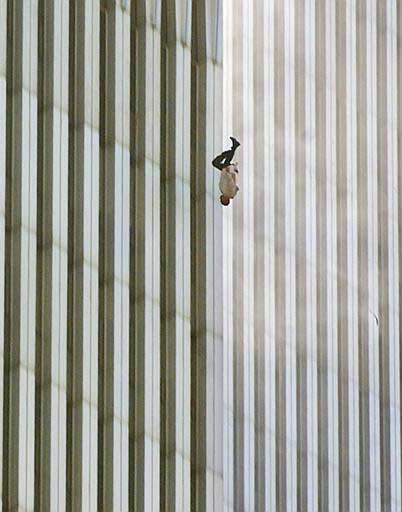
So was this:

wtc_jump_01_large.jpg


And this was infinitely more lethal.

Waterboarding will prevent more of this.

Sometimes you have to choose the lesser of evils.
 
I could go on, but the fact is that you haven't got a clue about Afghanistan or Al Qaeda or Zarqawi or Jordan or anything you're talking about.

Actually, that's my opinion of you.

So I don't intend to waste any more time discussing this with you.

I think I've said what needed to be said on this thread.

Readers can make up their own minds based on that.
 
And this was infinitely more lethal.

Waterboarding will prevent more of this.

Sometimes you have to choose the lesser of evils.

How will water-boarding prevent more of that? Also, there is no need to choose to torture people, NONE at all. No need for the "lesser of evils" here. Try again.

Now, about that evidence that torture actually is effective and reliable. Have anything more than opinions?
 
Shock. Hate. Intolerance. Terror.

It spells out the essence of conservative arguments.
 
The hypothetical of saving millions by torturing one evil person is just another fear-mongering tactic. Do conservatives ever get tired of dishing out fear?
 
I see you're continuing the off topic discussion of what constitutes torture rather than staying focused on the question of the effectiveness of torture.

I think I've already won this portion of the argument since I've already established that the definition of the phrases "severe" and "prolonged" in the definition of torture aren't written on any tablet or even in any convention or law signed or passed by the US.
Nonsense. The US Code says:
(2) “severe mental pain or suffering” means the prolonged mental harm caused by or resulting from—
(A) the intentional infliction or threatened infliction of severe physical pain or suffering;
(B) the administration or application, or threatened administration or application, of mind-altering substances or other procedures calculated to disrupt profoundly the senses or the personality;
(C) the threat of imminent death; or
(D) the threat that another person will imminently be subjected to death, severe physical pain or suffering, or the administration or application of mind-altering substances or other procedures calculated to disrupt profoundly the senses or personality;

This language is very similar to the language of the U.S.'s ratification reservations to the C.A.T.

So saying that the term "severe mental pain" is not defined is a lie.

Also, as I've pointed out repeatedly, the courts don't shy away from terms that involve judgement and degree like "severe" and "reasonable" and "appropriate".

Thus, interpretation plays an important role in the law and allows wide latitude as to what acts actually do constitute torture. We've seen that latitude at work over the last few decades.
I agree interpretation plays a role, but I disagree that there's such "wide latitude" that waterboarding which relies on making the victim think he is about to die can possibly be interpreted not to be the use of "threat of imminent death".

But let's assume for the sake of argument (a hypothetical, if you please) that waterboarding is torture. Even then, I think the CAT and your use of it in setting US policy is fatally flawed.
You're really all over the place with this, aren't you. So now you're leaving the question of the definition of torture and the effectiveness of torture and want to discuss the approach that you think the C.A.T. is bad law and it's bad policy to obey it. Fine.

The problem is that the Bush administration did not renounce the C.A.T. Instead they tried to spin the definitions (in contradiction to the law) and claim that we are not committing torture. (In other words, Dubya tried to maintain the illusion that if an agent of the U.S. government committed torture, we would still abide by our obligations under the C.A.T. and prosecute that person for his crimes.)

I disagree that it's bad law or a flawed policy for the reasons I've given repeatedly in these discussions. Primarily, if you allow exceptions for cases when you think you'll get valid intel, you have effectively removed the ban on torture. You can't make a separate law for "them" and "us". If you want us to rely on the judgement of our people, then you have to abide by the judgement of others, and pretty much we're just allowing torture.

The likelihood of a phobic person dying from fright from a bug is just as high as a person dying while being waterboarded by the CIA under the guidelines it set.
The likelihood of dying is not a requirement for something to be torture. It is the intentional infliction of severe mental pain, in this case. Can you find experts to testify that confining a person with a bad insect phobia in a box with an insect is NOT severe mental pain? I suspect if this case ever went to court, it would come down to a battle of experts trying to answer that question. (That's one way courts deal with these phrases that are subject to interpretation.)

Again, the whole point of waterboarding is to make the person think he is about to die. It is "the threat of imminent death". It is similar to the example of hauling a prisoner out of his cell, blindfolding him in front of a firing squad and shooting blanks. There is little to no danger of actually killing the guy, but this is nonetheless torture in that it is the threat of imminent death. It's illegal.
 
Shock. Hate. Intolerance. Terror.

It spells out the essence of conservative arguments.


As a conservative who doesn't believe in doing any of those things, I take offense at your broad brush stroking here. It actually strikes me as rhetoric, based in it's own hate and intolerance of conservatives. Is it really necessary to go this low? How is this anything more than a cheap shot? No substance, just throwing mud.

The hypothetical of saving millions by torturing one evil person is just another fear-mongering tactic. Do conservatives ever get tired of dishing out fear?


With all due respect, I find this also to be rhetoric. I wonder if people who hate the right will ever get tired of painting the right in the most evil, irresponsible, hateful and deceitful ways possible. Don't you realize that what you said is really the same as what you accuse the right of doing? You are accusing them of fear mongering, while making them out to be dishonest, manipulative and deceitful. In effect, also doing your own fear mongering, of them.

You have zero tolerance for conservatives, clearly.

I'm trying to find common ground with people here. But with some of you, I can't help but feel I'll never find it. You are way too certain in your assessment of what all conservatives are. Your opinions fly in the face of my own personal realty, consistently. And it bothers me.
 
Last edited:
Ok, I should've used the word "torture advocates" instead of "conservatives." Sorry about that, Whippy.
 
Whiplash, your point is well taken. There are conservatives who find torture generally, and waterboarding specifically, to be repugnant.

I do wonder, not specifically addressing you, are there any liberal advocates of torture? I'm sure there are. But such advocates do seem to identify as conservatives.
 
I've made fun of Whiplash in the past, because he seems to be so easily offended and outraged at (usually) nothing; but I have to say, in this case, I can't disagree with him. He's completely unlike BeAChooser and his pro-torture ilk, and in his place I would also take umbrage at being lumped long with him.

Oh yeah, can I get the million dollar now? :D
 
So was this:

[qimg]http://tonyrogers.com/images/wtc/wtc_jump_01_large.jpg[/qimg]

And this was infinitely more lethal.

Waterboarding will prevent more of this.

Sometimes you have to choose the lesser of evils.

Bull flops. Torture will convince more people that we had it coming because we are evil, arrogant and petty.

Torture makes this MORE likely, not less.

Torture does not yield actionable intel of any value.

Grow up.
 

Back
Top Bottom