East Indies Devastated By Quake, Tsunamis

varwoche said:
As I understand (based mainly on "Waves and Beaches" by Bascom) most tsunamis come in the form of a tidal surge, versus a breaking wave (again, depending on local topography). Wave length and speed are what distinguishes a tsunami from a wind wave. Take away the length and you'd have a big, fast wave that crashes violently on the beach without inundating land.

That's a very good point. Tsunami's will still mimic a breaking wave, at least a first, its the massive surge afterwards that causes the damage. The "wall of water" analogy is actually fairly accurate.

This is why I emphasize the importance of building some sort of sea wall before beach communities, it acts of brake of sorts to slow the initial surge. The low lying areas will still flood, but there will be less of an undertow when the waters recede, as well as less infrastructure damage.
 
hammegk said:
Y'all want to get nervous??

http://www.cdnn.info/article/tsunami/tsunami.html

I've read predictions about this volcano&slump to be 1000' waves breaking on parts of US east coast. Note that no prior high-magnitude earthquake would be neccesary, or even sufficient, for this one, nor for massive turbidite slumps elsewhere into deep water, nor for a major asteroid deep-water impact.

Yeech!

1000 foot waves, huh? Even though the highest waves on record don't even breach two hundred? I call bullsh!t

14. What is a mega-tsunami and can it happen today?

The following is a position paper that was issued by the Tsunami Society concerning the occurrence of Mega-Tsunamis:

The mission of the Tsunami Society includes "the dissemination of knowledge about tsunamis to scientists, officials, and the public". We have established a committee of private, university, and government scientists to accomplish part of this goal by correcting misleading or invalid information released to public about this hazard. We can supply both valid, correct and important information and advice to the public, and the names of reputable scientists active in the field of tsunami, who can provide such information.

Most recently, the Discovery Channel has replayed a program alleging potential destruction of coastal areas of the Atlantic by tsunami waves which might be generated in the near future by a volcanic collapse in the Canary Islands. Other reports have involved a smaller but similar catastrophe from Kilauea volcano on the island of Hawai`i. They like to call these occurences "mega tsunamis". We would like to halt the scaremongering from these unfounded reports. We wish to provide the media with factual information so that the public can be properly informed about actual hazards of tsunamis and their mitigation.

Here are a set of facts, agreed on by committee members, about the claims in these reports:

- While the active volcano of Cumbre Vieja on Las Palma is expected to erupt again, it will not send a large part of the island into the ocean, though small landslides may occur. The Discovery program does not bring out in the interviews that such volcanic collapses are extremely rare events, separated in geologic time by thousands or even millions of years.

- No such event - a mega tsunami - has occurred in either the Atlantic or Pacific oceans in recorded history. NONE.

- The colossal collapses of Krakatau or Santorin (the two most similar known happenings) generated catastrophic waves in the immediate area but hazardous waves did not propagate to distant shores. Carefully performed numerical and experimental model experiments on such events and of the postulated Las Palma event verify that the relatively short waves from these small, though intense, occurrences do not travel as do tsunami waves from a major earthquake.

- The U.S. volcano observatory, situated on Kilauea, near the current eruption, states that there is no likelihood of that part of the island breaking off into the ocean.

- These considerations have been published in journals and discussed at conferences sponsored by the Tsunami Society.

 
Mr Manifesto said:
1000 foot waves, huh? Even though the highest waves on record don't even breach two hundred? I call bullsh!t
Well, one requirement of a 1000ft wave would be an ocean depth of about 2000ft right outside the coast. When the depth falls to about twice the hight of a wave approaching land, it will break and start dissipating its energy. Of course, a 1000ft wave that starts to break a mile from the shore will still go far inland..

Hans
 
Thank Ed no 2000' water depths exist anywhere near the East Coast.

Now, please assure me that Chicxulub Crater, Yellowstone Caldera, and the Tunguska event are also bs, and I'll be grateful.
 
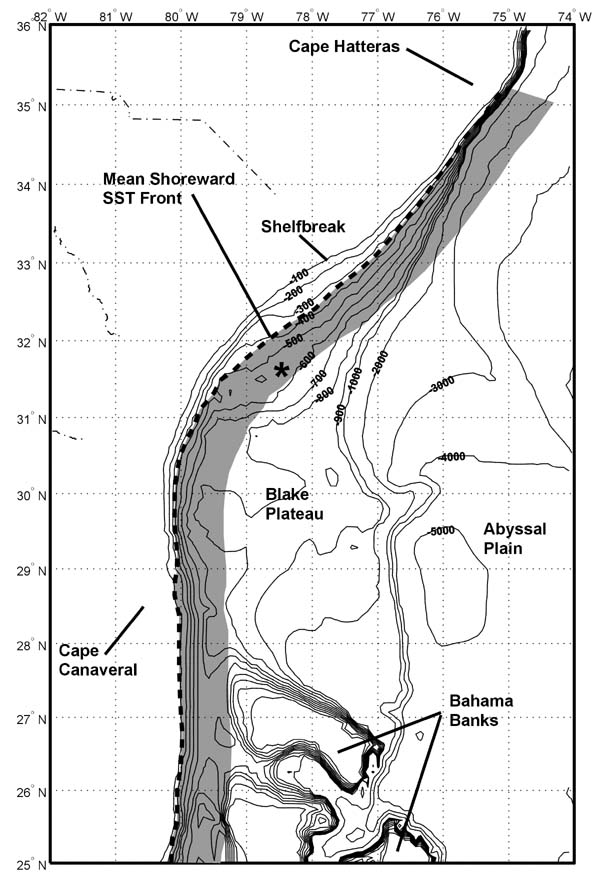
no 2000' drop off east coast?

(being an old salt in my youth, sailing from miami to the bahamas) ... there sure is:

bump_map_600.jpg


that is cape hataras, south carolina, just for an example.

there is plenty of stuff to be scared of, what about the lake toba supervolcano, eruption every 70,000 years, last eruption 74,000 years ago, killed off 30% of life on the planet and caused "nuclear winter" type conditions. it's volcanic output was 3000 times what Mt. St. Helens put out.

but scaring people about such events is just the flip-side of a "woo woo". a way to get people to run out and buy useless books and listen to half-baked scientific theories.
 

Back
Top Bottom