More than with, say, symmetric/central difference with a "similar" window ?Savitzky-Golay differentiation tends to underestimate acceleration near the beginning of a period of rapid acceleration, especially with the wide windows needed here to deal with noise.

You are using an out of date browser. It may not display this or other websites correctly.
You should upgrade or use an alternative browser.
You should upgrade or use an alternative browser.
Merged Discussion of femr's video data analysis
- Thread starter tfk
- Start date
I suggest that "realistic" is not going in the right direction.One has to experiment in order to move toward the most realistic solutions.
"useful" would be my preference. Trend, to get as much useful information out from beneath the noise (which we must not forget is actually lower per sample than any other dataset, it's simply that it has a higher samplig frequency that causes issues when generating derivatives...as over narrow window methods massively amplify relatively low noise)
Early motion has been clearly stated many times, and, yes, it refers to behaviour up to minutes prior to release.I'm not sure, as it's hard to follow his posts because he just says "early movement" without restating what he refers to. I know he's done in past but I don't remember exactly and I'm lazy to search. My recollection is that he refers to movement well before the EPH fall, maybe minutes. I haven't looked that early yet.
I mean that the fall (not the failure - my mistake) of the east penthouse (EPH) might have caused enough ground shaking as to shake the camera and cause apparent motion. Actually the whole internal process that was happening inside starting with that failure might.
If so, you should be able to identify it on this graph...http://femr2.ucoz.com/_ph/7/904064319.png
Didn't femr2 track foreground points as well to account for camera motion?
Correct. Dan Rather static trace data is also on my downloads page.
Of course not ALL camera motion can be extracted...sa static point traces themselves contain some noise. However, that noise is significantly lower than that for, say, the NW corner, for various reasons, and will result in a nett and significant reduction in camera motion effects....most definitely a whole lot better than not removing the camera motion.Yes, but I'm not too sure that that can successfully filter out camera shake, for various reasons, especially when we're dealing with subtle features.
cam#3...splendid. I've been waiting for about 2 years for someone to jump in there.At the risk of introducing more confusion, here's an illustrative graph showing the velocity and acceleration trends from Cam #3.
I may generate the appropriate graphs from my cam#3 dataset (which I don't think has actually been released...through lack of interest), and post the results.
Of course, perspective has a much greater effect upon derivative data, so disclaimers ahoy all over the place

(As montioned many moons ago, your acceleration profile is pretty comparable to that using Dan Rather, which is always a good sign)

Which doesn't qualify it as "good enough".The trace data really is as good as it's possible to extract from the video.
You might have a point if you had stated your method (which you haven't) and I claimed that it can't be right (which I obviously haven't).Yes, the point is that you used symmetric difference to generate derivatives. SG generated derivatives differentiate the individual polynomial fits. The results differ, and conform to different "rules".
I knew when I found QtiPlot and did my analysis, and openly acknowledge hereby, that taking the derivative by central differences after (or before) SG has the potential of giving different results to those of taking the derivatives using SG.
Sorry?????And both are speaking of "inviolate rules" that don't apply to SG derivatives.
The definition of derivative is inviolate, and does not include smoothing. You are doing smoothing+derivative, not derivative. The result is not that of a derivative.
It's not a question of method. If you call derivative the result of smoothing + derivative, then you're not doing a derivative, even if you call it so. SG is not a method for differentiating. Central differencing gives an as good enough approximation as to provide a curve which is visually consistent with the mathematical definition.It would appear you, like tfk, still do not quite "get" the difference the different derivative methods make...ho hum.
Was the static point far from the camera? Perspective can play a role in smoothing camera shake.Of course not ALL camera motion can be extracted...sa static point traces themselves contain some noise. However, that noise is significantly lower than that for, say, the NW corner, for various reasons, and will result in a nett and significant reduction in camera motion effects....most definitely a whole lot better than not removing the camera motion.
Last edited:
ozeco41
Philosopher

Remember that WDC was responding to my post and totally missing the point I made. Sure my posts had a few minor bits of possible confusion BUT my purpose and focus was explicit.More than with, say, symmetric/central difference with a "similar" window ?
Both WDC and pgimeno are complaining about your methods by alleging errors. With no indication of what range of errors are significant. Nor to whom they could be significant nor the purpose those persons would have for using the data...etc etc...
...all the "is it good enough" questions without addressing "Good enough for Who?" and "For what purpose?"
Hence my posts which were setting the foundations for a discussion of said significance. We even have claims that you, femr, are wrong on 'near "G" ' which do not even address the issue that NIST and Chandler were apparently correct with their claims for similar accelerations. Sure NIST and Chandler are off topic but I have mental difficulties processing how you can be wrong on something yet NIST + Chandler are right on the same claim. With the contrast avoided because it is off topic.
The rational way through that would be if those opposing you on philosophic points about method would quantify the range of errors they are alluding to without actually saying. I happen to think that you have established at least prima facie that your methods are producing more accurate results than (say) NIST and Chandler.
Hence (again) my specific reference to your four plots of the collapse stage where four methods differ but still stay within "rapid collapse". And that was only my first step of the process of logical reasoning to narrow and nail down the implied but unstated "range of error" issue which, whilst ever it remains unstated, is the main barrier to progress of this topic from the direction I would take.
The "only read the last post" problem.Early motion has been clearly stated many times, and, yes, it refers to behaviour up to minutes prior to release....

The expression is almost self defining and has been part of the language used in this topic for a long time. We have a "forest and trees" problem - fossicking down into nit-pick detail and forgetting the context. Which is why I started to attempt to put the discussion back into an objective context. And gave up in frustration. Because WDC and pgimeno are among our clearer thinkers/better arguers and if they don't understand me then either I have a problem or they do.
) Or all of us.)Which doesn't qualify it as "good enough"....
OR "...qualify it as NOT good enough!!!!"
Otherwise SPOT ON!!! for identifying the issue.
BUT please resist the temptation to leave that key issue dragging whilst you go down side tracks...answer these?
...Good enough for who???
...Who are they???
...what is their need???
If that is too "abstract" then try stating YOUR need and compare it with femr's.
And the misfit of objectives has to be dealt with. You cannot refer to "good enough" without having some purpose in mind. BUT femr is developing rulers and measuring some features using those rulers.
"good enough" belongs in use of the measurements the rulers produce. And quite a few people want to use the data in areas which fall outside femr's scope of interest as he has said many times. So is the accuracy "good enough" for them? For their purpose?
And whatever the range of errors there may be in femr's work:
1) It is more than good enough for most of the discussion on WTC7 collapses - the example we are currently using;
2) No one has shown that NIST or Chandler (or anyone else) has produced better;
3) So it remains the default best available till someone shows that it is in error AND that the range of errors makes use of femr data unsuitable for purpose.
And you cannot get to that last stage until you/we/someone:
a) "Proves" and quantifies the range of errors; AND
b) defines some purposes for using the data where those errors are significant.
For what ?Which doesn't qualify it as "good enough".
Details for replicating the 1-pass SG derivative have been provided in full.You might have a point if you had stated your method (which you haven't)
The differences between symmetric difference and SG derivative have nothing to do with any information I may or may not provide you with. They are two different methods and generate different output data.
Potential ? The output data will be different.taking the derivative by central differences after (or before) SG has the potential of giving different results to those of taking the derivatives using SG.
Both methods provide discrete data of approximate and average derivative value over the period of the window width. They simply generate averages via different methods. They output a different average.The definition of derivative is inviolate
Symmetric difference is a smoothing method. All averaging techniques impose smoothing.and does not include smoothing
Again, all averaging techniques smooth data.You are doing smoothing+derivative, not derivative. The result is not that of a derivative.
Again, all averaging techniques smooth data...including symmetric/central difference.It's not a question of method. If you call derivative the result of smoothing + derivative, then you're not doing a derivative
SG is not a method for differentiating. Central differencing gives an as good enough approximation as to provide a curve which is visually consistent with the mathematical definition.
 I suggest you look further into both methods of providing derivative data before making such proclamations. Adopting "stuff" from tfk isn't a great idea.
Perhaps you'd like to look at the difference between SG and SD again...

You are suggesting one shows derived velocity, and the other doesn't. Neither show instantaneous velocity, but average velocity, of course. Neither show a mathematically pure derivative. Both provide a view. SG is better at cutting through noise.
Several regions were traced, at similar distance from the camera to WTC7...Was the static point far from the camera? Perspective can play a role in smoothing camera shake.

Last edited:
Indeed. Multiple years of criticism of femr2 for providing higher quality data than either, in numerical form such that anyone can apply whatever methods they please to generate their own derivatives for velocity and acceleration, yet practically zero critique for NIST whose methods were almost identical to Chandlers, who has of course been criticised.We even have claims that you, femr, are wrong on 'near "G" ' which do not even address the issue that NIST and Chandler were apparently correct with their claims for similar accelerations.
It dinny mek sense
The funny thing is that those who have generated their own velocity and acceleration profiles present data which looks a hell of a lot like mine, and so different to those from NIST and Chandler, especially acceleration.
The main difference is tracing technique. I think it has been shown that SynthEyes automated feature tracking facilities are very capable, generating sub-pixel accurate data. Both NIST and Chandler skipped over 80% of the frames and positioned markers by hand.I happen to think that you have established at least prima facie that your methods are producing more accurate results than (say) NIST and Chandler.
Pretty similar trend, regardless of method to generate, indeed.Hence (again) my specific reference to your four plots of the collapse stage where four methods differ but still stay within "rapid collapse".
Correction: I should have added "necessarily" to that sentence: 'which doesn't necessarily qualify it as "good enough"'.Which doesn't qualify it as "good enough".The trace data really is as good as it's possible to extract from the video.
I am raising objections challenging his alleged results (his interpretation of the data). What I expect is for him to address the objections. He says there is early motion minutes before release but as far as my recollection goes (I admit to my bad memory), he has not presented his case of early motion convincingly yet. I just recall the bare assertions and the graphs.Both WDC and pgimeno are complaining about your methods by alleging errors. With no indication of what range of errors are significant. Nor to whom they could be significant nor the purpose those persons would have for using the data...etc etc...
In the sentence at the beginning of my post, good enough to give credibility to his claims....all the "is it good enough" questions without addressing "Good enough for Who?" and "For what purpose?"
For the sake of comparison, we're in a similar case to that of Jones et al. claiming the iron spheres are the result of a thermite reaction with the iron oxide particles, but having enough iron oxide visible in their micrograhps as to challenge that conclusion.
For the record, I have never said that femr is wrong on 'near "G"' [sic]. I really hope you don't mean that I implied this. In other occasions you have referred to distorted versions of what I said without naming me, and since it was not what I said, I didn't feel alluded. But if I am right and you imply here that I said that, I must say that those distortions are lawyer tricks that don't seek to find the truth but to win a case, which would destroy all your credibility here, at least for me.We even have claims that you, femr, are wrong on 'near "G" ' which do not even address the issue that NIST and Chandler were apparently correct with their claims for similar accelerations.
It almost always has the form of you stating something that you say other posters have said, just like here, without naming anyone in particular, and it turns out that when you make such claims, I don't remember haven't seen that in the recent post history, even if I have said something that has some similarity. That would qualify as lying by innuendo, and it's devastating to credibility.
In this particular case, I don't remember anyone recently making the claim that femr2 is wrong on "near g acceleration". However I have said something similar recently, in post 2625, where you said: c) That there was no period of "over 'G'"? and I replied: a) and c) have a certain degree of support, in that the noise level may ruin that assessment. Which is not similar to "denying" "near g acceleration" on two acounts: first I am not denying, but implying it may be right or wrong and neither outcome can be reliably concluded, and second it doesn't apply to near g, but to over g.
I've seen a similar pattern of subtle distortions of words I've said or similar innuendo, for example, in threads related to Bazant, in which I didn't feel alluded, but now that I see a recurring pattern, I'm starting to think it's purposeful lawyertalk techniques.
And if you are resorting to such dishonest tactics in order to "win" your case, you're shredding your credibility, and even more on the account that you've criticized a similar attitude on other posters. Between straightening the record at every such innuendo and just not believing you, I'd opt for the latter, and probably other posters might do the same.
That said, your best defense would be to present an instance of a claim matching this assertion of yours: We even have claims that you, femr, are wrong on 'near "G" ' at which point I will immediately apologize.
And back to the topic, as for NIST, I don't think their margin of error really proves their acceleration profile, but that doesn't matter, as their discussion focuses on splitting the fall into stages, one of which consists of the connections breaking and giving way, and that's enough to explain the visual record. Which serves as a definition of what is "good enough" when applied to NIST's analysis.
If you mean me, not nearly. I read each and every post of the threads I follow, and take good precautions to do so, including for example scrolling up right after posting to check if I missed something that was posted while I was writing. Right now I've noticed femr2 has posted while I was writing this and will read his posts later (I need to go now).The "only read the last post" problem.
I've admitted that I seemed to remember that femr2 said the movement happed minutes before, but wasn't sure because of my memory. Which is not the same as not having read it as you imply.
femr2 has shown results and I am claiming that these results don't necessarily follow from his data.BUT please resist the temptation to leave that key issue dragging whilst you go down side tracks...answer these?
...Good enough for who???
...Who are they???
...what is their need???
So:
... good enough to prove femr2's analysis,
... "they" is femr2,
... he needs more effort in presenting his case in a way that excludes the sources of error we have identified.
Discussed above.For what ?
Not under all circumstances. Thus "potential". For this case, yes, sure.Potential ? The output data will be different.
No, I am not.You are suggesting one shows derived velocity, and the other doesn't.
I am suggesting that SG shows derived velocity of the post-smoothing data, data which you have not ever shown (in order to do so, you just would have to apply SG with the same parameters and request the smoothed data instead of its derivative), while central differencing shows derived velocity consistent with the original data, which I'm not sure if you have shown.
First, I haven't claimed a mathematically pure derivative. That is impossible, because we're talking of discrete functions, meaning functions defined only at certain points, which are by their own nature not continuous and therefore not derivable.Neither show instantaneous velocity, but average velocity, of course. Neither show a mathematically pure derivative. Both provide a view. SG is better at cutting through noise.
I claimed central differencing yields a derivative visually consistent with the mathematical definition (I was referring specifically to the interpretation of a derivative as the slope of a curve at a certain point). Visually means that the eye (or the software) interpolates points in the graphs, making a continuous function out of an otherwise discrete function, and I say that the slope of that interpolated function is consistent with what central differencing shows. Not so in the case of derivatives obtained by smoothing then taking the derivative. Just as an example, this shows an acceleration profile consistent with the slope of velocity:

(That's merely a zoomed version of the velocity and acceleration graphs I posted in message #2612.)
While this graph you have provided does not show an acceleration profile (blue line) consistent with the slope of velocity (red line):

Because you have not shown the post-SG-smoothing velocity, which is the one you're taking the derivative of.
Why do you post an image of Dan Rather? You posted a Cam #3 static point graphic. Seriously, you really have a problem communicating.Several regions were traced, at similar distance from the camera to WTC7...
[qimg]http://femr2.ucoz.com/_ph/7/759212128.png[/qimg]
Last edited:
Which are what ?I am raising objections challenging his alleged results (his interpretation of the data).
Why should I bother ? The SG acceleration trend profile graph has been "discussed" for about 2 years.What I expect is for him to address the objections.
Tracing techniques for an even longer period. Everything you need to know about the raw data has been provided many times.
I do indeed.He says there is early motion minutes before release
but as far as my recollection goes (I admit to my bad memory), he has not presented his case of early motion convincingly yet. I just recall the bare assertions and the graphs.
If you don't want to accept that the building was in motion long before release, that's entirely up to you... though quite why you want to preclude it is rather beyond me.I rekn I'm going to have to create a "blue sky" smiley you know.
Why don't you prove it's not there ?
I guess you don't have the facilities (or experience) to perform feature tracing yourself, so in that sense you are reliant upon my data, however, there's nothing stopping you using other techniques, such as static frame subtraction...assuming you have some basic video processing facilities.
Here's an idea... Make your ownIn the sentence at the beginning of my post, good enough to give credibility to his claims.

Er, no. I suggest early motion....because tracing the position of the NW corner indicates...motion. Ta-da. It's really not complicated.For the sake of comparison, we're in a similar case to that of Jones et al. claiming the iron spheres are the result of a thermite reaction with the iron oxide particles, but having enough iron oxide visible in their micrograhps as to challenge that conclusion.
Perhaps you'd like to begin critique of the NIST data ? Could you say a few words about the 1s of over-G acceleration exhibited by the NIST velocity function if derived for acceleration ? Perhaps you'd care to comment upon the NIST "32.196" ft/s^2 metric...which itself is over-G (Earth gravity in NY is 32.159 ft/2^2)I am not denying, but implying it may be right or wrong and neither outcome can be reliably concluded, and second it doesn't apply to near g, but to over g.
Perhaps you'd care to explain why, when you've clearly only just "discovered" the tools you're using you have any firm footing on which to base your opinion upon ?
Perhaps you'd care to make the leap into extracting your own position/time data, that would be cool
What makes you assume "near-G" doesn't include over-G ?That said, your best defense would be to present an instance of a claim matching this assertion of yours: We even have claims that you, femr, are wrong on 'near "G" ' at which point I will immediately apologize.
Where do they specify their margin of error ?And back to the topic, as for NIST, I don't think their margin of error really proves their acceleration profile
Of course it doesn'tbut that doesn't matter
In what way are "my assertions" significantly different ? Do you even know what assertions I've made about the acceleration behaviour ?as their discussion focuses on splitting the fall into stages, one of which consists of the connections breaking and giving way, and that's enough to explain the visual record. Which serves as a definition of what is "good enough" when applied to NIST's analysis.
Why are you suggesting the data does not show early motion when you haven't posted any views of the early motion data, nor have you generated your own ? And I doubt you've even scrubbed through the 1GB DV version to "see" any early motion eh ?femr2 has shown results and I am claiming that these results don't necessarily follow from his data.
No I don't. Several folk have now produced acceleration trend graphs, and all show the same basic information. (I suggest you have a look to see what I've actually "claimed")he needs more effort in presenting his case
Meh. What "claims" have I made ?Discussed above.
The "potential" for a discrete dataset generated via symmetric difference matching a discrete dataset generated by differentiating a series of polynomials against the same source dataset is practically zero. Perhaps you'd like to state the situation(s) where they would output the same data ?Not under all circumstances. Thus "potential". For this case, yes, sure.

That your facilities don't allow you to actually generate derivatives via differentiation of the individual polynomials (SG derivative) is no excuse for you to not understand that SG based "smoothing" and SG based "derivative" are two separate things.I am suggesting that SG shows derived velocity of the post-smoothing data
Did I smooth the raw data before applying the SG filter ?data which you have not ever shown
Ew. You clearly don't understand.(in order to do so, you just would have to apply SG with the same parameters and request the smoothed data instead of its derivative)
I know, I'm the one who just reminded you. Do you understand that each value output by the SG filter with a derivative value above zero is in fact a mathematically pure derivative value generated by mathematical differentiation of its polynomial function ? In that sense SG provides data closer to "pure". Your "issue" is that you cannot reconcile the obvious reasons why SG derivatives do not comply with your assumption that a view of velocity data must be "consistent"* with a view of acceleration data.First, I haven't claimed a mathematically pure derivative. That is impossible, because we're talking of discrete functions, meaning functions defined only at certain points, which are by their own nature not continuous and therefore not derivable.
* The problem being your interpretation of what the data shows. Each point is discrete. To try and bang on your skull... Assume an SG window width of 61 samples...Each discrete derived value shows the derivative at the centre point of a curve fitted to 1 second of the source data. As the window is shifted the curve fits are influenced by all data within the 1s period. Can you not see why derived views don't necessarily conform to your "inviolate laws" ?
You said "SG is not a method for differentiating. Central differencing gives an as good enough approximation as to provide a curve which is visually consistent with the mathematical definition.".I claimed central differencing yields a derivative visually consistent with the mathematical definition (I was referring specifically to the interpretation of a derivative as the slope of a curve at a certain point).
SG is most certainly capable of providing derivative data, and for data containing noise, arguably far superior data than that produced by SD.
That is what you have done.I say that the slope of that interpolated function is consistent with what central differencing shows. Not so in the case of derivatives obtained by smoothing then taking the derivative.
I suggest you zoom in the vertical axis of the acceleration data.Just as an example, this shows an acceleration profile consistent with the slope of velocity:
[qimg]http://www.formauri.es/personal/pgimeno/xfiles/11-s/VelocityVsAccelerationZoomed.png[/qimg]
While this graph you have provided does not show an acceleration profile (blue line) consistent with the slope of velocity (red line)
And ? (also, interpretation od graphs content comes into play of course )Are you sure about that ?Because you have not shown the post-SG-smoothing velocity, which is the one you're taking the derivative of.
Because all derivative data from me relates to the Dan Rather dataset.Why do you post an image of Dan Rather?
You have the Cam#3 data. It's hardly rocket science to check where the pixel locations are upon the video frame.
LOL. Perhaps you need to be clearer about what you ask from me. If I choose I may grace you with the honour of providing you with your wishSeriously, you really have a problem communicating.
Last edited:
ozeco41
Philosopher
Which is why I prefaced my recent remarks with this comment:Indeed. Multiple years of criticism of femr2 for providing higher quality data than either, in numerical form such that anyone can apply whatever methods they please to generate their own derivatives for velocity and acceleration, yet practically zero critique for NIST whose methods were almost identical to Chandlers, who has of course been criticised....
Put simply, at this stage, there are only two points I am seeking to bring under rational and objective focus stripped of all the personalities stuff:My question was quite explicit as to its scope. I'm trying to cut through the fog and ambiguities to see if there is strong evidence that those three aspects - early movement - a period of high acceleration and a period in excess of 'G' have been rigorously rebutted. And each of them as separate findings. My purpose being to find the status of those issues as objective fact trimmed of all the emotive "oppose femr at any cost" from multiple posters other than you and possibly WDC. Your work appears to be commendable as I said in an earlier post however all I see so far is definite statements by femr and vague disagreements by others on those three specific points.
A) The first one is "What is the status of available opinions as to three stages of WTC7 collapse?" viz:
(i) early movement i.e. movement before the "release point' when
(ii) there was a stage of rapid falling characterised by accelerations around "G" and which at its later stages involved
(iii)a period of "over 'G'".
AND
B) the second one is whether the scope/range of errors being claimed for your (femr's) work rebut any one or more of those three stages.
The overall reason is that I am attempting to set an "upper bound" as a starting point for discussion from which we can progressively test where the claimed errors - if in fact there are any - start to impact on use of the data.
Stated differently I am trying to get discussion heading towards the reality that any claim of errors in your (femr's) work must show that the error is significant in the setting of some context. Of which there are two types of context which are:
P) Use of your data by other persons to support explanations - in this case explanations of WTC7 collapse but the comment is generically valid. Those "other persons" will need to judge for themselves if they choose to employ your data - which requires that they form an opinion as to whether the accuracy is "good enough" for their purpose - which, in turn., means they must be clear as to their purpose; OR
Q) Whether your analysis supports your own claims which is the pgimeno position of "I'm not convinced that his arguments support his claims".
The latter is valid for pgimeno and anyone else who wants to hold that view. BUT is is not the issue I have raised repeatedly in this thread. Nor am I interested in discussing it - until false conclusions drawn from that perspective start to cross over into the area of objective fact that I am interested in discussing.
So, again trying to put it in simple terms not capable of misinterpretation, there are two issues conflated:
T) Is femr's work accurate enough to use - which depends on who wants to use it and the accuracy required by their purpose in using it; AND
U) Are femrs explantions good enough to persuade certain members - pginmeno already identified and probably there are others.
Put very simply if your data is good enough - point "T)" - then I'm not much interested in whether or not some people don't believe your explanations - point "U)".
Except from a "meteorological perspective"....It dinny mek sense
Yes - I had noticed. Funny that NIST can be right and Chandler wrong when their findings are near identical. And your methods are implicitly more accurate even before the disputed mathematical methods come into play.. So if the disputed mathematical methods are introducing errors the will have to be b..... big errors before they make your work less accurate than NIST/Chandler et al....The funny thing is that those who have generated their own velocity and acceleration profiles present data which looks a hell of a lot like mine, and so different to those from NIST and Chandler, especially acceleration...
Which to me says "prima facie" femr's method is more accurate. And anyone claiming he is not more accurate had better produce some numbers or focussed logical claims which at least identify the ball park of errors.The main difference is tracing technique. I think it has been shown that SynthEyes automated feature tracking facilities are very capable, generating sub-pixel accurate data. Both NIST and Chandler skipped over 80% of the frames and positioned markers by hand...
Which is where I have been trying to lead some discussion....but.....
Which says "it cannot be 'all that far out'" and imposes an obligation on those offering criticisms to drop the unquantified claims and innuendo/implication of gross errors and put some numbers on it or at least some persuasive logic....Pretty similar trend, regardless of method to generate, indeed.
ozeco41
Philosopher
Did you challenge his results OR his explanation of how he achieved them? Do you distinguish those two separable aspects or do you conflate them?I am raising objections challenging his alleged results (his interpretation of the data). What I expect is for him to address the objections....
The first is a matter of objective fact capable of being verified by various approaches to the accuracy required by various uses and users of the data.
I note your use of an analogy later in your post. So my analogy is that in explaining WTC1 and WTC2 collapses I never rely on NIST arguments. (The reasons not relevant here) I form my own explanation based on available evidence. By analogy why don't you form your own opinion as to femr's accuracy? For example if you were to form such an opinion you would have to consider whether femr's methods are or are not inherently more accurate than those used by NIST or Chandler. Deciding that NIST and Chandler's claims do not exist and femr has to stand "in vacuo" is not a legitimate position for a reasoned explanation..
The building fell down. There was a visible release point. There must have been "early movement" for some time before "release". I am only aware of one partly plausible collapse explanation that would not involve "early motion". That explanation would fail for other reasons not remotely related to femr's measurements. So where do you stand on early motion? Are you saying that there can not have been early motion because you don't accept femr's explanation? Back to my analogy I am convinced of early motion and have not the slightest need to rely on femr's measurements for "proof". What is your position - the issue of fact "was there early motion" can be addressed easily without reliance on femr. The involvement of femr's data can therefore be limited to confirming magnitudes and timings of early motion - not the fact that there was early motion....He says there is early motion minutes before release but as far as my recollection goes (I admit to my bad memory), he has not presented his case of early motion convincingly yet. I just recall the bare assertions and the graphs...
Your antagonism does you no credit. I never deliberately set out to insult or demean. I usually ignore insults and snide comments directed at me and I will not break that rule to counter the multiple slights in the remainder of your post....For the record, I have never said that femr is wrong on 'near "G"' [sic]. I really hope you don't mean that I implied this. In other occasions you have referred to distorted versions of what I said without naming me, and since it was not what I said, I didn't feel alluded. But if I am right and you imply here that I said that, I must say that those distortions are lawyer tricks that don't seek to find the truth but to win a case, which would destroy all your credibility here, at least for me....
I have commended your efforts several times in recent posts. Your responding posts ignore or overlook the obvious key points of my posts to focus on minor issues.
Why not try responding to my posts in the spirit they are made - as claims which are based on objective facts and (hopefully) sound reasoning. Alternatively make no response - I'll soon get tired of talking to myself.
Last edited:
As it seems others, including pgimeno, cannot remember/have not bothered to look/are clouded by their own or others perception of what they think has been "claimed"...I'll repeat again...starting with...Put simply, at this stage, there are only two points I am seeking to bring under rational and objective focus stripped of all the personalities stuff
The NIST moire method identified the following motion prior to release...(i) early movement i.e. movement before the "release point'

Note the displacement scale...in inches.
Note the graph includes motion prior to EPH descent, which itself is ~7s prior to the NIST T0 (release).
I have also traced this motion...
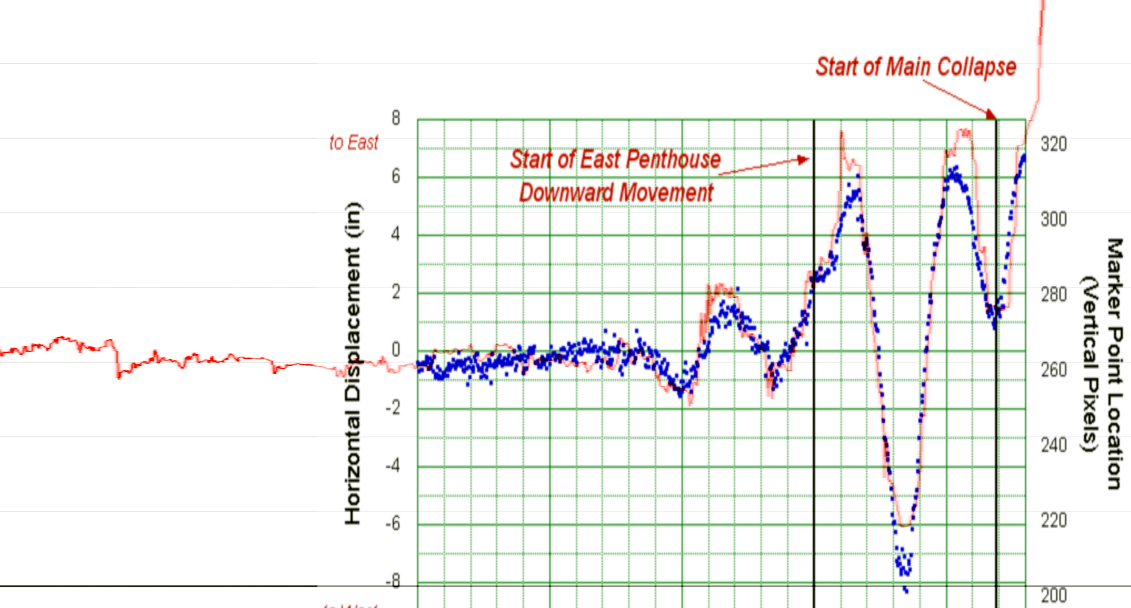
(red overlay is my data)
My data is not taken from the exact same position as NIST, and via a completely different method. But it is clear that:
a) My methods are capable of detecting a similar fidelity of motion (if not greater)
b) The noise level in my data is lower.
NIST also performed their moire method upon a much longer period...

...which clearly indicates change in horizontal position, however, they did not account for camera motion at all.
I have also performed tracing over a longer period...

I have taken account of camera motion...


...which is subtracted from the raw feature trace data data.
Using the NW corner as a trace location has the benefit of providing 2 dimensional data...
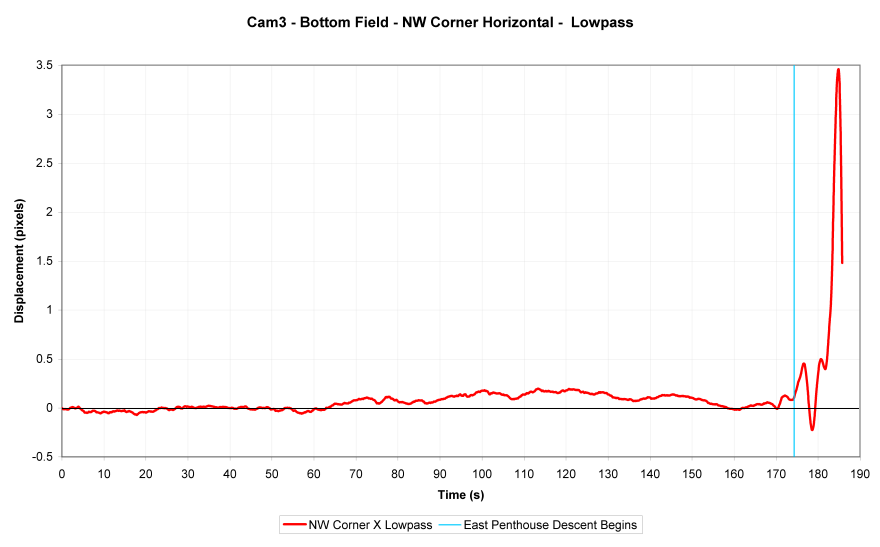
...zoomed...
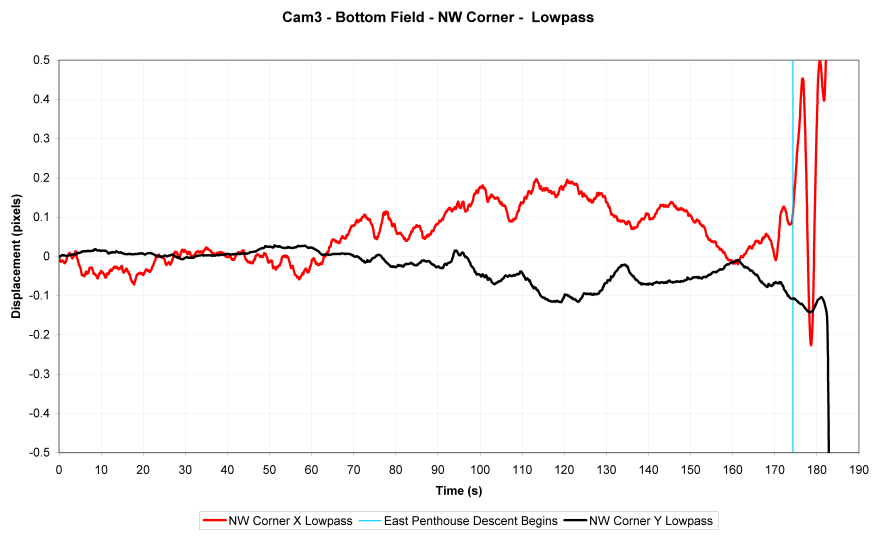
...and the previous couple of minutes...

I base my opinion that early motion ocurred on many factors, including:
a) The behaviour of the apparent motion, especially points of inflexion.
b) Correlation between different tracing methods at different locations.
c) Visual inspection of the 1Gb DV version of the video
d) The bleedin' motion clearly present
I challenge his explanation of how he achieved his results.Did you challenge his results OR his explanation of how he achieved them? Do you distinguish those two separable aspects or do you conflate them?
I do not say his results are false; merely unproven.
The EPH fall is early motion, with early motion defined as "movement some [unspecified] time before release of the façade". It happened. Therefore there was early motion, by that definition. And that has been well known and thoroughly discussed for ages.The building fell down. There was a visible release point. There must have been "early movement" for some time before "release". I am only aware of one partly plausible collapse explanation that would not involve "early motion". That explanation would fail for other reasons not remotely related to femr's measurements. So where do you stand on early motion?
Whether more early motion can be visible in the NW corner is what I am challenging at this stage.
You're failing at a very basic logic premise.Are you saying that there can not have been early motion because you don't accept femr's explanation?
We're in a very simple logic case in essence: "femr2 methods imply early motion".
I am claiming femr2 methods are wrong.
When the premise is false, we don't know anything about the conclusion. It doesn't mean the conclusion is true. But it doesn't mean it's false either. It is merely unproven.
Nor did I say it was deliberate. But given the absence of an explanation or a quotation, sorry but your credibility has plummeted for me. Your comment as perceived was a snide comment (as was the "only read the last post" comment) and you have made no effort to clarify it. In the lack of a clarification I have to assume you have double standards, in that you can bite but not be bitten. You criticize double standards and snide comments in others and ask for responses to your criticism but won't respond to similar criticism made against you. Not to mention that I've been addressing your questions as well.Your antagonism does you no credit. I never deliberately set out to insult or demean. I usually ignore insults and snide comments directed at me and I will not break that rule to counter the multiple slights in the remainder of your post.
tsig
a carbon based life-form

- Joined
- Nov 25, 2005
- Messages
- 39,049
I challenge his explanation of how he achieved his results.
I do not say his results are false; merely unproven.
The EPH fall is early motion, with early motion defined as "movement some [unspecified] time before release of the façade". It happened. Therefore there was early motion, by that definition. And that has been well known and thoroughly discussed for ages.
Whether more early motion can be visible in the NW corner is what I am challenging at this stage.
You're failing at a very basic logic premise.
We're in a very simple logic case in essence: "femr2 methods imply early motion".
I am claiming femr2 methods are wrong.
When the premise is false, we don't know anything about the conclusion. It doesn't mean the conclusion is true. But it doesn't mean it's false either. It is merely unproven.
Nor did I say it was deliberate. But given the absence of an explanation or a quotation, sorry but your credibility has plummeted for me. Your comment as perceived was a snide comment (as was the "only read the last post" comment) and you have made no effort to clarify it. In the lack of a clarification I have to assume you have double standards, in that you can bite but not be bitten. You criticize double standards and snide comments in others and ask for responses to your criticism but won't respond to similar criticism made against you. Not to mention that I've been addressing your questions as well.
Posting disparaging remarks about forum members on truther forums causes loss of credibility also.
(oz on 911forums)
You are aware that any doubts you have about methods of generating derivatives have absolutely zero to do with identification of early motion, yes ?I am claiming femr2 methods are wrong.
All early motion assertions are based upon displacement data only, not velocity or acceleration derivatives.
So, are you in doubt about the ability of SynthEyes to detect sub-pixel scale positional changes in traced feature region ?
If so, perhaps you could say a few words about its ability to, at least, match the NIST moire method in detection of subtle motion (though of course SynthEyes has many advantages over that very limited method).
Do you reject the results of the NIST moire method ?
Here are a couple of visual examples of SynthEyes performance in real-world situations...
http://femr2.ucoz.com/szm.gif
...a single trace location on the antenna of WTC1, which is a zoomed view of...
http://femr2.ucoz.com/_ph/6/2/814421844.png
...which is a section of...
http://femr2.ucoz.com/_ph/6/819896425.png
Or perhaps a closer view with 9 separate traces displayed, showing the extreme similarity between trace region motion from slightly different initial region positions...
http://femr2.ucoz.com/_ph/6/515553996.gif
Or perhaps a view of the West edge of WTC7, split by RGB colour plane...
http://femr2.ucoz.com/wsvsv.gif
Or...
None of this information is "new", and has been presented before.
There is an abundent wealth of additional information within this forum about the performance and ability of SynthEyes to detect and record extremely subtle positional change (which also includes figure of merit (FOM) data indicating the "closeness of match" for each sampled position.
Edited by LashL:
Changed the images to regular links as they were causing problems with some members' browsers.
Last edited by a moderator:
Yes. But when such identification is made by the same person who makes such blatant mistakes, I have to doubt the identification, and the standard for proof is raised.You are aware that any doubts you have about methods of generating derivatives have absolutely zero to do with identification of early motion, yes ?
No.So, are you in doubt about the ability of SynthEyes to detect sub-pixel scale positional changes in traced feature region ?