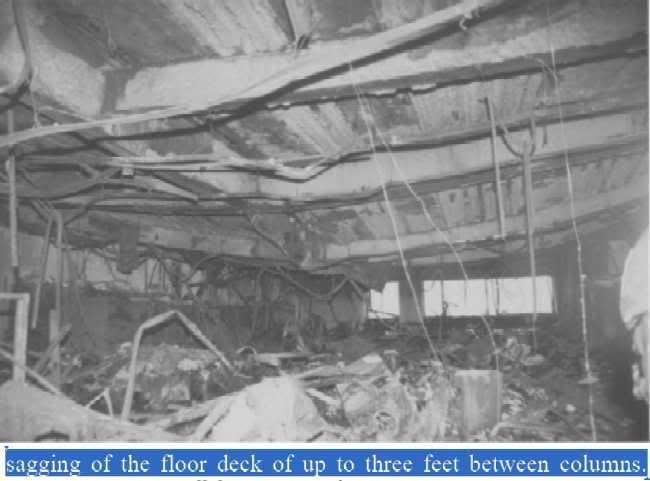
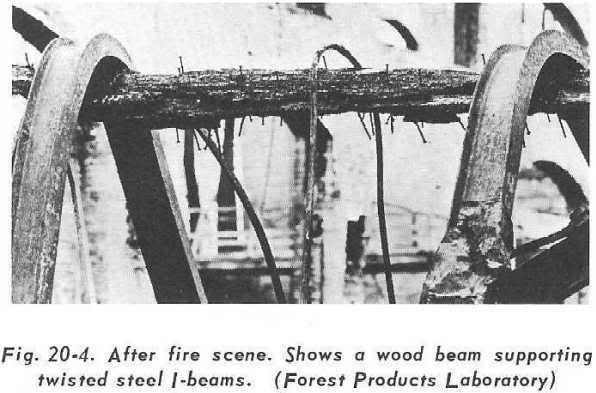
...The truss sag thing does not ring true to me... Is it supposed to have been going on all around the core almost uniformly? I simply can't see how that was working over the foot print... color me dumb. Or did it only happen in a few places and ????...
Take care that you are not creating a strawman for yourself. I mean the assumption that joist/truss sag had to be all round the tower. Actually it only needed to start in one place and the rest would topple like dominoes or like a zip fastener pulling apart from one end...but I'm getting ahead of myself. I commented on this scenario in my previous post. But the key comment was probably lost in my long paragraph. Here is the bit that matters. Go back and read the earlier post if you want context:
In years past I have engaged in detailed discussion of the three dimensions plus time complexities if the cascade failure mechanisms of the "initiation"....A long time since I've seen anyone take on that level of complexity...
The debate over Twin Towers initiation has been mostly overlaid with assumptions about "uniformity"; approximations which are either one dimensional or pseudo static AND limited understanding of load redistribution especially as a dynamic process. The process was dynamic - had to be. It wasn't uniform with everything failing at once - couldn't be. So we need to comprehend the sort of complexities involved as failure spread rapidly across the impact and fire zone. I will try to isolate a couple of them. There are many more.
So I will try to explain the sort of process - without any attempt to make it fit exactly column for column on what really happened - just illustrations of the sort of mechanisms.
Let's start by taking it that a floor joist sags and starts to pull in a perimeter column. (Even that is not accurate - it would be several floor joists over several columns...but stay with the simple for now.) (also look at the current thread "Challenge: Demonstrate Sagging floor Trusses Pulling in Perimeter Columns" - it does some calculation based analysis
of the simple first stage I am about to present.)
As the column is bent inwards it still has the vertical column load on top of it - the load it was designed to carry ( Overlooking, again for simplicity, all the live/dead/wind load variances which may or may not have applied at the actual time.) As the column starts bowing inward from the joist sag pull in the vertical load moves from axial to eccentric to off the line of column..to...(leave the thought there...) And as that happens the column becomes unstable and at some stage stops acting like a column and starts acting like a bent strut. Which "bent strut" cannot support the original load and two consequences:
1) The applied load is far to much for the bent strut and it continues to bend of its own weakness without needing the truss/joist pull in force (Historically a lot of discussion has missed that point.); AND
2) The downwards load is still there. It is more than our column now a bent strut can carry so the surplus load is still there - it has to redistribute - has to be carried by something else.
The obvious thing to happen is that the surplus load goes to the adjacent columns. Which raises several new complications:
A) Which columns does it go to and how much to each?
B) Is it only the next column either side? OR Several? If so how far does it spread?
C) Meanwhile if heat induced sag started this column bending what about the next columns either side? The fire could not be so focussed that it affects one joist and misses the adjacent ones.
D) If we try to conceptualise the load shedding to adjacent columns how much goes where will depend on the rigidity/flexibility of the tower framework - both above and below this point of failure.
AND what I have described for one column failing is happening at different stages of progress for all the adjacent columns.
Getting complicated isn't it?
And I've only scanned across the immediate vicinity. What about weakening of core? Weakening on the other side of the tower? Transfers via the hat truss? All affected by flexibility of the whole relevant portions of the tower structure.
So let's stop there with the difficulties and focus on another aspect...dynamics.
This analogy will either work for you or it wont. Let's see - using analogies is always risky on Internet forums.
Take a common "zip" fastener which holds both sides of your track suit top/cardigan/raincoat...whatever. If it is closed it is hard to pull apart. The material will tear first and you wont be strong enough to achieve that by unaided arm muscle power. Now cut the bottom off the zip - pull the two bottom sides starting at the bottom and the zip will peel apart tooth by tooth from the bottom (the wrong way round but that's not a big point.) Each tooth in sequence has to withstand your total applied force and cannot do it. So the whole fastener opens up tooth by tooth. If you don't like that analogy try thinking about a line of dominoes toppling in sequence...I wont explain that one further.
Either is analogous to what happens in a cascade failure of the WTC1-2 type on 9/11. With some exceptions in details naturally.
If a dozen or more columns on one side of the building are failing at nearly the same time--nearly the same stage of sequence - it is easy to imagine/visualise but very hard to maths quantify. And I'm not trying to match the "which column went first..second...third..." of the actual collapse. Merely illustrate some principles.
Now your possibly self imposed strawman of "uniformity" wouldn't happen in a real cascade collapse. Nor would uniformity of fire. Cascade starts at the weakest point, drops load which then triggers the next weak point which is now the weakest
which then triggers the next weak point which is now the weakest which then triggers the next weak point which is now the weakest--- repeat that loop till it is all falling downwards.
and visualise it as something starting at one place - one column...one group of columns - and the failure racing along the row of columns - round the corner but..
By that stage core collapse and other factors will also have come into play (presuming that core didn't start the whole thing

- which wouldn't change the principle involved - start at one place rapidly progress to the nearest neighbour then the next...etc. No uniformity. Uniformity not needed and not possible - remember the zip? Or the dominoes - they don't all fall at once.)
I know that you comprehend that "fire heated steel becomes weak" so I wont address that aspect. Redwood has posted examples. Beachnut has a favourite picture he posts regularly and my personal example is the collapse of Coventry Cathedral during WWII.
That much should be enough to point you in a direction. Let's see if it helps.
BTW the nearest parallel I am aware of would be Major_Tom's research into the zone collapse aspects of ROOSD - he took the details a lot further than I ever did with my 2007-8 efforts. His material is published you know where. Otherwise not a lot of attempts to explain the dynamics as I said earlier.
Let me know if this post helps.
And did I refer to 'Dust Studies' often enough?
HINT start your own thread JSanderO
NOTE: I've PM'ed a Mod to request this series of posts be transferred to its own thread. Otherwise AAH awaits by my reading.


 Meanwhile remember this is dusting off some points of interest but even including the word "dust" may not leave these posts here in this thread. But I takes me chances and presses on...

 )